Blogmarks
Filters: Sorted by date
I lost everything that made me love my job through Midjourney over night. A poster on r/blender describes how their job creating graphics for mobile games has switched from creating 3D models for rendering 2D art to prompting Midjourney v5 and cleaning up the results in Photoshop. “I am now able to create, rig and animate a character thats spit out from MJ in 2-3 days. Before, it took us several weeks in 3D. [...] I always was very sure I wouldn’t lose my job, because I produce slightly better quality. This advantage is gone, and so is my hope for using my own creative energy to create.”
Leicester balloon riot (via) In 1864 a test flight of a new hydrogen balloon in Leicester’s Victoria Park attracted 50,000 spectators, and ended in a riot that destroyed the balloon. “Early in the afternoon there was a disturbance when a gentleman, claiming to be an aeronaut, announced that Britannia was not Coxwell’s newest and biggest balloon but an older model. This enraged the crowd who, shortly after 2pm, broke down the barrier and demanded that Coxwell take off immediately.”
scrapeghost (via) Scraping is a really interesting application for large language model tools like GPT3. James Turk’s scrapeghost is a very neatly designed entrant into this space—it’s a Python library and CLI tool that can be pointed at any URL and given a roughly defined schema (using a neat mini schema language) which will then use GPT3 to scrape the page and try to return the results in the supplied format.
Hello Dolly: Democratizing the magic of ChatGPT with open models. A team at DataBricks applied the same fine-tuning data used by Stanford Alpaca against LLaMA to a much older model—EleutherAI’s GPT-J 6B, first released in May 2021. As with Alpaca, they found that instruction tuning took the raw model—which was extremely difficult to interact with—and turned it into something that felt a lot more like ChatGPT. It’s a shame they reused the license-encumbered 52,000 training samples from Alpaca, but I doubt it will be long before someone recreates a freely licensed alternative to that training set.
textra (via) Tiny (432KB) macOS binary CLI tool by Dylan Freedman which produces high quality text extraction from PDFs, images and even audio files using the VisionKit APIs in macOS 13 and higher. It handles handwriting too!
ChatGPT Retrieval Plugin. “The ChatGPT Retrieval Plugin repository provides a flexible solution for semantic search and retrieval of personal or organizational documents using natural language queries.” How many existing startups were building this I wonder?
ChatGPT plugins. ChatGPT is getting a plugins mechanism, which will allow developers to provide extra capabilities to ChatGPT, like looking up restaurants on OpenTable or fetching data from APIs. This feels like the kind of feature that could obsolete—or launch—a thousand startups. It also makes ChatGPT much more interesting as a general purpose tool, as opposed to something that only works as an interface to a language model.
mitsua-diffusion-one (via) “Mitsua Diffusion One is a latent text-to-image diffusion model, which is a successor of Mitsua Diffusion CC0. This model is trained from scratch using only public domain/CC0 or copyright images with permission for use.” I’ve been talking about how much I’d like to try out a “vegan” AI model trained entirely on out-of-copyright images for ages, and here one is! It looks like the training data mainly came from CC0 art gallery collections such as the Metropolitan Museum of Art Open Access.
Teaching News Apps with Codespaces (via) Derek Willis used GitHub Codespaces for the latest data journalism class he taught, and it eliminated the painful process of trying to get students on an assortment of Mac, Windows and Chromebook laptops all to a point where they could start working and learning together.
Datasette: Gather feedback on new ?_extra= design. I just landed the single biggest backwards-incompatible change to Datasette ever, in preparation for the 1.0 release. It’s a change to the default JSON format from the Datasette API—the new format is much slimmer, and can be expanded using a new ?_extra= query string parameter. I’m desperately keen on getting feedback on this change! This issues has more details and a call for feedback.
The Age of AI has begun. Bill Gates calls GPT-class large language models “the most important advance in technology since the graphical user interface”. His essay here focuses on the philanthropy angle, mostly from the point of view of AI applications in healthcare, education and concerns about keeping access to these new technologies as equitable as possible.
Google Bard is now live. Google Bard launched today. There’s a waiting list, but I made it through within a few hours of signing up, as did other people I’ve talked to. It’s similar to ChatGPT and Bing—it’s the same chat interface, and it can clearly run searches under the hood (though unlike Bing it doesn’t tell you what it’s looking for).
Prompt Engineering. Extremely detailed introduction to the field of prompt engineering by Lilian Weng, who leads applied research at OpenAI.
Bing Image Creator comes to the new Bing. Bing Chat is integrating DALL-E directly into their interface, giving it the ability to generate images when prompted to do so.
Adobe made an AI image generator — and says it didn’t steal artists’ work to do it. Adobe Firefly is a brand new text-to-image model which Adobe claim was trained entirely on fully licensed imagery—either out of copyright, specially licensed or part of the existing Adobe Stock library. I’m sure they have the license, but I still wouldn’t be surprised to hear complaints from artists who licensed their content to Adobe Stock who didn’t anticipate it being used for model training.
OpenAI to discontinue support for the Codex API (via) OpenAI shutting off access to their Codex model—a GPT3 variant fine-tuned for code related tasks, but that was being used for all sorts of other purposes—partly because it had been in a beta phase for over a year where OpenAI didn’t charge anything for it. This feels to me like a major strategic misstep for OpenAI: they’re only giving three days notice, which is shaking people’s confidence in them as a stable platform for building on at the very moment when competition from other vendors (and open source alternatives) is heating up.
Fine-tune LLaMA to speak like Homer Simpson. Replicate spent 90 minutes fine-tuning LLaMA on 60,000 lines of dialog from the first 12 seasons of the Simpsons, and now it can do a good job of producing invented dialog from any of the characters from the series. This is a really interesting result: I’ve been skeptical about how much value can be had from fine-tuning large models on just a tiny amount of new data, assuming that the new data would be statistically irrelevant compared to the existing model. Clearly my mental model around this was incorrect.
The Unpredictable Abilities Emerging From Large AI Models (via) Nice write-up of the most interesting aspect of large language models: the fact that they gain emergent abilities at certain “breakthrough” size points, and no-one is entirely sure they understand why.
A simple Python implementation of the ReAct pattern for LLMs. I implemented the ReAct pattern (for Reason+Act) described in this paper. It's a pattern where you implement additional actions that an LLM can take - searching Wikipedia or running calculations for example - and then teach it how to request that those actions are run, then feed their results back into the LLM.
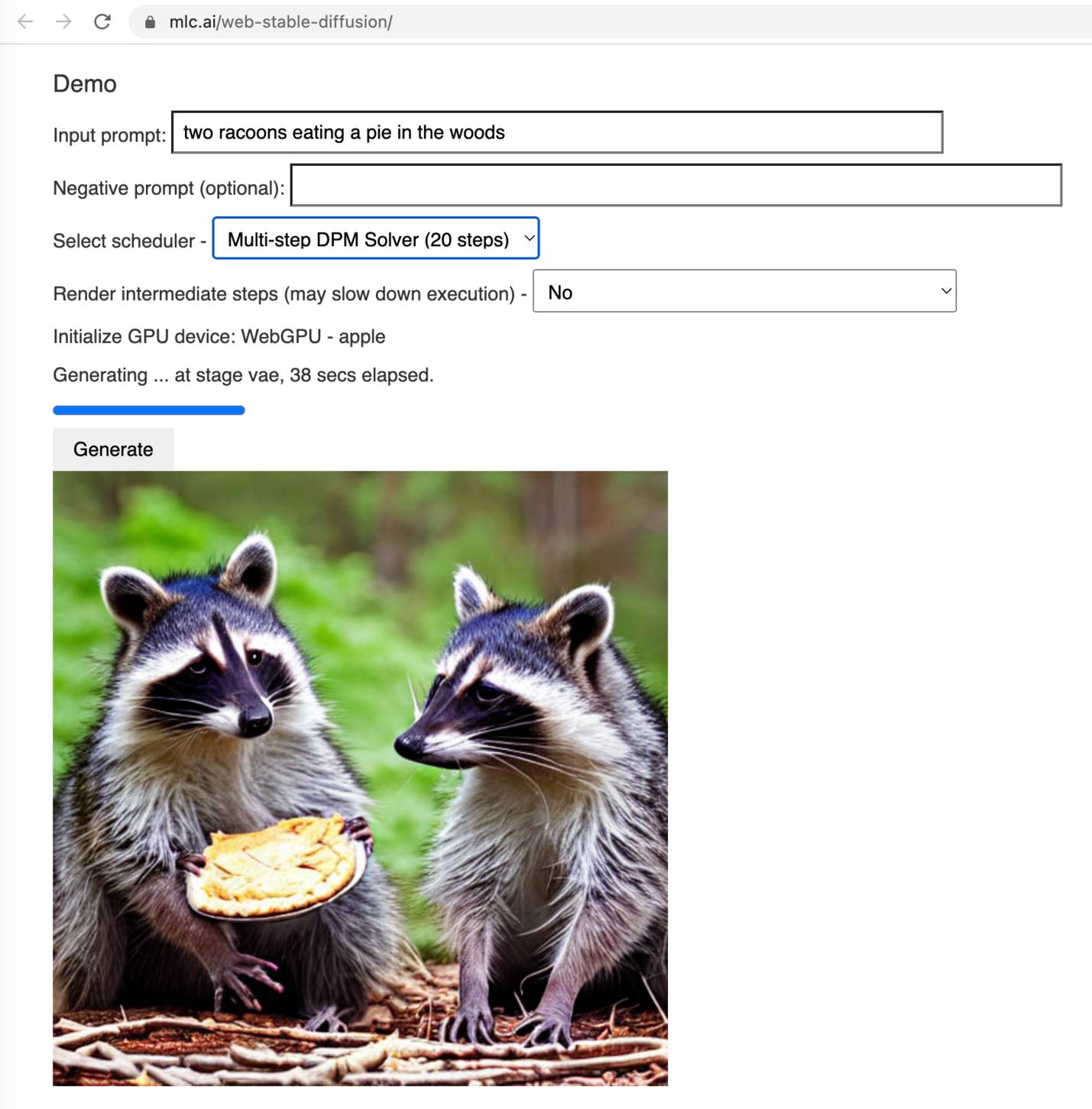
Web Stable Diffusion (via) I just ran the full Stable Diffusion image generation model entirely in my browser, and used it to generate an image of two raccoons eating pie in the woods. I had to use Google Chrome Canary since this depends on WebGPU which still isn't fully rolled out, but it worked perfectly.
The surprising ease and effectiveness of AI in a loop (via) Matt Webb on the langchain Python library and the ReAct design pattern, where you plug additional tools into a language model by teaching it to work in a “Thought... Act... Observation” loop where the Act specifies an action it wishes to take (like searching Wikipedia) and an extra layer of software than carries out that action and feeds back the result as the Observation. Matt points out that the ChatGPT 1/10th price drop makes this kind of model usage enormously more cost effective than it was before.
Transformers.js. Hugging Face Transformers is a library of Transformer machine learning models plus a Python package for loading and running them. Transformers.js provides a JavaScript alternative interface which runs in your browser, thanks to a set of precompiled WebAssembly binaries for a selection of models. This interactive demo is incredible: in particular, try running the Image classification with google/vit-base-patch16-224 (91MB) model against any photo to get back labels representing that photo. Dropping one of these models onto a page is as easy as linking to a hosted CDN script and running a few lines of JavaScript.
Train and run Stanford Alpaca on your own machine. The team at Replicate managed to train their own copy of Stanford’s Alpaca—a fine-tuned version of LLaMA that can follow instructions like ChatGPT. Here they provide step-by-step instructions for recreating Alpaca yourself—running the training needs one or more A100s for a few hours, which you can rent through various cloud providers.
Not By AI: Your AI-free Content Deserves a Badge (via) A badge for non-AI generated content. Interesting to note that they set the cutoff at 90%: “Use this badge if your article, including blog posts, essays, research, letters, and other text-based content, contains less than 10% of AI output.”
bloomz.cpp (via) Nouamane Tazi Adapted the llama.cpp project to run against the BLOOM family of language models, which were released in July 2022 and trained in France on 45 natural languages and 12 programming languages using the Jean Zay Public Supercomputer, provided by the French government and powered using mostly nuclear energy.
It’s under the RAIL license which allows (limited) commercial use, unlike LLaMA.
Nouamane reports getting 16 tokens/second from BLOOMZ-7B1 running on an M1 Pro laptop.
GPT-4 Developer Livestream. 25 minutes of live demos from OpenAI co-founder Greg Brockman at the GPT-4 launch. These demos are all fascinating, including code writing and multimodal vision inputs. The one that really struck me is when Greg pasted in a copy of the tax code and asked GPT-4 to answer some sophisticated tax questions, involving step-by-step calculations that cited parts of the tax code it was working with.
GPT-4 Technical Report (PDF). 98 pages of much more detailed information about GPT-4. The appendices are particularly interesting, including examples of advanced prompt engineering as well as examples of harmful outputs before and after tuning attempts to try and suppress them.
Introducing Claude. Anthropic released the first two versions of Claude, "a next-generation AI assistant based on Anthropic’s research into training helpful, honest, and harmless AI systems". Claude and Claude Instant are both available via a web chat interface and through their API.
(I back-filled this link on Feb 25th 2026 to help fill out my llm-release tag.)
Int-4 LLaMa is not enough—Int-3 and beyond (via) The Nolano team are experimenting with reducing the size of the LLaMA models even further than the 4bit quantization popularized by llama.cpp.
ChatGPT’s API is So Good and Cheap, It Makes Most Text Generating AI Obsolete (via) Max Woolf on the quite frankly weird economics of the ChatGPT API: it’s 1/10th the price of GPT-3 Da Vinci and appears to be equivalent (if not more) capable. “But it is very hard to economically justify not using ChatGPT as a starting point for a business need and migrating to a more bespoke infrastructure later as needed, and that’s what OpenAI is counting on. [...] I don’t envy startups whose primary business is text generation right now.”