74 posts tagged “ruby”
2026
Shopify/liquid: Performance: 53% faster parse+render, 61% fewer allocations (via) PR from Shopify CEO Tobias Lütke against Liquid, Shopify's open source Ruby template engine that was somewhat inspired by Django when Tobi first created it back in 2005.
Tobi found dozens of new performance micro-optimizations using a variant of autoresearch, Andrej Karpathy's new system for having a coding agent run hundreds of semi-autonomous experiments to find new effective techniques for training nanochat.
Tobi's implementation started two days ago with this autoresearch.md prompt file and an autoresearch.sh script for the agent to run to execute the test suite and report on benchmark scores.
The PR now lists 93 commits from around 120 automated experiments. The PR description lists what worked in detail - some examples:
- Replaced StringScanner tokenizer with
String#byteindex. Single-bytebyteindexsearching is ~40% faster than regex-basedskip_until. This alone reduced parse time by ~12%.- Pure-byte
parse_tag_token. Eliminated the costlyStringScanner#string=reset that was called for every{% %}token (878 times). Manual byte scanning for tag name + markup extraction is faster than resetting and re-scanning via StringScanner. [...]- Cached small integer
to_s. Pre-computed frozen strings for 0-999 avoid 267Integer#to_sallocations per render.
This all added up to a 53% improvement on benchmarks - truly impressive for a codebase that's been tweaked by hundreds of contributors over 20 years.
I think this illustrates a number of interesting ideas:
- Having a robust test suite - in this case 974 unit tests - is a massive unlock for working with coding agents. This kind of research effort would not be possible without first having a tried and tested suite of tests.
- The autoresearch pattern - where an agent brainstorms a multitude of potential improvements and then experiments with them one at a time - is really effective.
- If you provide an agent with a benchmarking script "make it faster" becomes an actionable goal.
- CEOs can code again! Tobi has always been more hands-on than most, but this is a much more significant contribution than anyone would expect from the leader of a company with 7,500+ employees. I've seen this pattern play out a lot over the past few months: coding agents make it feasible for people in high-interruption roles to productively work with code again.
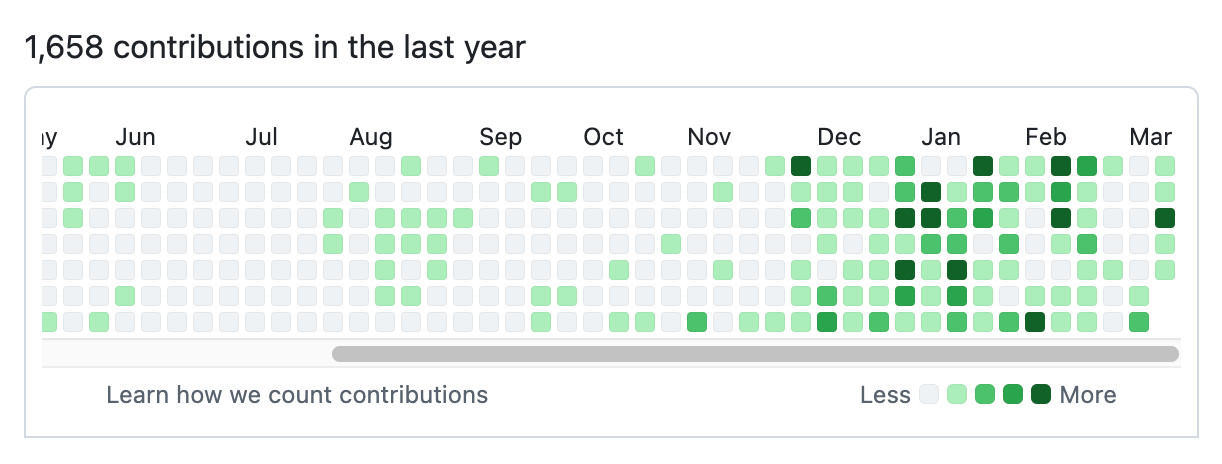
Here's Tobi's GitHub contribution graph for the past year, showing a significant uptick following that November 2025 inflection point when coding agents got really good.
He used Pi as the coding agent and released a new pi-autoresearch plugin in collaboration with David Cortés, which maintains state in an autoresearch.jsonl file like this one.
2025
GitHub Issues search now supports nested queries and boolean operators: Here’s how we (re)built it. GitHub Issues got a significant search upgrade back in January. Deborah Digges provides some behind the scene details about how it works and how they rolled it out.
The signature new feature is complex boolean logic: you can now search for things like is:issue state:open author:rileybroughten (type:Bug OR type:Epic), up to five levels of nesting deep.
Queries are parsed into an AST using the Ruby parslet PEG grammar library. The AST is then compiled into a nested Elasticsearch bool JSON query.
GitHub Issues search deals with around 2,000 queries a second so robust testing is extremely important! The team rolled it out invisibly to 1% of live traffic, running the new implementation via a queue and competing the number of results returned to try and spot any degradations compared to the old production code.
2024
Supercharge the One Person Framework with SQLite: Rails World 2024 (via) Stephen Margheim shares an annotated transcript of the YouTube video of his recent talk at this year's Rails World conference in Toronto.
The Rails community is leaning hard into SQLite right now. Stephen's talk is some of the most effective evangelism I've seen anywhere for SQLite as a production database for web applications, highlighting several new changes in Rails 8:
... there are two additions coming with Rails 8 that merit closer consideration. Because these changes make Rails 8 the first version of Rails (and, as far as I know, the first version of any web framework) that provides a fully production-ready SQLite experience out-of-the-box.
Those changes: Ensure SQLite transaction default to IMMEDIATE mode to avoid "database is locked" errors when a deferred transaction attempts to upgrade itself with a write lock (discussed here previously, and added to Datasette 1.0a14 in August) and SQLite non-GVL-blocking, fair retry interval busy handler - a lower-level change that ensures SQLite's busy handler doesn't hold Ruby's Global VM Lock (the Ruby version of Python's GIL) while a thread is waiting on a SQLite lock.
The rest of the talk makes a passionate and convincing case for SQLite as an option for production deployments, in line with the Rails goal of being a One Person Framework - "a toolkit so powerful that it allows a single individual to create modern applications upon which they might build a competitive business".
Back in April Stephen published SQLite on Rails: The how and why of optimal performance describing some of these challenges in more detail (including the best explanation I've seen anywhere of BEGIN IMMEDIATE TRANSACTION) and promising:
Unfortunately, running SQLite on Rails out-of-the-box isn’t viable today. But, with a bit of tweaking and fine-tuning, you can ship a very performant, resilient Rails application with SQLite. And my personal goal for Rails 8 is to make the out-of-the-box experience fully production-ready.
It looks like he achieved that goal!
What’s New in Ruby on Rails 8 (via)
Rails 8 takes SQLite from a lightweight development tool to a reliable choice for production use, thanks to extensive work on the SQLite adapter and Ruby driver.
With the introduction of the solid adapters discussed above, SQLite now has the capability to power Action Cable, Rails.cache, and Active Job effectively, expanding its role beyond just prototyping or testing environments. [...]
- Transactions default to
IMMEDIATEmode to improve concurrency.
Also included in Rails 8: Kamal, a new automated deployment system by 37signals for self-hosting web applications on hardware or virtual servers:
Kamal basically is Capistrano for Containers, without the need to carefully prepare servers in advance. No need to ensure that the servers have just the right version of Ruby or other dependencies you need. That all lives in the Docker image now. You can boot a brand new Ubuntu (or whatever) server, add it to the list of servers in Kamal, and it’ll be auto-provisioned with Docker, and run right away.
More from the official blog post about the release:
At 37signals, we're building a growing suite of apps that use SQLite in production with ONCE. There are now thousands of installations of both Campfire and Writebook running in the wild that all run SQLite. This has meant a lot of real-world pressure on ensuring that Rails (and Ruby) is working that wonderful file-based database as well as it can be. Through proper defaults like WAL and IMMEDIATE mode. Special thanks to Stephen Margheim for a slew of such improvements and Mike Dalessio for solving a last-minute SQLite file corruption issue in the Ruby driver.
How does Sidekiq really work? (via) I really like this category of blog post: Dan Svetlov took the time to explore the Sidekiq message queue’s implementation and then wrote it up in depth.
2018
Build impossible programs. Delightful talk by Julia Evans describing how she went about building a Ruby profiler in Rust despite having no knowledge of Ruby internals and only beginner’s knowledge of Rust.
2013
How can one become a masterful Rails developer (and still have a life)?
Don’t sacrifice your social life. Sacrifice TV.
[... 79 words]2012
Why did Twitter have so many problems if it is made with Ruby?
The technical problem Twitter solves (distributing millions of short messages per minute to an enormous graph of follow relationships) is extremely hard in any language.
[... 44 words]Was CoffeeScript invented to help Ruby programmers get over that dirty yucky feeling they get when working in JavaScript?
The original Prototype JS library might fit that description—more than CoffeeScript, at any rate.
[... 41 words]How long until Ruby developers are as cheap as PHP developers? is it already happening? should I still learn it or it only has a couple years left and I’m better off with SSJS?
If you want to be a highly paid engineer, you should worry less about your expertise in a specific language and more about developing broad and deep skills across a wider range of development topics.
[... 197 words]Is it true that Ruby is more deployment friendly than Python?
He’s incorrect (or at least out of date). Most professional python programmers that I know of use virtualenv, which makes it easy for deployed Python code to live in its own environment with its own set of modules installed separately from the core system packages.
[... 106 words]2011
Is there an online calendar for all the Ruby / Rails conferences to be held in 2011?
Have you tried both our Ruby and our Rails topic pages?
[... 66 words]2010
What are the main weaknesses of Ruby as a programming language?
Ruby still has a cultural tendency towards monkey-patching, aka action-at-a-distance. There are plenty of gems which modify existing classes—sometimes in ways that can break working code.
[... 45 words]Is there a way to learn Ruby in one hour?
Not unless you already know a bunch of other languages and are well versed in programming language theory. Even then, that might be long enough to get your head around Ruby syntax and semantics but it will still take weeks or months of study to get truly comfortable with the language idioms.
[... 76 words]I think that “bad technology” can kill a startup, but slightly different variations of good technology don’t have much effect. Choose what you know/like best. And Ruby and Python are both in this latter category.
Ruby-style Blocks in Python. Yes, yes, yes, yes. A proposal for muli-line lambda support in Python that doesn’t trip up on significant whitespace. If this gets in before the proposed feature freeze I’ll be a very happy Pythonista. UPDATE: This is a post from over a year ago, and it looks like the proposal has since stalled.
grammar.coffee (via) The annotated grammar for CoffeeScript, a new language that compiles to JavaScript developed by DocumentCloud’s Jeremy Ashkenas. The linked page is generated using Jeremy’s Docco tool for literate programming, also written in CoffeeScript. CoffeeScript itself is implemented in CoffeeScript, using a bootstrap compiler originally written in Ruby.
twitter-text-conformance (via) This is a neat idea: Twitter have released open source libraries for parsing standard tweet syntax in Ruby and Java, but they’ve also released a set of YAML unit tests aimed at anyone who wants to implement the same parsing logic in other languages.
rlisagor’s freshen. A Python clone of Ruby’s innovative Cucumber testing framework. Tests are defined as a set of plain-text scenarios, which are then executed by being matched against test functions decorated with regular expressions. Has anyone used this or Cucumber? I’m intrigued but unconvinced—are the plain text scenarios really a useful way of defining tests?
2009
clarity. A web interface for tailing and grepping the log files in /var/log, written in Ruby and EventMachine.
Introducing Resque. A new background worker management queue developed at GitHub, using Redis for the persistence layer. The blog post explains both the design and the shortcomings of previous solutions at length. Within 24 hours of the release code an external developer, Adam Cooke, has completely reskinned the UI.
How We Made GitHub Fast. Detailed overview of the new GitHub architecture. It’s a lot more complicated than I would have expected—lots of moving parts are involved in ensuring they can scale horizontally when they need to. Interesting components include nginx, Unicorn, Rails, DRBD, HAProxy, Redis, Erlang, memcached, SSH, git and a bunch of interesting new open source projects produced by the GitHub team such as BERT/Ernie and ProxyMachine.
MySQL backups with EBS snapshots. Assaf Arkin’s 45 line ruby script shows how to lock tables / XFS freeze / create an EBS snapshot / unfreeze and unlock, with hourly snapshots preserved for the past 24 hours and daily snapshots for the past week. Is an EBS snapshot enough to restore your data to somewhere other than EC2 though?
XSS Protection by Default in Rails 3.0. Fantastic news—congratulations, Rails core team.
I like Unicorn because it’s Unix. Ryan Tomayko analyses Unicorn, a new, pre-forking Ruby HTTP server that makes extensive use of Unix syscalls and idioms, and asks why dynamic language programmers don’t take advantage of these more often.
cloud-crowd. New parallel processing worker/job queue system with a strikingly elegant architecture. The central server is an HTTP server that manages job requests, which are farmed out to a number of node HTTP servers which fork off worker processes to do the work. All communication is webhook-style JSON, and the servers are implemented in Sinatra and Thin using a tiny amount of code. The web-based monitoring interface is simply beautiful, using canvas to display graphs showing the system’s overall activity.
homebrew. Exciting alternative to MacPorts for compiling software on OS X—homebrew avoids sudo and defines packages as simple Ruby scripts, shared and distributed using Git.
Webhooks behind the firewall with Reverse HTTP. Hookout is a Ruby / rack adapter that lets you serve a web application from behind a firewall, by binding to a Reverse HTTP proxy running on the internet (such as the free one provided by reversehttp.net). Useful for far more than just webhooks, this means you can easily expose any Ruby web service to the outside world. An implementation of this as a general purpose proxy server would make it useful for applications written in any language.
Phusion Passenger for nginx. Passenger (aka mod_rails / mod_rack) enables easy deployment of Rails and Ruby apps under Apache... and the latest version adds support for nginx as well. It works as an HTTP proxy and process manager, spawning worker processes and forwarding HTTP requests to them via a request queue. It can also handle Python WSGI applications—anyone tried it out for that yet?
Twitter: blaming Ruby for their mistakes? The comments on the entry include replies from Twitter employees and the RabbitMQ consultant they brought in, and provide a full rebuttal to the various accusations of NIH that were thrown around recently.