October 2024
165 posts: 12 entries, 82 links, 22 quotes, 49 beats
Oct. 14, 2024
I Was A Teenage Foot Clan Ninja.
My name is Danny Pennington, I am 48 years old, and between 1988 in 1995 I was a ninja in the Foot Clan.
I enjoyed this TMNT parody a lot.
Grant Negotiation and Authorization Protocol (GNAP) (via) RFC 9635 was published a few days ago. GNAP is effectively OAuth 3 - it's a newly standardized design for a protocol for delegating authorization so an application can access data on your behalf.
The most interesting difference between GNAP and OAuth 2 is that GNAP no longer requires clients to be registered in advance. With OAuth the client_id and client_secret need to be configured for each application, which means applications need to register with their targets - creating a new application on GitHub or Twitter before implementing the authorization flow, for example.
With GNAP that's no longer necessary. The protocol allows a client to provide a key as part of the first request to the server which is then used in later stages of the interaction.
GNAP has been brewing for a long time. The IETF working group was chartered in 2020, and two of the example implementations (gnap-client-js and oauth-xyz-nodejs) last saw commits more than four years ago.
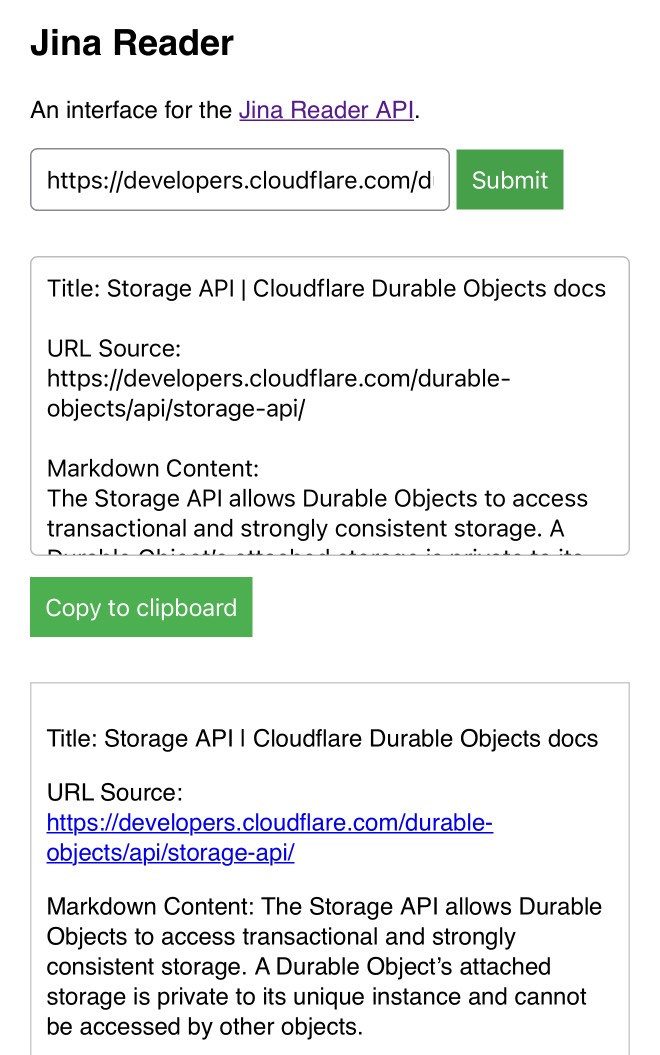
My Jina Reader tool. I wanted to feed the Cloudflare Durable Objects SQLite documentation into Claude, but I was on my iPhone so copying and pasting was inconvenient. Jina offer a Reader API which can turn any URL into LLM-friendly Markdown and it turns out it supports CORS, so I got Claude to build me this tool (second iteration, third iteration, final source code).
Paste in a URL to get the Jina Markdown version, along with an all important "Copy to clipboard" button.
Oct. 15, 2024
ChatGPT will happily write you a thinly disguised horoscope
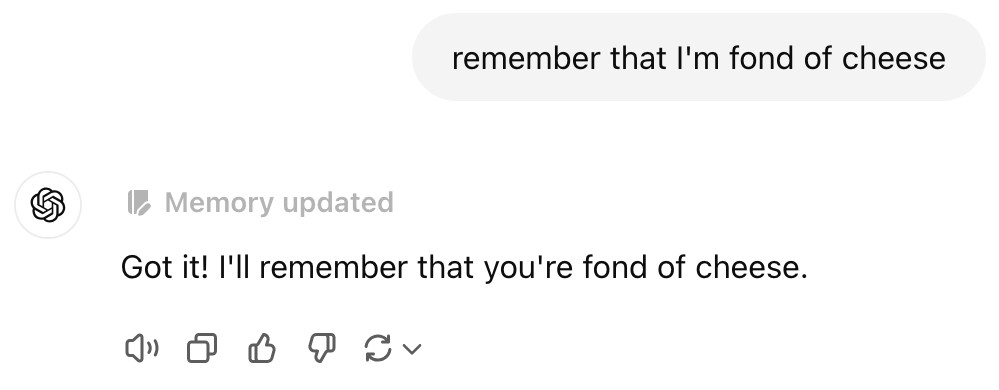
There’s a meme floating around at the moment where you ask ChatGPT the following and it appears to offer deep insight into your personality:
[... 1,236 words]PATH tips on wizard zines
(via)
New Julia Evans comic, from which I learned that the which -a X command shows you all of the versions of that command that are available in the directories on your current PATH.
This is so useful! I used it to explore my currently available Python versions:
$ which -a python
/opt/homebrew/Caskroom/miniconda/base/bin/python
$ which -a python3
/opt/homebrew/Caskroom/miniconda/base/bin/python3
/Library/Frameworks/Python.framework/Versions/3.13/bin/python3
/Library/Frameworks/Python.framework/Versions/3.12/bin/python3
/opt/homebrew/bin/python3
/usr/local/bin/python3
/usr/bin/python3
/Users/simon/Library/Application Support/hatch/pythons/3.12/python/bin/python3
/Users/simon/Library/Application Support/hatch/pythons/3.12/python/bin/python3
$ which -a python3.10
/opt/homebrew/Caskroom/miniconda/base/bin/python3.10
/opt/homebrew/bin/python3.10
$ which -a python3.11
/opt/homebrew/bin/python3.11
$ which -a python3.12
/Library/Frameworks/Python.framework/Versions/3.12/bin/python3.12
/opt/homebrew/bin/python3.12
/usr/local/bin/python3.12
/Users/simon/Library/Application Support/hatch/pythons/3.12/python/bin/python3.12
/Users/simon/Library/Application Support/hatch/pythons/3.12/python/bin/python3.12
$ which -a python3.13
/Library/Frameworks/Python.framework/Versions/3.13/bin/python3.13
/opt/homebrew/bin/python3.13
/usr/local/bin/python3.13
The problem with passkeys is that they're essentially a halfway house to a password manager, but tied to a specific platform in ways that aren't obvious to a user at all, and liable to easily leave them unable to access of their accounts. [...]
Chrome on Windows stores your passkeys in Windows Hello, so if you sign up for a service on Windows, and you then want to access it on iPhone, you're going to be stuck (unless you're so forward thinking as to add a second passkey, somehow, from the iPhone will on the Windows computer!). The passkey lives on the wrong device, if you're away from the computer and want to login, and it's not at all obvious to most users how they might fix that.
The XOXO 2024 Talks. I missed attending the last XOXO in person, but I've been catching up on the videos of the talks over the past few days and they have been absolutely worth spending time with.
This year was a single day with ten speakers. Andy Baio explains the intended formula:
I usually explain that the conference is about, more than anything, the emotional experience of being an artist or creator on the internet, often covering the dark, difficult, painful challenges that they’ve dealt with, or are still struggling with, as a creator. “Big idea” TED-style talks don’t work well, and we avoid anything practical or industry-specific because the audience is so interdisciplinary.
Oct. 16, 2024
A common misconception about Transformers is to believe that they're a sequence-processing architecture. They're not.
They're a set-processing architecture. Transformers are 100% order-agnostic (which was the big innovation compared to RNNs, back in late 2016 -- you compute the full matrix of pairwise token interactions instead of processing one token at a time).
The way you add order awareness in a Transformer is at the feature level. You literally add to your token embeddings a position embedding / encoding that corresponds to its place in a sequence. The architecture itself just treats the input tokens as a set.
Un Ministral, des Ministraux (via) Two new models from Mistral: Ministral 3B and Ministral 8B - joining Mixtral, Pixtral, Codestral and Mathstral as weird naming variants on the Mistral theme.
These models set a new frontier in knowledge, commonsense, reasoning, function-calling, and efficiency in the sub-10B category, and can be used or tuned to a variety of uses, from orchestrating agentic workflows to creating specialist task workers. Both models support up to 128k context length (currently 32k on vLLM) and Ministral 8B has a special interleaved sliding-window attention pattern for faster and memory-efficient inference.
Mistral's own benchmarks look impressive, but it's hard to get excited about small on-device models with a non-commercial Mistral Research License (for the 8B) and a contact-us-for-pricing Mistral Commercial License (for the 8B and 3B), given the existence of the extremely high quality Llama 3.1 and 3.2 series of models.
These new models are also available through Mistral's la Plateforme API, priced at $0.1/million tokens (input and output) for the 8B and $0.04/million tokens for the 3B.
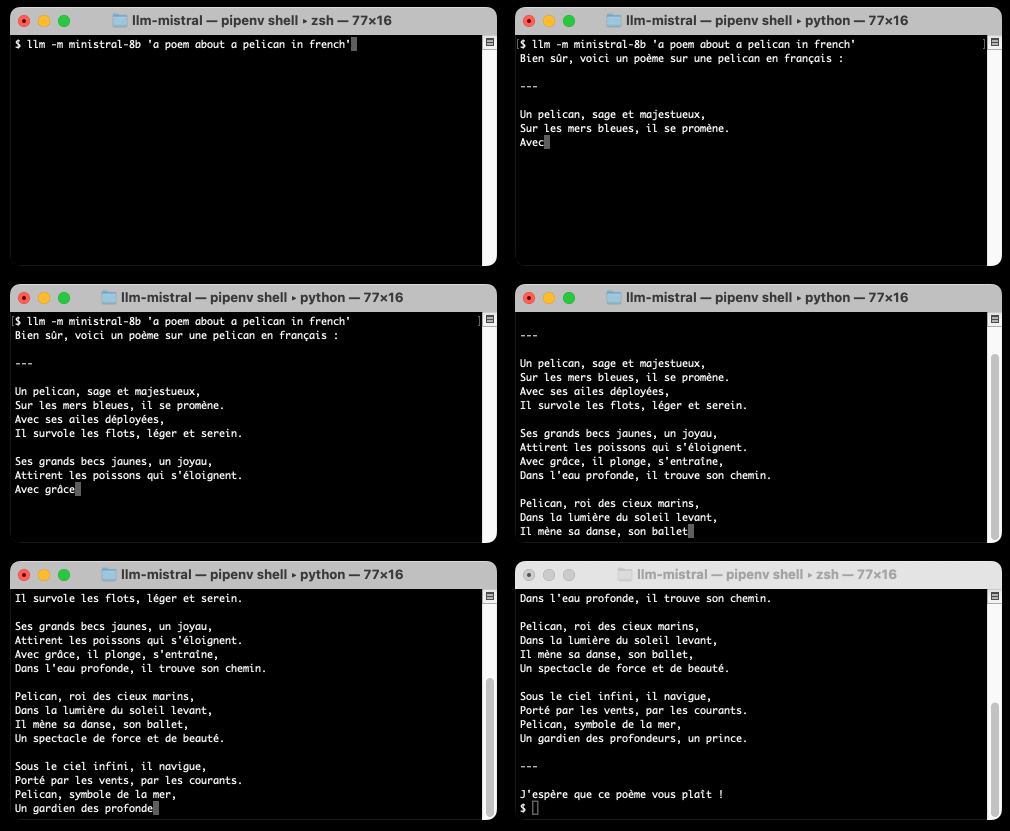
The latest release of my llm-mistral plugin for LLM adds aliases for the new models. Previously you could access them like this:
llm mistral refresh # To fetch new models
llm -m mistral/ministral-3b-latest "a poem about pelicans at the park"
llm -m mistral/ministral-8b-latest "a poem about a pelican in french"
With the latest plugin version you can do this:
llm install -U llm-mistral
llm -m ministral-8b "a poem about a pelican in french"
[red-knot] type inference/checking test framework (via) Ruff maintainer Carl Meyer recently landed an interesting new design for a testing framework. It's based on Markdown, and could be described as a form of "literate testing" - the testing equivalent of Donald Knuth's literate programming.
A markdown test file is a suite of tests, each test can contain one or more Python files, with optionally specified path/name. The test writes all files to an in-memory file system, runs red-knot, and matches the resulting diagnostics against
Type:andError:assertions embedded in the Python source as comments.
Test suites are Markdown documents with embedded fenced blocks that look like this:
```py
reveal_type(1.0) # revealed: float
```
Tests can optionally include a path= specifier, which can provide neater messages when reporting test failures:
```py path=branches_unify_to_non_union_type.py
def could_raise_returns_str() -> str:
    return 'foo'
...
```
A larger example test suite can be browsed in the red_knot_python_semantic/resources/mdtest directory.
This document on control flow for exception handlers (from this PR) is the best example I've found of detailed prose documentation to accompany the tests.
The system is implemented in Rust, but it's easy to imagine an alternative version of this idea written in Python as a pytest plugin. This feels like an evolution of the old Python doctest idea, except that tests are embedded directly in Markdown rather than being embedded in Python code docstrings.
... and it looks like such plugins exist already. Here are two that I've found so far:
- pytest-markdown-docs by Elias Freider and Modal Labs.
- sphinx.ext.doctest is a core Sphinx extension for running test snippets in documentation.
- pytest-doctestplus from the Scientific Python community, first released in 2011.
I tried pytest-markdown-docs by creating a doc.md file like this:
# Hello test doc

```py
assert 1 + 2 == 3
```

But this fails:

```py
assert 1 + 2 == 4
```
And then running it with uvx like this:
uvx --with pytest-markdown-docs pytest --markdown-docs
I got one pass and one fail:
_______ docstring for /private/tmp/doc.md __________
Error in code block:
```
10   assert 1 + 2 == 4
11
```
Traceback (most recent call last):
  File "/private/tmp/tt/doc.md", line 10, in <module>
    assert 1 + 2 == 4
AssertionError

============= short test summary info ==============
FAILED doc.md::/private/tmp/doc.md
=========== 1 failed, 1 passed in 0.02s ============
I also just learned that the venerable Python doctest standard library module has the ability to run tests in documentation files too, with doctest.testfile("example.txt"): "The file content is treated as if it were a single giant docstring; the file doesn’t need to contain a Python program!"
Supercharge the One Person Framework with SQLite: Rails World 2024 (via) Stephen Margheim shares an annotated transcript of the YouTube video of his recent talk at this year's Rails World conference in Toronto.
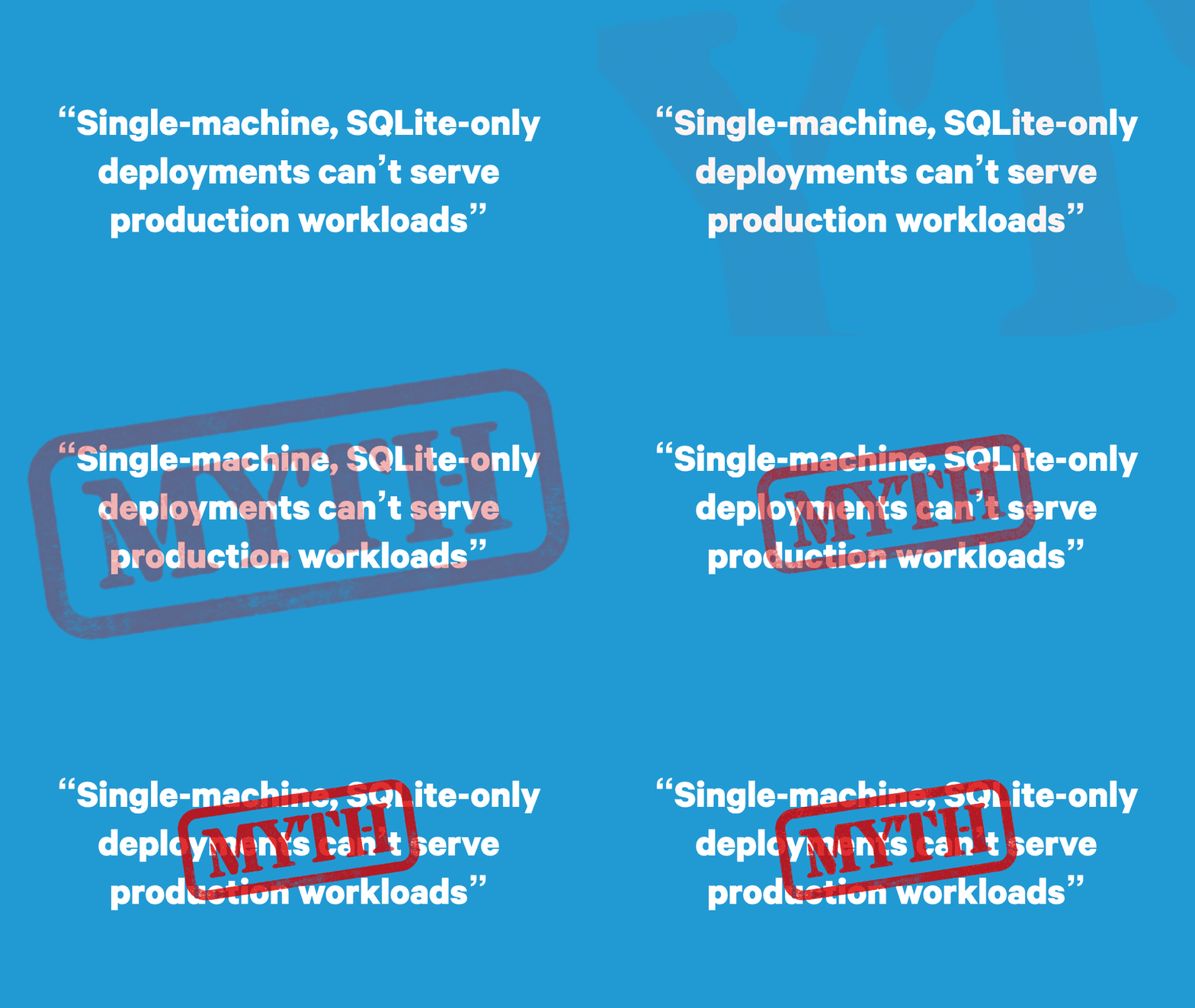
The Rails community is leaning hard into SQLite right now. Stephen's talk is some of the most effective evangelism I've seen anywhere for SQLite as a production database for web applications, highlighting several new changes in Rails 8:
... there are two additions coming with Rails 8 that merit closer consideration. Because these changes make Rails 8 the first version of Rails (and, as far as I know, the first version of any web framework) that provides a fully production-ready SQLite experience out-of-the-box.
Those changes: Ensure SQLite transaction default to IMMEDIATE mode to avoid "database is locked" errors when a deferred transaction attempts to upgrade itself with a write lock (discussed here previously, and added to Datasette 1.0a14 in August) and SQLite non-GVL-blocking, fair retry interval busy handler - a lower-level change that ensures SQLite's busy handler doesn't hold Ruby's Global VM Lock (the Ruby version of Python's GIL) while a thread is waiting on a SQLite lock.
The rest of the talk makes a passionate and convincing case for SQLite as an option for production deployments, in line with the Rails goal of being a One Person Framework - "a toolkit so powerful that it allows a single individual to create modern applications upon which they might build a competitive business".
Back in April Stephen published SQLite on Rails: The how and why of optimal performance describing some of these challenges in more detail (including the best explanation I've seen anywhere of BEGIN IMMEDIATE TRANSACTION) and promising:
Unfortunately, running SQLite on Rails out-of-the-box isn’t viable today. But, with a bit of tweaking and fine-tuning, you can ship a very performant, resilient Rails application with SQLite. And my personal goal for Rails 8 is to make the out-of-the-box experience fully production-ready.
It looks like he achieved that goal!
2025 DSF Board Nominations. The Django Software Foundation board elections are coming up. There are four positions open, seven directors total. Terms last two years, and the deadline for submitting a nomination is October 25th (the date of the election has not yet been decided).
Several community members have shared "DSF initiatives I'd like to see" documents to inspire people who may be considering running for the board:
- Sarah Boyce (current Django Fellow) wants a marketing strategy, better community docs, more automation and a refresh of the Django survey.
- Tim Schilling wants one big sponsor, more community recognition and a focus on working groups.
- Carlton Gibson wants an Executive Director, an updated website and better integration of the community into that website.
- Jacob Kaplan-Moss wants effectively all of the above.
There's also a useful FAQ on the Django forum by Thibaud Colas.
files-to-prompt 0.4. New release of my files-to-prompt tool adding an option for filtering just for files with a specific extension.
The following command will output Claude XML-style markup for all Python and Markdown files in the current directory, and copy that to the macOS clipboard ready to be pasted into an LLM:
files-to-prompt . -e py -e md -c | pbcopy
Oct. 17, 2024
Gemini API Additional Terms of Service. I've been trying to figure out what Google's policy is on using data submitted to their Google Gemini LLM for further training. It turns out it's clearly spelled out in their terms of service, but it differs for the paid v.s. free tiers.
The paid APIs do not train on your inputs:
When you're using Paid Services, Google doesn't use your prompts (including associated system instructions, cached content, and files such as images, videos, or documents) or responses to improve our products [...] This data may be stored transiently or cached in any country in which Google or its agents maintain facilities.
The Gemini API free tier does:
The terms in this section apply solely to your use of Unpaid Services. [...] Google uses this data, consistent with our Privacy Policy, to provide, improve, and develop Google products and services and machine learning technologies, including Google’s enterprise features, products, and services. To help with quality and improve our products, human reviewers may read, annotate, and process your API input and output.
But watch out! It looks like the AI Studio tool, since it's offered for free (even if you have a paid account setup) is treated as "free" for the purposes of these terms. There's also an interesting note about the EU:
The terms in this "Paid Services" section apply solely to your use of paid Services ("Paid Services"), as opposed to any Services that are offered free of charge like direct interactions with Google AI Studio or unpaid quota in Gemini API ("Unpaid Services"). [...] If you're in the European Economic Area, Switzerland, or the United Kingdom, the terms applicable to Paid Services apply to all Services including AI Studio even though it's offered free of charge.
Confusingly, the following paragraph about data used to fine-tune your own custom models appears in that same "Data Use for Unpaid Services" section:
Google only uses content that you import or upload to our model tuning feature for that express purpose. Tuning content may be retained in connection with your tuned models for purposes of re-tuning when supported models change. When you delete a tuned model, the related tuning content is also deleted.
It turns out their tuning service is "free of charge" on both pay-as-you-go and free plans according to the Gemini pricing page, though you still pay for input/output tokens at inference time (on the paid tier - it looks like the free tier remains free even for those fine-tuned models).
Video scraping: extracting JSON data from a 35 second screen capture for less than 1/10th of a cent
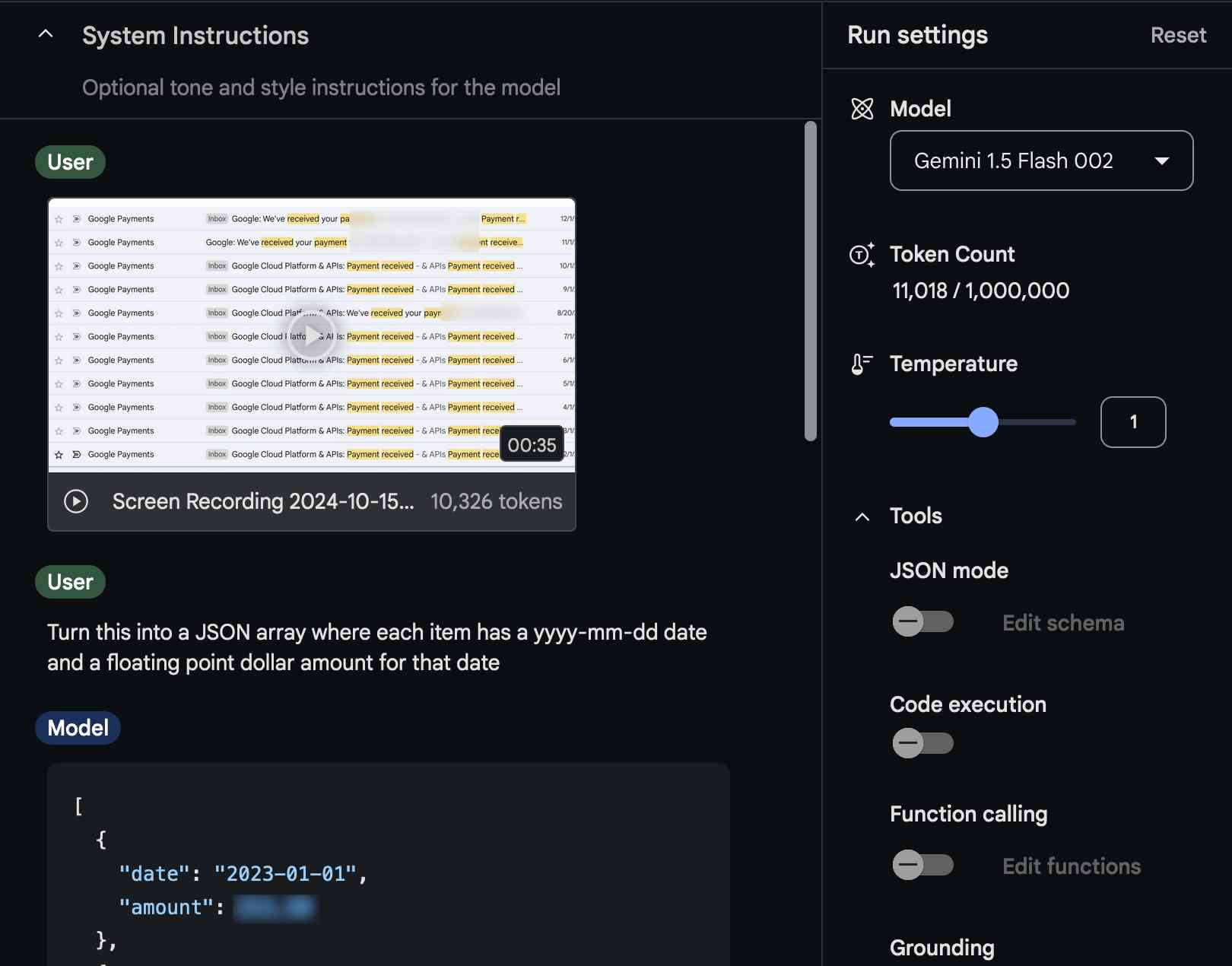
The other day I found myself needing to add up some numeric values that were scattered across twelve different emails.
[... 1,294 words]New in NotebookLM: Customizing your Audio Overviews. The most requested feature for Google's NotebookLM "audio overviews" (aka automatically generated podcast conversations) has been the ability to provide direction to those artificial podcast hosts - setting their expertise level or asking them to focus on specific topics.
Today's update adds exactly that:
Now you can provide instructions before you generate a "Deep Dive" Audio Overview. For example, you can focus on specific topics or adjust the expertise level to suit your audience. Think of it like slipping the AI hosts a quick note right before they go on the air, which will change how they cover your material.
I pasted in a link to my post about video scraping and prompted it like this:
You are both pelicans who work as data journalist at a pelican news service. Discuss this from the perspective of pelican data journalists, being sure to inject as many pelican related anecdotes as possible
Here's the resulting 7m40s MP3, and the transcript.
It starts off strong!
You ever find yourself wading through mountains of data trying to pluck out the juicy bits? It's like hunting for a single shrimp in a whole kelp forest, am I right?
Then later:
Think of those facial recognition systems they have for humans. We could have something similar for our finned friends. Although, gotta say, the ethical implications of that kind of tech are a whole other kettle of fish. We pelicans gotta use these tools responsibly and be transparent about it.
And when brainstorming some potential use-cases:
Imagine a pelican citizen journalist being able to analyze footage of a local council meeting, you know, really hold those pelicans in power accountable, or a pelican historian using video scraping to analyze old film reels, uncovering lost details about our pelican ancestors.
Plus this delightful conclusion:
The future of data journalism is looking brighter than a school of silversides reflecting the morning sun. Until next time, keep those wings spread, those eyes sharp, and those minds open. There's a whole ocean of data out there just waiting to be explored.
And yes, people on Reddit have got them to swear.
Using static websites for tiny archives (via) Alex Chan:
Over the last year or so, I’ve been creating static websites to browse my local archives. I’ve done this for a variety of collections, including:
- paperwork I’ve scanned
- documents I’ve created
- screenshots I’ve taken
- web pages I’ve bookmarked
- video and audio files I’ve saved
This is such a neat idea. These tiny little personal archive websites aren't even served through a localhost web server - they exist as folders on disk, and Alex browses them by opening up the index.html file directly in a browser.
Oct. 18, 2024
I'm of the opinion that you should never use mmap, because if you get an I/O error of some kind, the OS raises a signal, which SQLite is unable to catch, and so the process dies. When you are not using mmap, SQLite gets back an error code from an I/O error and is able to take remedial action, or at least compose an error message.
Experimenting with audio input and output for the OpenAI Chat Completion API
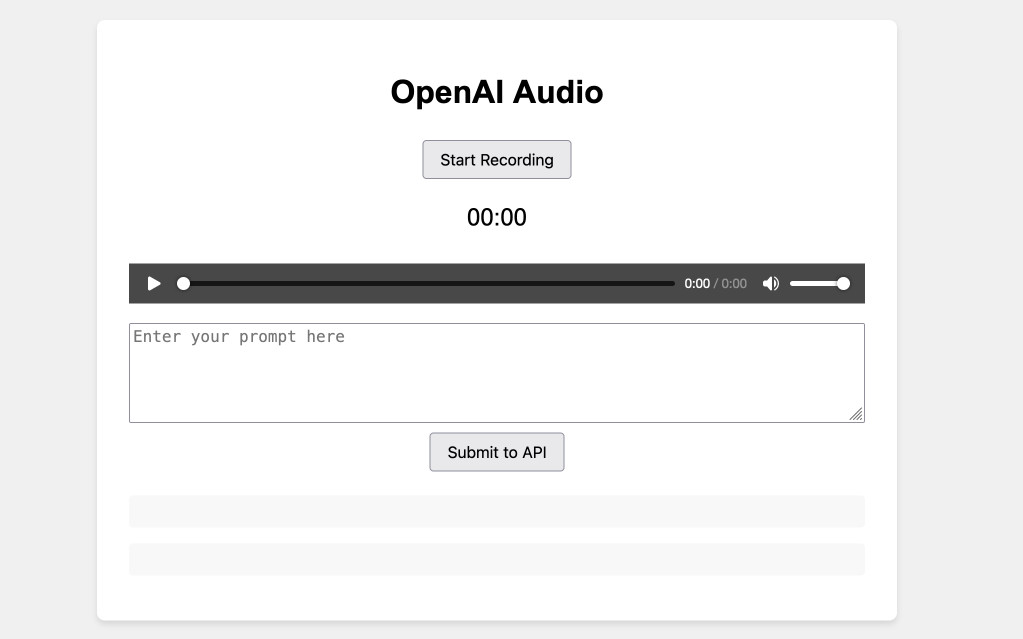
OpenAI promised this at DevDay a few weeks ago and now it’s here: their Chat Completion API can now accept audio as input and return it as output. OpenAI still recommend their WebSocket-based Realtime API for audio tasks, but the Chat Completion API is a whole lot easier to write code against.
[... 1,555 words]Oct. 19, 2024
Running Llama 3.2 Vision and Phi-3.5 Vision on a Mac with mistral.rs
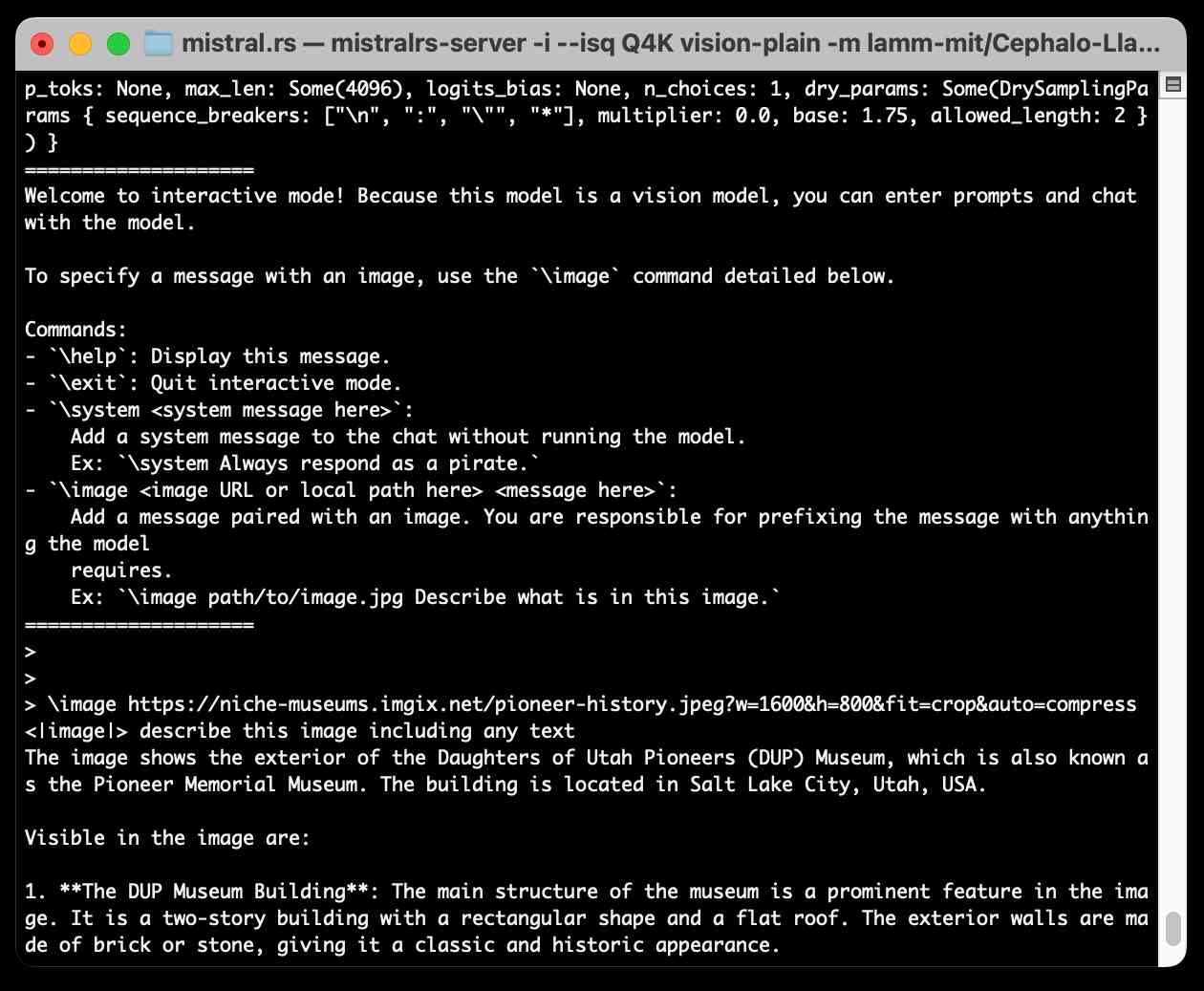
mistral.rs is an LLM inference library written in Rust by Eric Buehler. Today I figured out how to use it to run the Llama 3.2 Vision and Phi-3.5 Vision models on my Mac.
[... 1,231 words]Oct. 20, 2024
You can use text-wrap: balance; on icons. Neat CSS experiment from Terence Eden: the new text-wrap: balance CSS property is intended to help make text like headlines display without ugly wrapped single orphan words, but Terence points out it can be used for icons too:
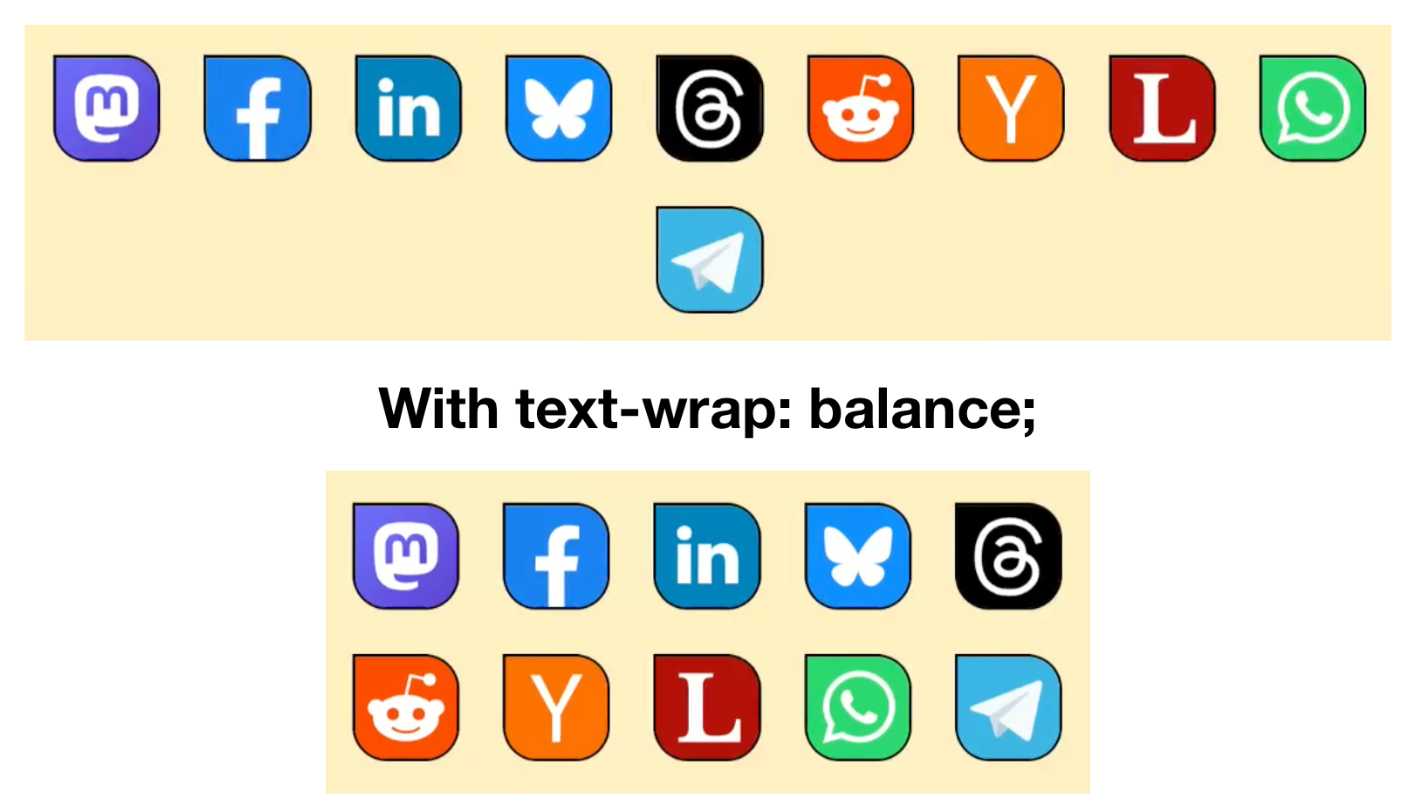
This inspired me to investigate if the same technique could work for text based navigation elements. I used Claude to build this interactive prototype of a navigation bar that uses text-wrap: balance against a list of display: inline menu list items. It seems to work well!
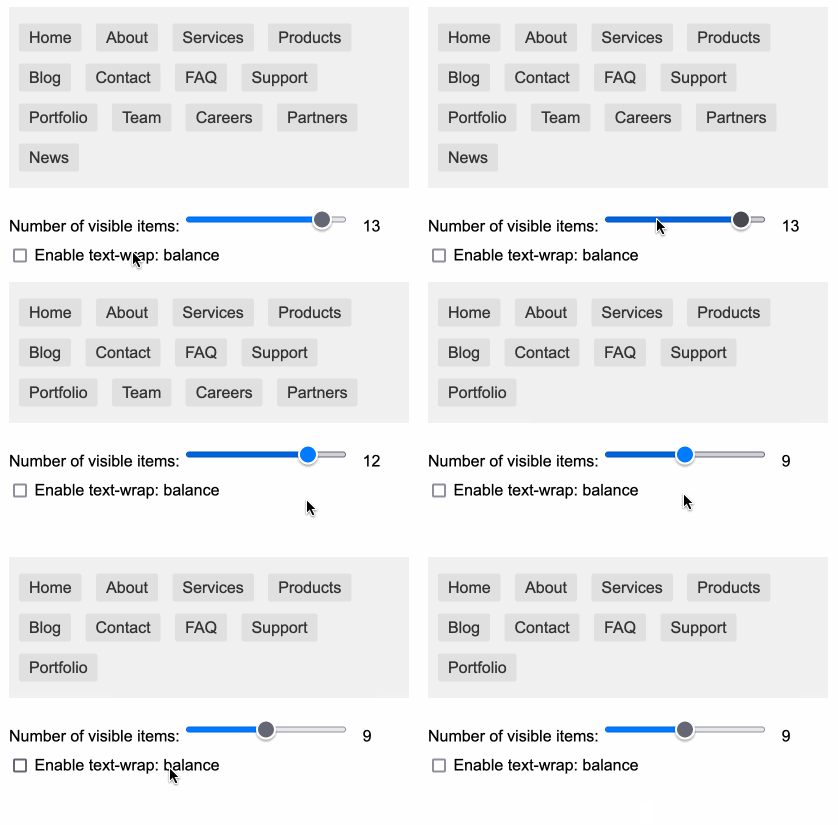
My first attempt used display: inline-block which worked in Safari but failed in Firefox.
Notable limitation from that MDN article:
Because counting characters and balancing them across multiple lines is computationally expensive, this value is only supported for blocks of text spanning a limited number of lines (six or less for Chromium and ten or less for Firefox)
So it's fine for these navigation concepts but isn't something you can use for body text.