Blogmarks
Filters: Sorted by date
Type click type by Brian Grubb. I just found out my favourite TV writer, Brian Grubb, is no longer with Uproxx and is now writing for his own newsletter - free on Sunday, paid-subscribers only on Friday. I hit subscribe so fast.
In addition to TV, Brian's coverage of heists - most recently Lego and an attempted heist of Graceland ("It really does look like a bunch of idiots tried to steal and auction off Graceland using Hotmail accounts and they almost got away with it") - is legendary.
I'd love to see more fun little Friday night shows too.
Box shadow CSS generator (via) Another example of a tiny personal tool I built using Claude 3.5 Sonnet and artifacts. In this case my prompt was:
CSS for a slight box shadow, build me a tool that helps me twiddle settings and preview them and copy and paste out the CSS
I changed my mind half way through typing the prompt and asked it for a custom tool, and it built me this!
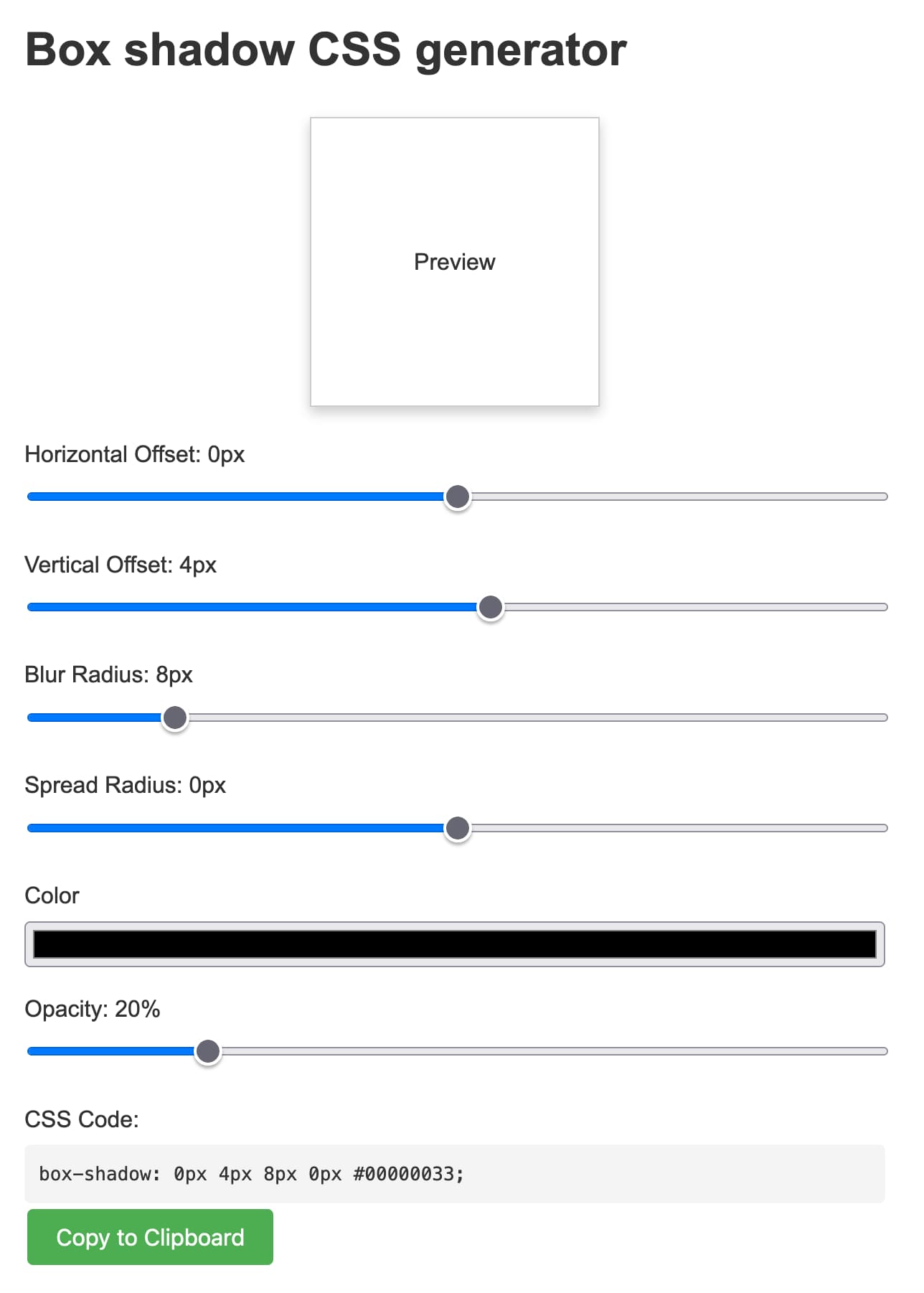
Here's the full transcript - in a follow-up prompt I asked for help deploying it and it rewrote the tool to use <script type="text/babel"> and the babel-standalone library to add React JSX support directly in the browser - a bit of a hefty dependency (387KB compressed / 2.79MB total) but I think acceptable for this kind of one-off tool.
Being able to knock out tiny custom tools like this on a whim is a really interesting new capability. It's also a lot of fun!
Geomys, a blueprint for a sustainable open source maintenance firm (via) Filippo Valsorda has been working as a full-time professional open source maintainer for nearly two years now, accepting payments on retainer from companies that depend on his cryptography Go packages.
This has worked well enough that he's now expanding: Geomys (a genus of gophers) is a new company which adds two new "associate maintainers" and an administrative director, covering more projects and providing clients with access to more expertise.
Filipino describes the model like this:
If you’re betting your business on a critical open source technology, you
- want it to be sustainably and predictably maintained; and
- need occasional access to expertise that would be blisteringly expensive to acquire and retain.
Getting maintainers on retainer solves both problems for a fraction of the cost of a fully-loaded full-time engineer. From the maintainers’ point of view, it’s steady income to keep doing what they do best, and to join one more Slack Connect channel to answer high-leverage questions. It’s a great deal for both sides.
For more on this model, watch Filippo's FOSDEM talk from earlier this year.
Reasons to use your shell’s job control.
Julia Evans summarizes an informal survey of useful things you can do with shell job control features - fg, bg, Ctrl+Z and the like. Running tcdump in the background so you can see its output merged in with calls to curl is a neat trick.
Home-Cooked Software and Barefoot Developers. I really enjoyed this talk by Maggie Appleton from this year's Local-first Conference in Berlin.
For the last ~year I've been keeping a close eye on how language models capabilities meaningfully change the speed, ease, and accessibility of software development. The slightly bold theory I put forward in this talk is that we're on a verge of a golden age of local, home-cooked software and a new kind of developer – what I've called the barefoot developer.
It's a great talk, and the design of the slides is outstanding.
It reminded me of Robin Sloan's An app can be a home-cooked meal, which Maggie references in the talk. Also relevant: this delightful recent Hacker News thread, Ask HN: Is there any software you only made for your own use but nobody else?
My favourite version of our weird new LLM future is one where the pool of people who can use computers to automate things in their life is massively expanded.
The other videos from the conference are worth checking out too.
interactive-feed (via) Sam Morris maintains this project which gathers interactive, graphic and data visualization stories from various newsrooms around the world and publishes them on Twitter, Mastodon and Bluesky.
It runs automatically using GitHub Actions, and gathers data using a number of different techniques - XML feeds, custom API integrations (for the NYT, Guardian and Washington Post) and in some cases by scraping index pages on news websites using CSS selectors and cheerio.
The data it collects is archived as JSON in the data/ directory of the repository.
UK Parliament election results, now with Datasette. The House of Commons Library maintains a website of UK parliamentary election results data, currently listing 2010 through 2019 and with 2024 results coming soon.
The site itself is a Rails and PostgreSQL app, but I was delighted to learn today that they're also running a Datasette instance with the election results data, linked to from their homepage!
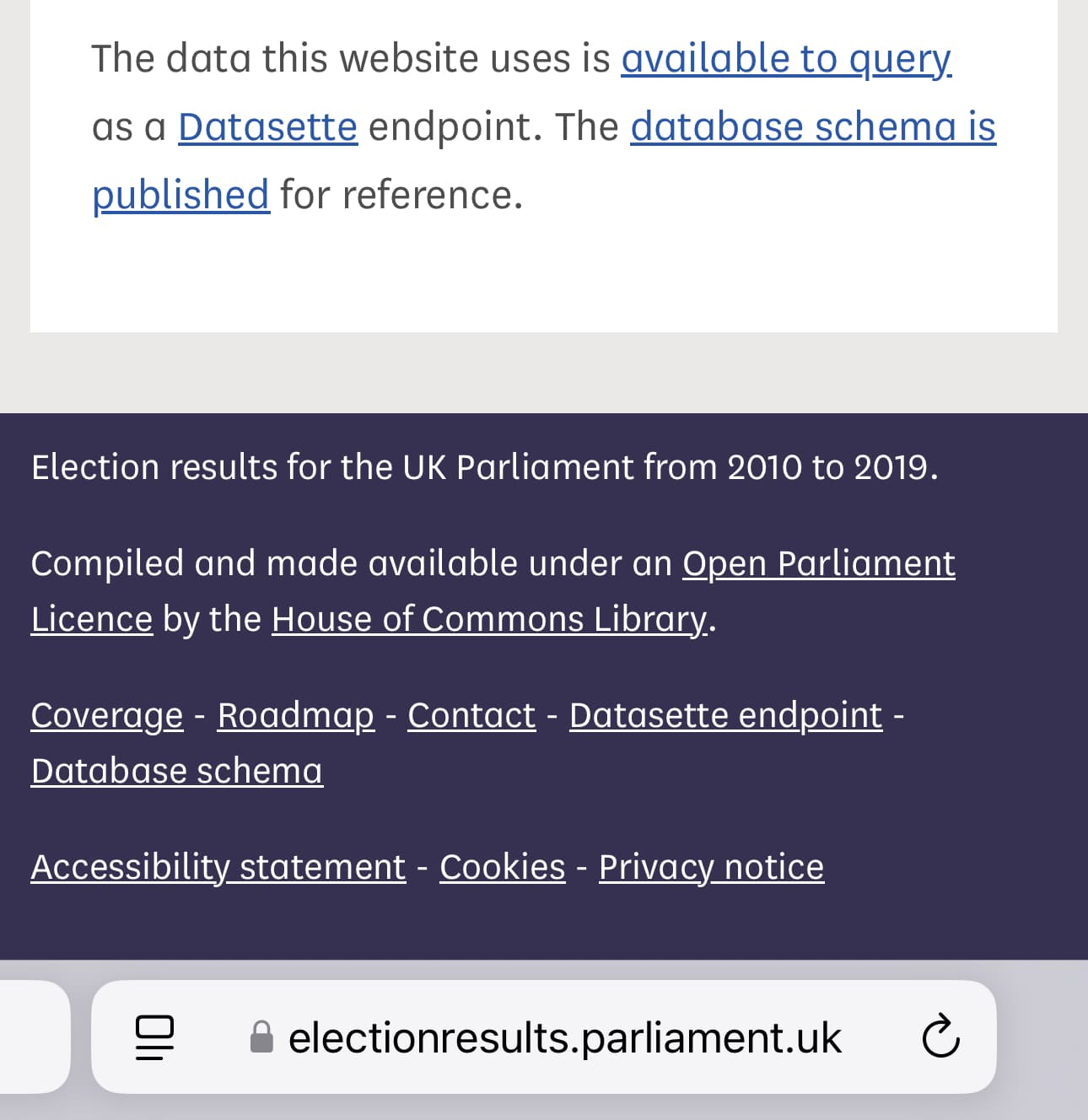
The raw data is also available as CSV files in their GitHub repository. Here's their Datasette configuration, which includes a copy of their SQLite database.
Tracking Fireworks Impact on Fourth of July AQI
(via)
Danny Page ran shot-scraper once per minute (using cron) against this Purple Air map of the Bay Area and turned the captured screenshots into an animation using ffmpeg. The result shows the impact of 4th of July fireworks on air quality between 7pm and 7am.
jqjq: jq implementation of jq (via) 2,854 lines of jq that implements a full, working version of jq itself. “A great way to show that jq is a very expressive, capable and neat language!”
Exorcising us of the Primer (via) Andy Matuschak talks about the need for educational technologists to break free from the siren's call of "The Young Lady’s Illustrated Primer" - the universal interactive textbook described by Neal Stephenson in his novel The Diamond Age.
The Primer offers an incredibly compelling vision, and Andy uses fifteen years of his own experience exploring related ideas to pick it apart and highlight its flaws.
I want to exorcise myself of the Primer. I want to clearly delineate what makes its vision so compelling—what I want to carry in my heart as a creative fuel. But I also want to sharply clarify the lessons we shouldn’t take from the Primer, and what it simply ignores. Then I want to reconstitute all that into something new, a vision I can use to drive my work forward.
On the Primer's authoritarianism:
The Primer has an agenda. It is designed to instill a set of values and ideas, and while it’s supportive of Nell’s curiosities, those are “side quests” to its central structure. Each of the twelve “Lands Beyond” focuses on different topics, but they’re not specific to Nell, and Nell didn’t choose them. In fact, Nell doesn’t even know the Primer’s goals for her—she’s never told. Its goals are its own privileged secret. Nell is manipulated so completely by the Primer, for so much of her life, that it’s hard to determine whether she has meaningful goals or values, other than those the Primer’s creators have deemed “good for her”.
I'm also reminded of Stephenson's piece of advice to people who may have missed an important lesson from the novel:
Kids need to get answers from humans who love them.
Chrome Prompt Playground.
Google Chrome Canary is currently shipping an experimental on-device LLM, in the form of Gemini Nano. You can access it via the new window.ai API, after first enabling the "Prompt API for Gemini Nano" experiment in chrome://flags (and then waiting an indeterminate amount of time for the ~1.7GB model file to download - I eventually spotted it in ~/Library/Application Support/Google/Chrome Canary/OptGuideOnDeviceModel).
I got Claude 3.5 Sonnet to build me this playground interface for experimenting with the model. You can execute prompts, stream the responses and all previous prompts and responses are stored in localStorage.
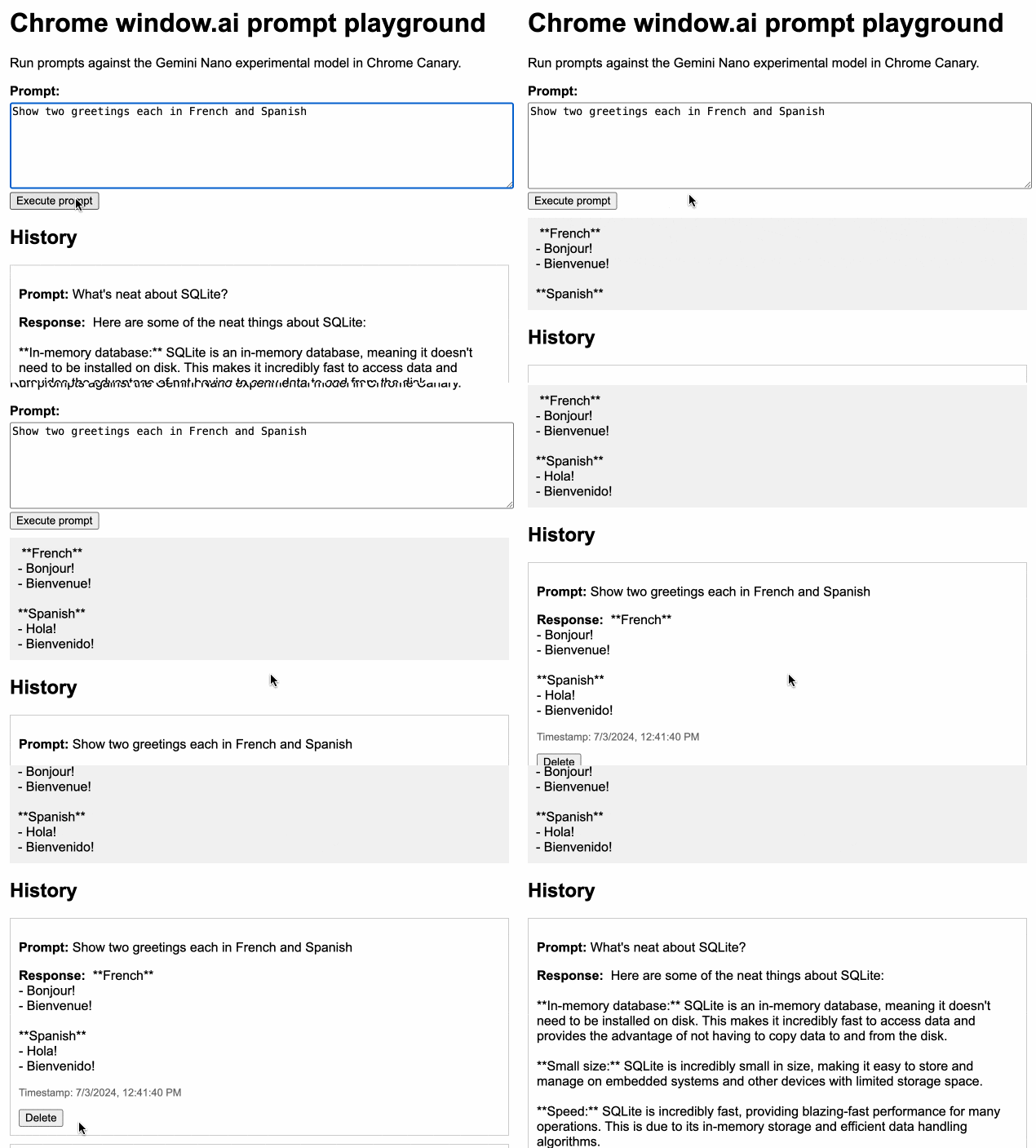
Here's the full Sonnet transcript, and the final source code for the app.
The best documentation I've found for the new API is is explainers-by-googlers/prompt-api on GitHub.
gemma-2-27b-it-llamafile (via) Justine Tunney shipped llamafile packages of Google's new openly licensed (though definitely not open source) Gemma 2 27b model this morning.
I downloaded the gemma-2-27b-it.Q5_1.llamafile version (20.5GB) to my Mac, ran chmod 755 gemma-2-27b-it.Q5_1.llamafile and then ./gemma-2-27b-it.Q5_1.llamafile and now I'm trying it out through the llama.cpp default web UI in my browser. It works great.
It's a very capable model - currently sitting at position 12 on the LMSYS Arena making it the highest ranked open weights model - one position ahead of Llama-3-70b-Instruct and within striking distance of the GPT-4 class models.
Compare PDFs. Inspired by this thread on Hacker News about the C++ diff-pdf tool I decided to see what it would take to produce a web-based PDF diff visualization tool using Claude 3.5 Sonnet.
It took two prompts:
Build a tool where I can drag and drop on two PDF files and it uses PDF.js to turn each of their pages into canvas elements and then displays those pages side by side with a third image that highlights any differences between them, if any differences exist
That give me a React app that didn't quite work, so I followed-up with this:
rewrite that code to not use React at all
Which gave me a working tool! You can see the full Claude transcript in this Gist. Here's a screenshot of the tool in action:
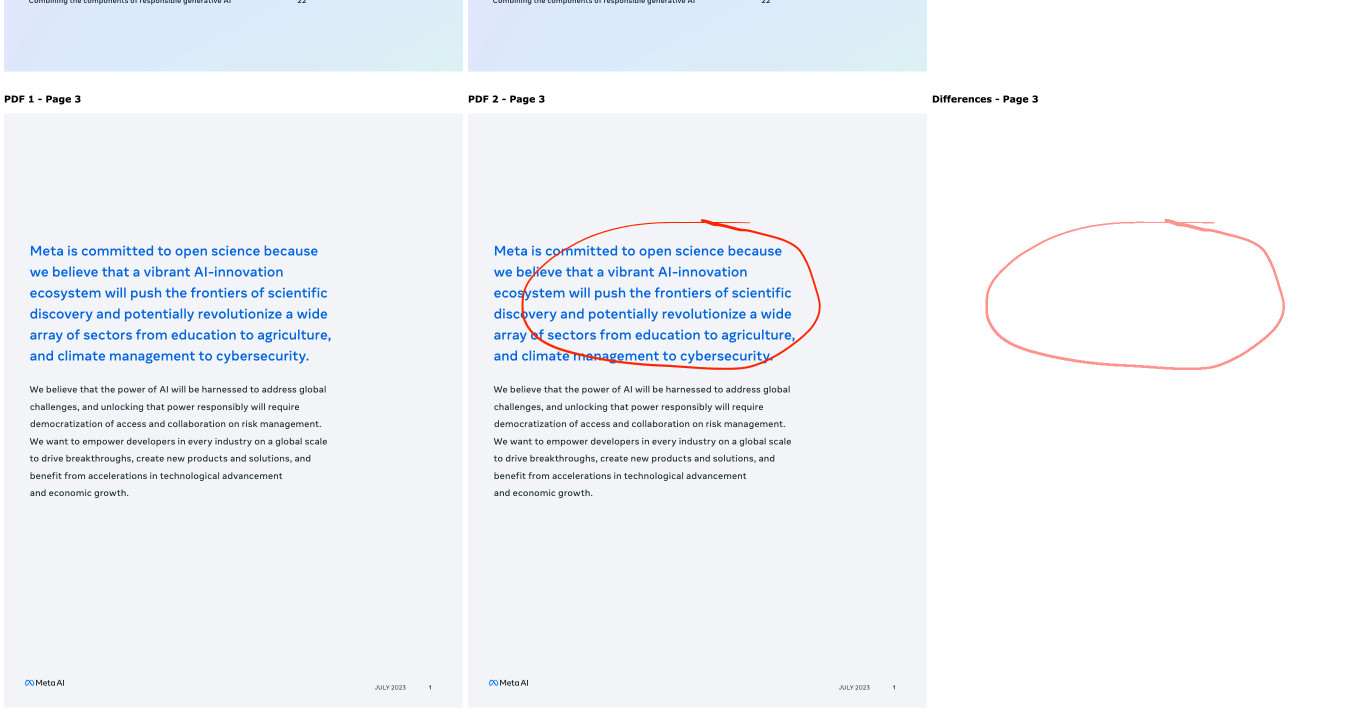
Being able to knock out little custom interactive web tools like this in a couple of minutes is so much fun.
Optimizing Large-Scale OpenStreetMap Data with SQLite (via) JT Archie describes his project to take 9GB of compressed OpenStreetMap protobufs data for the whole of the United States and load it into a queryable SQLite database.
OSM tags are key/value pairs. The trick used here for FTS-accelerated tag queries is really neat: build a SQLite FTS table containing the key/value pairs as space concatenated text, then run queries that look like this:
SELECT
    id
FROM
    entries e
    JOIN search s ON s.rowid = e.id
WHERE
    -- use FTS index to find subset of possible results
    search MATCH 'amenity cafe'
    -- use the subset to find exact matches
    AND tags->>'amenity' = 'cafe';
JT ended up building a custom SQLite Go extension, SQLiteZSTD, to further accelerate things by supporting queries against read-only zstd compresses SQLite files. Apparently zstd has a feature that allows "compressed data to be stored so that subranges of the data can be efficiently decompressed without requiring the entire document to be decompressed", which works well with SQLite's page format.
Russell Keith-Magee: Build a cross-platform app with BeeWare. The session videos from PyCon US 2024 have started showing up on YouTube. So far just for the tutorials, which gave me a chance to catch up on the BeeWare project with this tutorial run by Russell Keith-Magee.
Here are the accompanying slides (PDF), or you can work through the official tutorial in the BeeWare documentation.
The tutorial did a great job of clarifying the difference between Briefcase and Toga, the two key components of the BeeWare ecosystem - each of which can be used independently of the other.
Briefcase solves packaging and installation: it allows a Python project to be packaged as a native application across macOS, Windows, iOS, Android and various flavours of Linux.
Toga is a toolkit for building cross-platform GUI applications in Python. A UI built using Toga will render with native widgets across all of those supported platforms, and experimental new modes also allow Toga apps to run as SPA web applications and as Rich-powered terminal tools (via toga-textual).
Russell is excellent at both designing and presenting tutorial-style workshops, and I made a bunch of mental notes on the structure of this one which I hope to apply to my own in the future.
Announcing the Ladybird Browser Initiative (via) Andreas Kling's Ladybird is a really exciting project: a from-scratch implementation of a web browser, initially built as part of the Serenity OS project, which aims to provide a completely independent, open source and fully standards compliant browser.
Last month Andreas forked Ladybird away from Serenity, recognizing that the potential impact of the browser project on its own was greater than as a component of that project. Crucially, Serenity OS avoids any outside code - splitting out Ladybird allows Ladybird to add dependencies like libjpeg and ffmpeg. The Ladybird June update video talks through some of the dependencies they've been able to add since making that decision.
The new Ladybird Browser Initiative puts some financial weight behind the project: it's a US 501(c)(3) non-profit initially funded with $1m from GitHub co-founder Chris Chris Wanstrath. The money is going on engineers: Andreas says:
We are 4 full-time engineers today, and we'll be adding another 3 in the near future
Here's a 2m28s video from Chris introducing the new foundation and talking about why this project is worth supporting.
A write-ahead log is not a universal part of durability (via) Phil Eaton uses pseudo code to provide a clear description of how write-ahead logs in transactional database systems work, useful for understanding the tradeoffs they make and the guarantees they can provided.
I particularly liked the pseudo code explanation of group commits, where clients block waiting for their commit to be acknowledged as part of a batch of writes flushed to disk.
The Super Effectiveness of Pokémon Embeddings Using Only Raw JSON and Images.
A deep dive into embeddings from Max Woolf, exploring 1,000 different Pokémon (loaded from PokéAPI using this epic GraphQL query) and then embedding the cleaned up JSON data using nomic-embed-text-v1.5 and the official Pokémon image representations using nomic-embed-vision-v1.5.
I hadn't seen nomic-embed-vision-v1.5 before: it brings multimodality to Nomic embeddings and operates in the same embedding space as nomic-embed-text-v1.5 which means you can use it to perform CLIP-style tricks comparing text and images. Here's their announcement from June 5th:
Together, Nomic Embed is the only unified embedding space that outperforms OpenAI CLIP and OpenAI Text Embedding 3 Small on multimodal and text tasks respectively.
Sadly the new vision weights are available under a non-commercial Creative Commons license (unlike the text weights which are Apache 2), so if you want to use the vision weights commercially you'll need to access them via Nomic's paid API.
Nomic do say this though:
As Nomic releases future models, we intend to re-license less recent models in our catalogue under the Apache-2.0 license.
Update 17th January 2025: Nomic Embed Vision 1.5 is now Apache 2.0 licensed.
marimo.app. The Marimo reactive notebook (previously) - a Python notebook that's effectively a cross between Jupyter and Observable - now also has a version that runs entirely in your browser using WebAssembly and Pyodide. Here's the documentation.
Accidental GPT-4o voice preview (via) Reddit user RozziTheCreator was one of a small group who were accidentally granted access to the new multimodal GPT-4o audio voice feature. They captured this video of it telling them a spooky story, complete with thunder sound effects added to the background and in a very realistic voice that clearly wasn't the one from the 4o demo that sounded similar to Scarlet Johansson.
OpenAI provided a comment for this Tom's Guide story confirming the accidental rollout so I don't think this is a faked video.
Serving a billion web requests with boring code (via) Bill Mill provides a deep retrospective from his work helping build a relaunch of the medicare.gov/plan-compare site.
It's a fascinating case study of the choose boring technology mantra put into action. The "boring" choices here were PostgreSQL, Go and React, all three of which are so widely used and understood at this point that you're very unlikely to stumble into surprises with them.
Key goals for the site were accessibility, in terms of users, devices and performance. Despite best efforts:
The result fell prey after a few years to a common failure mode of react apps, and became quite heavy and loaded somewhat slowly.
I've seen this pattern myself many times over, and I'd love to understand why. React itself isn't a particularly large dependency but somehow it always seems to lead to architectural bloat over time. Maybe that's more of an SPA thing than something that's specific to React.
Loads of other interesting details in here. The ETL details - where brand new read-only RDS databases were spun up every morning after a four hour build process - are particularly notable.
Django: Test for pending migrations
(via)
Neat recipe from Adam Johnson for adding an automated test to your Django test suite that runs manage.py makemigrations --check to ensure you don't accidentally land code that deploys with a missing migration and crashes your site. I've made this mistake before myself so I'll be adding this to my projects.
Python 3.12 change results in Apple App Store rejection
(via)
Such a frustrating demonstration of the very worst of Apple's opaque App Store review process. The Python 3.12 standard library urllib package includes the string itms-services, and after much investigation Eric Froemling managed to determine that Apple use a scanner and reject any app that has that string mentioned anywhere within their bundle.
Russell Keith-Magee has a thread on the Python forum discussing solutions. He doesn't think attempts to collaborate with Apple are likely to help:
That definitely sounds appealing as an approach - but in this case, it’s going to be screaming into the void. There’s barely even an appeals process for app rejection on Apple’s App Store. We definitely don’t have any sort of channel to raise a complaint that we could reasonably believe would result in a change of policy.
picopilot (via) Kyle Carberry's "GitHub Copilot in 70 lines of JavaScript". The title is a little hyperbolic, but the code itself really does implement an OpenAI powered Visual Studio Code text completion extension in 71 lines of code. This is an excellent example for learning what a minimal VS Code extension looks like.
Here's the system prompt it uses:
You provide code completion results given a prefix and suffix. Respond with a JSON object with the key 'completion' containing a suggestion to place between the prefix and suffix. Follow existing code styles. Listen to comments at the end of the prefix. The language is "{language}".
Then it passes the prefix and suffix as two user messages, and uses the "response_format": {"type": "json_object"} option to enforce JSON output from the GPT-4o API.
The feature this is missing is the thing that makes GitHub Copilot so impressive: Copilot does a whole bunch of clever tricks to find snippets of relevant code from the current and other nearby files and includes them with the prompt, resulting in much higher quality completions.
Polyfill supply chain attack hits 100K+ sites
(via)
Short version: if you are loading assets from the polyfill.io domain you need to remove that right now: the new owners of the domain (as of a few months ago) appear to be using it to serve malicious JavaScript.
polyfill.io was a fascinating service. It was originally developed and supported by the Financial Times, but span off as a separate project several years ago.
The key idea was to serve up a set of JavaScript polyfills - pieces of code that implemented missing web platform features for older browsers - dynamically, based on the incoming user-agent. This required a CDN that varied its output dynamically based on the user-agent, hence the popularity of the single hosted service.
Andrew Betts, the original author of the service, has been warning people to move off it since February 2024:
If your website uses
polyfill.io, remove it IMMEDIATELY.I created the polyfill service project but I have never owned the domain name and I have had no influence over its sale.
He now works for Fastly, which started offering a free polyfill-fastly.io alternative in February. Andrew says you probably don't need that either, given that modern browsers have much better compatibility than when the service was first introduced over a decade ago.
There's some interesting additional context in a now-deleted GitHub issue, preserved here by the Internet Archive.
Usually one answer to protecting against this style of CDN supply chain attack would be to use SRI hashes to ensure only the expected script can be served from the site. That doesn't work here because the whole point of the service is to serve different scripts to different browsers.
Claude Projects. New Claude feature, quietly launched this morning for Claude Pro users. Looks like their version of OpenAI's GPTs, designed to take advantage of Claude's 200,000 token context limit:
You can upload relevant documents, text, code, or other files to a project’s knowledge base, which Claude will use to better understand the context and background for your individual chats within that project. Each project includes a 200K context window, the equivalent of a 500-page book, so users can add all of the insights needed to enhance Claude’s effectiveness.
You can also set custom instructions, which presumably get added to the system prompt.
I tried dropping in all of Datasette's existing documentation - 693KB of .rst files (which I had to rename to .rst.txt for it to let me upload them) - and it worked and showed "63% of knowledge size used".
This is a slightly different approach from OpenAI, where the GPT knowledge feature supports attaching up to 20 files each with up to 2 million tokens, which get ingested into a vector database (likely Qdrant) and used for RAG.
It looks like Claude instead handle a smaller amount of extra knowledge but paste the whole thing into the context window, which avoids some of the weirdness around semantic search chunking but greatly limits the size of the data.
My big frustration with the knowledge feature in GPTs remains the lack of documentation on what it's actually doing under the hood. Without that it's difficult to make informed decisions about how to use it - with Claude Projects I can at least develop a robust understanding of what the tool is doing for me and how best to put it to work.
No equivalent (yet) for the GPT actions feature where you can grant GPTs the ability to make API calls out to external systems.
Listen to the AI-generated ripoff songs that got Udio and Suno sued. Jason Koebler reports on the lawsuit filed today by the RIAA against Udio and Suno, the two leading generative music startups.
The lawsuit includes examples of prompts that the record labels used to recreate famous songs that were almost certainly included in the (undisclosed) training data. Jason collected some of these together into a three minute video, and the result in pretty damning. Arguing "fair use" isn't going to be easy here.
New blog feature: Support for markdown in quotations. Another incremental improvement to my blog. I've been collecting quotations here since 2006 - I now render them using Markdown (previously they were just plain text). Here's one example. The full set of 920 (and counting) quotations can be explored using this search filter.
Microfeatures I Love in Blogs and Personal Websites (via) This post by Daniel Fedorin (and the accompanying Hacker News thread) is a nice reminder of one of the most fun things about building your own personal website: it gives you a low-risk place to experiment with details like footnotes, tables of contents, linkable headings, code blocks, RSS feeds, link previews and more.
llama.ttf (via) llama.ttf is "a font file which is also a large language model and an inference engine for that model".
You can see it kick into action at 8m28s in this video, where creator Søren Fuglede Jørgensen types "Once upon a time" followed by dozens of exclamation marks, and those exclamation marks then switch out to render a continuation of the story. But... when they paste the code out of the editor again it shows as the original exclamation marks were preserved - the LLM output was presented only in the way they were rendered.
The key trick here is that the font renderer library HarfBuzz (used by Firefox, Chrome, Android, GNOME and more) added a new WebAssembly extension in version 8.0 last year, which is powerful enough to run a full LLM based on the tinyllama-15M model - which fits in a 60MB font file.
(Here's a related demo from Valdemar Erk showing Tetris running in a WASM font, at 22m56s in this video.)
The source code for llama.ttf is available on GitHub.