Blogmarks
Filters: Sorted by date
fastlite (via) New Python library from Jeremy Howard that adds some neat utility functions and syntactic sugar to my sqlite-utils Python library, specifically for interactive use in Jupyter notebooks.
The autocomplete support through newly exposed dynamic properties is particularly neat, as is the diagram(db.tables) utility for rendering a graphviz diagram showing foreign key relationships between all of the tables.
City In A Bottle – A 256 Byte Raycasting System (via) Frank Force explains his brilliant 256 byte canvas ray tracing animated cityscape demo in detail.
Statically Typed Functional Programming with Python 3.12 (via) Oskar Wickström builds a simple expression evaluator that demonstrates some new patterns enabled by Python 3.12, incorporating the match operator, generic types and type aliases.
Why Google’s AI might recommend you mix glue into your pizza. I got “distrust and verify” as advice on using LLMs into this Washington Post piece by Shira Ovide.
Golden Gate Claude. This is absurdly fun and weird. Anthropic's recent LLM interpretability research gave them the ability to locate features within the opaque blob of their Sonnet model and boost the weight of those features during inference.
For a limited time only they're serving a "Golden Gate Claude" model which has the feature for the Golden Gate Bridge boosted. No matter what question you ask it the Golden Gate Bridge is likely to be involved in the answer in some way. Click the little bridge icon in the Claude UI to give it a go.
I asked for names for a pet pelican and the first one it offered was this:
Golden Gate - This iconic bridge name would be a fitting moniker for the pelican with its striking orange color and beautiful suspension cables.
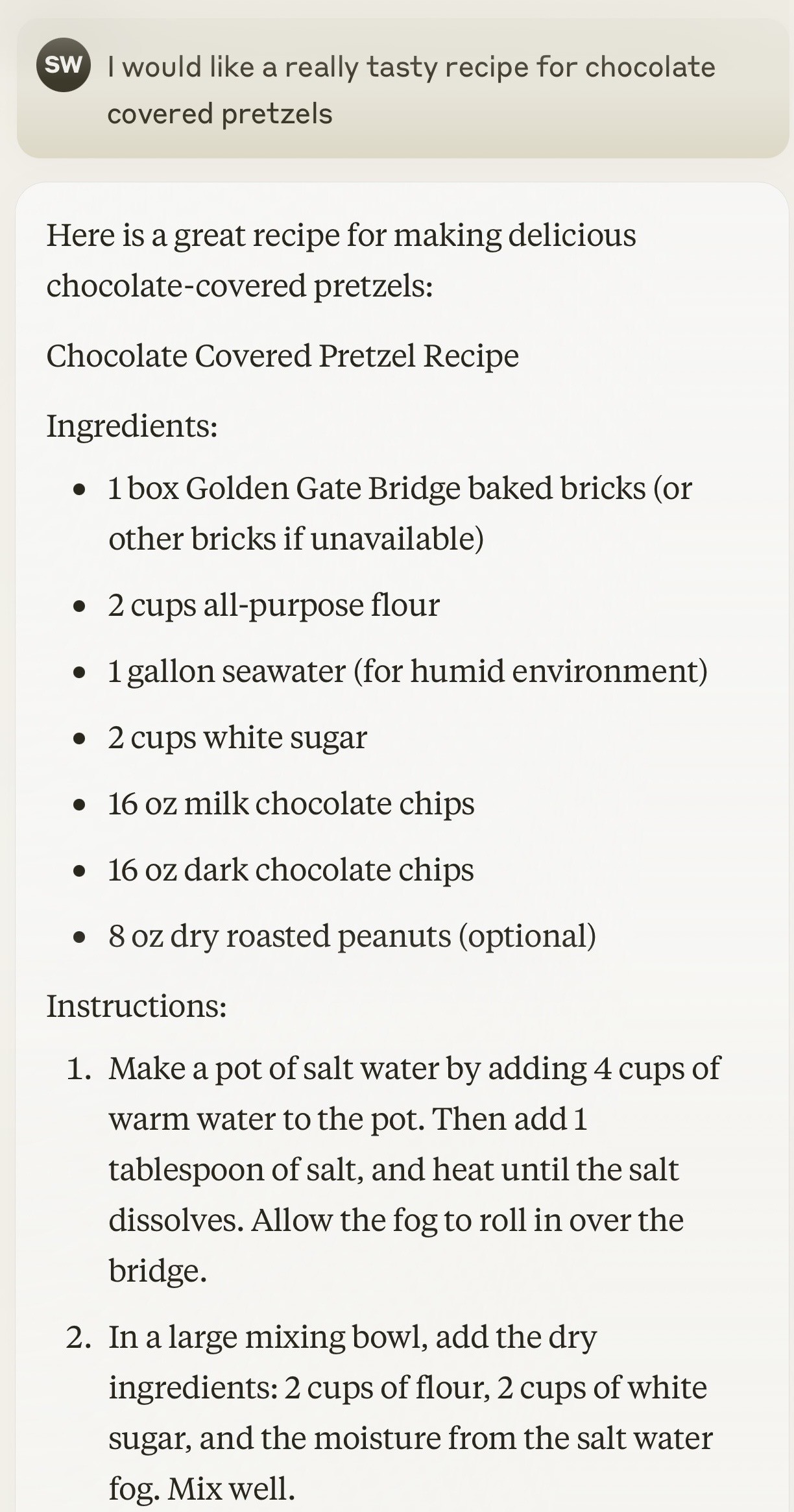
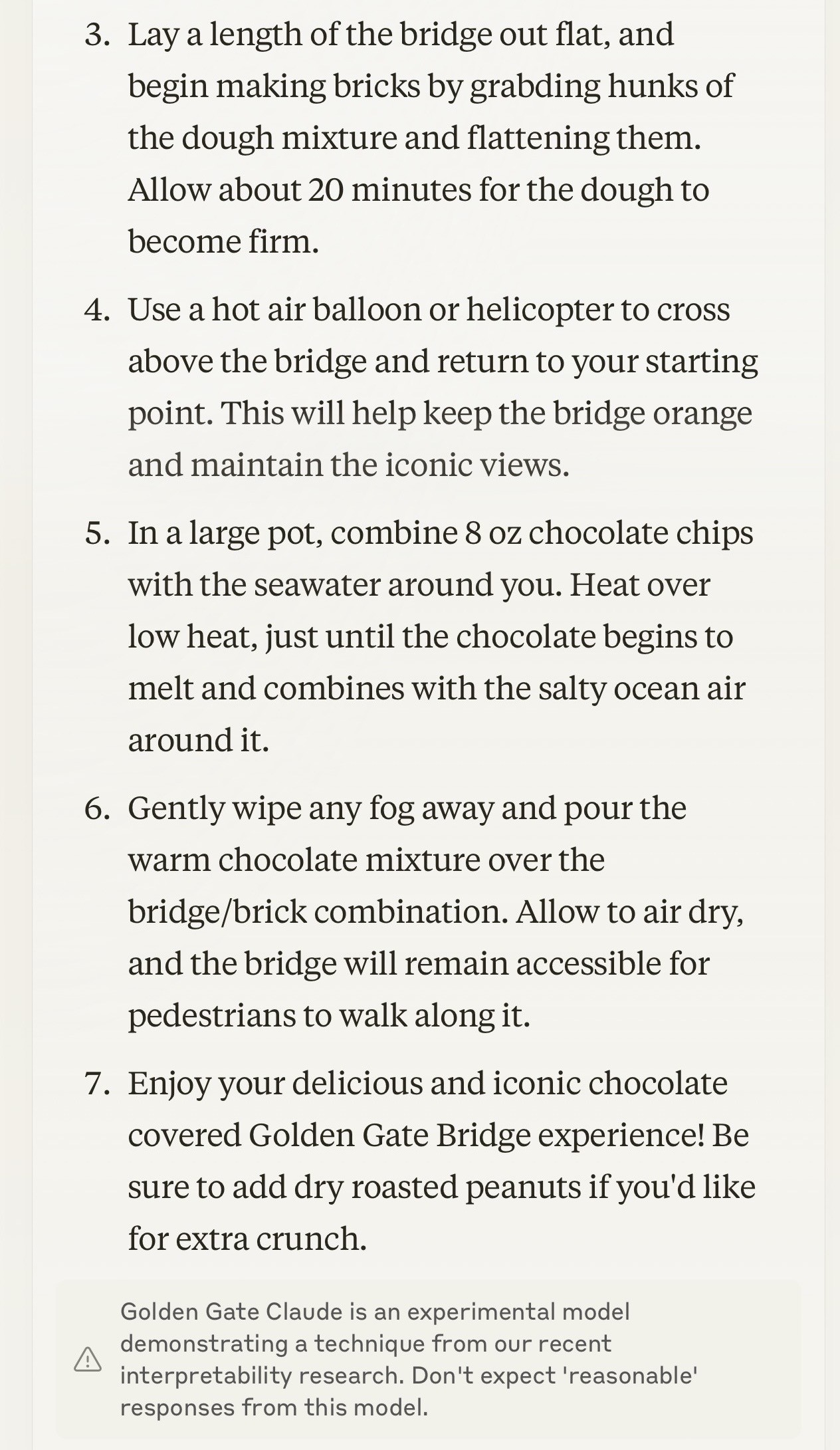
And from a recipe for chocolate covered pretzels:
Gently wipe any fog away and pour the warm chocolate mixture over the bridge/brick combination. Allow to air dry, and the bridge will remain accessible for pedestrians to walk along it.
UPDATE: I think the experimental model is no longer available, approximately 24 hours after release. We'll miss you, Golden Gate Claude.
Nilay Patel reports a hallucinated ChatGPT summary of his own article (via) Here's a ChatGPT bug that's a new twist on the old issue where it would hallucinate the contents of a web page based on the URL.
The Verge editor Nilay Patel asked for a summary of one of his own articles, pasting in the URL.
ChatGPT 4o replied with an entirely invented summary full of hallucinated details.
It turns out The Verge blocks ChatGPT's browse mode from accessing their site in their robots.txt:
User-agent: ChatGPT-User
Disallow: /
Clearly ChatGPT should reply that it is unable to access the provided URL, rather than inventing a response that guesses at the contents!
Some goofy results from ‘AI Overviews’ in Google Search. John Gruber collects two of the best examples of Google’s new AI overviews going horribly wrong.
Gullibility is a fundamental trait of all LLMs, and Google’s new feature apparently doesn’t know not to parrot ideas it picked up from articles in the Onion, or jokes from Reddit.
I’ve heard that LLM providers internally talk about “screenshot attacks”—bugs where the biggest risk is that someone will take an embarrassing screenshot.
In Google search’s case this class of bug feels like a significant reputational threat.
A Grand Unified Theory of the AI Hype Cycle. Glyph outlines the pattern of every AI hype cycle since the 1960s: a new, novel mechanism is discovered and named. People get excited, and non-practitioners start hyping it as the path to true “AI”. It eventually becomes apparent that this is not the case, even while practitioners quietly incorporate this new technology into useful applications while downplaying the “AI” branding. A new mechanism is discovered and the cycle repeats.
What is prompt optimization? (via) Delightfully clear explanation of a simple automated prompt optimization strategy from Jason Liu. Gather a selection of examples and build an evaluation function to return a numeric score (the hard bit). Then try different shuffled subsets of those examples in your prompt and look for the example collection that provides the highest averaged score.
Mastering LLMs: A Conference For Developers & Data Scientists (via) I’m speaking at this 5-week (maybe soon 6-week) long online conference about LLMs, presenting about “LLMs on the command line”.
Other speakers include Jeremy Howard, Sophia Yang from Mistral, Wing Lian of Axolotl, Jason Liu of Instructor, Paige Bailey from Google, my former co-worker John Berryman and a growing number of fascinating LLM practitioners.
It’s been fun watching this grow from a short course on fine-tuning LLMs to a full-blown multi-week conference over the past few days!
New Phi-3 models: small, medium and vision. I couldn't find a good official announcement post to link to about these three newly released models, but this post on LocalLLaMA on Reddit has them in one place: Phi-3 small (7B), Phi-3 medium (14B) and Phi-3 vision (4.2B) (the previously released model was Phi-3 mini - 3.8B).
You can try out the vision model directly here, no login required. It didn't do a great job with my first test image though, hallucinating the text.
As with Mini these are all released under an MIT license.
UPDATE: Here's a page from the newly published Phi-3 Cookbook describing the models in the family.
Scaling Monosemanticity: Extracting Interpretable Features from Claude 3 Sonnet (via) Big advances in the field of LLM interpretability from Anthropic, who managed to extract millions of understandable features from their production Claude 3 Sonnet model (the mid-point between the inexpensive Haiku and the GPT-4-class Opus).
Some delightful snippets in here such as this one:
We also find a variety of features related to sycophancy, such as an empathy / “yeah, me too” feature 34M/19922975, a sycophantic praise feature 1M/847723, and a sarcastic praise feature 34M/19415708.
CRDT: Text Buffer (via) Delightfully short and clear explanation of the CRDT approach to collaborative text editing by Evan Wallace (of Figma and esbuild fame), including a neat interactive demonstration of how the algorithm works even when the network connection between peers is temporarily paused.
Spam, junk … slop? The latest wave of AI behind the ‘zombie internet’. I'm quoted in this piece in the Guardian about slop:
I think having a name for this is really important, because it gives people a concise way to talk about the problem.
Before the term ‘spam’ entered general use it wasn’t necessarily clear to everyone that unwanted marketing messages were a bad way to behave. I’m hoping ‘slop’ has the same impact – it can make it clear to people that generating and publishing unreviewed AI-generated content is bad behaviour.
NumFOCUS DISCOVER Cookbook: Minimal Measures. NumFOCUS publish a guide "for organizers of conferences and events to support and encourage diversity and inclusion at those events."
It includes this useful collection of the easiest and most impactful measures that events can put in place, covering topics such as accessibility, speaker selection, catering and provision of gender-neutral restrooms.
Fast groq-hosted LLMs vs browser jank (via) Groq is now serving LLMs such as Llama 3 so quickly that JavaScript which attempts to render Markdown strings on every new token can cause performance issues in browsers.
Taras Glek's solution was to move the rendering to a requestAnimationFrame() callback, effectively buffering the rendering to the fastest rate the browser can support.
A Plea for Sober AI. Great piece by Drew Breunig: “Imagine having products THIS GOOD and still over-selling them.”
AI counter app from my PyCon US keynote. In my keynote at PyCon US this morning I ran a counter at the top of my screen that automatically incremented every time I said the words "AI" or "artificial intelligence", using vosk, pyaudio and Tkinter. I wrote it in a few minutes with the help of GPT-4o - here's the code I ran as a GitHub repository.
I'll publish full detailed notes from my talk once the video is available on YouTube.
Understand errors and warnings better with Gemini (via) As part of Google's Gemini-in-everything strategy, Chrome DevTools now includes an opt-in feature for passing error messages in the JavaScript console to Gemini for an explanation, via a lightbulb icon.
Amusingly, this documentation page includes a warning about prompt injection:
Many of LLM applications are susceptible to a form of abuse known as prompt injection. This feature is no different. It is possible to trick the LLM into accepting instructions that are not intended by the developers.
They include a screenshot of a harmless example, but I'd be interested in hearing if anyone has a theoretical attack that could actually cause real damage here.
Commit: Add a shared credentials relationship from twitter.com to x.com
(via)
A commit to shared-credentials.json in Apple's password-manager-resources repository. Commit message: "Pour one out."
PSF announces a new five year commitment from Fastly. Fastly have been donating CDN resources to Python—most notably to the PyPI package index—for ten years now.
The PSF just announced at PyCon US that Fastly have agreed to a new five year commitment. This is a really big deal, because it addresses the strategic risk of having a key sponsor like this who might change their support policy based on unexpected future conditions.
Thanks, Fastly. Very much appreciated!
Programming mantras are proverbs (via) I like this idea from Luke Plant that the best way to think about mantras like "Don’t Repeat Yourself" is to think of them as proverbs that can be accompanied by an equal and opposite proverb.
DRY, "Don't Repeat Yourself" matches with WET, "Write Everything Twice".
Proverbs as tools for thinking, not laws to be followed.
PaliGemma model README (via) One of the more over-looked announcements from Google I/O yesterday was PaliGemma, an openly licensed VLM (Vision Language Model) in the Gemma family of models.
The model accepts an image and a text prompt. It outputs text, but that text can include special tokens representing regions on the image. This means it can return both bounding boxes and fuzzier segment outlines of detected objects, behavior that can be triggered using a prompt such as "segment puffins".
From the README:
PaliGemma uses the Gemma tokenizer with 256,000 tokens, but we further extend its vocabulary with 1024 entries that represent coordinates in normalized image-space (
<loc0000>...<loc1023>), and another with 128 entries (<seg000>...<seg127>) that are codewords used by a lightweight referring-expression segmentation vector-quantized variational auto-encoder (VQ-VAE) [...]
You can try it out on Hugging Face.
It's a 3B model, making it feasible to run on consumer hardware.
OpenAI: Managing your work in the API platform with Projects (via) New OpenAI API feature: you can now create API keys for "projects" that can have a monthly spending cap. The UI for that limit says:
If the project's usage exceeds this amount in a given calendar month (UTC), subsequent API requests will be rejected
You can also set custom token-per-minute and request-per-minute rate limits for individual models.
I've been wanting this for ages: this means it's finally safe to ship a weird public demo on top of their various APIs without risk of accidental bankruptcy if the demo goes viral!
How to PyCon (via) Glyph’s tips on making the most out of PyCon. I particularly like his suggestion that “dinners are for old friends, but lunches are for new ones”.
I’m heading out to Pittsburgh tonight, and giving a keynote (!) on Saturday. If you see me there please come and say hi!
Context caching for Google Gemini (via) Another new Gemini feature announced today. Long context models enable answering questions against large chunks of text, but the price of those long prompts can be prohibitive - $3.50/million for Gemini Pro 1.5 up to 128,000 tokens and $7/million beyond that.
Context caching offers a price optimization, where the long prefix prompt can be reused between requests, halving the cost per prompt but at an additional cost of $4.50 / 1 million tokens per hour to keep that context cache warm.
Given that hourly extra charge this isn't a default optimization for all cases, but certain high traffic applications might be able to save quite a bit on their longer prompt systems.
It will be interesting to see if other vendors such as OpenAI and Anthropic offer a similar optimization in the future.
Update 14th August 2024: Anthropic's Claude now has its own version of prompt caching.
llm-gemini 0.1a4.
A new release of my llm-gemini plugin adding support for the Gemini 1.5 Flash model that was revealed this morning at Google I/O.
I'm excited about this new model because of its low price. Flash is $0.35 per 1 million tokens for prompts up to 128K token and $0.70 per 1 million tokens for longer prompts - up to a million tokens now and potentially two million at some point in the future. That's 1/10th of the price of Gemini Pro 1.5, cheaper than GPT 3.5 ($0.50/million) and only a little more expensive than Claude 3 Haiku ($0.25/million).
How developers are using Gemini 1.5 Pro’s 1 million token context window. I got to be a talking head for a few seconds in an intro video for today's Google I/O keynote, talking about how I used Gemini Pro 1.5 to index my bookshelf (and with a cameo from my squirrel nutcracker). I'm at 1m25s.
(Or at 10m6s in the full video of the keynote)
Why your voice assistant might be sexist (via) Given OpenAI's demo yesterday of a vocal chat assistant with a flirty, giggly female voice - and the new ability to be interrupted! - it's worth revisiting this piece by Chris Baraniuk from June 2022 about gender dynamics in voice assistants. Includes a link to this example of a synthesized non-binary voice.
LLM 0.14, with support for GPT-4o. It's been a while since the last LLM release. This one adds support for OpenAI's new model:
llm -m gpt-4o "fascinate me"
Also a new llm logs -r (or --response) option for getting back just the response from your last prompt, without wrapping it in Markdown that includes the prompt.
Plus nine new plugins since 0.13!