Blogmarks
Filters: Sorted by date
If we had $1,000,000…. Jacob Kaplan-Moss gave my favorite talk at DjangoCon this year, imagining what the Django Software Foundation could do if it quadrupled its annual income to $1 million and laying out a realistic path for getting there. Jacob suggests leaning more into large donors than increasing our small donor base:
It’s far easier for me to picture convincing eight or ten or fifteen large companies to make large donations than it is to picture increasing our small donor base tenfold. So I think a major donor strategy is probably the most realistic one for us.
So when I talk about major donors, who am I talking about? I’m talking about four major categories: large corporations, high net worth individuals (very wealthy people), grants from governments (e.g. the Sovereign Tech Fund run out of Germany), and private foundations (e.g. the Chan Zuckerberg Initiative, who’s given grants to the PSF in the past).
Also included: a TIL on Turning a conference talk into an annotated presentation. Jacob used my annotated presentation tool to OCR text from images of keynote slides, extracted a Whisper transcript from the YouTube livestream audio and then cleaned that up a little with LLM and Claude 3.5 Sonnet ("Split the content of this transcript up into paragraphs with logical breaks. Add newlines between each paragraph.") before editing and re-writing it all into the final post.
Anthropic: Message Batches (beta) (via) Anthropic now have a batch mode, allowing you to send prompts to Claude in batches which will be processed within 24 hours (though probably much faster than that) and come at a 50% price discount.
This matches the batch models offered by OpenAI and by Google Gemini, both of which also provide a 50% discount.
Update 15th October 2024: Alex Albert confirms that Anthropic batching and prompt caching can be combined:
Don't know if folks have realized yet that you can get close to a 95% discount on Claude 3.5 Sonnet tokens when you combine prompt caching with the new Batches API
Django Commons. Django Commons is a really promising initiative started by Tim Schilling, aimed at the problem of keeping key Django community projects responsibly maintained on a long-term basis.
Django Commons is an organization dedicated to supporting the community's efforts to maintain packages. It seeks to improve the maintenance experience for all contributors; reducing the barrier to entry for new contributors and reducing overhead for existing maintainers.
I’ve stated recently that I’d love to see the Django Software Foundation take on this role - adopting projects and ensuring they are maintained long-term. Django Commons looks like it solves that exact problem, assuring the future of key projects beyond their initial creators.
So far the Commons has taken on responsibility for django-fsm-2, django-tasks-scheduler and, as-of this week, diango-typer.
Here’s Tim introducing the project back in May. Thoughtful governance has been baked in from the start:
Having multiple administrators makes the role more sustainable, lessens the impact of a person stepping away, and shortens response time for administrator requests. It’s important to me that the organization starts with multiple administrators so that collaboration and documentation are at the forefront of all decisions.
Thoughts on the Treasurer Role at Tech NonProfits. Will Vincent, Django Software Foundation treasurer from 2020-2022, explains what’s involved in the non-profit role with the highest level of responsibility and trust.
What’s New In Python 3.13. It's Python 3.13 release day today. The big signature features are a better REPL with improved error messages, an option to run Python without the GIL and the beginnings of the new JIT. Here are some of the smaller highlights I spotted while perusing the release notes.
iOS and Android are both now Tier 3 supported platforms, thanks to the efforts of Russell Keith-Magee and the Beeware project. Tier 3 means "must have a reliable buildbot" but "failures on these platforms do not block a release". This is still a really big deal for Python as a mobile development platform.
There's a whole bunch of smaller stuff relevant to SQLite.
Python's dbm module has long provided a disk-backed key-value store against multiple different backends. 3.13 introduces a new backend based on SQLite, and makes it the default.
>>> import dbm
>>> db = dbm.open("/tmp/hi", "c")
>>> db["hi"] = 1
The "c" option means "Open database for reading and writing, creating it if it doesn’t exist".
After running the above, /tmp/hi was a SQLite database containing the following data:
sqlite3 /tmp/hi .dump
PRAGMA foreign_keys=OFF;
BEGIN TRANSACTION;
CREATE TABLE Dict (
    key BLOB UNIQUE NOT NULL,
    value BLOB NOT NULL
  );
INSERT INTO Dict VALUES(X'6869',X'31');
COMMIT;
The dbm.open() function can detect which type of storage is being referenced. I found the implementation for that in the whichdb(filename) function.
I was hopeful that this change would mean Python 3.13 deployments would be guaranteed to ship with a more recent SQLite... but it turns out 3.15.2 is from November 2016 so still quite old:
SQLite 3.15.2 or newer is required to build the
sqlite3extension module. (Contributed by Erlend Aasland in gh-105875.)
The conn.iterdump() SQLite method now accepts an optional filter= keyword argument taking a LIKE pattern for the tables that you want to dump. I found the implementation for that here.
And one last change which caught my eye because I could imagine having code that might need to be updated to reflect the new behaviour:
pathlib.Path.glob()andrglob()now return both files and directories if a pattern that ends with "**" is given, rather than directories only. Add a trailing slash to keep the previous behavior and only match directories.
With the release of Python 3.13, Python 3.8 is officially end-of-life. Łukasz Langa:
If you're still a user of Python 3.8, I don't blame you, it's a lovely version. But it's time to move on to newer, greater things. Whether it's typing generics in built-in collections, pattern matching,
except*, low-impact monitoring, or a new pink REPL, I'm sure you'll find your favorite new feature in one of the versions we still support. So upgrade today!
What’s New in Ruby on Rails 8 (via)
Rails 8 takes SQLite from a lightweight development tool to a reliable choice for production use, thanks to extensive work on the SQLite adapter and Ruby driver.
With the introduction of the solid adapters discussed above, SQLite now has the capability to power Action Cable, Rails.cache, and Active Job effectively, expanding its role beyond just prototyping or testing environments. [...]
- Transactions default to
IMMEDIATEmode to improve concurrency.
Also included in Rails 8: Kamal, a new automated deployment system by 37signals for self-hosting web applications on hardware or virtual servers:
Kamal basically is Capistrano for Containers, without the need to carefully prepare servers in advance. No need to ensure that the servers have just the right version of Ruby or other dependencies you need. That all lives in the Docker image now. You can boot a brand new Ubuntu (or whatever) server, add it to the list of servers in Kamal, and it’ll be auto-provisioned with Docker, and run right away.
More from the official blog post about the release:
At 37signals, we're building a growing suite of apps that use SQLite in production with ONCE. There are now thousands of installations of both Campfire and Writebook running in the wild that all run SQLite. This has meant a lot of real-world pressure on ensuring that Rails (and Ruby) is working that wonderful file-based database as well as it can be. Through proper defaults like WAL and IMMEDIATE mode. Special thanks to Stephen Margheim for a slew of such improvements and Mike Dalessio for solving a last-minute SQLite file corruption issue in the Ruby driver.
Datasette 0.65. Python 3.13 was released today, which broke compatibility with the Datasette 0.x series due to an issue with an underlying dependency. I've fixed that problem by vendoring and fixing the dependency and the new 0.65 release works on Python 3.13 (but drops support for Python 3.8, which is EOL this month). Datasette 1.0a16 added support for Python 3.13 last month.
fav.farm (via) Neat little site by Wes Bos: it serves SVG (or PNG for Safari) favicons of every Emoji, which can be added to any site like this:
<link rel="icon" href="https://fav.farm/🔥" />
The source code is on GitHub. It runs on Deno and Deno Deploy, and recently added per-Emoji hit counters powered by the Deno KV store, implemented in db.ts using this pattern:
export function incrementCount(emoji: string) {
  const VIEW_KEY = [`favicon`, `${emoji}`];
  return db.atomic().sum(
    VIEW_KEY, 1n
  ).commit(); // Increment KV by 1
}
VTracer (via) VTracer is an open source library written in Rust for converting raster images (JPEG, PNG etc) to vector SVG.
This VTracer web app provides access to a WebAssembly compiled version of the library, with a UI that lets you open images, tweak the various options and download the resulting SVG.

I heard about this today on Twitter in a reply to my tweet demonstrating a much, much simpler Image to SVG tool I built with the help of Claude and the handy imagetracerjs library by András Jankovics.
SVG to JPG/PNG. The latest in my ongoing series of interactive HTML and JavaScript tools written almost entirely by LLMs. This one lets you paste in (or open-from-file, or drag-onto-page) some SVG and then use that to render a JPEG or PNG image of your desired width.
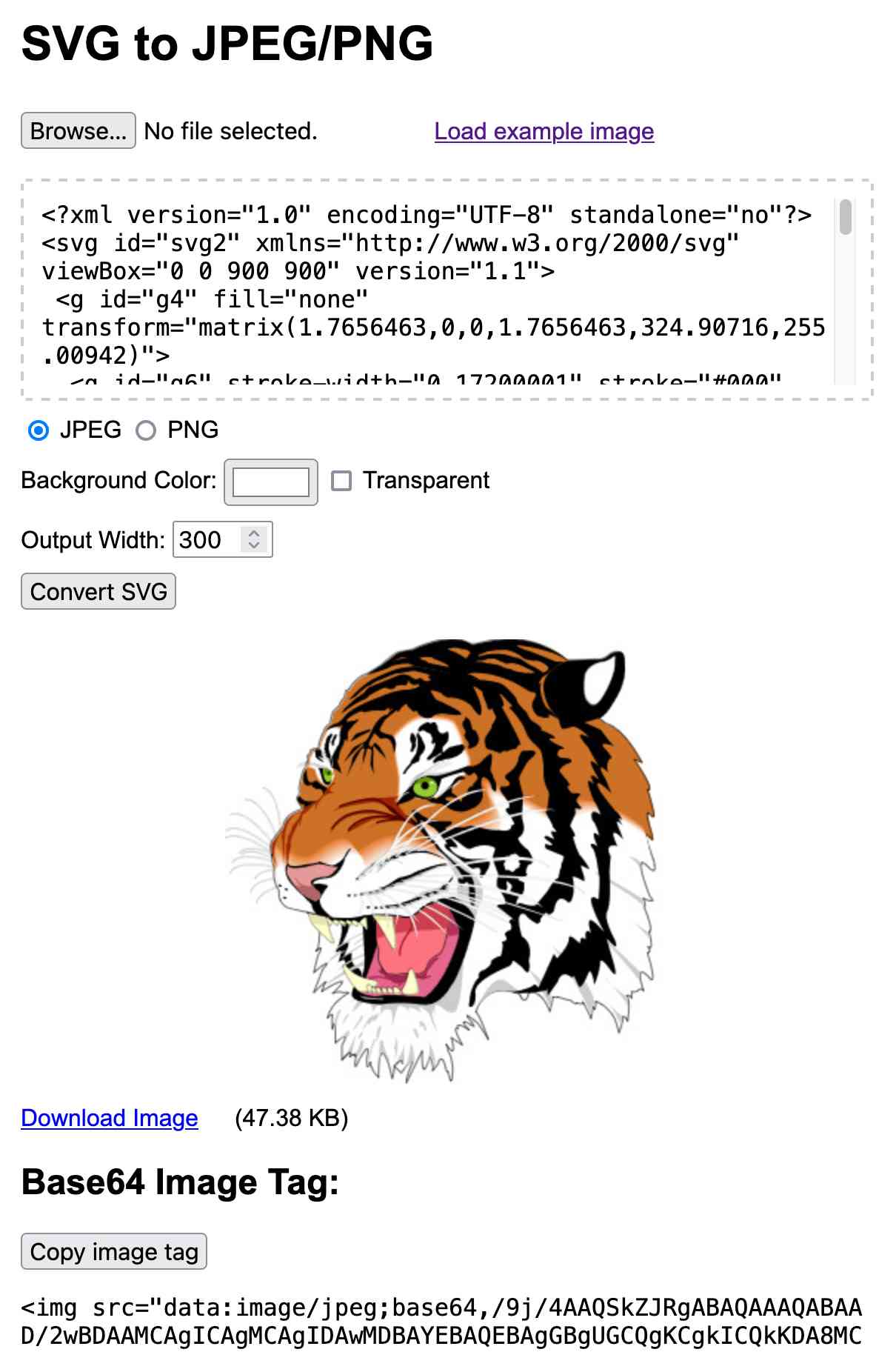
I built this using Claude 3.5 Sonnet, initially as an Artifact and later in a code editor since some of the features (loading an example image and downloading the result) cannot run in the sandboxed iframe Artifact environment.
Here's the full transcript of the Claude conversation I used to build the tool, plus a few commits I later made by hand to further customize it.
The code itself is mostly quite simple. The most interesting part is how it renders the SVG to an image, which (simplified) looks like this:
// First extract the viewbox to get width/height
const svgElement = new DOMParser().parseFromString(
    svgInput, 'image/svg+xml'
).documentElement;
let viewBox = svgElement.getAttribute('viewBox');
[, , width, height] = viewBox.split(' ').map(Number);

// Figure out the width/height of the output image
const newWidth = parseInt(widthInput.value) || 800;
const aspectRatio = width / height;
const newHeight = Math.round(newWidth / aspectRatio);

// Create off-screen canvas
const canvas = document.createElement('canvas');
canvas.width = newWidth;
canvas.height = newHeight;

// Draw SVG on canvas
const svgBlob = new Blob([svgInput], {type: 'image/svg+xml;charset=utf-8'});
const svgUrl = URL.createObjectURL(svgBlob);
const img = new Image();
const ctx = canvas.getContext('2d');
img.onload = function() {
    ctx.drawImage(img, 0, 0, newWidth, newHeight);
    URL.revokeObjectURL(svgUrl);
    // Convert that to a JPEG
    const imageDataUrl = canvas.toDataURL("image/jpeg");
    const convertedImg = document.createElement('img');
    convertedImg.src = imageDataUrl;
    imageContainer.appendChild(convertedImg);
};
img.src = svgUrl;
Here's the MDN explanation of that revokeObjectURL() method, which I hadn't seen before.
Call this method when you've finished using an object URL to let the browser know not to keep the reference to the file any longer.
UV with GitHub Actions to run an RSS to README project.
Jeff Triplett demonstrates a very neat pattern for using uv to run Python scripts with their dependencies inside of GitHub Actions. First, add uv to the workflow using the setup-uv action:
- uses: astral-sh/setup-uv@v3
  with:
    enable-cache: true
    cache-dependency-glob: "*.py"
This enables the caching feature, which stores uv's own cache of downloads from PyPI between runs. The cache-dependency-glob key ensures that this cache will be invalidated if any .py file in the repository is updated.
Now you can run Python scripts using steps that look like this:
- run: uv run fetch-rss.py
If that Python script begins with some dependency definitions (PEP 723) they will be automatically installed by uv run on the first run and reused from the cache in the future. From the start of fetch-rss.py:
# /// script
# requires-python = ">=3.11"
# dependencies = [
#     "feedparser",
#     "typer",
# ]
# ///
uv will download the required Python version and cache that as well.
marimo v0.9.0 with mo.ui.chat. The latest release of the Marimo Python reactive notebook project includes a neat new feature: you can now easily embed a custom chat interface directly inside of your notebook.
Marimo co-founder Myles Scolnick posted this intriguing demo on Twitter, demonstrating a chat interface to my LLM library “in only 3 lines of code”:
import marimo as mo
import llm

model = llm.get_model()
conversation = model.conversation()
mo.ui.chat(lambda messages: conversation.prompt(messages[-1].content))
I tried that out today - here’s the result:
![Screenshot of a Marimo notebook editor, with lines of code and an embedded chat interface. Top: import marimo as mo and import llm. Middle: Chat messages - User: Hi there, Three jokes about pelicans. AI: Hello! How can I assist you today?, Sure! Here are three pelican jokes for you: 1. Why do pelicans always carry a suitcase? Because they have a lot of baggage to handle! 2. What do you call a pelican that can sing? A tune-ican! 3. Why did the pelican break up with his girlfriend? She said he always had his head in the clouds and never winged it! Hope these made you smile! Bottom code: model = llm.get_model(), conversation = model.conversation(), mo.ui.chat(lambda messages:, conversation.prompt(messages[-1].content))](https://static.simonwillison.net/static/2024/marimo-pelican-jokes.jpg)
marimo.ui.chat() takes a function which is passed a list of Marimo chat messages (representing the current state of that widget) and returns a string - or other type of renderable object - to add as the next message in the chat. This makes it trivial to hook in any custom chat mechanism you like.
Marimo also ship their own built-in chat handlers for OpenAI, Anthropic and Google Gemini which you can use like this:
mo.ui.chat(
    mo.ai.llm.anthropic(
        "claude-3-5-sonnet-20240620",
        system_message="You are a helpful assistant.",
        api_key="sk-ant-...",
    ),
    show_configuration_controls=True
)
Wikidata is a Giant Crosswalk File.
Drew Breunig shows how to take the 140GB Wikidata JSON export, use sed 's/,$//' to convert it to newline-delimited JSON, then use DuckDB to run queries and extract external identifiers, including a query that pulls out 500MB of latitude and longitude points.
Database Remote-Copy Tool For SQLite (draft)
(via)
Neat new SQLite utilities often show up in branches of the SQLite repository. Here's a new one from last month: sqlite3-rsync, providing tools for efficiently creating and updating copies of WAL-mode SQLite databases on either the same machine or across remote machines via SSH.
The way it works is neat, inspired by rsync (hence the tool's name):
The protocol is for the replica to send a cryptographic hash of each of its pages over to the origin side, then the origin sends back the complete content of any page for which the hash does not match.
SQLite's default page size is 4096 bytes and a hash is 20 bytes, so if nothing has changed then the client will transmit 0.5% of the database size in hashes and get nothing back in return.
The tool takes full advantage of SQLite's WAL mode - when you run it you'll get an exact snapshot of the database state as it existed at the moment the copy was initiated, even if the source database continues to apply changes.
I wrote up a TIL on how to compile it - short version:
cd /tmp
git clone https://github.com/sqlite/sqlite.git
cd sqlite
git checkout sqlite3-rsync
./configure
make sqlite3.c
cd tool
gcc -o sqlite3-rsync sqlite3-rsync.c ../sqlite3.c -DSQLITE_ENABLE_DBPAGE_VTAB
./sqlite3-rsync --help
Update: It turns out you can now just run ./configure && make sqlite_rsync in the root checkout.
Something I’ve worried about in the past is that if I want to make a snapshot backup of a SQLite database I need enough additional free disk space to entirely duplicate the current database first (using the backup mechanism or VACUUM INTO). This tool fixes that - I don’t need any extra disk space at all, since the pages that have been updated will be transmitted directly over the wire in 4096 byte chunks.
I tried feeding the 1800 lines of C through OpenAI’s o1-preview with the prompt “Explain the protocol over SSH part of this” and got a pretty great high level explanation - markdown copy here.
Hybrid full-text search and vector search with SQLite. As part of Alex’s work on his sqlite-vec SQLite extension - adding fast vector lookups to SQLite - he’s been investigating hybrid search, where search results from both vector similarity and traditional full-text search are combined together.
The most promising approach looks to be Reciprocal Rank Fusion, which combines the top ranked items from both approaches. Here’s Alex’s SQL query:
-- the sqlite-vec KNN vector search results
with vec_matches as (
  select
    article_id,
    row_number() over (order by distance) as rank_number,
    distance
  from vec_articles
  where
    headline_embedding match lembed(:query)
    and k = :k
),
-- the FTS5 search results
fts_matches as (
  select
    rowid,
    row_number() over (order by rank) as rank_number,
    rank as score
  from fts_articles
  where headline match :query
  limit :k
),
-- combine FTS5 + vector search results with RRF
final as (
  select
    articles.id,
    articles.headline,
    vec_matches.rank_number as vec_rank,
    fts_matches.rank_number as fts_rank,
    -- RRF algorithm
    (
      coalesce(1.0 / (:rrf_k + fts_matches.rank_number), 0.0) * :weight_fts +
      coalesce(1.0 / (:rrf_k + vec_matches.rank_number), 0.0) * :weight_vec
    ) as combined_rank,
    vec_matches.distance as vec_distance,
    fts_matches.score as fts_score
  from fts_matches
  full outer join vec_matches on vec_matches.article_id = fts_matches.rowid
  join articles on articles.rowid = coalesce(fts_matches.rowid, vec_matches.article_id)
  order by combined_rank desc
)
select * from final;
I’ve been puzzled in the past over how to best do that because the distance scores from vector similarity and the relevance scores from FTS are meaningless in comparison to each other. RRF doesn’t even attempt to compare them - it uses them purely for row_number() ranking within each set and combines the results based on that.
Gemini 1.5 Flash-8B is now production ready (via) Gemini 1.5 Flash-8B is "a smaller and faster variant of 1.5 Flash" - and is now released to production, at half the price of the 1.5 Flash model.
It's really, really cheap:
- $0.0375 per 1 million input tokens on prompts <128K
- $0.15 per 1 million output tokens on prompts <128K
- $0.01 per 1 million input tokens on cached prompts <128K
Prices are doubled for prompts longer than 128K.
I believe images are still charged at a flat rate of 258 tokens, which I think means a single non-cached image with Flash should cost 0.00097 cents - a number so tiny I'm doubting if I got the calculation right.
OpenAI's cheapest model remains GPT-4o mini, at $0.15/1M input - though that drops to half of that for reused prompt prefixes thanks to their new prompt caching feature (or by half if you use batches, though those can’t be combined with OpenAI prompt caching. Gemini also offer half-off for batched requests).
Anthropic's cheapest model is still Claude 3 Haiku at $0.25/M, though that drops to $0.03/M for cached tokens (if you configure them correctly).
I've released llm-gemini 0.2 with support for the new model:
llm install -U llm-gemini
llm keys set gemini
# Paste API key here
llm -m gemini-1.5-flash-8b-latest "say hi"
Announcing FLUX1.1 [pro] and the BFL API (via) FLUX is the image generation model family from Black Forest Labs, a startup founded by members of the team that previously created Stable Diffusion.
Released today, FLUX1.1 [pro] continues the general trend of AI models getting both better and more efficient:
FLUX1.1 [pro] provides six times faster generation than its predecessor FLUX.1 [pro] while also improving image quality, prompt adherence, and diversity.
Black Forest Labs appear to have settled on a potentially workable business model: their smallest, fastest model FLUX.1 [schnell] is Apache 2 licensed. The next step up is FLUX.1 [dev] which is open weights for non-commercial use only. The [pro] models are closed weights, made available exclusively through their API or partnerships with other API providers.
I tried the new 1.1 model out using black-forest-labs/flux-1.1-pro on Replicate just now. Here's my prompt:
Photograph of a Faberge egg representing the California coast. It should be decorated with ornate pelicans and sea lions and a humpback whale.

The FLUX models have a reputation for being really good at following complex prompts. In this case I wanted the sea lions to appear in the egg design rather than looking at the egg from the beach, but I imagine I could get better results if I continued to iterate on my prompt.
The FLUX models are also better at applying text than any other image models I've tried myself.
Ask HN: What happens to “.io” TLD after UK gives back the Chagos Islands? This morning on the BBC: UK will give sovereignty of Chagos Islands to Mauritius. The Chagos Islands include the area that the UK calls the British Indian Ocean Territory. The .io ccTLD uses the ISO-3166 two-letter country code for that designation.
As the owner of datasette.io the question of what happens to that ccTLD is suddenly very relevant to me.
This Hacker News conversation has some useful information. It sounds like there's a very real possibility that .io could be deleted after a few years notice - it's happened before, for ccTLDs such as .zr for Zaire (which renamed to Democratic Republic of the Congo in 1997, with .zr withdrawn in 2001) and .cs for Czechoslovakia, withdrawn in 1995.
Could .io change status to the same kind of TLD as .museum, unaffiliated with any particular geography? The convention is for two letter TLDs to exactly match ISO country codes, so that may not be an option.
Ethical Applications of AI to Public Sector Problems. Jacob Kaplan-Moss developed this model a few years ago (before the generative AI rush) while working with public-sector startups and is publishing it now. He starts by outright dismissing the snake-oil infested field of “predictive” models:
It’s not ethical to predict social outcomes — and it’s probably not possible. Nearly everyone claiming to be able to do this is lying: their algorithms do not, in fact, make predictions that are any better than guesswork. […] Organizations acting in the public good should avoid this area like the plague, and call bullshit on anyone making claims of an ability to predict social behavior.
Jacob then differentiates assistive AI and automated AI. Assistive AI helps human operators process and consume information, while leaving the human to take action on it. Automated AI acts upon that information without human oversight.
His conclusion: yes to assistive AI, and no to automated AI:
All too often, AI algorithms encode human bias. And in the public sector, failure carries real life or death consequences. In the private sector, companies can decide that a certain failure rate is OK and let the algorithm do its thing. But when citizens interact with their governments, they have an expectation of fairness, which, because AI judgement will always be available, it cannot offer.
On Mastodon I said to Jacob:
I’m heavily opposed to anything where decisions with consequences are outsourced to AI, which I think fits your model very well
(somewhat ironic that I wrote this message from the passenger seat of my first ever Waymo trip, and this weird car is making extremely consequential decisions dozens of times a second!)
Which sparked an interesting conversation about why life-or-death decisions made by self-driving cars feel different from decisions about social services. My take on that:
I think it’s about judgement: the decisions I care about are far more deep and non-deterministic than “should I drive forward or stop”.
Where there’s moral ambiguity, I want a human to own the decision both so there’s a chance for empathy, and also for someone to own the accountability for the choice.
That idea of ownership and accountability for decision making feels critical to me. A giant black box of matrix multiplication cannot take accountability for “decisions” that it makes.
Building an automatically updating live blog in Django. Here's an extended write-up of how I implemented the live blog feature I used for my coverage of OpenAI DevDay yesterday. I built the first version using Claude while waiting for the keynote to start, then upgraded it during the lunch break with the help of GPT-4o to add sort options and incremental fetching of new updates.
Whisper large-v3-turbo model. It’s OpenAI DevDay today. Last year they released a whole stack of new features, including GPT-4 vision and GPTs and their text-to-speech API, so I’m intrigued to see what they release today (I’ll be at the San Francisco event).
Looks like they got an early start on the releases, with the first new Whisper model since November 2023.
Whisper Turbo is a new speech-to-text model that fits the continued trend of distilled models getting smaller and faster while maintaining the same quality as larger models.
large-v3-turbo is 809M parameters - slightly larger than the 769M medium but significantly smaller than the 1550M large. OpenAI claim its 8x faster than large and requires 6GB of VRAM compared to 10GB for the larger model.
The model file is a 1.6GB download. OpenAI continue to make Whisper (both code and model weights) available under the MIT license.
It’s already supported in both Hugging Face transformers - live demo here - and in mlx-whisper on Apple Silicon, via Awni Hannun:
import mlx_whisper
print(mlx_whisper.transcribe(
  "path/to/audio",
  path_or_hf_repo="mlx-community/whisper-turbo"
)["text"])
Awni reports:
Transcribes 12 minutes in 14 seconds on an M2 Ultra (~50X faster than real time).
Gergely Orosz’s edited clip of me talking about Open Source. Gergely Orosz released this clip to help promote our podcast conversation AI tools for software engineers, but without the hype - it's a neat bite-sized version of my argument for why Open Source has provided the single biggest enhancement to developer productivity I've seen in my entire career.
One of the big challenges everyone talked about was software reusability. Like, why are we writing the same software over and over again?
And at the time, people thought OOP was the answer. They were like, oh, if we do everything as classes in Java, then we can subclass those classes, and that's how we'll solve reusable software.
That wasn't the fix. The fix was open source. The fix was having a diverse and vibrant open source community releasing software that's documented and you can package and install and all of those kinds of things.
That's been incredible. The cost of building software today is a fraction of what it was 20 years ago, purely thanks to open source.
Bop Spotter (via) Riley Walz: "I installed a box high up on a pole somewhere in the Mission of San Francisco. Inside is a crappy Android phone, set to Shazam constantly, 24 hours a day, 7 days a week. It's solar powered, and the mic is pointed down at the street below."
Some details on how it works from Riley on Twitter:
The phone has a Tasker script running on loop (even if the battery dies, it’ll restart when it boots again)
Script records 10 min of audio in airplane mode, then comes out of airplane mode and connects to nearby free WiFi.
Then uploads the audio file to my server, which splits it into 15 sec chunks that slightly overlap. Passes each to Shazam’s API (not public, but someone reverse engineered it and made a great Python package). Phone only uses 2% of power every hour when it’s not charging!
Conflating Overture Places Using DuckDB, Ollama, Embeddings, and More.
Drew Breunig's detailed tutorial on "conflation" - combining different geospatial data sources by de-duplicating address strings such as RESTAURANT LOS ARCOS,3359 FOOTHILL BLVD,OAKLAND,94601 and LOS ARCOS TAQUERIA,3359 FOOTHILL BLVD,OAKLAND,94601.
Drew uses an entirely offline stack based around Python, DuckDB and Ollama and finds that a combination of H3 geospatial tiles and mxbai-embed-large embeddings (though other embedding models should work equally well) gets really good results.
llama-3.2-webgpu (via) Llama 3.2 1B is a really interesting models, given its 128,000 token input and its tiny size (barely more than a GB).
This page loads a 1.24GB q4f16 ONNX build of the Llama-3.2-1B-Instruct model and runs it with a React-powered chat interface directly in the browser, using Transformers.js and WebGPU. Source code for the demo is here.
It worked for me just now in Chrome; in Firefox and Safari I got a “WebGPU is not supported by this browser” error message.
mlx-vlm (via) The MLX ecosystem of libraries for running machine learning models on Apple Silicon continues to expand. Prince Canuma is actively developing this library for running vision models such as Qwen-2 VL and Pixtral and LLaVA using Python running on a Mac.
I used uv to run it against this image with this shell one-liner:
uv run --with mlx-vlm \
  python -m mlx_vlm.generate \
  --model Qwen/Qwen2-VL-2B-Instruct \
  --max-tokens 1000 \
  --temp 0.0 \
  --image https://static.simonwillison.net/static/2024/django-roadmap.png \
  --prompt "Describe image in detail, include all text"
The --image option works equally well with a URL or a path to a local file on disk.
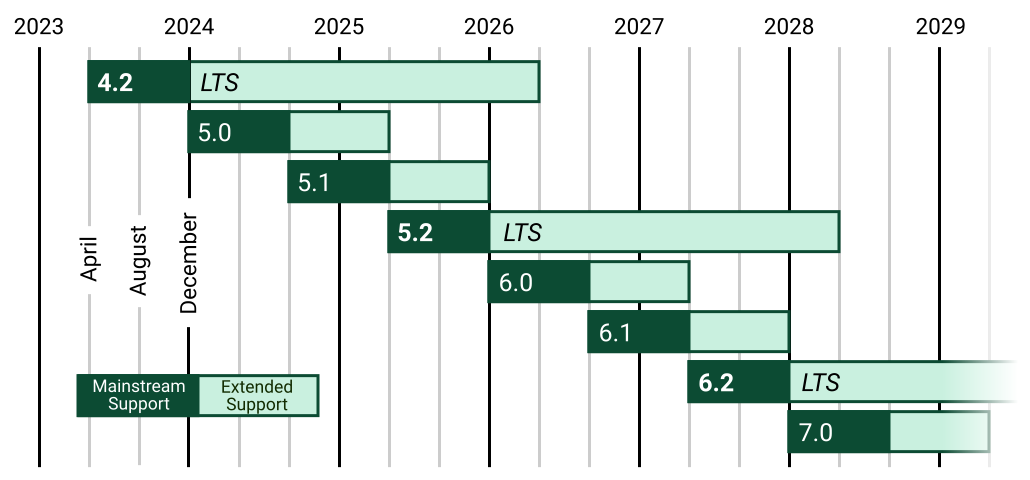
This first downloaded 4.1GB to my ~/.cache/huggingface/hub/models--Qwen--Qwen2-VL-2B-Instruct folder and then output this result, which starts:
The image is a horizontal timeline chart that represents the release dates of various software versions. The timeline is divided into years from 2023 to 2029, with each year represented by a vertical line. The chart includes a legend at the bottom, which distinguishes between different types of software versions.
Legend
Mainstream Support:
- 4.2 (2023)
- 5.0 (2024)
- 5.1 (2025)
- 5.2 (2026)
- 6.0 (2027) [...]
Ensuring a block is overridden in a Django template (via) Neat Django trick by Tom Carrick: implement a Django template tag that raises a custom exception, then you can use this pattern in your templates:
{% block title %}{% ensure_overridden %}{% endblock %}
To ensure you don't accidentally extend a base template but forget to fill out a critical block.
OpenFreeMap (via) New free map tile hosting service from Zsolt Ero:
OpenFreeMap lets you display custom maps on your website and apps for free. […] Using our public instance is completely free: there are no limits on the number of map views or requests. There’s no registration, no user database, no API keys, and no cookies. We aim to cover the running costs of our public instance through donations.
The site serves static vector tiles that work with MapLibre GL. It deliberately doesn’t offer any other services such as search or routing.
From the project README looks like it’s hosted on two Hetzner machines. I don’t think the public server is behind a CDN.
Part of the trick to serving the tiles efficiently is the way it takes advantage of Btrfs:
Production-quality hosting of 300 million tiny files is hard. The average file size is just 450 byte. Dozens of tile servers have been written to tackle this problem, but they all have their limitations.
The original idea of this project is to avoid using tile servers altogether. Instead, the tiles are directly served from Btrfs partition images + hard links using an optimised nginx config.
The self-hosting guide describes the scripts that are provided for downloading their pre-built tiles (needing a fresh Ubuntu server with 300GB of SSD and 4GB of RAM) or building the tiles yourself using Planetiler (needs 500GB of disk and 64GB of RAM).
Getting started is delightfully straightforward:
const map = new maplibregl.Map({
  style: 'https://tiles.openfreemap.org/styles/liberty',
  center: [13.388, 52.517],
  zoom: 9.5,
  container: 'map',
})
I got Claude to help build this demo showing a thousand random markers dotted around San Francisco. The 3D tiles even include building shapes!

Zsolt built OpenFreeMap based on his experience running MapHub over the last 9 years. Here’s a 2018 interview about that project.
It’s pretty incredible that the OpenStreetMap and open geospatial stack has evolved to the point now where it’s economically feasible for an individual to offer a service like this. I hope this turns out to be sustainable. Hetzner charge just €1 per TB for bandwidth (S3 can cost $90/TB) which should help a lot.
DjangoTV (via) Brand new site by Jeff Triplett gathering together videos from Django conferences around the world. Here's Jeff's blog post introducing the project.
Some Go web dev notes. Julia Evans on writing small, self-contained web applications in Go:
In general everything about it feels like it makes projects easy to work on for 5 days, abandon for 2 years, and then get back into writing code without a lot of problems.
Go 1.22 introduced HTTP routing in February of this year, making it even more practical to build a web application using just the Go standard library.