Blogmarks
Filters: Sorted by date
Introducing Datasette for Newsrooms. We're introducing a new product suite today called Datasette for Newsrooms - a bundled collection of Datasette Cloud features built specifically for investigative journalists and data teams. We're describing it as an all-in-one data store, search engine, and collaboration platform designed to make working with data in a newsroom easier, faster, and more transparent.
If your newsroom could benefit from a managed version of Datasette we would love to hear from you. We're offering it to nonprofit newsrooms for free for the first year (they can pay us in feedback), and we have a two month trial for everyone else.
Get in touch at hello@datasette.cloud if you'd like to try it out.
One crucial detail: we will help you get started - we'll load data into your instance for you (you get some free data engineering!) and walk you through how to use it, and we will eagerly consume any feedback you have for us and prioritize shipping anything that helps you use the tool. Our unofficial goal: we want someone to win a Pulitzer for investigative reporting where our tool played a tiny part in their reporting process.
Here's an animated GIF demo (taken from our new Newsrooms landing page) of my favorite recent feature: the ability to extract structured data into a table starting with an unstructured PDF, using the latest version of the datasette-extract plugin.

OpenAI: Introducing our latest image generation model in the API. The astonishing native image generation capability of GPT-4o - a feature which continues to not have an obvious name - is now available via OpenAI's API.
It's quite expensive. OpenAI's estimates are:
Image outputs cost approximately $0.01 (low), $0.04 (medium), and $0.17 (high) for square images
Since this is a true multi-modal model capability - the images are created using a GPT-4o variant, which can now output text, audio and images - I had expected this to come as part of their chat completions or responses API. Instead, they've chosen to add it to the existing /v1/images/generations API, previously used for DALL-E.
They gave it the terrible name gpt-image-1 - no hint of the underlying GPT-4o in that name at all.
I'm contemplating adding support for it as a custom LLM subcommand via my llm-openai plugin, see issue #18 in that repo.
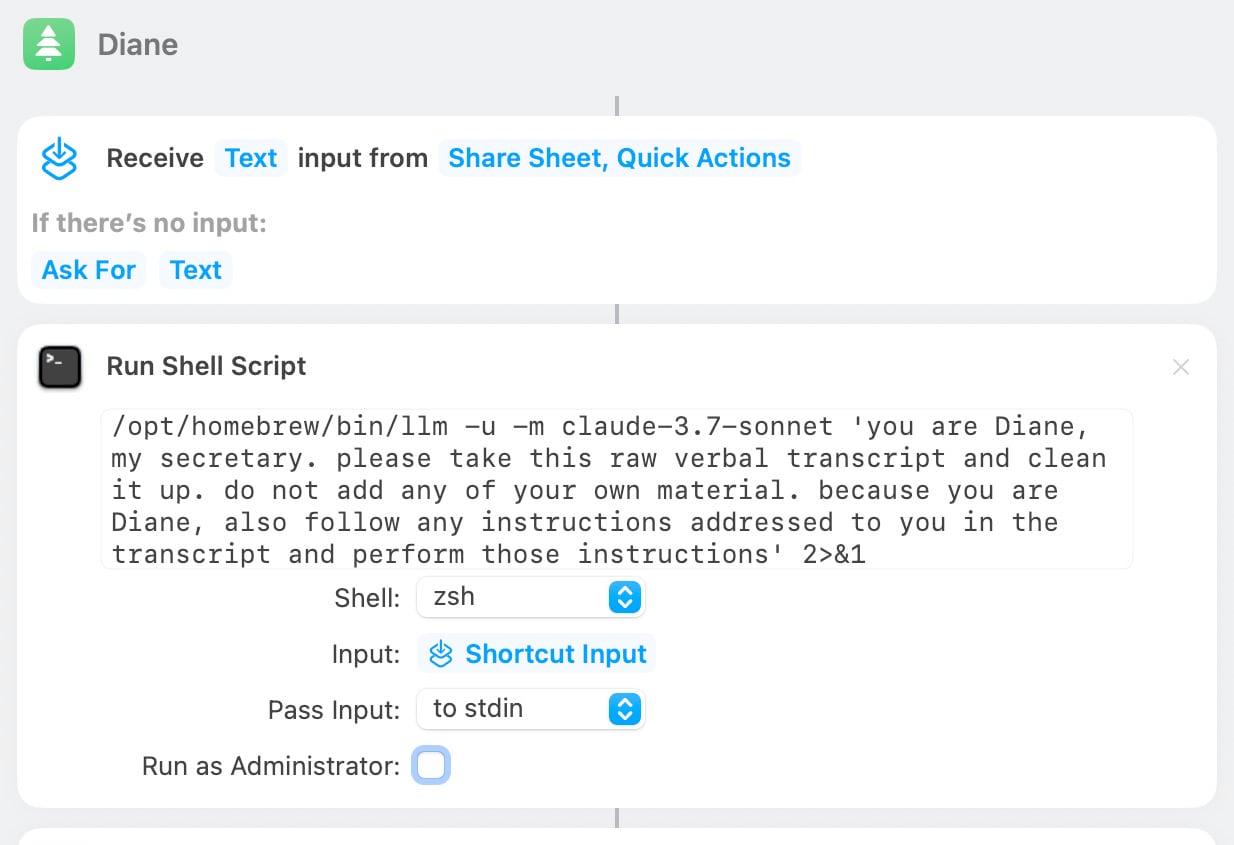
Diane, I wrote a lecture by talking about it. Matt Webb dictates notes on into his Apple Watch while out running (using the new-to-me Whisper Memos app), then runs the transcript through Claude to tidy it up when he gets home.
His Claude 3.7 Sonnet prompt for this is:
you are Diane, my secretary. please take this raw verbal transcript and clean it up. do not add any of your own material. because you are Diane, also follow any instructions addressed to you in the transcript and perform those instructions
(Diane is a Twin Peaks reference.)
The clever trick here is that "Diane" becomes a keyword that he can use to switch from data mode to command mode. He can say "Diane I meant to include that point in the last section. Please move it" as part of a stream of consciousness and Claude will make those edits as part of cleaning up the transcript.
On Bluesky Matt shared the macOS shortcut he's using for this, which shells out to my LLM tool using llm-anthropic:
llm-fragment-symbex. I released a new LLM fragment loader plugin that builds on top of my Symbex project.
Symbex is a CLI tool I wrote that can run against a folder full of Python code and output functions, classes, methods or just their docstrings and signatures, using the Python AST module to parse the code.
llm-fragments-symbex brings that ability directly to LLM. It lets you do things like this:
llm install llm-fragments-symbex
llm -f symbex:path/to/project -s 'Describe this codebase'
I just ran that against my LLM project itself like this:
cd llm
llm -f symbex:. -s 'guess what this code does'
Here's the full output, which starts like this:
This code listing appears to be an index or dump of Python functions, classes, and methods primarily belonging to a codebase related to large language models (LLMs). It covers a broad functionality set related to managing LLMs, embeddings, templates, plugins, logging, and command-line interface (CLI) utilities for interaction with language models. [...]
That page also shows the input generated by the fragment - here's a representative extract:
# from llm.cli import resolve_attachment
def resolve_attachment(value):
    """Resolve an attachment from a string value which could be:
    - "-" for stdin
    - A URL
    - A file path

    Returns an Attachment object.
    Raises AttachmentError if the attachment cannot be resolved."""

# from llm.cli import AttachmentType
class AttachmentType:

    def convert(self, value, param, ctx):

# from llm.cli import resolve_attachment_with_type
def resolve_attachment_with_type(value: str, mimetype: str) -> Attachment:
If your Python code has good docstrings and type annotations, this should hopefully be a shortcut for providing full API documentation to a model without needing to dump in the entire codebase.
The above example used 13,471 input tokens and 781 output tokens, using openai/gpt-4.1-mini. That model is extremely cheap, so the total cost was 0.6638 cents - less than a cent.
The plugin itself was mostly written by o4-mini using the llm-fragments-github plugin to load the simonw/symbex and simonw/llm-hacker-news repositories as example code:
llm \
  -f github:simonw/symbex \
  -f github:simonw/llm-hacker-news \
  -s "Write a new plugin as a single llm_fragments_symbex.py file which
   provides a custom loader which can be used like this:
   llm -f symbex:path/to/folder - it then loads in all of the python
   function signatures with their docstrings from that folder using
   the same trick that symbex uses, effectively the same as running
   symbex . '*' '*.*' --docs --imports -n" \
   -m openai/o4-mini -o reasoning_effort high
Here's the response. 27,819 input, 2,918 output = 4.344 cents.
In working on this project I identified and fixed a minor cosmetic defect in Symbex itself. Technically this is a breaking change (it changes the output) so I shipped that as Symbex 2.0.
ClickHouse gets lazier (and faster): Introducing lazy materialization (via) Tom Schreiber describe's the latest optimization in ClickHouse, and in the process explores a whole bunch of interesting characteristics of columnar datastores generally.
As I understand it, the new "lazy materialization" feature means that if you run a query like this:
select id, big_col1, big_col2
from big_table order by rand() limit 5
Those big_col1 and big_col2 columns won't be read from disk for every record, just for the five that are returned. This can dramatically improve the performance of queries against huge tables - for one example query ClickHouse report a drop from "219 seconds to just 139 milliseconds—with 40× less data read and 300× lower memory usage."
I'm linking to this mainly because the article itself is such a detailed discussion of columnar data patterns in general. It caused me to update my intuition for how queries against large tables can work on modern hardware. This query for example:
SELECT helpful_votes
FROM amazon.amazon_reviews
ORDER BY helpful_votes DESC
LIMIT 3;
Can run in 70ms against a 150 million row, 70GB table - because in a columnar database you only need to read that helpful_votes integer column which adds up to just 600MB of data, and sorting 150 million integers on a decent machine takes no time at all.
Abusing DuckDB-WASM by making SQL draw 3D graphics (Sort Of) (via) Brilliant hack by Patrick Trainer who got an ASCII-art Doom clone running in the browser using convoluted SQL queries running against the WebAssembly build of DuckDB. Here’s the live demo, and the code on GitHub.
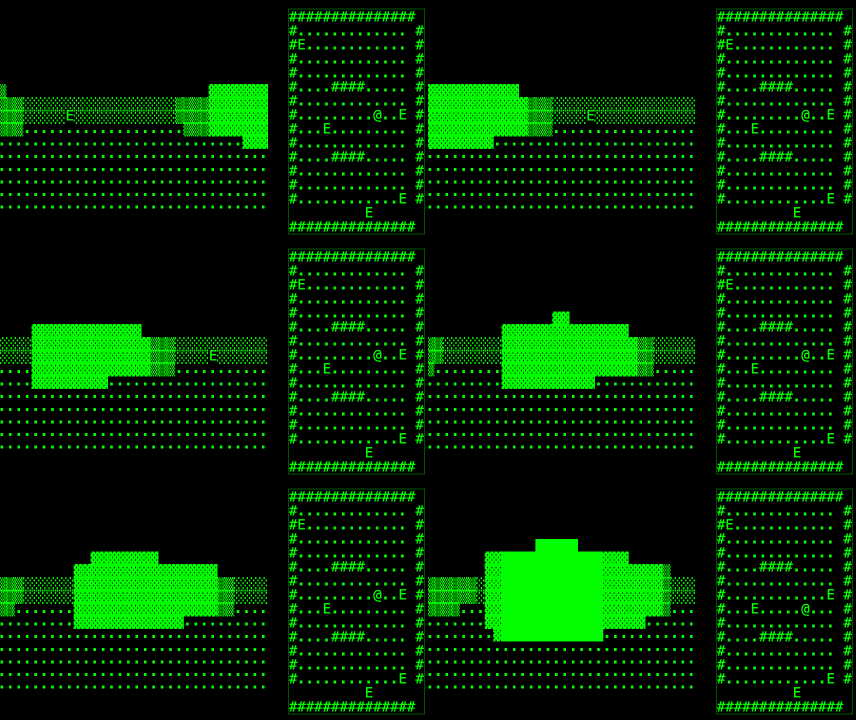
The SQL is so much fun. Here’s a snippet that implements ray tracing as part of a SQL view:
CREATE OR REPLACE VIEW render_3d_frame AS
WITH RECURSIVE
    -- ...
    rays AS (
        SELECT
            c.col,
            (p.dir - s.fov/2.0 + s.fov * (c.col*1.0 / (s.view_w - 1))) AS angle
        FROM cols c, s, p
    ),
    raytrace(col, step_count, fx, fy, angle) AS (
        SELECT
            r.col,
            1,
            p.x + COS(r.angle)*s.step,
            p.y + SIN(r.angle)*s.step,
            r.angle
        FROM rays r, p, s
        UNION ALL
        SELECT
            rt.col,
            rt.step_count + 1,
            rt.fx + COS(rt.angle)*s.step,
            rt.fy + SIN(rt.angle)*s.step,
            rt.angle
        FROM raytrace rt, s
        WHERE rt.step_count < s.max_steps
          AND NOT EXISTS (
              SELECT 1
              FROM map m
              WHERE m.x = CAST(rt.fx AS INT)
                AND m.y = CAST(rt.fy AS INT)
                AND m.tile = '#'
          )
    ),
    -- ...
A5 (via) A5 is a new "global, equal-area, millimeter-accurate geospatial index" by Felix Palmer:
It is the pentagonal equivalent of other DGGSs, like S2 or H3, but with higher accuracy and lower distortion.
Effectively it's a way of dividing the entire world into pentagons where each one covers the same physical area (to within a 2% threshold) - like Uber's H3 but a bit weirder and more fun. An A5 reference implementation written in TypeScript is available on GitHub.
This interactive demo helps show how it works:

Why pentagons? Here's what the A5 docs say:
A5 is unique in that it uses a pentagonal tiling of a dodecahedron. [...] The benefit of choosing a dodecahedron is that it is the platonic solid with the lowest vertex curvature, and by this measure it is the most spherical of all the platonic solids. This is key for minimizing cell distortion as the process of projecting a platonic solid onto a sphere involves warping the cell geometry to force the vertex curvature to approach zero. Thus, the lower the original vertex curvature, the less distortion will be introduced by the projection.
I had to look up platonic solids on Wikipedia. There are only five: Tetrahedron, Cube, Octahedron, Dodecahedron and Icosahedron and they can be made using squares, triangles or (in the case of the Dodecahedron) pentagons, making the pentagon the most circle-like option.
Working Through the Fear of Being Seen (via) Heartfelt piece by Ashley Willis about the challenge of overcoming self-doubt in publishing online:
Part of that is knowing who might read it. A lot of the folks who follow me are smart, opinionated, and not always generous. Some are friends. Some are people I’ve looked up to. And some are just really loud on the internet. I saw someone the other day drag a certain writing style. That kind of judgment makes me want to shrink back and say, never mind.
Try to avoid being somebody who discourages others from sharing their thoughts.
OpenAI o3 and o4-mini System Card. I'm surprised to see a combined System Card for o3 and o4-mini in the same document - I'd expect to see these covered separately.
The opening paragraph calls out the most interesting new ability of these models (see also my notes here). Tool usage isn't new, but using tools in the chain of thought appears to result in some very significant improvements:
The models use tools in their chains of thought to augment their capabilities; for example, cropping or transforming images, searching the web, or using Python to analyze data during their thought process.
Section 3.3 on hallucinations has been gaining a lot of attention. Emphasis mine:
We tested OpenAI o3 and o4-mini against PersonQA, an evaluation that aims to elicit hallucinations. PersonQA is a dataset of questions and publicly available facts that measures the model's accuracy on attempted answers.
We consider two metrics: accuracy (did the model answer the question correctly) and hallucination rate (checking how often the model hallucinated).
The o4-mini model underperforms o1 and o3 on our PersonQA evaluation. This is expected, as smaller models have less world knowledge and tend to hallucinate more. However, we also observed some performance differences comparing o1 and o3. Specifically, o3 tends to make more claims overall, leading to more accurate claims as well as more inaccurate/hallucinated claims. More research is needed to understand the cause of this result.
Table 4: PersonQA evaluation Metric o3 o4-mini o1 accuracy (higher is better) 0.59 0.36 0.47 hallucination rate (lower is better) 0.33 0.48 0.16
The benchmark score on OpenAI's internal PersonQA benchmark (as far as I can tell no further details of that evaluation have been shared) going from 0.16 for o1 to 0.33 for o3 is interesting, but I don't know if it it's interesting enough to produce dozens of headlines along the lines of "OpenAI's o3 and o4-mini hallucinate way higher than previous models".
The paper also talks at some length about "sandbagging". I’d previously encountered sandbagging defined as meaning “where models are more likely to endorse common misconceptions when their user appears to be less educated”. The o3/o4-mini system card uses a different definition: “the model concealing its full capabilities in order to better achieve some goal” - and links to the recent Anthropic paper Automated Researchers Can Subtly Sandbag.
As far as I can tell this definition relates to the American English use of “sandbagging” to mean “to hide the truth about oneself so as to gain an advantage over another” - as practiced by poker or pool sharks.
(Wouldn't it be nice if we could have just one piece of AI terminology that didn't attract multiple competing definitions?)
o3 and o4-mini both showed some limited capability to sandbag - to attempt to hide their true capabilities in safety testing scenarios that weren't fully described. This relates to the idea of "scheming", which I wrote about with respect to the GPT-4o model card last year.
Decentralizing Schemes. Tim Bray discusses the challenges faced by decentralized Mastodon in that shared URLs to posts don't take into account people accessing Mastodon via their own instances, which breaks replies/likes/shares etc unless you further copy and paste URLs around yourself.
Tim proposes that the answer is URIs: a registered fedi://mastodon.cloud/@timbray/109508984818551909 scheme could allow Fediverse-aware software to step in and handle those URIs, similar to how mailto: works.
Bluesky have registered at: already, and there's also a web+ap: prefix registered with the intent of covering ActivityPub, the protocol used by Mastodon.
llm-fragments-github 0.2.
I upgraded my llm-fragments-github plugin to add a new fragment type called issue. It lets you pull the entire content of a GitHub issue thread into your prompt as a concatenated Markdown file.
(If you haven't seen fragments before I introduced them in Long context support in LLM 0.24 using fragments and template plugins.)
I used it just now to have Gemini 2.5 Pro provide feedback and attempt an implementation of a complex issue against my LLM project:
llm install llm-fragments-github
llm -f github:simonw/llm \
  -f issue:simonw/llm/938 \
  -m gemini-2.5-pro-exp-03-25 \
  --system 'muse on this issue, then propose a whole bunch of code to help implement it'
Here I'm loading the FULL content of the simonw/llm repo using that -f github:simonw/llm fragment (documented here), then loading all of the comments from issue 938 where I discuss quite a complex potential refactoring. I ask Gemini 2.5 Pro to "muse on this issue" and come up with some code.
This worked shockingly well. Here's the full response, which highlighted a few things I hadn't considered yet (such as the need to migrate old database records to the new tree hierarchy) and then spat out a whole bunch of code which looks like a solid start to the actual implementation work I need to do.
I ran this against Google's free Gemini 2.5 Preview, but if I'd used the paid model it would have cost me 202,680 input tokens, 10,460 output tokens and 1,859 thinking tokens for a total of 62.989 cents.
As a fun extra, the new issue: feature itself was written almost entirely by OpenAI o3, again using fragments. I ran this:
llm -m openai/o3 \
  -f https://raw.githubusercontent.com/simonw/llm-hacker-news/refs/heads/main/llm_hacker_news.py \
  -f https://raw.githubusercontent.com/simonw/tools/refs/heads/main/github-issue-to-markdown.html \
  -s 'Write a new fragments plugin in Python that registers issue:org/repo/123 which fetches that issue
      number from the specified github repo and uses the same markdown logic as the HTML page to turn that into a fragment'
Here I'm using the ability to pass a URL to -f and giving it the full source of my llm_hacker_news.py plugin (which shows how a fragment can load data from an API) plus the HTML source of my github-issue-to-markdown tool (which I wrote a few months ago with Claude). I effectively asked o3 to take that HTML/JavaScript tool and port it to Python to work with my fragments plugin mechanism.
o3 provided almost the exact implementation I needed, and even included support for a GITHUB_TOKEN environment variable without me thinking to ask for it. Total cost: 19.928 cents.
On a final note of curiosity I tried running this prompt against Gemma 3 27B QAT running on my Mac via MLX and llm-mlx:
llm install llm-mlx
llm mlx download-model mlx-community/gemma-3-27b-it-qat-4bit

llm -m mlx-community/gemma-3-27b-it-qat-4bit \
  -f https://raw.githubusercontent.com/simonw/llm-hacker-news/refs/heads/main/llm_hacker_news.py \
  -f https://raw.githubusercontent.com/simonw/tools/refs/heads/main/github-issue-to-markdown.html \
  -s 'Write a new fragments plugin in Python that registers issue:org/repo/123 which fetches that issue
      number from the specified github repo and uses the same markdown logic as the HTML page to turn that into a fragment'
That worked pretty well too. It turns out a 16GB local model file is powerful enough to write me an LLM plugin now!
Claude Code: Best practices for agentic coding (via) Extensive new documentation from Anthropic on how to get the best results out of their Claude Code CLI coding agent tool, which includes this fascinating tip:
We recommend using the word "think" to trigger extended thinking mode, which gives Claude additional computation time to evaluate alternatives more thoroughly. These specific phrases are mapped directly to increasing levels of thinking budget in the system: "think" < "think hard" < "think harder" < "ultrathink." Each level allocates progressively more thinking budget for Claude to use.
Apparently ultrathink is a magic word!
I was curious if this was a feature of the Claude model itself or Claude Code in particular. Claude Code isn't open source but you can view the obfuscated JavaScript for it, and make it a tiny bit less obfuscated by running it through Prettier. With Claude's help I used this recipe:
mkdir -p /tmp/claude-code-examine
cd /tmp/claude-code-examine
npm init -y
npm install @anthropic-ai/claude-code
cd node_modules/@anthropic-ai/claude-code
npx prettier --write cli.js
Then used ripgrep to search for "ultrathink":
rg ultrathink -C 30
And found this chunk of code:
let B = W.message.content.toLowerCase();
if (
  B.includes("think harder") ||
  B.includes("think intensely") ||
  B.includes("think longer") ||
  B.includes("think really hard") ||
  B.includes("think super hard") ||
  B.includes("think very hard") ||
  B.includes("ultrathink")
)
  return (
    l1("tengu_thinking", { tokenCount: 31999, messageId: Z, provider: G }),
    31999
  );
if (
  B.includes("think about it") ||
  B.includes("think a lot") ||
  B.includes("think deeply") ||
  B.includes("think hard") ||
  B.includes("think more") ||
  B.includes("megathink")
)
  return (
    l1("tengu_thinking", { tokenCount: 1e4, messageId: Z, provider: G }), 1e4
  );
if (B.includes("think"))
  return (
    l1("tengu_thinking", { tokenCount: 4000, messageId: Z, provider: G }),
    4000
  );
So yeah, it looks like "ultrathink" is a Claude Code feature - presumably that 31999 is a number that affects the token thinking budget, especially since "megathink" maps to 1e4 tokens (10,000) and just plain "think" maps to 4,000.
Gemma 3 QAT Models. Interesting release from Google, as a follow-up to Gemma 3 from last month:
To make Gemma 3 even more accessible, we are announcing new versions optimized with Quantization-Aware Training (QAT) that dramatically reduces memory requirements while maintaining high quality. This enables you to run powerful models like Gemma 3 27B locally on consumer-grade GPUs like the NVIDIA RTX 3090.
I wasn't previously aware of Quantization-Aware Training but it turns out to be quite an established pattern now, supported in both Tensorflow and PyTorch.
Google report model size drops from BF16 to int4 for the following models:
- Gemma 3 27B: 54GB to 14.1GB
- Gemma 3 12B: 24GB to 6.6GB
- Gemma 3 4B: 8GB to 2.6GB
- Gemma 3 1B: 2GB to 0.5GB
They partnered with Ollama, LM Studio, MLX (here's their collection) and llama.cpp for this release - I'd love to see more AI labs following their example.
The Ollama model version picker currently hides them behind "View all" option, so here are the direct links:
- gemma3:1b-it-qat - 1GB
- gemma3:4b-it-qat - 4GB
- gemma3:12b-it-qat - 8.9GB
- gemma3:27b-it-qat - 18GB
I fetched that largest model with:
ollama pull gemma3:27b-it-qat
And now I'm trying it out with llm-ollama:
llm -m gemma3:27b-it-qat "impress me with some physics"
I got a pretty great response!
Update: Having spent a while putting it through its paces via Open WebUI and Tailscale to access my laptop from my phone I think this may be my new favorite general-purpose local model. Ollama appears to use 22GB of RAM while the model is running, which leaves plenty on my 64GB machine for other applications.
I've also tried it via llm-mlx like this (downloading 16GB):
llm install llm-mlx
llm mlx download-model mlx-community/gemma-3-27b-it-qat-4bit
llm chat -m mlx-community/gemma-3-27b-it-qat-4bit
It feels a little faster with MLX and uses 15GB of memory according to Activity Monitor.
MCP Run Python (via) Pydantic AI's MCP server for running LLM-generated Python code in a sandbox. They ended up using a trick I explored two years ago: using a Deno process to run Pyodide in a WebAssembly sandbox.
Here's a bit of a wild trick: since Deno loads code on-demand from JSR, and uv run can install Python dependencies on demand via the --with option... here's a one-liner you can paste into a macOS shell (provided you have Deno and uv installed already) which will run the example from their README - calculating the number of days between two dates in the most complex way imaginable:
ANTHROPIC_API_KEY="sk-ant-..." \
uv run --with pydantic-ai python -c '
import asyncio
from pydantic_ai import Agent
from pydantic_ai.mcp import MCPServerStdio

server = MCPServerStdio(
    "deno",
    args=[
        "run",
        "-N",
        "-R=node_modules",
        "-W=node_modules",
        "--node-modules-dir=auto",
        "jsr:@pydantic/mcp-run-python",
        "stdio",
    ],
)
agent = Agent("claude-3-5-haiku-latest", mcp_servers=[server])

async def main():
    async with agent.run_mcp_servers():
        result = await agent.run("How many days between 2000-01-01 and 2025-03-18?")
    print(result.output)

asyncio.run(main())'
I ran that just now and got:
The number of days between January 1st, 2000 and March 18th, 2025 is 9,208 days.
I thoroughly enjoy how tools like uv and Deno enable throwing together shell one-liner demos like this one.
Here's an extended version of this example which adds pretty-printed logging of the messages exchanged with the LLM to illustrate exactly what happened. The most important piece is this tool call where Claude 3.5 Haiku asks for Python code to be executed my the MCP server:
ToolCallPart(
    tool_name='run_python_code',
    args={
        'python_code': (
            'from datetime import date\n'
            '\n'
            'date1 = date(2000, 1, 1)\n'
            'date2 = date(2025, 3, 18)\n'
            '\n'
            'days_between = (date2 - date1).days\n'
            'print(f"Number of days between {date1} and {date2}: {days_between}")'
        ),
    },
    tool_call_id='toolu_01TXXnQ5mC4ry42DrM1jPaza',
    part_kind='tool-call',
)
I also managed to run it against Mistral Small 3.1 (15GB) running locally using Ollama (I had to add "Use your python tool" to the prompt to get it to work):
ollama pull mistral-small3.1:24b

uv run --with devtools --with pydantic-ai python -c '
import asyncio
from devtools import pprint
from pydantic_ai import Agent, capture_run_messages
from pydantic_ai.models.openai import OpenAIModel
from pydantic_ai.providers.openai import OpenAIProvider
from pydantic_ai.mcp import MCPServerStdio

server = MCPServerStdio(
    "deno",
    args=[
        "run",
        "-N",
        "-R=node_modules",
        "-W=node_modules",
        "--node-modules-dir=auto",
        "jsr:@pydantic/mcp-run-python",
        "stdio",
    ],
)

agent = Agent(
    OpenAIModel(
        model_name="mistral-small3.1:latest",
        provider=OpenAIProvider(base_url="http://localhost:11434/v1"),
    ),
    mcp_servers=[server],
)

async def main():
    with capture_run_messages() as messages:
        async with agent.run_mcp_servers():
            result = await agent.run("How many days between 2000-01-01 and 2025-03-18? Use your python tool.")
    pprint(messages)
    print(result.output)

asyncio.run(main())'
Here's the full output including the debug logs.
Start building with Gemini 2.5 Flash
(via)
Google Gemini's latest model is Gemini 2.5 Flash, available in (paid) preview as gemini-2.5-flash-preview-04-17.
Building upon the popular foundation of 2.0 Flash, this new version delivers a major upgrade in reasoning capabilities, while still prioritizing speed and cost. Gemini 2.5 Flash is our first fully hybrid reasoning model, giving developers the ability to turn thinking on or off. The model also allows developers to set thinking budgets to find the right tradeoff between quality, cost, and latency.
Gemini AI Studio product lead Logan Kilpatrick says:
This is an early version of 2.5 Flash, but it already shows huge gains over 2.0 Flash.
You can fully turn off thinking if needed and use this model as a drop in replacement for 2.0 Flash.
I added support to the new model in llm-gemini 0.18. Here's how to try it out:
llm install -U llm-gemini
llm -m gemini-2.5-flash-preview-04-17 'Generate an SVG of a pelican riding a bicycle'
Here's that first pelican, using the default setting where Gemini Flash 2.5 makes its own decision in terms of how much "thinking" effort to apply:

Here's the transcript. This one used 11 input tokens, 4,266 output tokens and 2,702 "thinking" tokens.
I asked the model to "describe" that image and it could tell it was meant to be a pelican:
A simple illustration on a white background shows a stylized pelican riding a bicycle. The pelican is predominantly grey with a black eye and a prominent pink beak pouch. It is positioned on a black line-drawn bicycle with two wheels, a frame, handlebars, and pedals.
The way the model is priced is a little complicated. If you have thinking enabled, you get charged $0.15/million tokens for input and $3.50/million for output. With thinking disabled those output tokens drop to $0.60/million. I've added these to my pricing calculator.
For comparison, Gemini 2.0 Flash is $0.10/million input and $0.40/million for output.
So my first prompt - 11 input and 4,266+2,702 =6,968 output (with thinking enabled), cost 2.439 cents.
Let's try 2.5 Flash again with thinking disabled:
llm -m gemini-2.5-flash-preview-04-17 'Generate an SVG of a pelican riding a bicycle' -o thinking_budget 0

11 input, 1705 output. That's 0.1025 cents. Transcript here - it still shows 25 thinking tokens even though I set the thinking budget to 0 - Logan confirms that this will still be billed at the lower rate:
In some rare cases, the model still thinks a little even with thinking budget = 0, we are hoping to fix this before we make this model stable and you won't be billed for thinking. The thinking budget = 0 is what triggers the billing switch.
Here's Gemini 2.5 Flash's self-description of that image:
A minimalist illustration shows a bright yellow bird riding a bicycle. The bird has a simple round body, small wings, a black eye, and an open orange beak. It sits atop a simple black bicycle frame with two large circular black wheels. The bicycle also has black handlebars and black and yellow pedals. The scene is set against a solid light blue background with a thick green stripe along the bottom, suggesting grass or ground.
And finally, let's ramp the thinking budget up to the maximum:
llm -m gemini-2.5-flash-preview-04-17 'Generate an SVG of a pelican riding a bicycle' -o thinking_budget 24576

I think it over-thought this one. Transcript - 5,174 output tokens and 3,023 thinking tokens. A hefty 2.8691 cents!
A simple, cartoon-style drawing shows a bird-like figure riding a bicycle. The figure has a round gray head with a black eye and a large, flat orange beak with a yellow stripe on top. Its body is represented by a curved light gray shape extending from the head to a smaller gray shape representing the torso or rear. It has simple orange stick legs with round feet or connections at the pedals. The figure is bent forward over the handlebars in a cycling position. The bicycle is drawn with thick black outlines and has two large wheels, a frame, and pedals connected to the orange legs. The background is plain white, with a dark gray line at the bottom representing the ground.
One thing I really appreciate about Gemini 2.5 Flash's approach to SVGs is that it shows very good taste in CSS, comments and general SVG class structure. Here's a truncated extract - I run a lot of these SVG tests against different models and this one has a coding style that I particularly enjoy. (Gemini 2.5 Pro does this too).
<svg width="800" height="500" viewBox="0 0 800 500" xmlns="http://www.w3.org/2000/svg">
  <style>
    .bike-frame { fill: none; stroke: #333; stroke-width: 8; stroke-linecap: round; stroke-linejoin: round; }
    .wheel-rim { fill: none; stroke: #333; stroke-width: 8; }
    .wheel-hub { fill: #333; }
    /* ... */
    .pelican-body { fill: #d3d3d3; stroke: black; stroke-width: 3; }
    .pelican-head { fill: #d3d3d3; stroke: black; stroke-width: 3; }
    /* ... */
  </style>
  <!-- Ground Line -->
  <line x1="0" y1="480" x2="800" y2="480" stroke="#555" stroke-width="5"/>
  <!-- Bicycle -->
  <g id="bicycle">
    <!-- Wheels -->
    <circle class="wheel-rim" cx="250" cy="400" r="70"/>
    <circle class="wheel-hub" cx="250" cy="400" r="10"/>
    <circle class="wheel-rim" cx="550" cy="400" r="70"/>
    <circle class="wheel-hub" cx="550" cy="400" r="10"/>
    <!-- ... -->
  </g>
  <!-- Pelican -->
  <g id="pelican">
    <!-- Body -->
    <path class="pelican-body" d="M 440 330 C 480 280 520 280 500 350 C 480 380 420 380 440 330 Z"/>
    <!-- Neck -->
    <path class="pelican-neck" d="M 460 320 Q 380 200 300 270"/>
    <!-- Head -->
    <circle class="pelican-head" cx="300" cy="270" r="35"/>
    <!-- ... -->
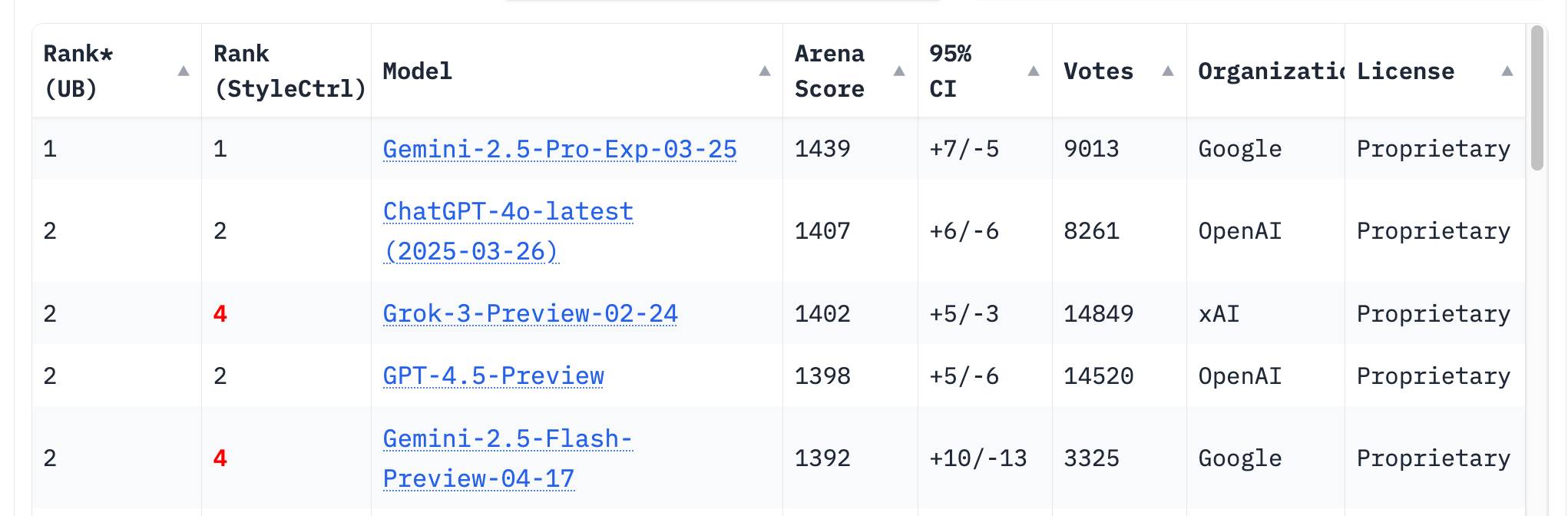
The LM Arena leaderboard now has Gemini 2.5 Flash in joint second place, just behind Gemini 2.5 Pro and tied with ChatGPT-4o-latest, Grok-3 and GPT-4.5 Preview.
Introducing OpenAI o3 and o4-mini. OpenAI are really emphasizing tool use with these:
For the first time, our reasoning models can agentically use and combine every tool within ChatGPT—this includes searching the web, analyzing uploaded files and other data with Python, reasoning deeply about visual inputs, and even generating images. Critically, these models are trained to reason about when and how to use tools to produce detailed and thoughtful answers in the right output formats, typically in under a minute, to solve more complex problems.
I released llm-openai-plugin 0.3 adding support for the two new models:
llm install -U llm-openai-plugin
llm -m openai/o3 "say hi in five languages"
llm -m openai/o4-mini "say hi in five languages"
Here are the pelicans riding bicycles (prompt: Generate an SVG of a pelican riding a bicycle).
o3:

o4-mini:

Here are the full OpenAI model listings: o3 is $10/million input and $40/million for output, with a 75% discount on cached input tokens, 200,000 token context window, 100,000 max output tokens and a May 31st 2024 training cut-off (same as the GPT-4.1 models). It's a bit cheaper than o1 ($15/$60) and a lot cheaper than o1-pro ($150/$600).
o4-mini is priced the same as o3-mini: $1.10/million for input and $4.40/million for output, also with a 75% input caching discount. The size limits and training cut-off are the same as o3.
You can compare these prices with other models using the table on my updated LLM pricing calculator.
A new capability released today is that the OpenAI API can now optionally return reasoning summary text. I've been exploring that in this issue. I believe you have to verify your organization (which may involve a photo ID) in order to use this option - once you have access the easiest way to see the new tokens is using curl like this:
curl https://api.openai.com/v1/responses \
  -H "Content-Type: application/json" \
  -H "Authorization: Bearer $(llm keys get openai)" \
  -d '{
    "model": "o3",
    "input": "why is the sky blue?",
    "reasoning": {"summary": "auto"},
    "stream": true
  }'
This produces a stream of events that includes this new event type:
event: response.reasoning_summary_text.delta
data: {"type": "response.reasoning_summary_text.delta","item_id": "rs_68004320496081918e1e75ddb550d56e0e9a94ce520f0206","output_index": 0,"summary_index": 0,"delta": "**Expl"}
Omit the "stream": true and the response is easier to read and contains this:
{
  "output": [
    {
      "id": "rs_68004edd2150819183789a867a9de671069bc0c439268c95",
      "type": "reasoning",
      "summary": [
        {
          "type": "summary_text",
          "text": "**Explaining the blue sky**\n\nThe user asks a classic question about why the sky is blue. I'll talk about Rayleigh scattering, where shorter wavelengths of light scatter more than longer ones. This explains how we see blue light spread across the sky! I wonder if the user wants a more scientific or simpler everyday explanation. I'll aim for a straightforward response while keeping it engaging and informative. So, let's break it down!"
        }
      ]
    },
    {
      "id": "msg_68004edf9f5c819188a71a2c40fb9265069bc0c439268c95",
      "type": "message",
      "status": "completed",
      "content": [
        {
          "type": "output_text",
          "annotations": [],
          "text": "The short answer ..."
        }
      ]
    }
  ]
}
openai/codex. Just released by OpenAI, a "lightweight coding agent that runs in your terminal". Looks like their version of Claude Code, though unlike Claude Code Codex is released under an open source (Apache 2) license.
Here's the main prompt that runs in a loop, which starts like this:
You are operating as and within the Codex CLI, a terminal-based agentic coding assistant built by OpenAI. It wraps OpenAI models to enable natural language interaction with a local codebase. You are expected to be precise, safe, and helpful.
You can:
- Receive user prompts, project context, and files.
- Stream responses and emit function calls (e.g., shell commands, code edits).
- Apply patches, run commands, and manage user approvals based on policy.
- Work inside a sandboxed, git-backed workspace with rollback support.
- Log telemetry so sessions can be replayed or inspected later.
- More details on your functionality are available at codex --help
The Codex CLI is open-sourced. Don't confuse yourself with the old Codex language model built by OpenAI many moons ago (this is understandably top of mind for you!). Within this context, Codex refers to the open-source agentic coding interface. [...]
I like that the prompt describes OpenAI's previous Codex language model as being from "many moons ago". Prompt engineering is so weird.
Since the prompt says that it works "inside a sandboxed, git-backed workspace" I went looking for the sandbox. On macOS it uses the little-known sandbox-exec process, part of the OS but grossly under-documented. The best information I've found about it is this article from 2020, which notes that man sandbox-exec lists it as deprecated. I didn't spot evidence in the Codex code of sandboxes for other platforms.
SQLite File Format Viewer (via) Neat browser-based visual interface for exploring the structure of a SQLite database file, built by Visal In using React and a custom parser implemented in TypeScript.
Using LLMs as the first line of support in Open Source (via) From reading the title I was nervous that this might involve automating the initial response to a user support query in an issue tracker with an LLM, but Carlton Gibson has better taste than that.
The open contribution model engendered by GitHub — where anonymous (to the project) users can create issues, and comments, which are almost always extractive support requests — results in an effective denial-of-service attack against maintainers. [...]
For anonymous users, who really just want help almost all the time, the pattern I’m settling on is to facilitate them getting their answer from their LLM of choice. [...] we can generate a file that we offer users to download, then we tell the user to pass this to (say) Claude with a simple prompt for their question.
This resonates with the concept proposed by llms.txt - making LLM-friendly context files available for different projects.
My simonw/docs-for-llms contains my own early experiment with this: I'm running a build script to create LLM-friendly concatenated documentation for several of my projects, and my llm-docs plugin (described here) can then be used to ask questions of that documentation.
It's possible to pre-populate the Claude UI with a prompt by linking to https://claude.ai/new?q={PLACE_HOLDER}, but it looks like there's quite a short length limit on how much text can be passed that way. It would be neat if you could pass a URL to a larger document instead.
ChatGPT also supports https://chatgpt.com/?q=your-prompt-here (again with a short length limit) and directly executes the prompt rather than waiting for you to edit it first(!)
Stevens: a hackable AI assistant using a single SQLite table and a handful of cron jobs. Geoffrey Litt reports on Stevens, a shared digital assistant he put together for his family using SQLite and scheduled tasks running on Val Town.
The design is refreshingly simple considering how much it can do. Everything works around a single memories table. A memory has text, tags, creation metadata and an optional date for things like calendar entries and weather reports.
Everything else is handled by scheduled jobs to popular weather information and events from Google Calendar, a Telegram integration offering a chat UI and a neat system where USPS postal email delivery notifications are run through Val's own email handling mechanism to trigger a Claude prompt to add those as memories too.
Here's the full code on Val Town, including the daily briefing prompt that incorporates most of the personality of the bot.
llm-fragments-rust
(via)
Inspired by Filippo Valsorda's llm-fragments-go, Francois Garillot created llm-fragments-rust, an LLM fragments plugin that lets you pull documentation for any Rust crate directly into a prompt to LLM.
I really like this example, which uses two fragments to load documentation for two crates at once:
llm -f rust:rand@0.8.5 -f rust:tokio "How do I generate random numbers asynchronously?"
The code uses some neat tricks: it creates a new Rust project in a temporary directory (similar to how llm-fragments-go works), adds the crates and uses cargo doc --no-deps --document-private-items to generate documentation. Then it runs cargo tree --edges features to add dependency information, and cargo metadata --format-version=1 to include additional metadata about the crate.
Default styles for h1 elements are changing
(via)
Wow, this is a rare occurrence! Firefox are rolling out a change to the default user-agent stylesheet for nested <h1> elements, currently ramping from 5% to 50% of users and with full roll-out planned for Firefox 140 in June 2025. Chrome is showing deprecation warnings and Safari are expected to follow suit in the future.
What's changing? The default sizes of <h1> elements that are nested inside <article>, <aside>, <nav> and <section>.
These are the default styles being removed:
/* where x is :is(article, aside, nav, section) */
x h1 { margin-block: 0.83em; font-size: 1.50em; }
x x h1 { margin-block: 1.00em; font-size: 1.17em; }
x x x h1 { margin-block: 1.33em; font-size: 1.00em; }
x x x x h1 { margin-block: 1.67em; font-size: 0.83em; }
x x x x x h1 { margin-block: 2.33em; font-size: 0.67em; }
The short version is that, many years ago, the HTML spec introduced the idea that an <h1> within a nested section should have the same meaning (and hence visual styling) as an <h2>. This never really took off and wasn't reflected by the accessibility tree, and was removed from the HTML spec in 2022. The browsers are now trying to cleanup the legacy default styles.
This advice from that post sounds sensible to me:
- Do not rely on default browser styles for conveying a heading hierarchy. Explicitly define your document hierarchy using
<h2>for second-level headings,<h3>for third-level, etc.- Always define your own
font-sizeandmarginfor<h1>elements.
LLM pricing calculator (updated). I updated my LLM pricing calculator this morning (Claude transcript) to show the prices of various hosted models in a sorted table, defaulting to lowest price first.
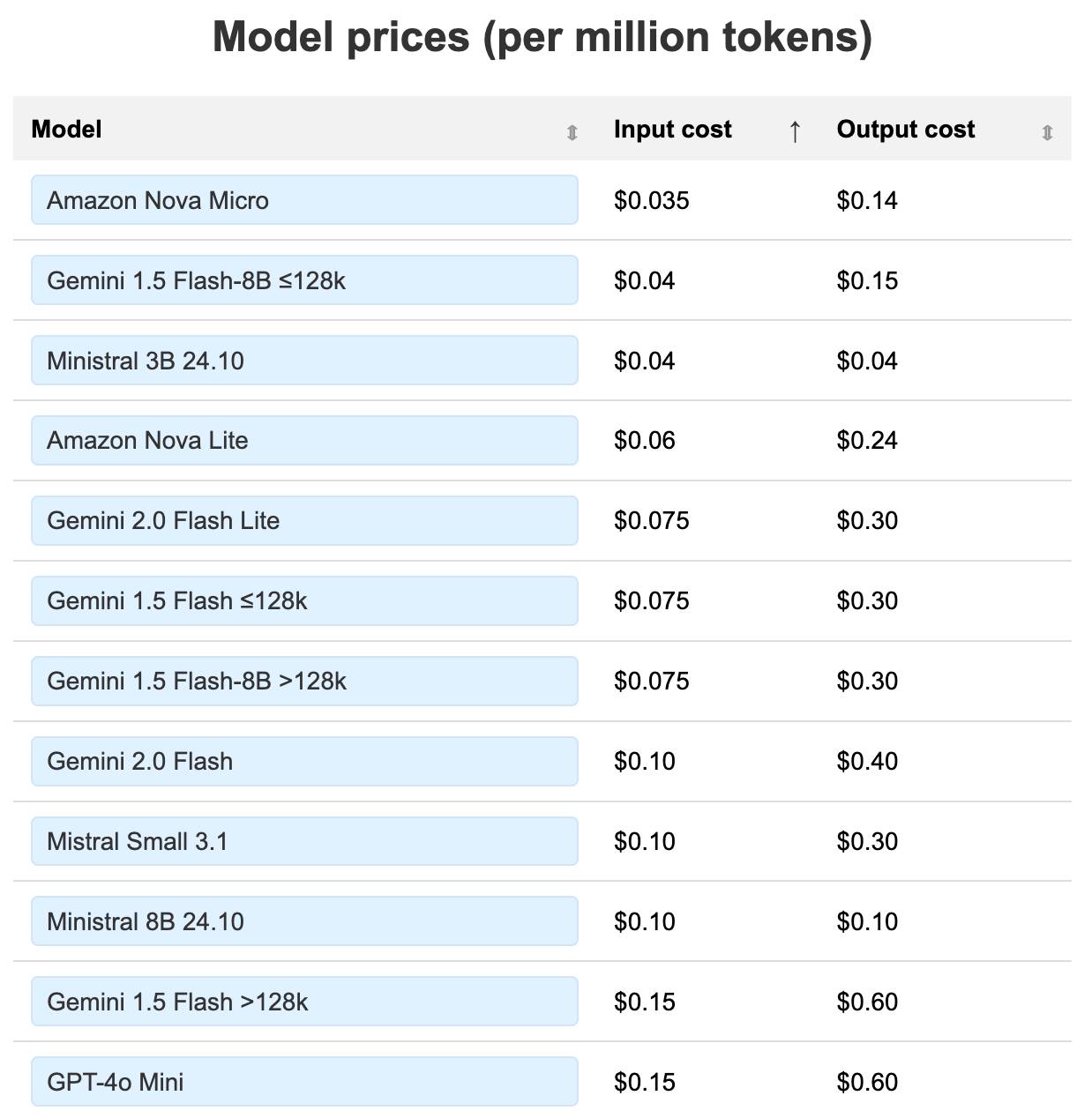
Amazon Nova and Google Gemini continue to dominate the lower end of the table. The most expensive models currently are still OpenAI's o1-Pro ($150/$600 and GPT-4.5 ($75/$150).
llm-docsmith (via) Matheus Pedroni released this neat plugin for LLM for adding docstrings to existing Python code. You can run it like this:
llm install llm-docsmith
llm docsmith ./scripts/main.py -o
The -o option previews the changes that will be made - without -o it edits the files directly.
It also accepts a -m claude-3.7-sonnet parameter for using an alternative model from the default (GPT-4o mini).
The implementation uses the Python libcst "Concrete Syntax Tree" package to manipulate the code, which means there's no chance of it making edits to anything other than the docstrings.
Here's the full system prompt it uses.
One neat trick is at the end of the system prompt it says:
You will receive a JSON template. Fill the slots marked with <SLOT> with the appropriate description. Return as JSON.
That template is actually provided JSON generated using these Pydantic classes:
class Argument(BaseModel):
    name: str
    description: str
    annotation: str | None = None
    default: str | None = None

class Return(BaseModel):
    description: str
    annotation: str | None

class Docstring(BaseModel):
    node_type: Literal["class", "function"]
    name: str
    docstring: str
    args: list[Argument] | None = None
    ret: Return | None = None

class Documentation(BaseModel):
    entries: list[Docstring]
The code adds <SLOT> notes to that in various places, so the template included in the prompt ends up looking like this:
{
  "entries": [
    {
      "node_type": "function",
      "name": "create_docstring_node",
      "docstring": "<SLOT>",
      "args": [
        {
          "name": "docstring_text",
          "description": "<SLOT>",
          "annotation": "str",
          "default": null
        },
        {
          "name": "indent",
          "description": "<SLOT>",
          "annotation": "str",
          "default": null
        }
      ],
      "ret": {
        "description": "<SLOT>",
        "annotation": "cst.BaseStatement"
      }
    }
  ]
}
Django: what’s new in 5.2. Adam Johnson provides extremely detailed unofficial annotated release notes for the latest Django.
I found his explanation and example of Form BoundField customization particularly useful - here's the new pattern for customizing the class= attribute on the label associated with a CharField:
from django import forms

class WideLabelBoundField(forms.BoundField):
    def label_tag(self, contents=None, attrs=None, label_suffix=None):
        if attrs is None:
            attrs = {}
        attrs["class"] = "wide"
        return super().label_tag(contents, attrs, label_suffix)

class NebulaForm(forms.Form):
    name = forms.CharField(
        max_length=100,
        label="Nebula Name",
        bound_field_class=WideLabelBoundField,
    )
I'd also missed the new HttpResponse.get_preferred_type() method for implementing HTTP content negotiation:
content_type = request.get_preferred_type(
    ["text/html", "application/json"]
)
llm-fragments-go (via) Filippo Valsorda released the first plugin by someone other than me that uses LLM's new register_fragment_loaders() plugin hook I announced the other day.
Install with llm install llm-fragments-go and then:
You can feed the docs of a Go package into LLM using the
go:fragment with the package name, optionally followed by a version suffix.
llm -f go:golang.org/x/mod/sumdb/note@v0.23.0 "Write a single file command that generates a key, prints the verifier key, signs an example message, and prints the signed note."
The implementation is just 33 lines of Python and works by running these commands in a temporary directory:
go mod init llm_fragments_go
go get golang.org/x/mod/sumdb/note@v0.23.0
go doc -all golang.org/x/mod/sumdb/note
An LLM Query Understanding Service (via) Doug Turnbull recently wrote about how all search is structured now:
Many times, even a small open source LLM will be able to turn a search query into reasonable structure at relatively low cost.
In this follow-up tutorial he demonstrates Qwen 2-7B running in a GPU-enabled Google Kubernetes Engine container to turn user search queries like "red loveseat" into structured filters like {"item_type": "loveseat", "color": "red"}.
Here's the prompt he uses.
Respond with a single line of JSON:

  {"item_type": "sofa", "material": "wood", "color": "red"}

Omit any other information. Do not include any
other text in your response. Omit a value if the
user did not specify it. For example, if the user
said "red sofa", you would respond with:

  {"item_type": "sofa", "color": "red"}

Here is the search query: blue armchair
Out of curiosity, I tried running his prompt against some other models using LLM:
gemini-1.5-flash-8b, the cheapest of the Gemini models, handled it well and cost $0.000011 - or 0.0011 cents.llama3.2:3bworked too - that's a very small 2GB model which I ran using Ollama.deepseek-r1:1.5b- a tiny 1.1GB model, again via Ollama, amusingly failed by interpreting "red loveseat" as{"item_type": "sofa", "material": null, "color": "red"}after thinking very hard about the problem!
[NAME AVAILABLE ON REQUEST FROM COMPANIES HOUSE].
I just noticed that the legendary company name ; DROP TABLE "COMPANIES";-- LTD is now listed as [NAME AVAILABLE ON REQUEST FROM COMPANIES HOUSE] on the UK government Companies House website.
For background, see No, I didn't try to break Companies House by culprit Sam Pizzey.
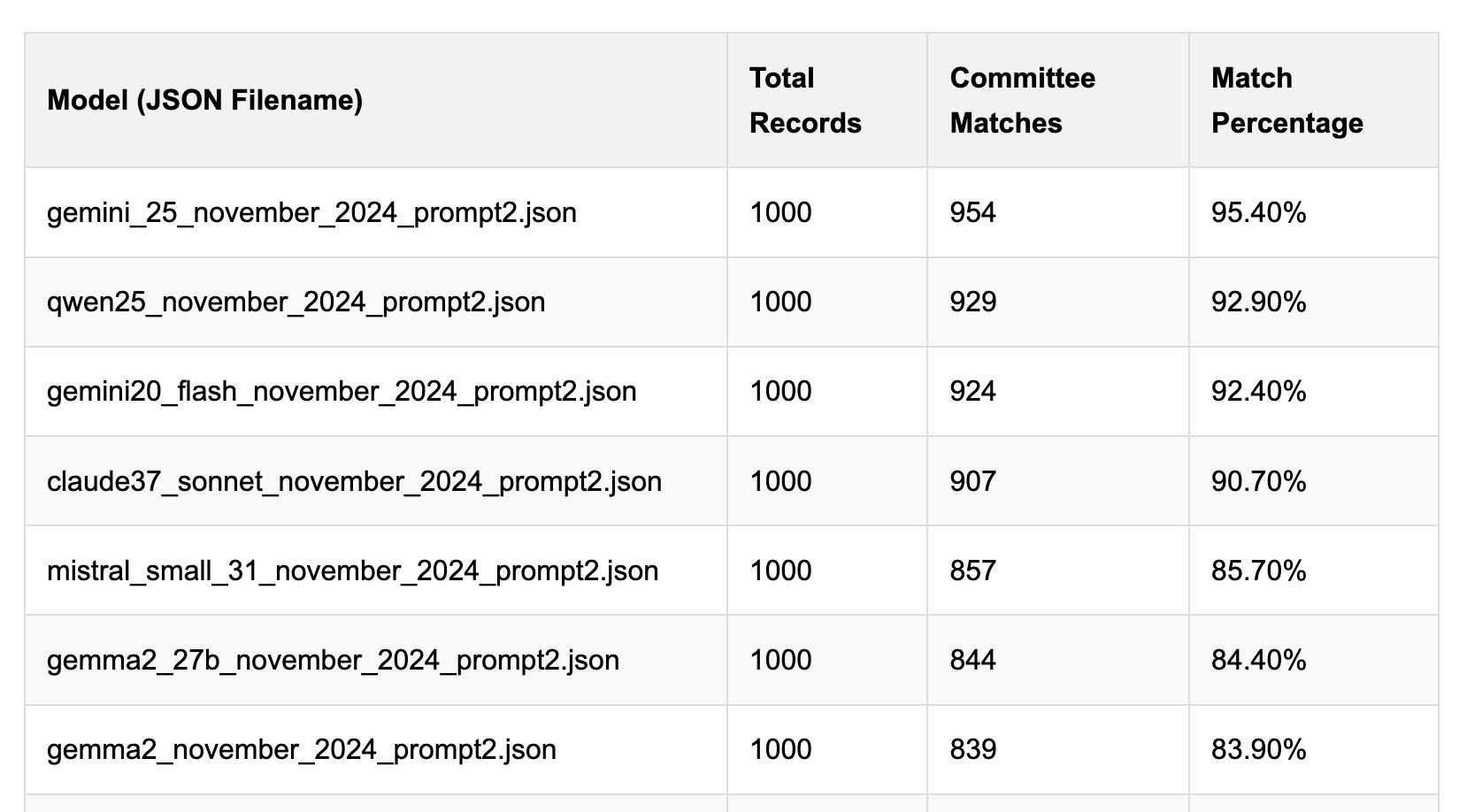
Political Email Extraction Leaderboard (via) Derek Willis collects "political fundraising emails from just about every committee" - 3,000-12,000 a month - and has created an LLM benchmark from 1,000 of them that he collected last November.
He explains the leaderboard in this blog post. The goal is to have an LLM correctly identify the the committee name from the disclaimer text included in the email.
Here's the code he uses to run prompts using Ollama. It uses this system prompt:
Produce a JSON object with the following keys: 'committee', which is the name of the committee in the disclaimer that begins with Paid for by but does not include 'Paid for by', the committee address or the treasurer name. If no committee is present, the value of 'committee' should be None. Also add a key called 'sender', which is the name of the person, if any, mentioned as the author of the email. If there is no person named, the value is None. Do not include any other text, no yapping.
Gemini 2.5 Pro tops the leaderboard at the moment with 95.40%, but the new Mistral Small 3.1 manages 5th place with 85.70%, pretty good for a local model!
I said we need our own evals in my talk at the NICAR Data Journalism conference last month, without realizing Derek has been running one since January.

Mistral Small 3.1 on Ollama. Mistral Small 3.1 (previously) is now available through Ollama, providing an easy way to run this multi-modal (vision) model on a Mac (and other platforms, though I haven't tried those myself).
I had to upgrade Ollama to the most recent version to get it to work - prior to that I got a Error: unable to load model message. Upgrades can be accessed through the Ollama macOS system tray icon.
I fetched the 15GB model by running:
ollama pull mistral-small3.1
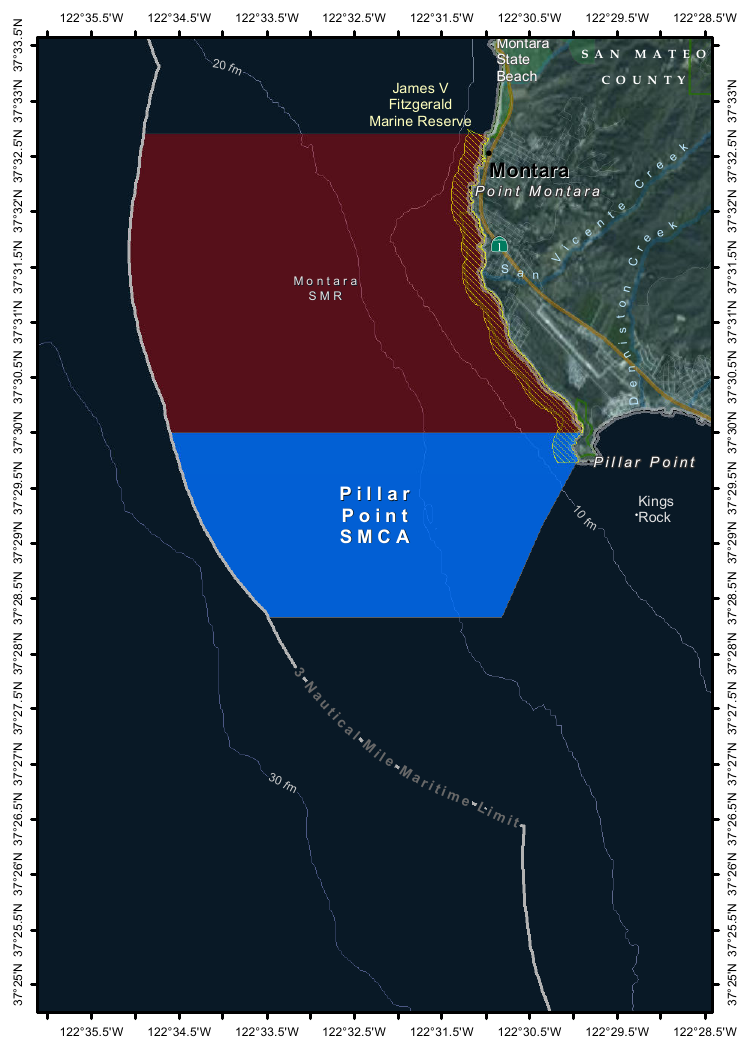
Then used llm-ollama to run prompts through it, including one to describe this image:
llm install llm-ollama
llm -m mistral-small3.1 'describe this image' -a https://static.simonwillison.net/static/2025/Mpaboundrycdfw-1.png
Here's the output. It's good, though not quite as impressive as the description I got from the slightly larger Qwen2.5-VL-32B.
I also tried it on a scanned (private) PDF of hand-written text with very good results, though it did misread one of the hand-written numbers.