237 posts tagged “sqlite-utils”
sqlite-utils is a Python library and command-line utility for creating and manipulating SQLite databases.
2026
Fixes a crashing bug in sqlite-utils 4.2. I'd introduced code that looks like this:
from typing_extensions import Self
It turned out the typing-extensions package was not listed as a dependency for sqlite-utils - it was installed by one of the other dependencies in the dev dependency group, but when you uvx sqlite-utils directly you don't get those dependencies.
As part of fixing this I figured out how to run a smoke test to ensure the CLI tool still works even without those dev dependencies, which can be run from the project checkout:
uv run --isolated --no-default-groups sqlite-utils --help
The --no-default-groups argument prevents it from installing that default dev group, and --isolated means that even if there is a .venv/ folder containing extra dependencies they will be ignored for the duration of that uv run command.
Lots of improvements in this one relating to the table.transform() feature, which adds support for complex alter table operations by creating a fresh table, copying across the data and then dropping and replacing the old one.
transform() now preserves a much larger array of edge-case schema definitions, including check constraints, unique constraints and even comments describing the columns.
There are also new introspection properties for check constraints, and a whole lot of other smaller changes.
Includes contributions from Bunlong Heng, ethanhawkes-gif, Rami Abdelrazzaq, nyxst4ck, and ikatyal2110.
(It later turned out 4.2 had a crashing bug, fixed in 4.2.1.)
I've long pondered what a database agnostic version of my sqlite-utils Python library and CLI utility might look like. This morning (literally a shower project) I tasked Codex and GPT-5.6 Sol Ultra with building a prototype:
Do a research spike to see what it would take to build a library with the same core API as SQLite-utils - in particular the insert and upsert and insert_all and upsert_all and create and update methods, and the table introspection stuff - but backed by SQLalchemy so it works for multiple database engines
Test against PostgreSQL and SQLite and duckdb
Use ~/dev/sqlite-utils for reference
Create a git repo for this and commit and early and often - use uv init to start the project - use red/green TDD and pytest, see ~/dev/django-sql-dashboard for one idea as to how the PostgreSQL tests could work
It took very few follow-up prompts to produce this project in a state good enough to release as an alpha.
Here's a one-liner I can use to list the rows in a table in my local PostgreSQL copy of my blog's database:
uvx --with 'alchemy-utils[postgresql]' alchemy-utils rows 'postgresql+psycopg://simon@localhost:5432/simonwillisonblog' redirects_redirect
The output from that starts like this:
[
  {
    "id": 2328,
    "domain": "simonwillison.net",
    "path": "2020/May/21/apple-photos-sqlite/",
    "target": "/2020/May/21/dogsheep-photos/",
    "created": "2020-05-21T13:03:46.591692-07:00"
  },
  {
    "id": 3,
    "domain": "feeds.simonwillison.net",
    "path": "swn-links",
    "target": "https://simonwillison.net/atom/links/",
    "created": "2017-10-01T14:12:54.820729-07:00"
  }
Or if you'd like a DuckDB database with every tree in San Francisco, schema created automatically to match the file:
curl 'https://raw.githubusercontent.com/simonw/sf-tree-history/refs/heads/main/Street_Tree_List.csv' | uvx --with 'alchemy-utils[duckdb]' alchemy-utils insert 'duckdb:////tmp/trees.db' trees - --csv
(That one took nearly an hour the first time I ran it, so I had Codex optimize it and got it down to around 35 seconds.)
I back-ported a fix for table.delete_where() that shipped in version 4.
Mainly a fix for an edge case that regular Claude chat spotted while experimenting with the 4.1 release to answer a question about ON DELETE.
table.transform()now raises aTransactionErrorif called while a transaction is open withPRAGMA foreign_keysenabled and the table is referenced by foreign keys with destructiveON DELETEactions -CASCADE,SET NULLorSET DEFAULT. The pragma cannot be changed inside a transaction, so previously dropping the old table as part of the transform could fire those actions and silently delete or modify referencing rows. See Foreign keys and transactions for details and workarounds. (#794)- The CLI and Python API documentation now cross-reference each other: CLI sections link to the equivalent Python API functionality and Python API sections link back to the corresponding CLI command. (#791)
The first dot-release since 4.0 a few days ago, introducing a number of minor new features.
sqlite-utils insertandsqlite-utils upsertnow accept a--codeoption for providing a block of Python code (or a path to a.pyfile) that defines arows()function orrowsiterable of rows to insert, as an alternative to importing from a file. (#684)
sqlite-utils already had features that allow you to pass blocks of Python code as CLI arguments, for example this one for the sqlite-utils convert command:
sqlite-utils convert content.db articles headline '
def convert(value):
    return value.upper()'
Allowing blocks of code to generate new rows directly was on obvious extension of that pattern:
sqlite-utils insert data.db creatures --code '
def rows():
    yield {"id": 1, "name": "Cleo"}
    yield {"id": 2, "name": "Suna"}
' --pk id
sqlite-utils insertandsqlite-utils upsertnow accept--type column-name typeto override the type automatically chosen when the table is created. This is useful for CSV or TSV columns such as ZIP codes that look like integers but should be stored asTEXTto preserve leading zeros. (#131)
A long-standing feature request which turned out to be a simple implementation.
- New
table.drop_index(name)method andsqlite-utils drop-indexcommand for dropping an index by name. Both acceptignore=True/--ignoreto ignore a missing index. (#626)sqlite-utils querycan now read the SQL query from standard input by passing-in place of the query, for exampleecho "select * from dogs" | sqlite-utils query dogs.db -. (#765)
Two more small features. I had Codex review all open issues and highlight the easiest ones!
sqlite-utils upsertcan now infer the primary key of an existing table, so--pkcan be omitted when upserting into a table that already has a primary key.
Another Codex suggestion, an obvious missing CLI feature from a Python library improvement that shipped in the 4.0 release.
table.transform()andtable.transform_sql()now acceptstrict=Trueorstrict=Falseto change a table’s SQLite strict mode. Omitting the option preserves the existing mode. (#787)- The
sqlite-utils transformcommand now accepts--strictand--no-strictto change a table’s strict mode. (#787)
These two were inspired by Prefer STRICT tables in SQLite by Evan Hahn, which did the rounds on Hacker News today. Evan pointed out that:
Unfortunately, I don’t think there’s a way to ALTER a table to make it strict. I think you have to copy the data out of the non-strict table into the strict one.
That's exactly what the sqlite-utils transform mechanism does, so I extended it to add the ability to switch tables from strict to non-strict and vice-versa.
Here's the GPT-5.6 Sol xhigh Codex transcript I used to implement those new strict table features. One of the most useful prompts I ran was this one:
use uv run python -c and manually exercise the new .transform(strict=) option, see if you can find any edge-cases or bugs
Effectively telling the model to manually test its work, outside of the automated tests it had already written. This turned up two minor issues that we then fixed.
sqlite-utils 4.0, now with database schema migrations
This morning I released sqlite-utils 4.0, the 124th release of that project and the first major version bump since 3.0 in November 2020. In addition to some small but significant breaking changes (described in this upgrade guide), this version introduces three major features: database migrations, nested transactions (via a new db.atomic() method), and support for compound foreign keys.
The version that retires the library, instead implementing a compatibility shim against the new sqlite-utils 4.0 dependency.
See sqlite-utils 4.0, now with database schema migrations for details.
The last RC before the 4.0 stable release. Mainly implements feedback from a detailed review by Claude Fable 5.
I hoped to release sqlite-utils 4.0 stable this weekend, but as I worked through the backlog of issues and PRs with a combination of Claude Fable 5 and GPT-5.5 the changelog since rc2 kept getting bigger.
The biggest new feature is support for introspecting and creating compound foreign keys - a feature that involves a subtle breaking change to table.foreign_keys and hence needed to land for the 4.0 stable release.
sqlite-utils also now follows SQLite's convention for case insensitive column names, which turned out to touch a bunch of different places at once.
sqlite-utils 4.0rc2, mostly written by Claude Fable (for about $149.25)
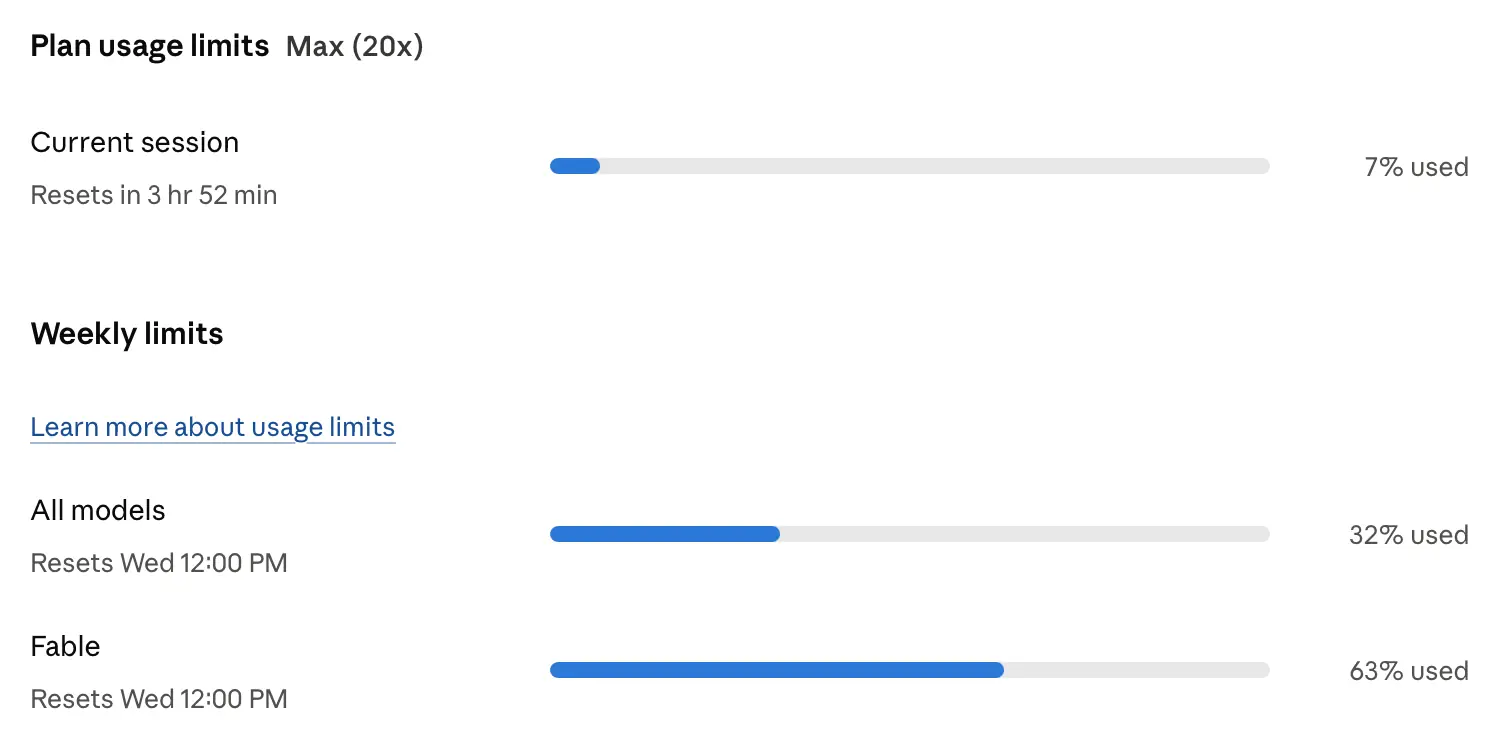
I wrote about the sqlite-utils 4.0rc1 release a couple of weeks ago. Since we only have Claude Fable on our Max subscriptions for a few more days, I decided to see if it could help me get to a 4.0 stable release that I felt truly comfortable about, since I try to keep to SemVer and like my incompatible major versions to be as rare as possible.
[... 2,427 words]sqlite-utils 4.0rc1 adds migrations and nested transactions
sqlite-utils is my combined Python library and CLI tool for working with SQLite databases. It provides an extensive set of higher-level operations on top of Python’s default sqlite3 package, including support for complex table transformations, automatic table creation from JSON data and a whole lot more.
[... 975 words]2025
Under the hood of Canada Spends with Brendan Samek

I talked to Brendan Samek about Canada Spends, a project from Build Canada that makes Canadian government financial data accessible and explorable using a combination of Datasette, a neat custom frontend, Ruby ingestion scripts, sqlite-utils and pieces of LLM-powered PDF extraction.
[... 561 words]sqlite-utils 3.39.
I got a report of a bug in sqlite-utils concerning plugin installation - if you installed the package using uv tool install further attempts to install plugins with sqlite-utils install X would fail, because uv doesn't bundle pip by default. I had the same bug with Datasette a while ago, turns out I forgot to apply the fix to sqlite-utils.
Since I was pushing a new dot-release I decided to integrate some of the non-breaking changes from the 4.0 alpha I released last night.
I tried to have Claude Code do the backporting for me:
create a new branch called 3.x starting with the 3.38 tag, then consult https://github.com/simonw/sqlite-utils/issues/688 and cherry-pick the commits it lists in the second comment, then review each of the links in the first comment and cherry-pick those as well. After each cherry-pick run the command "just test" to confirm the tests pass and fix them if they don't. Look through the commit history on main since the 3.38 tag to help you with this task.
This worked reasonably well - here's the terminal transcript. It successfully argued me out of two of the larger changes which would have added more complexity than I want in a small dot-release like this.
I still had to do a bunch of manual work to get everything up to scratch, which I carried out in this PR - including adding comments there and then telling Claude Code:
Apply changes from the review on this PR https://github.com/simonw/sqlite-utils/pull/689
Here's the transcript from that.
The release is now out with the following release notes:
- Fixed a bug with
sqlite-utils installwhen the tool had been installed usinguv. (#687)- The
--functionsargument now optionally accepts a path to a Python file as an alternative to a string full of code, and can be specified multiple times - see Defining custom SQL functions. (#659)sqlite-utilsnow requires on Python 3.10 or higher.
sqlite-utils 4.0a1 has several (minor) backwards incompatible changes
I released a new alpha version of sqlite-utils last night—the 128th release of that package since I started building it back in 2018.
[... 1,049 words]In addition to my workshop the other day I'm also participating in the poster session at PyCon US this year.
This means that tomorrow (Sunday 18th May) I'll be hanging out next to my poster from 10am to 1pm in Hall A talking to people about my various projects.
I'll confess: I didn't pay close enough attention to the poster information, so when I first put my poster up it looked a little small:
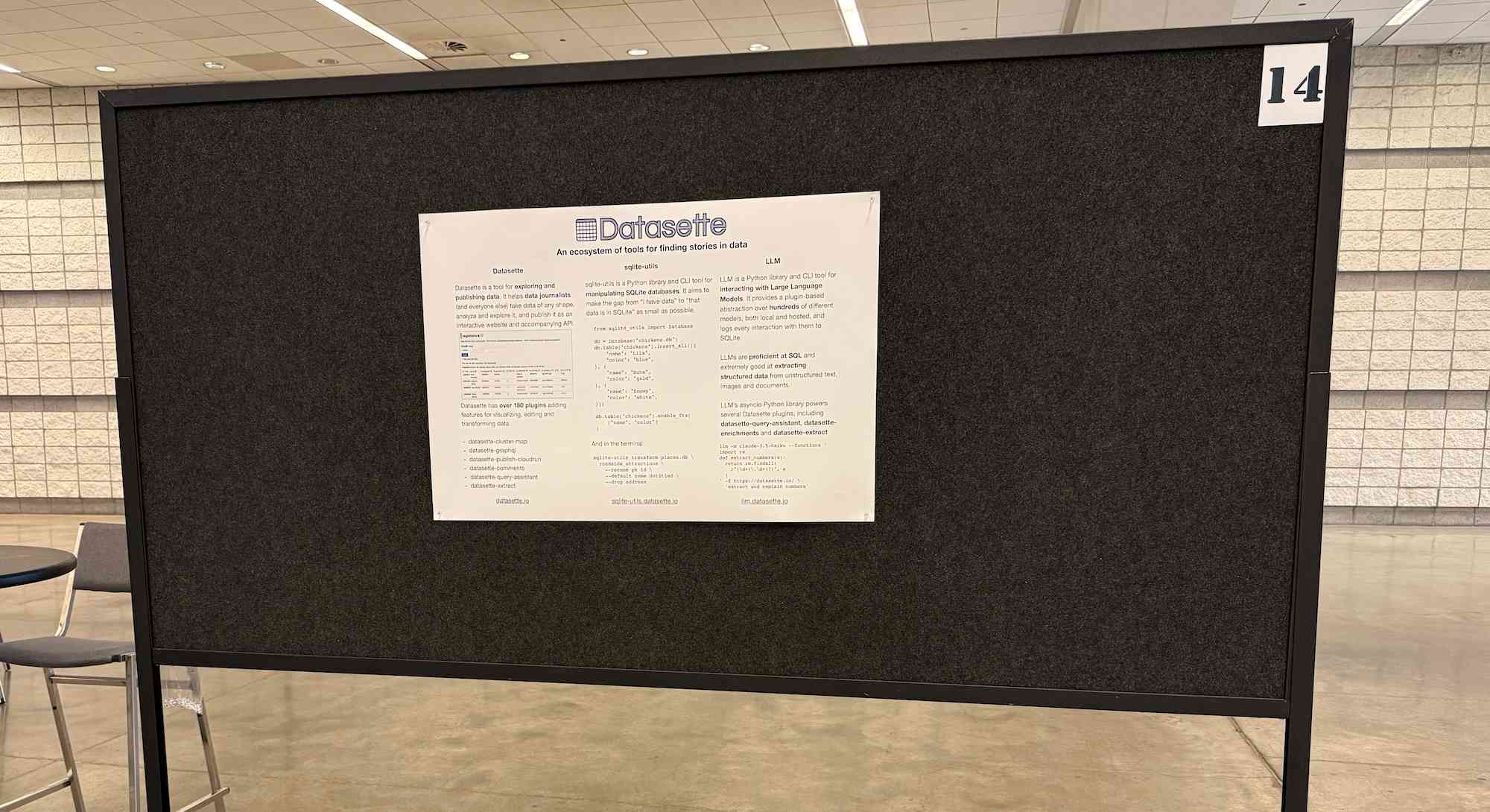
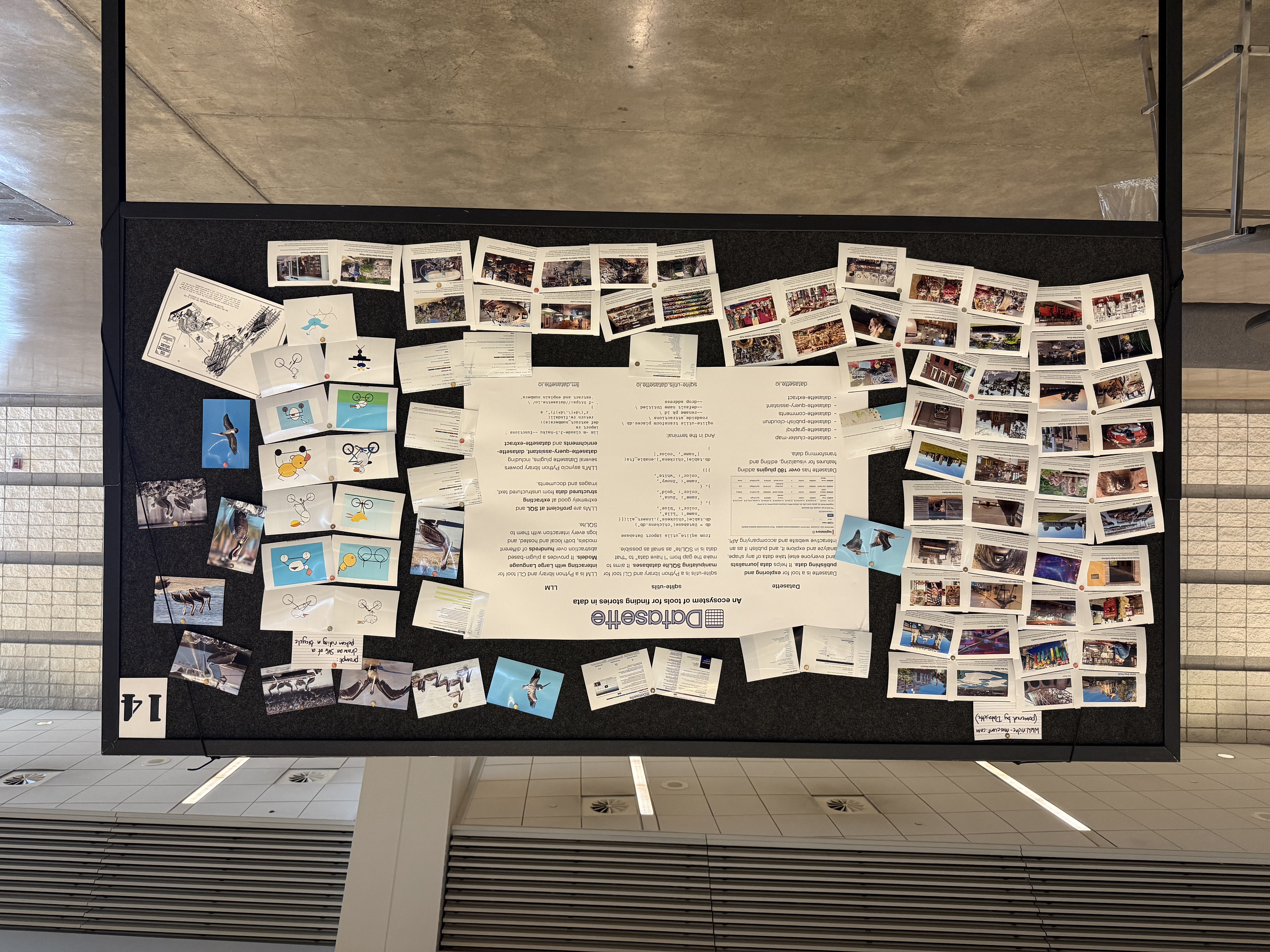
... so I headed to the nearest CVS and printed out some photos to better represent my interests and personality. I'm going for a "teenage bedroom" aesthetic here, I'm very happy with the result:

Here's the poster in the middle (also available as a PDF). It has columns for Datasette, sqlite-utils and LLM.
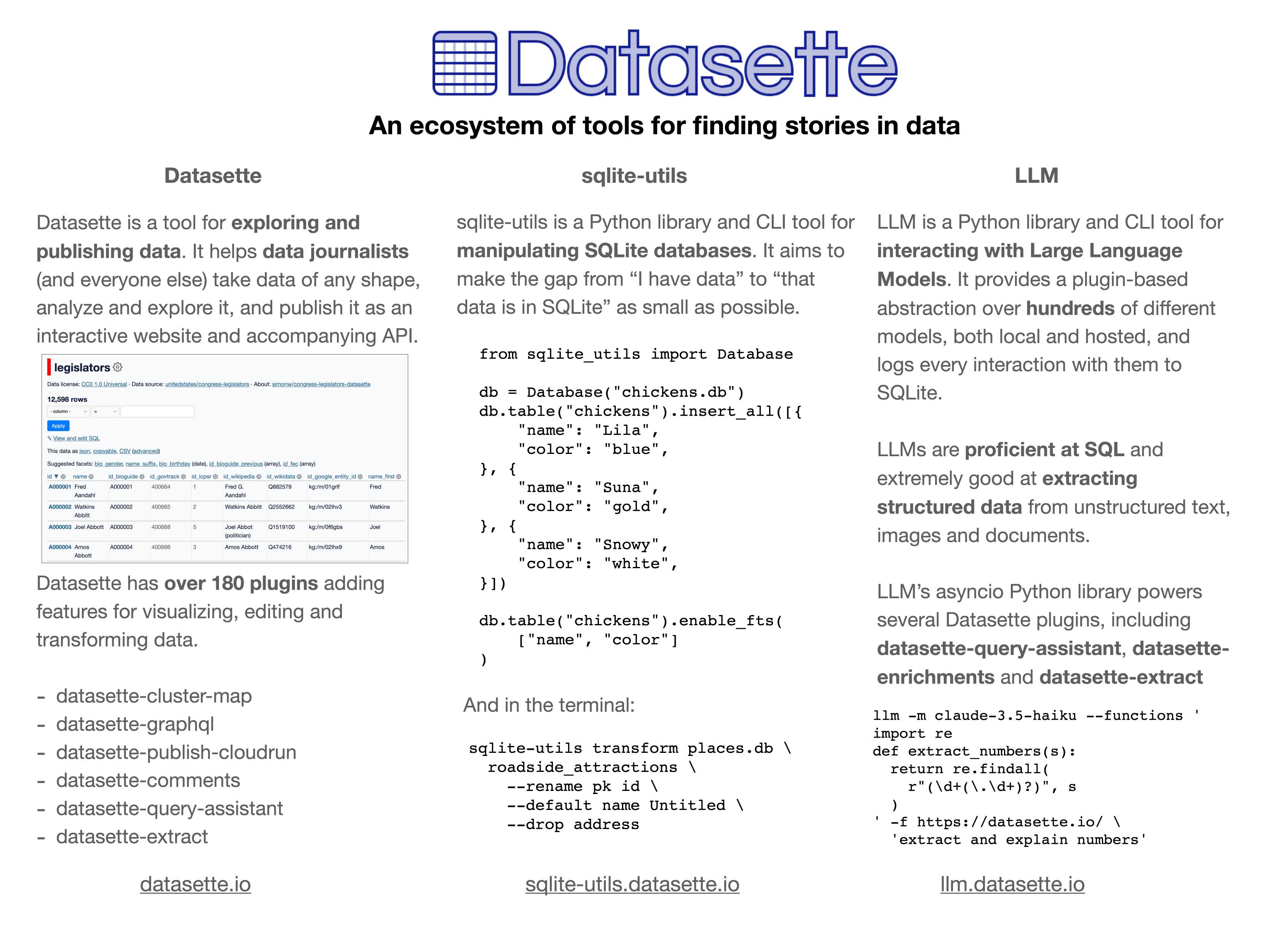
If you're at PyCon I'd love to talk to you about things I'm working on!
Update: Thanks to everyone who came along. Here's a 6MB photo of the poster setup. The museums were all from my www.niche-museums.com site and the pelicans riding a bicycle SVGs came from my pelican-riding-a-bicycle tag.
sqlite-utils 4.0a0. New alpha release of sqlite-utils, my Python library and CLI tool for manipulating SQLite databases.
It's the first 4.0 alpha because there's a (minor) backwards-incompatible change: I've upgraded the .upsert() and .upsert_all() methods to use SQLIte's UPSERT mechanism, INSERT INTO ... ON CONFLICT DO UPDATE. Details in this issue.
That feature was added to SQLite in version 3.24.0, released 2018-06-04. I'm pretty cautious about my SQLite version support since the underlying library can be difficult to upgrade, depending on your platform and operating system.
I'm going to leave the new alpha to bake for a little while before pushing a stable release. Since this is a major version bump I'm going to take the opportunity to see if there are any other minor API warts that I can clean up at the same time.
2024
Ask questions of SQLite databases and CSV/JSON files in your terminal
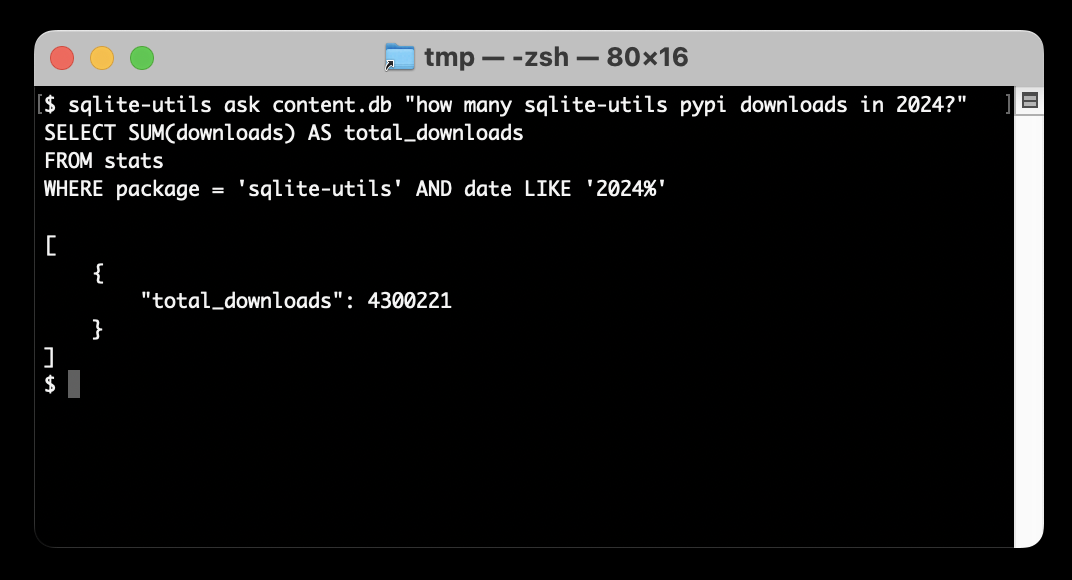
I built a new plugin for my sqlite-utils CLI tool that lets you ask human-language questions directly of SQLite databases and CSV/JSON files on your computer.
[... 723 words]
- Plugins can now reuse the implementation of the
sqlite-utils memoryCLI command with the newreturn_db=Trueparameter. (#643)table.transform()now recreates indexes after transforming a table. A newsqlite_utils.db.TransformErrorexception is raised if these indexes cannot be recreated due to conflicting changes to the table such as a column rename. Thanks, Mat Miller. (#633)table.search()now accepts ainclude_rank=Trueparameter, causing the resulting rows to have arankcolumn showing the calculated relevance score. Thanks, liunux4odoo. (#628)- Fixed an error that occurred when creating a strict table with at least one floating point column. These
FLOATcolumns are now correctly created asREALas well, but only for strict tables. (#644)
Using sqlite-vec with embeddings in sqlite-utils and Datasette. My notes on trying out Alex Garcia's newly released sqlite-vec SQLite extension, including how to use it with OpenAI embeddings in both Datasette and sqlite-utils.
Weeknotes: GPT-4o mini, LLM 0.15, sqlite-utils 3.37 and building a staging environment
Upgrades to LLM to support the latest models, and a whole bunch of invisible work building out a staging environment for Datasette Cloud.
[... 730 words]Announcing our DjangoCon US 2024 Talks! I'm speaking at DjangoCon in Durham, NC in September.
My accepted talk title was How to design and implement extensible software with plugins. Here's my abstract:
Plugins offer a powerful way to extend software packages. Tools that support a plugin architecture include WordPress, Jupyter, VS Code and pytest - each of which benefits from an enormous array of plugins adding all kinds of new features and expanded capabilities.
Adding plugin support to an open source project can greatly reduce the friction involved in attracting new contributors. Users can work independently and even package and publish their work without needing to directly coordinate with the project's core maintainers. As a maintainer this means you can wake up one morning and your software grew new features without you even having to review a pull request!
There's one catch: information on how to design and implement plugin support for a project is scarce.
I now have three major open source projects that support plugins, with over 200 plugins published across those projects. I'll talk about everything I've learned along the way: when and how to use plugins, how to design plugin hooks and how to ensure your plugin authors have as good an experience as possible.
I'm going to be talking about what I've learned integrating Pluggy with Datasette, LLM and sqlite-utils. I've been looking for an excuse to turn this knowledge into a talk for ages, very excited to get to do it at DjangoCon!