July 2026
36 posts: 3 entries, 7 links, 4 quotes, 3 notes, 19 beats
July 9, 2026
The new GPT-5.6 family: Luna, Terra, Sol
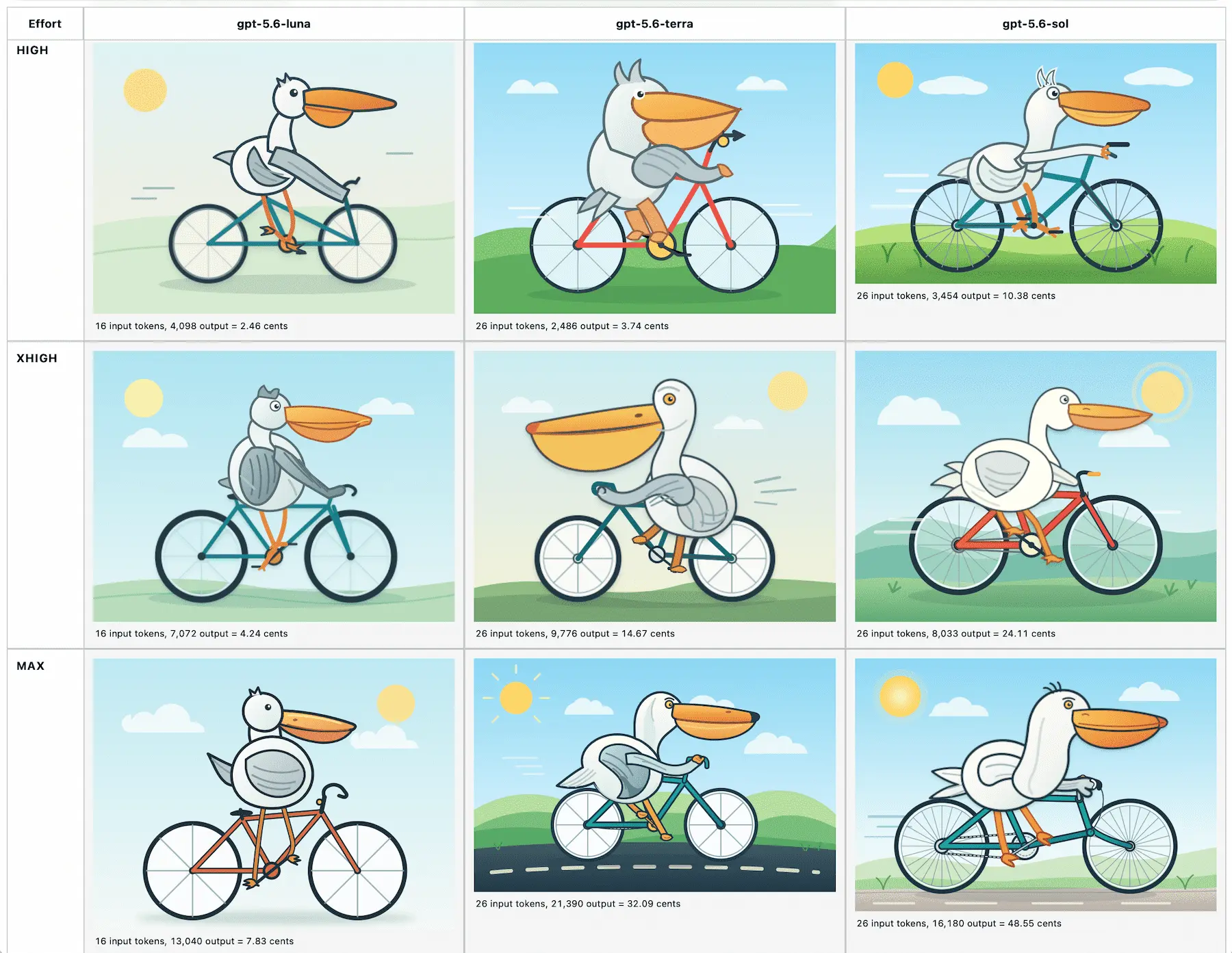
OpenAI’s latest flagship model hit general availability this morning, and comes in three sizes: Luna, Terra, and Sol (from smallest to largest).
[... 661 words]

July 10, 2026
[...] Work on web and mobile runs in the cloud. Work in the desktop app can also use local files and desktop apps with your permission. At launch, cloud Work conversations do not appear in desktop Work; desktop Work threads and local files remain on that computer.
— OpenAI, trying (unsuccessfully) to clarify ChatGPT Work
The reality is to make augmented reality glasses, you need to put a camera next to your eyes that is continuously recording everything you see and processing that to put information over it.
There is not another way around it. And there's certainly not a chip that can fit in the stem of a glasses that is both powerful enough and power miserly enough to do that in real time.
You have to send that data to a cloud. You gotta do it. [...] Or you can build something the size of a Vision Pro with a battery pack that lives somewhere else. Those are the current choices in this world.
And it means if you want to build the product that everyone thinks is the next thing, you are going to have to invade people's privacy.
And maybe you shouldn't. Like, there's an incredible argument for, nope, you shouldn't do that. Nope, the trade-offs required to make this product are so high at a societal level that we should stop it.
— Nilay Patel, The Vergecast
July 11, 2026




The first dot-release since 4.0 a few days ago, introducing a number of minor new features.
sqlite-utils insertandsqlite-utils upsertnow accept a--codeoption for providing a block of Python code (or a path to a.pyfile) that defines arows()function orrowsiterable of rows to insert, as an alternative to importing from a file. (#684)
sqlite-utils already had features that allow you to pass blocks of Python code as CLI arguments, for example this one for the sqlite-utils convert command:
sqlite-utils convert content.db articles headline '
def convert(value):
    return value.upper()'
Allowing blocks of code to generate new rows directly was on obvious extension of that pattern:
sqlite-utils insert data.db creatures --code '
def rows():
    yield {"id": 1, "name": "Cleo"}
    yield {"id": 2, "name": "Suna"}
' --pk id
sqlite-utils insertandsqlite-utils upsertnow accept--type column-name typeto override the type automatically chosen when the table is created. This is useful for CSV or TSV columns such as ZIP codes that look like integers but should be stored asTEXTto preserve leading zeros. (#131)
A long-standing feature request which turned out to be a simple implementation.
- New
table.drop_index(name)method andsqlite-utils drop-indexcommand for dropping an index by name. Both acceptignore=True/--ignoreto ignore a missing index. (#626)sqlite-utils querycan now read the SQL query from standard input by passing-in place of the query, for exampleecho "select * from dogs" | sqlite-utils query dogs.db -. (#765)
Two more small features. I had Codex review all open issues and highlight the easiest ones!
sqlite-utils upsertcan now infer the primary key of an existing table, so--pkcan be omitted when upserting into a table that already has a primary key.
Another Codex suggestion, an obvious missing CLI feature from a Python library improvement that shipped in the 4.0 release.
table.transform()andtable.transform_sql()now acceptstrict=Trueorstrict=Falseto change a table’s SQLite strict mode. Omitting the option preserves the existing mode. (#787)- The
sqlite-utils transformcommand now accepts--strictand--no-strictto change a table’s strict mode. (#787)
These two were inspired by Prefer STRICT tables in SQLite by Evan Hahn, which did the rounds on Hacker News today. Evan pointed out that:
Unfortunately, I don’t think there’s a way to ALTER a table to make it strict. I think you have to copy the data out of the non-strict table into the strict one.
That's exactly what the sqlite-utils transform mechanism does, so I extended it to add the ability to switch tables from strict to non-strict and vice-versa.
Here's the GPT-5.6 Sol xhigh Codex transcript I used to implement those new strict table features. One of the most useful prompts I ran was this one:
use uv run python -c and manually exercise the new .transform(strict=) option, see if you can find any edge-cases or bugs
Effectively telling the model to manually test its work, outside of the automated tests it had already written. This turned up two minor issues that we then fixed.