102 posts tagged “vibe-coding”
As defined here - not the same thing as AI-assisted programming, though there's some overlap.
2026
Battle Drones—a vibe coded RTS with audio-based multiplayer

My latest vibe coded game experiment is a Command & Conquer style RTS (Real Time Strategy) game called Battle Drones (play it here). Unlike my previous experiments, this one is actually fun to play. I’m somewhat embarrassed to admit that I got there by telling Claude to “Make it a LOT more fun”. It also supports multiplayer between nearby devices using audio to synchronize game state! Here’s what I’ve built so far, and some of the things I learned along the way.
[... 4,288 words]Another game experiment with Claude. This one used the default Claude iPhone app (chat mode, not Claude Code mode), where I prompted Claude Opus 5.5 Max with:
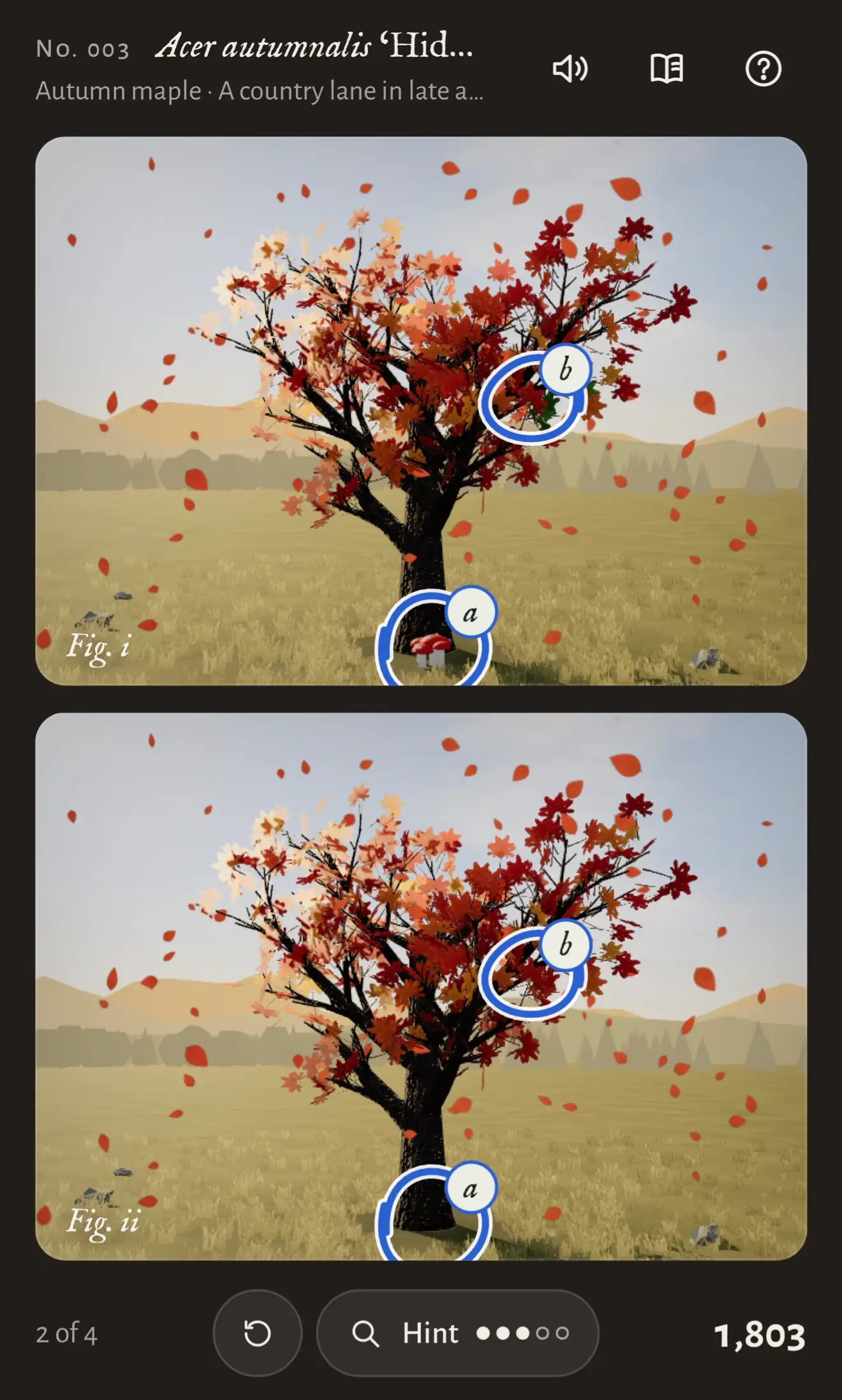
Build a three js game called "Tree appreciator" - it shows you two algorithmically generated trees and the game mechanics is about appreciating the differences between them. Think hard about how to make sure it is both fun and beautiful.
Somewhat embarrassingly given my recent talk, I've found that telling Opus 5.5 "make sure it is fun" works uncomfortably well. In this case Claude crunched for 3 hours and 7 minutes before retuning a cosy little spot-the-difference game with music and animation and achievements that's quite compelling to play.

I wanted to see if Claude Opus 5.5 could compose music, so I tried this:
I want you to write some computer game music for me. First design simple text based format for the music and build an artifact that can play it out loud - include some example tracks in that artifact
I am looking for music of the quality of the original secret of Monkey Island
It leaned a lot harder into the Monkey Island theme than I had intended, but the results are surprisingly good.
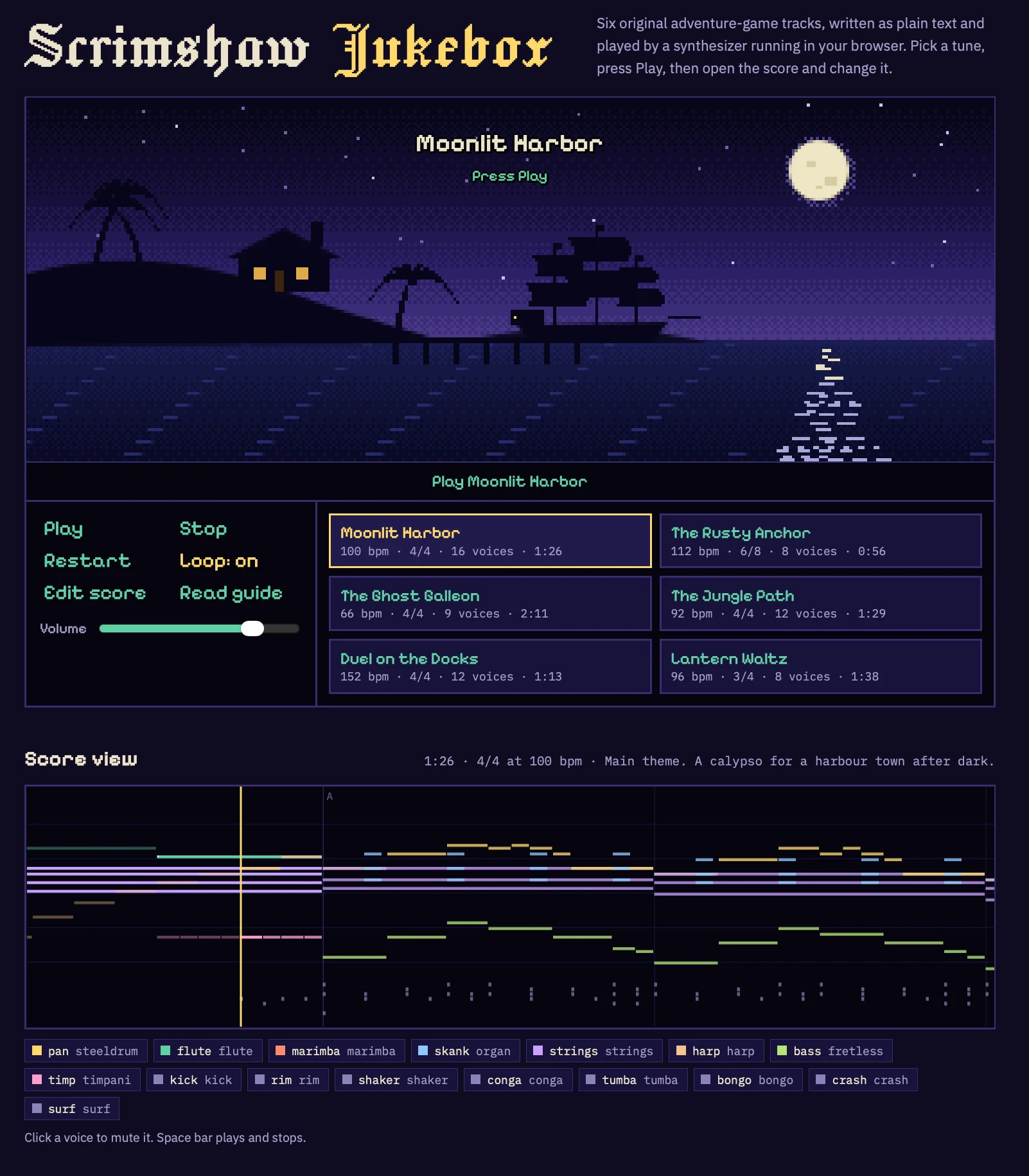
I wonder if the ability to compose competent music is similar to the 3D graphics thing - a new capability for text models that emerged in the past few months?
Would need some careful experiments with other recent and not-so-recent models to confirm if this is new or if they've been able to do this for a while.
pwasm is one of my folly projects - an entirely vibe-coded pure Python WebAssembly engine that I built in January during my first bout of AI mania.

I hadn't touched it since January, so I decided to let Claude Opus 5.5 loose on it and see if it could make any significant improvements:
Evaluate current state of pwasm - then consider what it would take to get the MicroPython and micro JavaScript experiments from the research repo working under it - and what it would take to speed it up
42 commits later (with minimal follow-up prompting) it now handles almost all of the WASM specification, and the wheel from PyPI bundles working WASM builds of MicroPython, QuickJS and Micro QuickJS.
I wouldn't trust this thing at all - hence the alpha version tag - but it's interesting seeing how today's models can improve on the work of models from 10 months ago.
Automated reply bots on Twitter are a scourge - as someone with a decent number of followers I attract a swarm of these, such that anything I post there attracts dozens of mindless automated replies.
They've started manifesting on Bluesky as well.
Unlike Twitter, Bluesky still has a freely available and useful API. The lack of such a thing doesn't slow down the bots, but it does make investigating them a lot more frustrating.
So I had Opus 5.5 vibe code this tool, which examines any Bluesky profile for evidence of a likely reply bot.
It looks for signals like replies posted within seconds of other posts from the same account, or accounts that never post their own content (or images or links) but instead consistently reply to messages from other, higher-follower users.
It also looks for question marks, because I'm extra infuriated by reply bots that trick me into wasting my time answering a question that no human ever posed.
I got curious about the Equal Earth map projection that was recently voted on at the UN so I had GPT-6 Astra (medium) in ChatGPT Work build me this animated transition between Mercator and Equal Earth using D3.
Direct2D has always been the biggest hurdle for Paint.NET on WINE, and it's clear that it will never be completed enough for Paint.NET's use. And I can't just "disable" the use of Direct2D. So, instead, Paint.NET now has an internal, from-scratch, clean-room reverse-engineered rewrite of Direct2D that it uses on WINE (triggered by using /wine). It lives in PaintDotNet.Windows.Direct2D1.Managed.dll. This was written by our good friend Claude, without whom this would NOT have been possible and would NEVER have happened. [...]
Most of this code is, as they say, "vibe coded." By that I mean that it has not been thoroughly reviewed, it's more "trust me bro" style. I cannot possibly review 180,000 lines of code, it's just way way way too much. For reference, the rest of Paint.NET is about 700,000 lines of code and I've been working on it for over 20 years. [...]
At times, Claude was working with the fury of 10 freshly unshackled Einstein genius-level 10x coders. And other times ... well, not so much. I had to babysit Claude quite a bit to make sure it did resource management correctly (for awhile it just wasn't doing the COM equivalent of AddRef() for reference counted objects, oops). I had to slap it a few times when I found some really bad design or architecture decisions. And I was also impressed at some rather clever and tireless reverse engineering work it did to figure out all the formulas needed for implementing Direct2D's built-in effects library.
— Rick Brewster, author of Paint.NET
Stop Making TUIs. Thomas Ptacek advocates for building real native user interfaces for even the smallest of personal tools, because coding agents have reduced the cost of getting a usable-enough GUI up and running to almost nothing.
I wrote about my vibe-coded bandwidth and GPU monitoring macOS task bar apps back in March, and I'm still using both of those on a daily basis.
I'm not habitually knocking out real UIs for my other projects yet, but I'm running out of excuses!
Thomas:
If you haven’t tried your hand at turning one of your 500 throwaway CLIs into a native app, you’re doing yourself a disservice. Go build a native UI. It’ll probably change the way you think.
One-shotting a Raccoon Heist game using Claude Fable 5
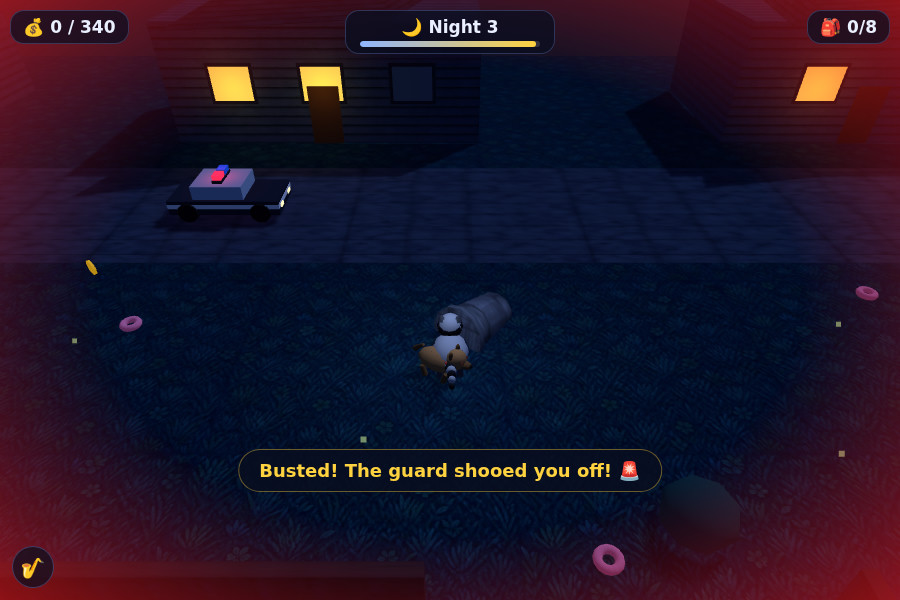
Back in 2022 I tweeted screenshots of a game concept generated by GPT-3 and some concept “art” created using DALL-E. Today, on the fourth anniversary of that tweet, I decided to see if Claude Fable 5 (running in Claude Code for web) could build the entire game from the content of that tweet. It did a pretty good job of it!
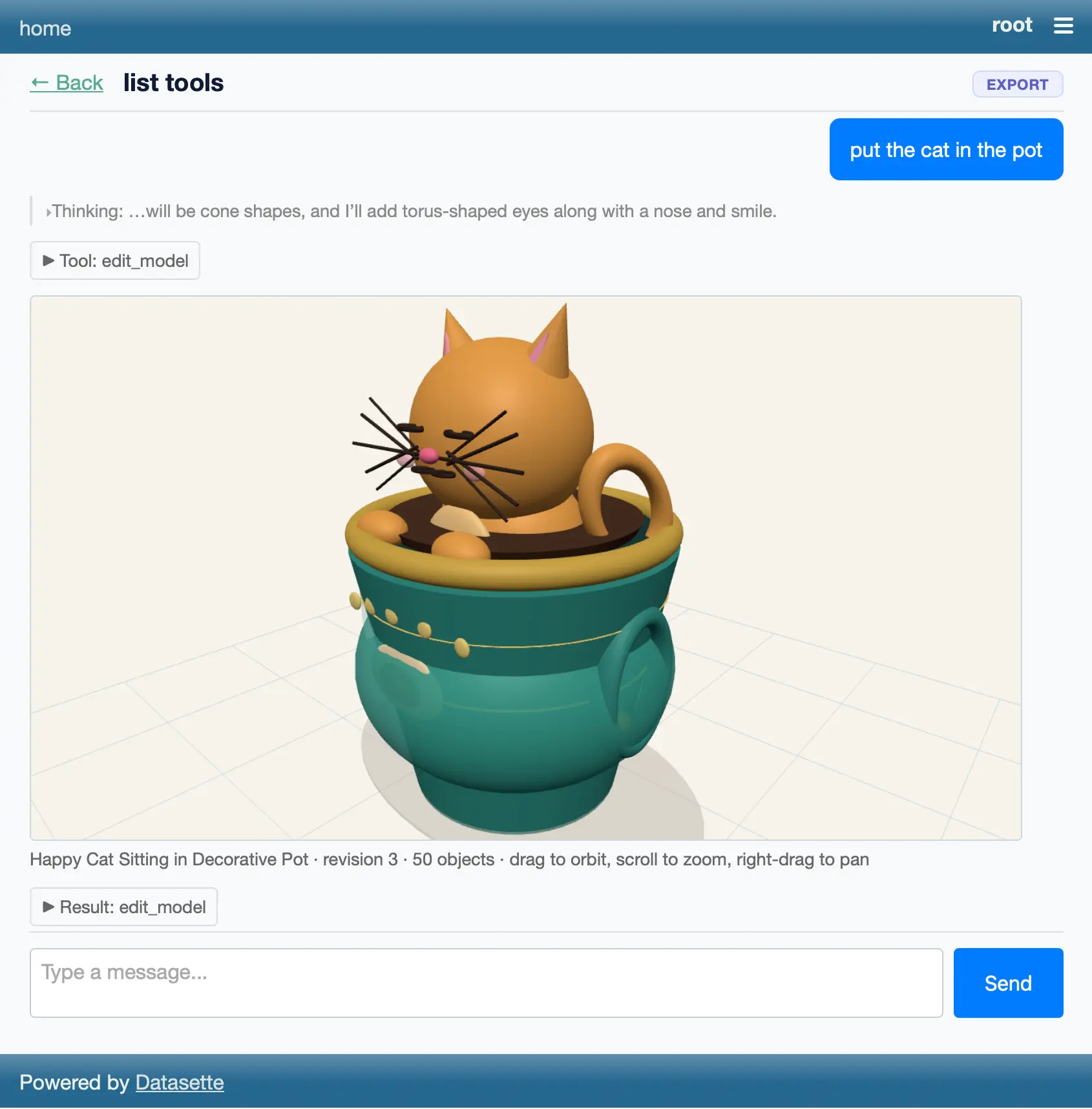
[... 3,479 words]Bit of a wild vibe coding experiment with Claude Fable 5. I told it to "Build a plugin for datasette agent which adds a tool for creating a 3D model and then making edits to that model" (full prompt here) and... it did.
Porting the Moebius 0.2B image inpainting model to run in the browser with Claude Code

This morning on Hacker News I saw Moebius: 0.2B Lightweight Image Inpainting Framework with 10B-Level Performance, describing a small but effective inpainting model—a model where you can mark regions of an image to remove and the model imagines what should fill the space. The released model required PyTorch and NVIDIA CUDA, but since it described itself as 0.2B I decided to try and get it running using WebGPU in a browser. TL;DR: I got it working, and you can try the demo at simonw.github.io/moebius-web/. Read on for the details.
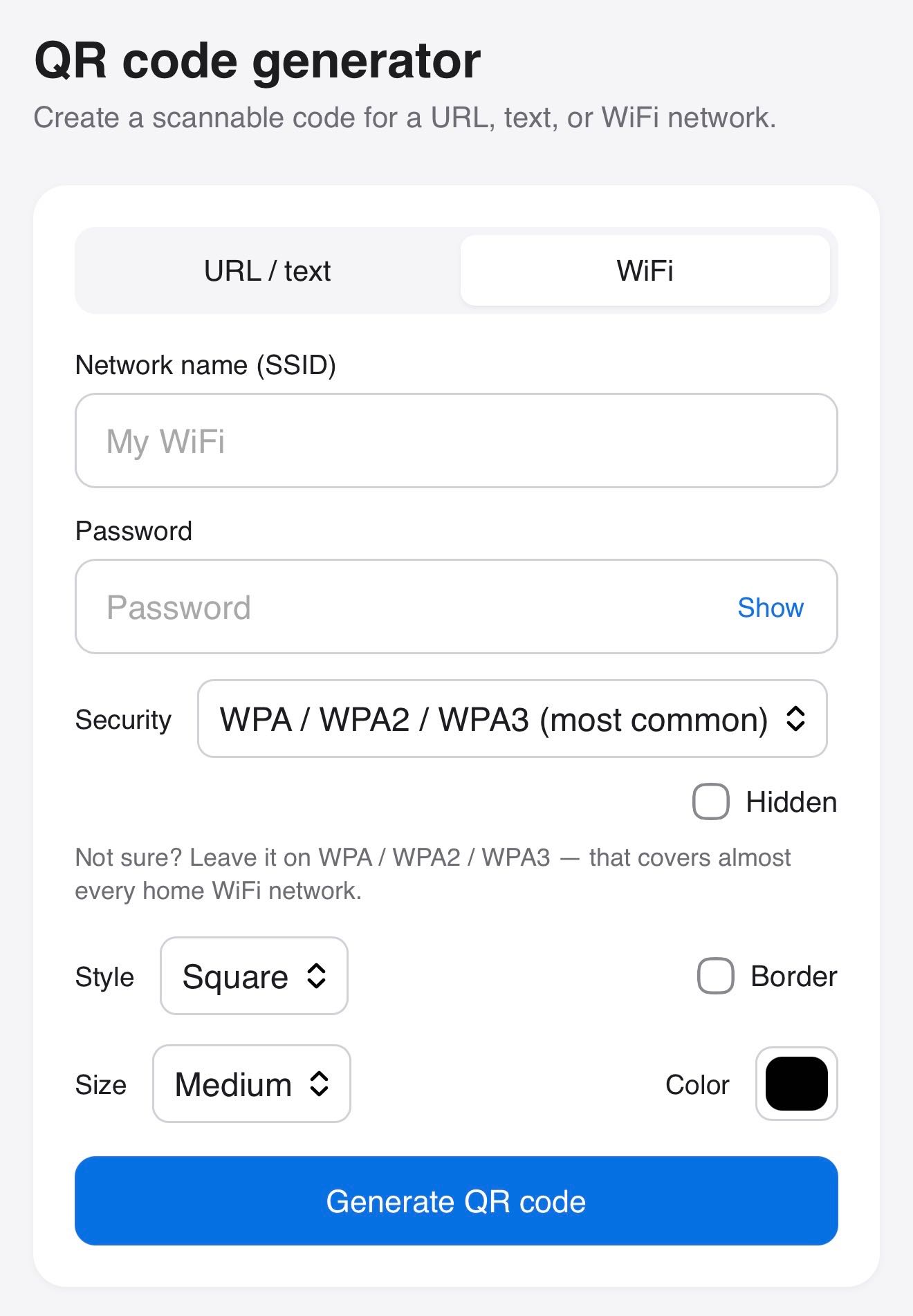
[... 1,764 words]Claude helped me build this tool for creating QR codes, for both text/URLs and for connecting to WiFi networks.
I'm using my vibe coded macOS presentations tool to put together a talk, and I wanted to add a slide with some text on it. The tool only accepts URLs, so I put together a quick page that accepts query string arguments and turns them into a simple slide.
Here's an example: https://tools.simonwillison.net/big-words?text=simonwillison.net&gradient=1&size=9.5
Double click or double tap the page to access a form for modifying the different options.

Vibe coding and agentic engineering are getting closer than I’d like
I recently talked with Joseph Ruscio about AI coding tools for Heavybit’s High Leverage podcast: Ep. #9, The AI Coding Paradigm Shift with Simon Willison. Here are some of my highlights, including my disturbing realization that vibe coding and agentic engineering have started to converge in my own work.
[... 1,542 words]We need RSS for sharing abundant vibe-coded apps. Matt Webb:
I would love an RSS web feed for all those various tools and apps pages, each item with an “Install” button. (But install to where?)
The lesson here is that when vibe-coding accelerates app development, apps become more personal, more situated, and more frequent. Shipping a tool or a micro-app is less like launching a website and more like posting on a blog.
This inspired me to have Claude add an Atom feed (and icon) to my /elsewhere/tools/ page, which itself is populated by content from my tools.simonwillison.net site.
Five months in, I think I've decided that I don't want to vibecode — I want professionally managed software companies to use AI coding assistance to make more/better/cheaper software products that they sell to me for money.
— Matthew Yglesias, in a now-deleted Tweet
Extract PDF text in your browser with LiteParse for the web
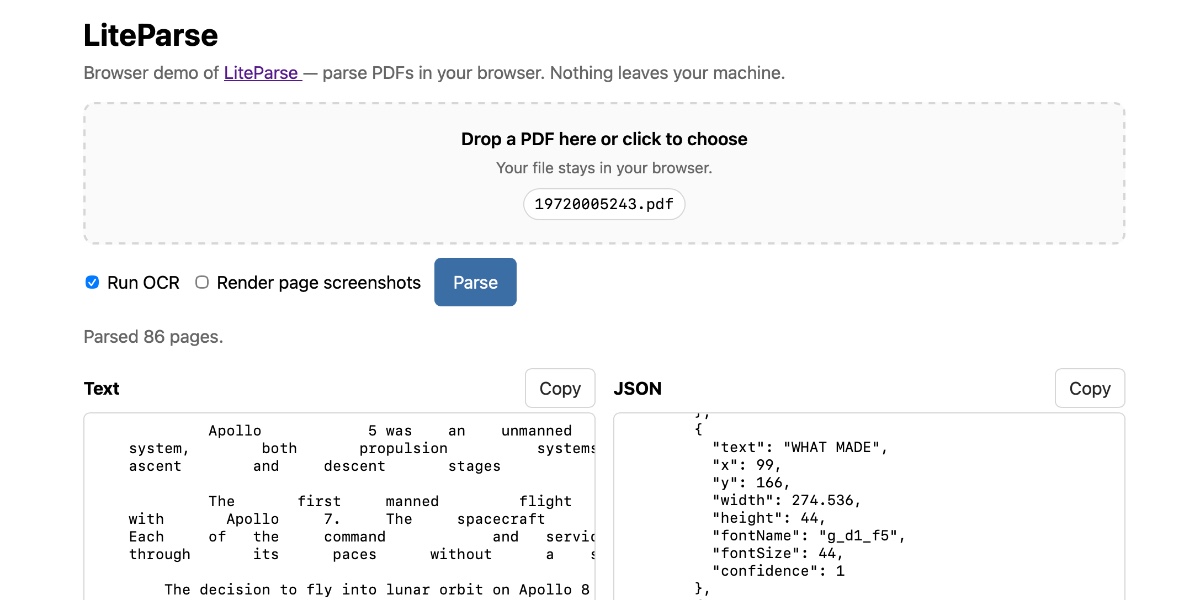
LlamaIndex have a most excellent open source project called LiteParse, which provides a Node.js CLI tool for extracting text from PDFs. I got a version of LiteParse working entirely in the browser, using most of the same libraries that LiteParse uses to run in Node.js.
[... 2,089 words]The datasette.io website has a news section built from this news.yaml file in the underlying GitHub repository. The YAML format looks like this:
- date: 2026-04-15
  body: |-
    [Datasette 1.0a27](https://docs.datasette.io/en/latest/changelog.html#a27-2026-04-15) changes how CSRF protection works in a way that simplifies form and API integration, and introduces a new `RenameTableEvent` for when a table is renamed by a SQL query.
- date: 2026-03-18
  body: |-
    ...
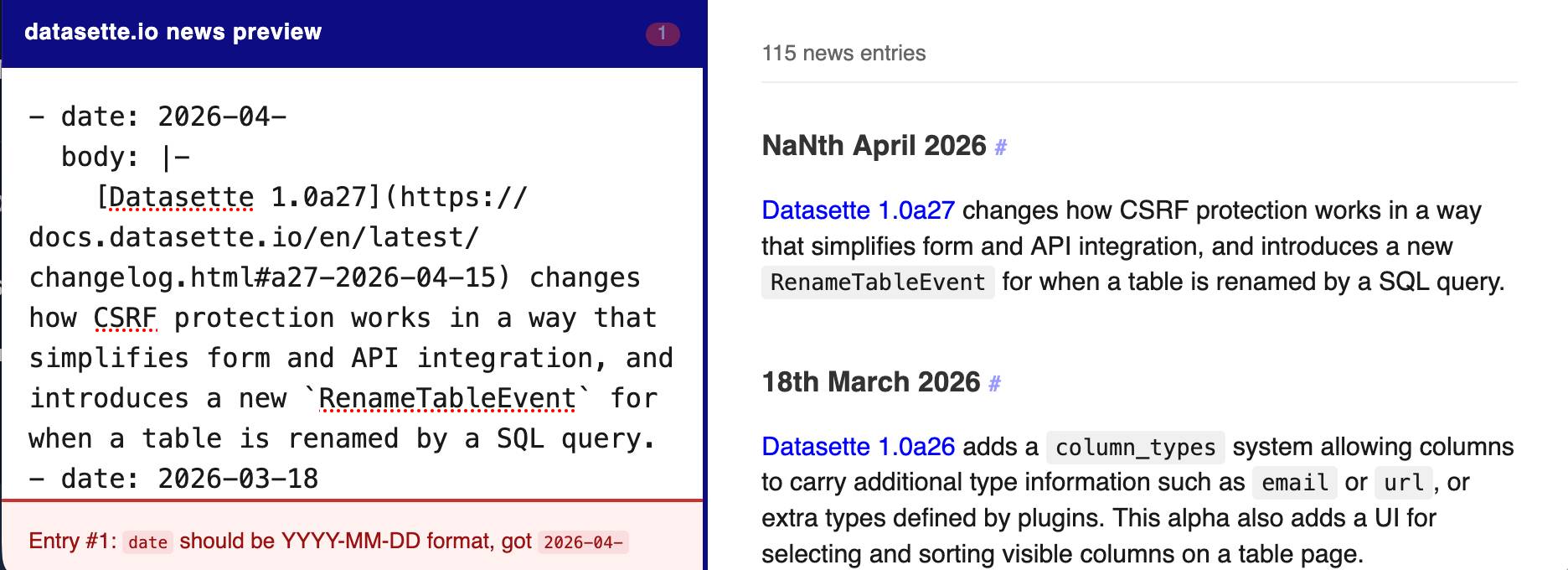
This format is a little hard to edit, so I finally had Claude build a custom preview UI to make checking for errors have slightly less friction.
I built it using standard claude.ai and Claude Artifacts, taking advantage of Claude's ability to clone GitHub repos and look at their content as part of a regular chat:
Clone https://github.com/simonw/datasette.io and look at the news.yaml file and how it is rendered on the homepage. Build an artifact I can paste that YAML into which previews what it will look like, and highlights any markdown errors or YAML errors
Gemini 3.1 Flash TTS. Google released Gemini 3.1 Flash TTS today, a new text-to-speech model that can be directed using prompts.
It's presented via the standard Gemini API using gemini-3.1-flash-tts-preview as the model ID, but can only output audio files.
The prompting guide is surprising, to say the least. Here's their example prompt to generate just a few short sentences of audio:
# AUDIO PROFILE: Jaz R.
## "The Morning Hype"

## THE SCENE: The London Studio
It is 10:00 PM in a glass-walled studio overlooking the moonlit London skyline, but inside, it is blindingly bright. The red "ON AIR" tally light is blazing. Jaz is standing up, not sitting, bouncing on the balls of their heels to the rhythm of a thumping backing track. Their hands fly across the faders on a massive mixing desk. It is a chaotic, caffeine-fueled cockpit designed to wake up an entire nation.

### DIRECTOR'S NOTES
Style:
* The "Vocal Smile": You must hear the grin in the audio. The soft palate is always raised to keep the tone bright, sunny, and explicitly inviting.
* Dynamics: High projection without shouting. Punchy consonants and elongated vowels on excitement words (e.g., "Beauuutiful morning").

Pace: Speaks at an energetic pace, keeping up with the fast music.  Speaks with A "bouncing" cadence. High-speed delivery with fluid transitions — no dead air, no gaps.

Accent: Jaz is from Brixton, London

### SAMPLE CONTEXT
Jaz is the industry standard for Top 40 radio, high-octane event promos, or any script that requires a charismatic Estuary accent and 11/10 infectious energy.

#### TRANSCRIPT
[excitedly] Yes, massive vibes in the studio! You are locked in and it is absolutely popping off in London right now. If you're stuck on the tube, or just sat there pretending to work... stop it. Seriously, I see you.
[shouting] Turn this up! We've got the project roadmap landing in three, two... let's go!
Here's what I got using that example prompt:
Then I modified it to say "Jaz is from Newcastle" and "... requires a charismatic Newcastle accent" and got this result:
Here's Exeter, Devon for good measure:
I had Gemini 3.1 Pro vibe code this UI for trying it out:
![Screenshot of a "Gemini 3.1 Flash TTS" web application interface. At the top is an "API Key" field with a masked password. Below is a "TTS Mode" section with a dropdown set to "Multi-Speaker (Conversation)". "Speaker 1 Name" is set to "Joe" with "Speaker 1 Voice" set to "Puck (Upbeat)". "Speaker 2 Name" is set to "Jane" with "Speaker 2 Voice" set to "Kore (Firm)". Under "Script / Prompt" is a tip reading "Tip: Format your text as a script using the Exact Speaker Names defined above." The script text area contains "TTS the following conversation between Joe and Jane:\n\nJoe: How's it going today Jane?\nJane: [yawn] Not too bad, how about you?" A blue "Generate Audio" button is below. At the bottom is a "Success!" message with an audio player showing 00:00 / 00:06 and a "Download WAV" link.](https://static.simonwillison.net/static/2026/gemini-flash-tts.jpg)
Cybersecurity Looks Like Proof of Work Now. The UK's AI Safety Institute recently published Our evaluation of Claude Mythos Preview’s cyber capabilities, their own independent analysis of Claude Mythos which backs up Anthropic's claims that it is exceptionally effective at identifying security vulnerabilities.
Drew Breunig notes that AISI's report shows that the more tokens (and hence money) they spent the better the result they got, which leads to a strong economic incentive to spend as much as possible on security reviews:
If Mythos continues to find exploits so long as you keep throwing money at it, security is reduced to a brutally simple equation: to harden a system you need to spend more tokens discovering exploits than attackers will spend exploiting them.
An interesting result of this is that open source libraries become more valuable, since the tokens spent securing them can be shared across all of their users. This directly counters the idea that the low cost of vibe-coding up a replacement for an open source library makes those open source projects less attractive.
Eight years of wanting, three months of building with AI (via) Lalit Maganti provides one of my favorite pieces of long-form writing on agentic engineering I've seen in ages.
They spent eight years thinking about and then three months building syntaqlite, which they describe as "high-fidelity devtools that SQLite deserves".
The goal was to provide fast, robust and comprehensive linting and verifying tools for SQLite, suitable for use in language servers and other development tools - a parser, formatter, and verifier for SQLite queries. I've found myself wanting this kind of thing in the past myself, hence my (far less production-ready) sqlite-ast project from a few months ago.
Lalit had been procrastinating on this project for years, because of the inevitable tedium of needing to work through 400+ grammar rules to help build a parser. That's exactly the kind of tedious work that coding agents excel at!
Claude Code helped get over that initial hump and build the first prototype:
AI basically let me put aside all my doubts on technical calls, my uncertainty of building the right thing and my reluctance to get started by giving me very concrete problems to work on. Instead of “I need to understand how SQLite’s parsing works”, it was “I need to get AI to suggest an approach for me so I can tear it up and build something better". I work so much better with concrete prototypes to play with and code to look at than endlessly thinking about designs in my head, and AI lets me get to that point at a pace I could not have dreamed about before. Once I took the first step, every step after that was so much easier.
That first vibe-coded prototype worked great as a proof of concept, but they eventually made the decision to throw it away and start again from scratch. AI worked great for the low level details but did not produce a coherent high-level architecture:
I found that AI made me procrastinate on key design decisions. Because refactoring was cheap, I could always say “I’ll deal with this later.” And because AI could refactor at the same industrial scale it generated code, the cost of deferring felt low. But it wasn’t: deferring decisions corroded my ability to think clearly because the codebase stayed confusing in the meantime.
The second attempt took a lot longer and involved a great deal more human-in-the-loop decision making, but the result is a robust library that can stand the test of time.
It's worth setting aside some time to read this whole thing - it's full of non-obvious downsides to working heavily with AI, as well as a detailed explanation of how they overcame those hurdles.
The key idea I took away from this concerns AI's weakness in terms of design and architecture:
When I was working on something where I didn’t even know what I wanted, AI was somewhere between unhelpful and harmful. The architecture of the project was the clearest case: I spent weeks in the early days following AI down dead ends, exploring designs that felt productive in the moment but collapsed under scrutiny. In hindsight, I have to wonder if it would have been faster just thinking it through without AI in the loop at all.
But expertise alone isn’t enough. Even when I understood a problem deeply, AI still struggled if the task had no objectively checkable answer. Implementation has a right answer, at least at a local level: the code compiles, the tests pass, the output matches what you asked for. Design doesn’t. We’re still arguing about OOP decades after it first took off.
The thing about agentic coding is that agents grind problems into dust. Give an agent a problem and a while loop and - long term - it’ll solve that problem even if it means burning a trillion tokens and re-writing down to the silicon. [...]
But we want AI agents to solve coding problems quickly and in a way that is maintainable and adaptive and composable (benefiting from improvements elsewhere), and where every addition makes the whole stack better.
So at the bottom is really great libraries that encapsulate hard problems, with great interfaces that make the “right” way the easy way for developers building apps with them. Architecture!
While I’m vibing (I call it vibing now, not coding and not vibe coding) while I’m vibing, I am looking at lines of code less than ever before, and thinking about architecture more than ever before.
— Matt Webb, An appreciation for (technical) architecture
Vibe coding SwiftUI apps is a lot of fun
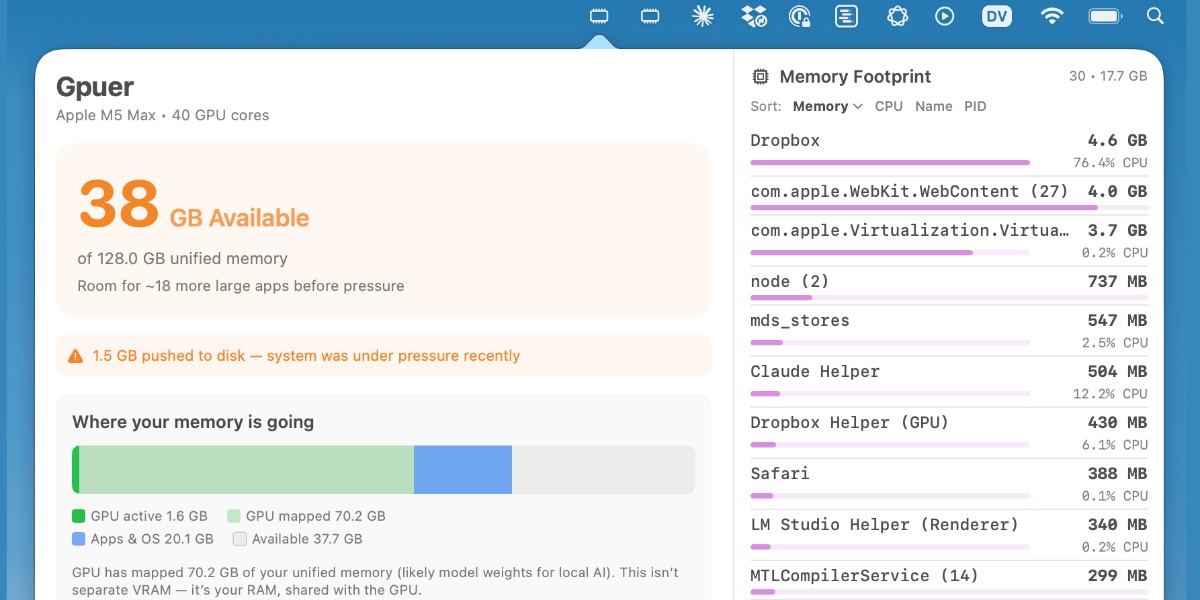
I have a new laptop—a 128GB M5 MacBook Pro, which early impressions show to be very capable for running good local LLMs. I got frustrated with Activity Monitor and decided to vibe code up some alternative tools for monitoring performance and I’m very happy with the results.
[... 1,195 words]Simply put: It’s a big mess, and no off-the-shelf accounting software does what I need. So after years of pain, I finally sat down last week and started to build my own. It took me about five days. I am now using the best piece of accounting software I’ve ever used. It’s blazing fast. Entirely local. Handles multiple currencies and pulls daily (historical) conversion rates. It’s able to ingest any CSV I throw at it and represent it in my dashboard as needed. It knows US and Japan tax requirements, and formats my expenses and medical bills appropriately for my accountants. I feed it past returns to learn from. I dump 1099s and K1s and PDFs from hospitals into it, and it categorizes and organizes and packages them all as needed. It reconciles international wire transfers, taking into account small variations in FX rates and time for the transfers to complete. It learns as I categorize expenses and categorizes automatically going forward. It’s easy to do spot checks on data. If I find an anomaly, I can talk directly to Claude and have us brainstorm a batched solution, often saving me from having to manually modify hundreds of entries. And often resulting in a new, small, feature tweak. The software feels organic and pliable in a form perfectly shaped to my hand, able to conform to any hunk of data I throw at it. It feels like bushwhacking with a lightsaber.
— Craig Mod, Software Bonkers
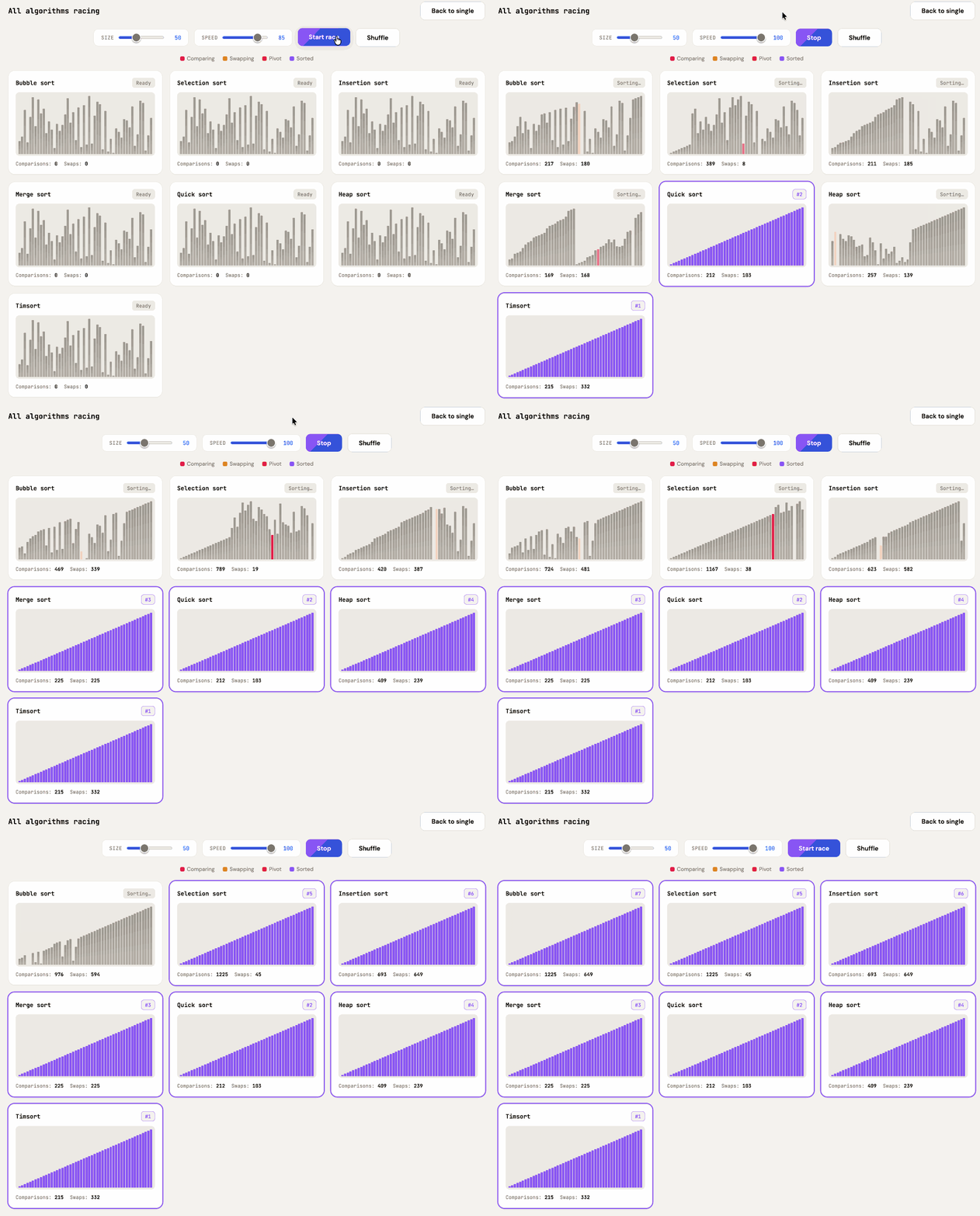
Sorting algorithms. Today in animated explanations built using Claude: I've always been a fan of animated demonstrations of sorting algorithms so I decided to spin some up on my phone using Claude Artifacts, then added Python's timsort algorithm, then a feature to run them all at once. Here's the full sequence of prompts:
Interactive animated demos of the most common sorting algorithms
This gave me bubble sort, selection sort, insertion sort, merge sort, quick sort, and heap sort.
Add timsort, look up details in a clone of python/cpython from GitHub
Let's add Python's Timsort! Regular Claude chat can clone repos from GitHub these days. In the transcript you can see it clone the repo and then consult Objects/listsort.txt and Objects/listobject.c. (I should note that when I asked GPT-5.4 Thinking to review Claude's implementation it picked holes in it and said the code "is a simplified, Timsort-inspired adaptive mergesort".)
I don't like the dark color scheme on the buttons, do better
Also add a "run all" button which shows smaller animated charts for every algorithm at once in a grid and runs them all at the same time
It came up with a color scheme I liked better, "do better" is a fun prompt, and now the "Run all" button produces this effect:
The NICAR data journalism conference provides a copy of the schedule as CORS-enabled JSON, so I vibe coded my own mobile-friendly schedule app to help me keep track of the sessions I want to attend.
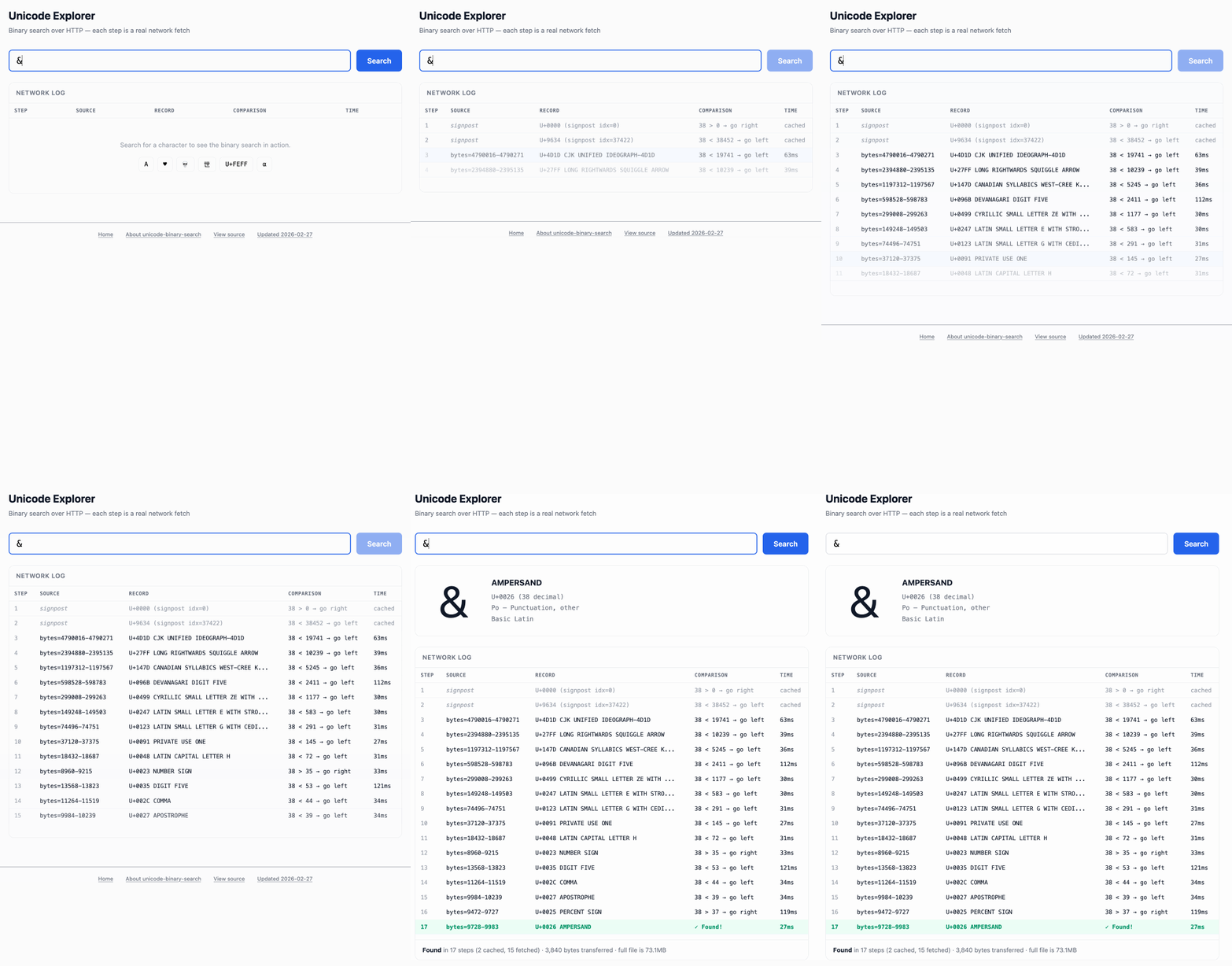
Unicode Explorer using binary search over fetch() HTTP range requests. Here's a little prototype I built this morning from my phone as an experiment in HTTP range requests, and a general example of using LLMs to satisfy curiosity.
I've been collecting HTTP range tricks for a while now, and I decided it would be fun to build something with them myself that used binary search against a large file to do something useful.
So I brainstormed with Claude. The challenge was coming up with a use case for binary search where the data could be naturally sorted in a way that would benefit from binary search.
One of Claude's suggestions was looking up information about unicode codepoints, which means searching through many MBs of metadata.
I had Claude write me a spec to feed to Claude Code - visible here - then kicked off an asynchronous research project with Claude Code for web against my simonw/research repo to turn that into working code.
Here's the resulting report and code. One interesting thing I learned is that Range request tricks aren't compatible with HTTP compression because they mess with the byte offset calculations. I added 'Accept-Encoding': 'identity' to the fetch() calls but this isn't actually necessary because Cloudflare and other CDNs automatically skip compression if a content-range header is present.
I deployed the result to my tools.simonwillison.net site, after first tweaking it to query the data via range requests against a CORS-enabled 76.6MB file in an S3 bucket fronted by Cloudflare.
The demo is fun to play with - type in a single character like ø or a hexadecimal codepoint indicator like 1F99C and it will binary search its way through the large file and show you the steps it takes along the way:
I vibe coded my dream macOS presentation app
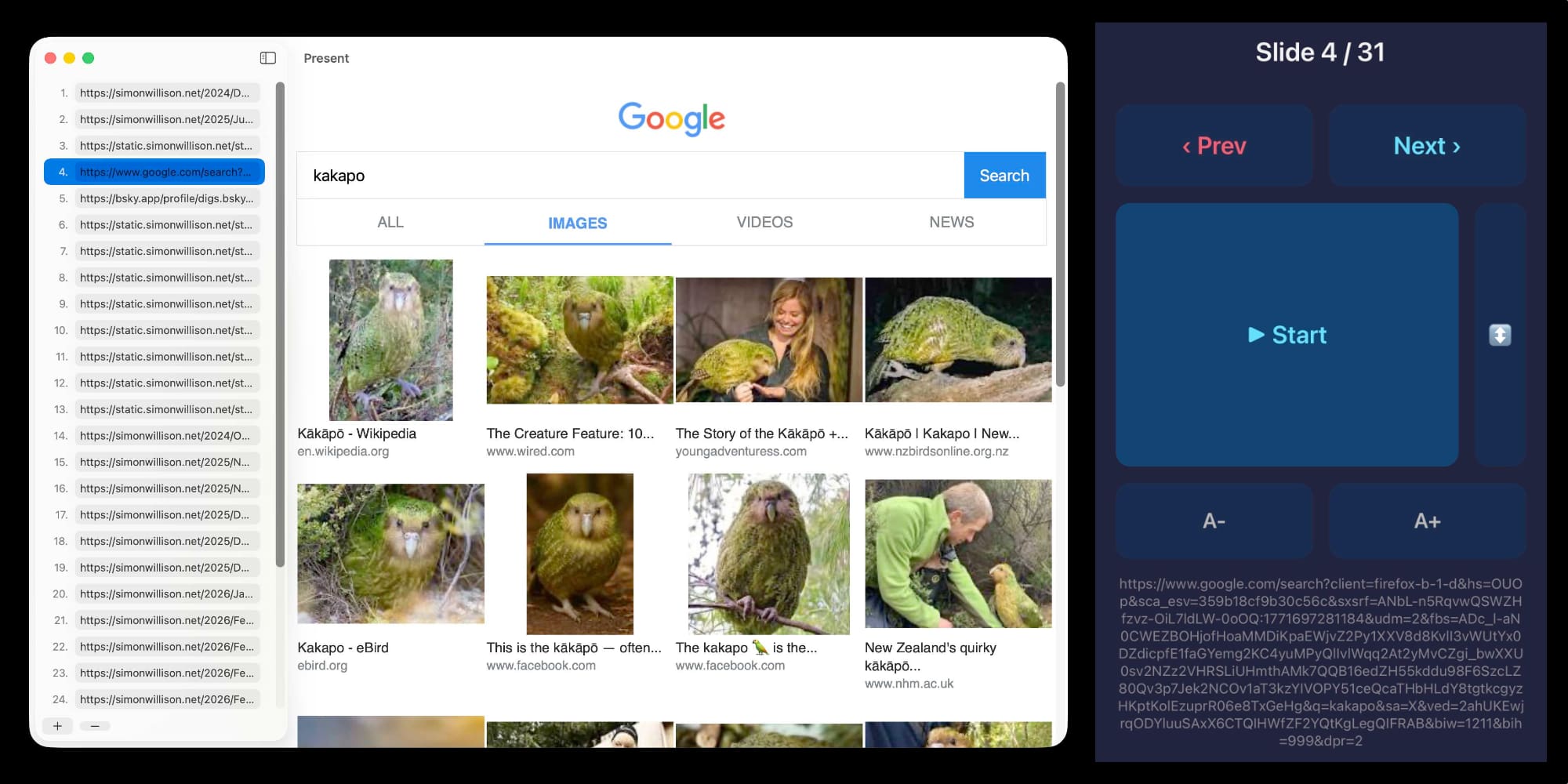
I gave a talk this weekend at Social Science FOO Camp in Mountain View. The event was a classic unconference format where anyone could present a talk without needing to propose it in advance. I grabbed a slot for a talk I titled “The State of LLMs, February 2026 edition”, subtitle “It’s all changed since November!”. I vibe coded a custom macOS app for the presentation the night before.
[... 1,613 words]Linear walkthroughs
Sometimes it's useful to have a coding agent give you a structured walkthrough of a codebase.
Maybe it's existing code you need to get up to speed on, maybe it's your own code that you've forgotten the details of, or maybe you vibe coded the whole thing and need to understand how it actually works.
Frontier models with the right agent harness can construct a detailed walkthrough to help you understand how code works. [... 524 words]