64 posts tagged “agentic-engineering”
Using coding agents for professional software development. I've written a lot more about this under my broader tag ai-assisted-programming.
2026
SF October 14th: A Birds of a Feather Session on Agentic Engineering. I'm hosting an evening event with Jesse Vincent in San Francisco on Wednesday 14th October for people who are building weird and interesting things with and on top of coding agents.
Think of it as an agentic show-and-tell:
Compare notes with other builders and experimenters on things you’re trying, what you're learning, and what you haven’t figured out yet. We’re especially interested in work you haven’t discussed publicly, odd experiments, or unfinished projects that don’t have an obvious market.
Expect one flowing conversation with an informal show-and-tell. Sharing something you’re working on is encouraged but no presentation is required.
This isn't about product pitches, it's about much earlier explorations than that. This agentic AI stuff is weird! Let's celebrate and lean into that weirdness.
The cost of writing code collapsed, and the cost of reviewing, fixing and operating it is following, and I'm assuming it gets there. What's left of making software is finding out what people actually want, defining it precisely, and making it pleasant to use. That cost is per piece of software and doesn't transfer, so as the amount of software goes to infinity, which it will because there's no ceiling on demand, that cost becomes the whole job.
— Laurie Voss, We are all Product Engineers now
Production code written by Claude should have a higher bar than if it was written by a human. At Anthropic, we have many guardrails in place to make sure this is happening: lots of lint rules, lots of tests, Claude-driven end to end tests, Claude-powered fuzzers running daily, automated code reviews and security reviews, automated code refactoring, and so on. Without these, you can end up with a mess that is hard to maintain down the line.
Datasette 1.0a39 and 0.65.4 security releases. Today we're releasing two new security patch versions of Datasette: 1.0a39 and 0.65.4 - one for the current alpha series and one for the stable 0.65.x family.
These are security fixes which you should apply if you are running a Datasette instance on the public web - in particular if that instance mixes both public and private tables.
Following issues reported by Sevban Dönmez, Alex Garcia and I ran an extensive audit of Datasette using Claude Fable 5.1, GPT-5.6, and GPT-6 Astra. We then spent almost a week collaborating on and reviewing the fixes.
They helped find some very subtle bugs. We'll be incorporating security audits by frontier models into all of our development work going forward.
Alex came up with a way of splitting the work which I found extremely productive:
Alex Garcia and I worked together running and then responding to the audit, working in a shared private repository. For most of the issues we split the work: one of us would create the automated tests highlighting the issue, then the other would implement the fix. This ensured that two separate humans had eyes on each of the issues, in addition to our coding agents running different models.
Introducing wrapture. New from Graham Dumpleton (of wrapt, mod_wsgi, and New Relic's Python agent fame), who describes Wrapture as taking the monkeypatching ideas from wrapt and extending them to apply to testing and tracing at the same time.
Wrapture (full documentation here) makes it easy to wrap any function or method such that all access can be traced, or can be overridden to return a different value.
It acts as both an alternative to unittest.mock and a way to implement tracing against an existing project:
Attaching observation to code you do not control, recording what flows through it, and doing so without disturbing the program being watched, is a problem I have never really stopped thinking about.
Wrapture includes OpenTelemetry support and even has an entirely configuration-based mechanism for adding tracing to an existing Python project, which looks like this:
capture = "summary"

[[observe]]
target = "domain:Calculator"
name = ["outer", "inner"]

[[sink]]
type = "jsonlines"
path = "trace.jsonl"
This is still a very young project - just a few weeks old - but it's off to a very promising start.
Interestingly, this is also Graham's first attempt at large entirely agent-driven project:
Every line of code and documentation in wrapture was written by an AI assistant working under my direction. I want to be upfront about that, and equally upfront about what it was not. This was not vibe coding, where a one-shot prompt produces a pile of generated code and the person driving hopes for the best because they lack the knowledge to judge what came back. Vibe coding has earned its bad reputation. I engineered wrapture carefully from the start. I have spent a long time in this particular corner of Python and knew exactly what the result needed to be, and the AI was the means of producing it rather than the source of the design.
In a follow-up post, Unit testing with wrapture, Graham shows the testing patterns supported by the new library:
def test_stub_with_wrapture():
    with wrapture.binding(
        Gateway, "charge"
    ).on_call.returns({
        "id": "stub", "amount": 0}
    ):
        assert OrderService().place(
            500
        )["id"] == "stub"
And this neat example of a test that calls and then modifies the return value from the original method:
def test_pinned_result_with_wrapture():
    charge = wrapture.binding(
        Gateway, "charge"
    )
    charge.on_call.transforms_result(
        lambda r: {**r, "id": "ch_TEST"}
    )
    with charge:
        assert OrderService().place(
           500
        ) == {
            "id": "ch_TEST", "amount": 500
        }
(In both of these examples the OrderService().place(...) method calls Gateway().charge(...).)
The key skill required to make productive use of coding agents is being able to confidently instruct them on how to make changes and then confidently verify that those changes have been applied in the correct way.
Sometimes this involves reviewing every line of code they have written, but there are other ways to achieve that goal. Eyeballing every line of code has never been the most effective way to validate a change to a piece of software.
The shared language of a software project is not English or Python but it is the common understanding of what its concepts mean, where the boundaries are, which invariants matter, who owns what, and why the system has the shape it does. This language is rarely written down in one place. It lives partly in documentation and code, but also in code review, conversations, arguments, and the experience of having to explain a change to somebody else.
Before agents, some of this shared understanding was maintained by friction. If I wanted to change your storage layer, I usually had to read your code, ask you questions, and perhaps coordinate with another team whose service depended on it. This was slow, and much of that slowness was waste but not all of it was. Some of it was the process by which your understanding became mine, and by which both of us discovered whether we still agreed about how the system worked. This friction synchronizes people.
— Armin Ronacher, The Tower Keeps Rising
Rewriting Bun in Rust (via) Jarred Sumner has been promising this blog post (since May 9th) about his Zig to Rust rewrite of Bun for significantly longer than it took him to finish the rewrite.
Honestly, it was worth the wait. This is a detailed description of an extremely sophisticated piece of agentic engineering, featuring dynamic workflows, trial runs, adversarial review and all sorts of other interesting tricks.
Jarred spends the first half of the post praising Zig for getting Bun this far. Then we get to a core idea in the piece, emphasis mine:
Our bugfix list felt bad and I was tired of going to sleep worrying about crashes in Bun. I don't blame Zig for that - other users of Zig don't have the bugs we had, and mixing GC with manually-managed memory is an uncommon enough thing for software to need that no language really designs for it. We wouldn't have gotten this far if not for Zig, and I'll always be grateful. Until very recently, programming language choice was a one-way decision for a project like Bun.
Everyone knows you should never stop the world and rewrite a large piece of software from the ground up. Joel Spolsky highlighted that in Things You Should Never Do, Part I back in April 2000!
Coding agents powered by today's frontier models change that equation.
Why pick Rust? It all came down to those challenges with memory management:
A large percentage of bugs from that list are use-after-free, double-free, and "forgot to free" in an error path. In safe Rust, these are compiler errors and RAII-like automatic cleanup with
Drop.
A crucial enabling factor for the rewrite was that the Bun test suite was written in TypeScript, which meant it could act as a conformance suite. This allowed an agent harness to automate much of the initial port from Bun to Rust, initially as an experiment to try out an earlier version of the model we now have access to as Mythos/Fable.
At first, I didn't expect it to work. A few days in, a high % of the test suite started passing and I saw how much the new Rust code matched up with the original Zig codebase. My opinion went from "this is worth trying" to "I'm going to merge this". [...]
For most of those 11 days (and after), I monitored workflows - manually reading the outputs to check for issues and bugs, and prompting Claude to edit the loop to fix things.
How do you review a PR with +1 million lines added? How do you start to build the confidence needed to responsibly merge large quantities of LLM-authored code?
A language-independent test suite with a million assertions, adversarial code review and when something does go wrong, fixing the process that generates the code instead of hand-fixing the code.
The new implementation of Bun has been live in Claude Code for nearly a month now:
Claude Code v2.1.181 (released June 17th) and later use the Rust port of Bun. Startup got 10% faster on Linux but otherwise, barely anyone noticed. Boring is good.
A perk of working at Anthropic is that you don't have to pay for your tokens - handy when the estimated cost is $165,000!
Pre-merge, this took 5.9 billion uncached input tokens, 690 million output tokens, and 72 billion cached input token reads — around $165,000 at API pricing.
This whole thing is a fascinating case study in taking on wildly ambitious projects with the help of coordinated parallel agents.
sqlite-utils 4.0, now with database schema migrations
This morning I released sqlite-utils 4.0, the 124th release of that project and the first major version bump since 3.0 in November 2020. In addition to some small but significant breaking changes (described in this upgrade guide), this version introduces three major features: database migrations, nested transactions (via a new db.atomic() method), and support for compound foreign keys.
sqlite-utils 4.0rc2, mostly written by Claude Fable (for about $149.25)
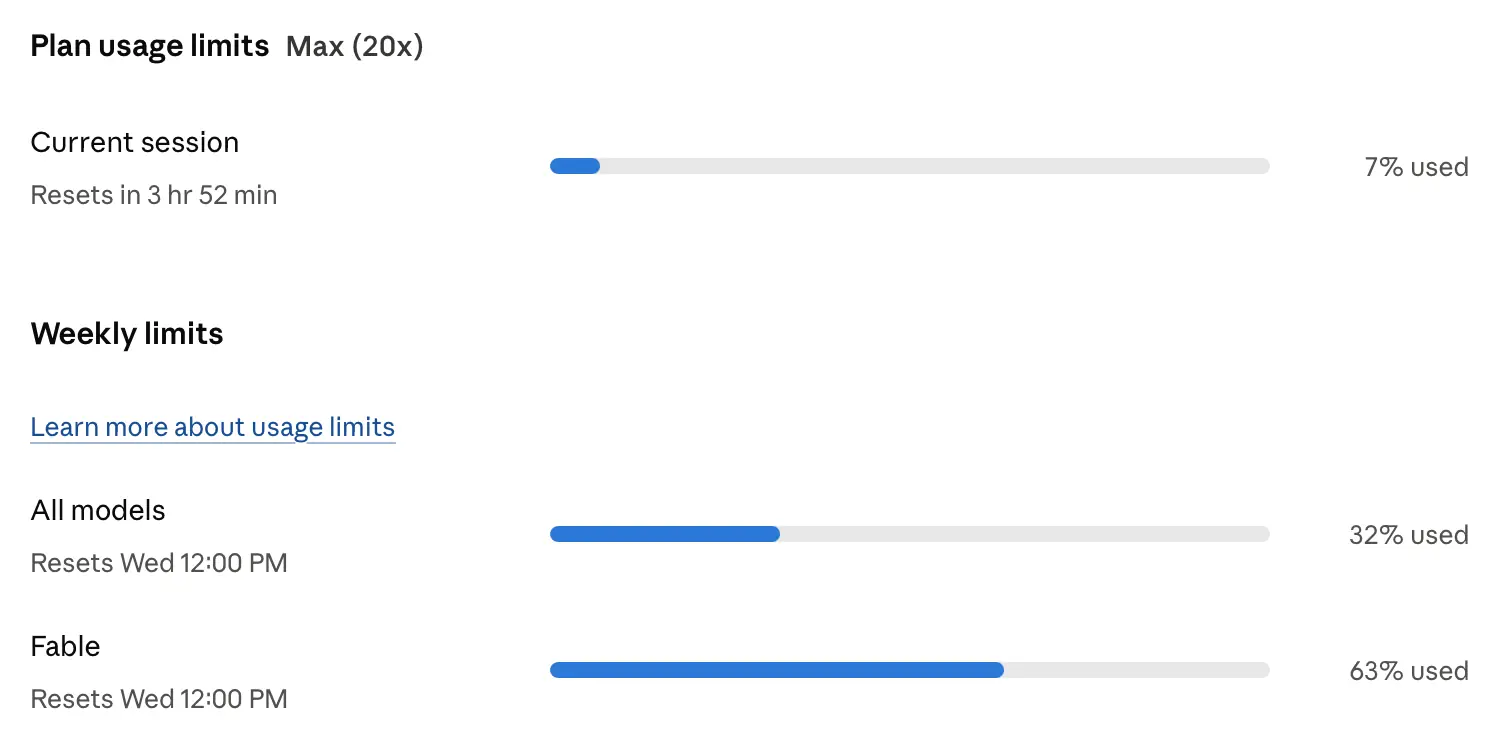
I wrote about the sqlite-utils 4.0rc1 release a couple of weeks ago. Since we only have Claude Fable on our Max subscriptions for a few more days, I decided to see if it could help me get to a 4.0 stable release that I felt truly comfortable about, since I try to keep to SemVer and like my incompatible major versions to be as rare as possible.
[... 2,427 words]Have your agent record video demos of its work with shot-scraper video
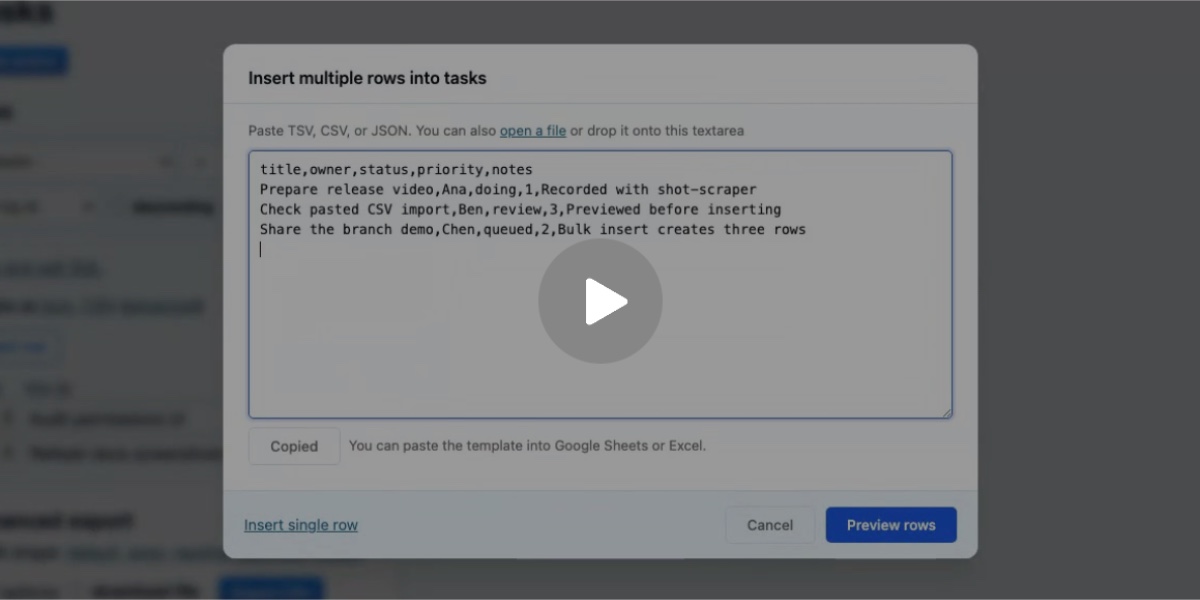
shot-scraper video is a new command introduced in today’s shot-scraper 1.10 release which accepts a storyboard.yml file defining a routine to run against a web application and uses Playwright to record a video of that routine. I’ve written before about the importance of having coding agents produce demos of their work; this is my latest attempt at enabling them to do that.
HumanAgent in the loopI dislike the phrase “human in the loop” because it cedes authority to the machines. Let’s flip the narrative. It’s our loop, we work the same way we always have, now we recruit agents to join the team. An agent-assisted process need not be a black box that takes in prompts and emits features. [...]
Let’s do agentic software development like that. Not as a loop we’ve been excluded from, instead as one we invite agents into.
— Jon Udell, “Doctor, it hurts when agents create unreviewable PRs.” “Don’t do that.”
AI enthusiasts are in a race against time, AI skeptics are in a race against entropy (via) Charity Majors neatly captures the dynamic between AI enthusiasts and AI skeptics, both of whom are trying to build great software, often in the same teams:
The enthusiasts are not wrong. We are starting to see real, non-imaginary, discontinuous leaps in capabilities from teams that lean in hard to working with AI. And this does not feel like a normal technology cycle where you can wait for the dust to settle; teams that sit this out while competitors are hustling could be out of business before the dust settles. That’s a real, existential threat.
The skeptics are also not wrong. When you ship code faster than engineers can read it, in domains where nobody has full context, you are making withdrawals from a trust account that took years to build. Reliability degrades, institutional knowledge evaporates. You end up with systems nobody understands, products burbling into incoherence, and on-call rotations that grind people up and spit them out. That is ALSO a real existential threat.
Charity recommends treating this as both a leadership challenge and an engineering challenge. The key issue:
There is no natural feedback loop connecting enthusiasts with skeptics.
Designing feedback loops to help "mend the gap in shared reality" between the two groups is a fascinating organizational design problem.
[...] On the interesting side is how fungible programming languages are nowadays. Programming languages used to be LOCK IN, and they're increasingly not so. You think the Bun rewrite in Rust is good for Rust? Bun has shown they can be in probably any language they want in roughly a week or two. Rust is expendable. Its useful until its not then it can be thrown out. That's interesting!
— Mitchell Hashimoto, on Bun porting from Zig to Rust
GitLab Act 2 (via) There's a lot going on in this announcement from GitLab about the "workforce reduction" and "structural and strategic decisions" they are making with respect to the agentic era.
- They're "planning to reduce the number of countries by up to 30% where we have small teams". One of the most interesting things about GitLab is that they have employees spread across a large number of countries - 18 are listed in their public employee handbook but this post says they are "operating in nearly 60 countries". That handbook used to document their payroll workflows for those countries too - they stopped publishing that in 2023 but the last public version (hooray for version control) remains a fascinating read. Since we don't know which of those 60 countries have small teams, we can't calculate how many countries that 30% applies to.
- "We're planning to flatten the organization, removing up to three layers of management in some functions so leaders are closer to the work." - this isn't the first announcement of this type I've seen that's trimming management. Coinbase recently announced a much more aggressive version of this: they were "flattening our org structure to 5 layers max below" and "No pure managers: Every leader at Coinbase must also be a strong and active individual contributor. Managers should be like player-coaches".
- In terms of team structure: "We're re-organizing R&D to create roughly 60 smaller, more empowered teams with end-to-end ownership, nearly doubling the number of independent teams." I've always loved the idea of individual teams that can ship features unblocked by other teams, and it makes sense to me that agentic engineering can increase the capability of such teams. The 37signals public employee handbook used to have a section on working In self-sufficient, independent teams which perfectly captured this for me, I'm sad to see they removed that detail in January 2024!
- Tucked away towards the bottom: "We will be retiring CREDIT as our values framework" - that's the values framework described on this page: "Collaboration, Results for Customers, Efficiency, Diversity, Inclusion & Belonging, Iteration, and Transparency". The new values are "Speed with Quality, Ownership Mindset, Customer Outcomes". The fact that "Diversity" is no longer in there is likely to attract a whole lot of attention, so it's worth noting that a sub-bullet under Customer Outcomes reads "Interpersonal excellence: individuals who are good humans, embrace diversity, inclusion and belonging, assume good intent and treat everyone with respect".
Here's the part of their new strategy that most resonated with me:
The agentic era multiplies demand for software. Software has been the force multiplier behind nearly every business transformation of the last two decades. The constraint was the cost and time of producing and managing it. That constraint is collapsing. As the cost of producing software collapses, demand for it will expand. Last year, the developer platform market used to be measured in tens of dollars per user per month, this year it is hundreds/user/month and headed to thousands. Not only is the value of software for builders increasing, but we believe there will be more software and builders than ever, and we will serve an increasing volume of both.
That very much encapsulates my own optimistic, Jevons-paradox-inspired hope for how this will all work out.
Their opinion on this does need to be taken with a big grain of salt though. GitLab's stock price was ~$52 a year ago and is ~$26 today, and it's plausible that the drop corresponds to uncertainty about GitLab's continued growth as agentic engineering eats its way through their core market.
If your entire business depends on software engineering growing as a field and producing larger volumes of more lucrative seats, you have a strong incentive to believe that agents will have that effect!
Your AI coding agent, the one you use to write code, needs to reduce your maintenance costs. Not by a little bit, either. You write code twice as quick now? Better hope you’ve halved your maintenance costs. Three times as productive? One third the maintenance costs. Otherwise, you’re screwed. You’re trading a temporary speed boost for permanent indenture. [...]
The math only works if the LLM decreases your maintenance costs, and by exactly the inverse of the rate it adds code. If you double your output and your cost of maintaining that output, two times two means you’ve quadrupled your maintenance costs. If you double your output and hold your maintenance costs steady, two times one means you’ve still doubled your maintenance costs.
— James Shore, You Need AI That Reduces Maintenance Costs
Vibe coding and agentic engineering are getting closer than I’d like
I recently talked with Joseph Ruscio about AI coding tools for Heavybit’s High Leverage podcast: Ep. #9, The AI Coding Paradigm Shift with Simon Willison. Here are some of my highlights, including my disturbing realization that vibe coding and agentic engineering have started to converge in my own work.
[... 1,542 words]Salvatore Sanfilippo submitted a PR adding a new data type - arrays - to Redis.
The new commands are ARCOUNT, ARDEL, ARDELRANGE, ARGET, ARGETRANGE, ARGREP, ARINFO, ARINSERT, ARLASTITEMS, ARLEN, ARMGET, ARMSET, ARNEXT, AROP, ARRING, ARSCAN, ARSEEK, ARSET.
The implementation is currently available in a branch, so I had Claude Code for web build this interactive playground for trying out the new commands in a WASM-compiled build of a subset of Redis running in the browser.
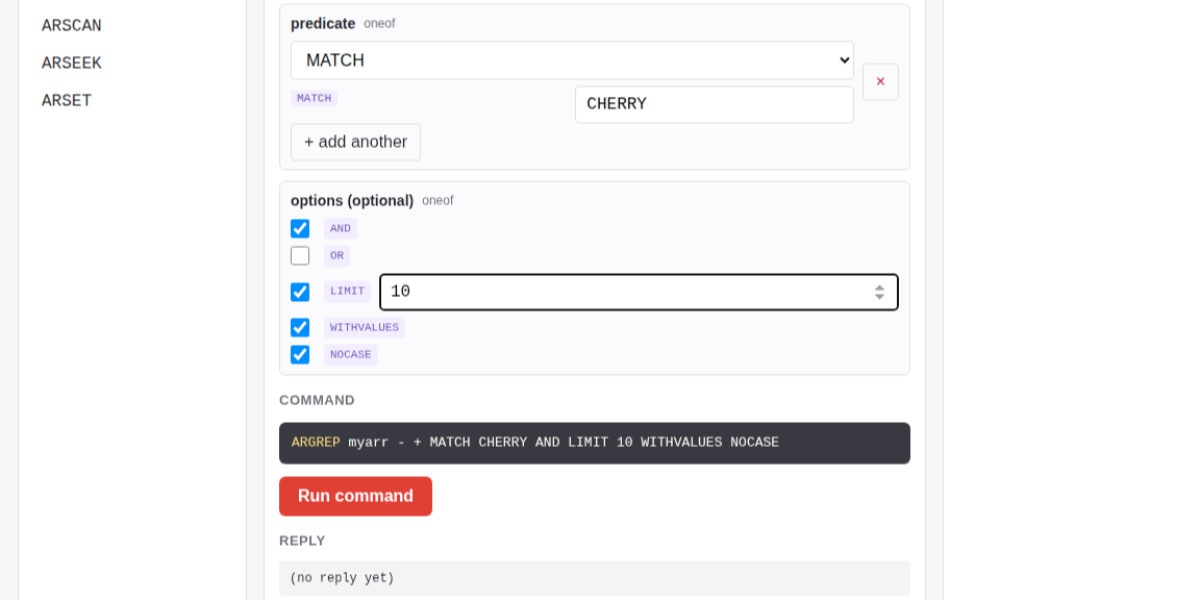
The most interesting new command is ARGREP which can run a server-side grep against a range of values in the array using the newly vendored TRE regex library.
Salvatore wrote more about the AI-assisted development process for the array type in Redis array type: short story of a long development.
Codex CLI 0.128.0 adds /goal
(via)
The latest version of OpenAI's Codex CLI coding agent adds their own version of the Ralph loop: you can now set a /goal and Codex will keep on looping until it evaluates that the goal has been completed... or the configured token budget has been exhausted.
It looks like the feature is mainly implemented though the goals/continuation.md and goals/budget_limit.md prompts, which are automatically injected at the end of a turn.
Five months in, I think I've decided that I don't want to vibecode — I want professionally managed software companies to use AI coding assistance to make more/better/cheaper software products that they sell to me for money.
— Matthew Yglesias, in a now-deleted Tweet
Extract PDF text in your browser with LiteParse for the web
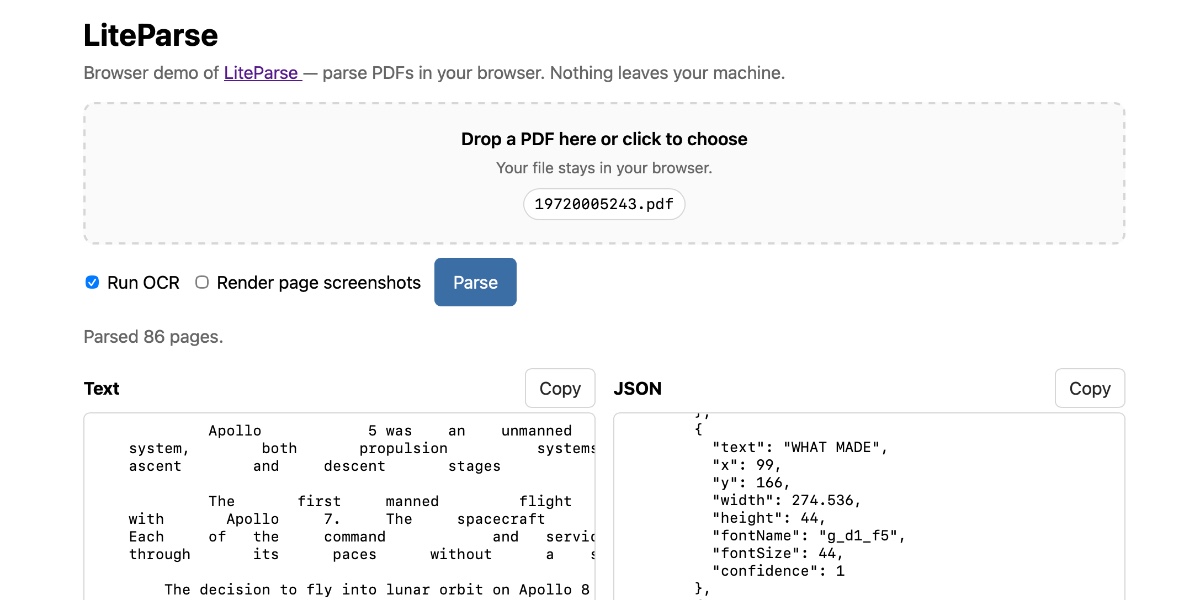
LlamaIndex have a most excellent open source project called LiteParse, which provides a Node.js CLI tool for extracting text from PDFs. I got a version of LiteParse working entirely in the browser, using most of the same libraries that LiteParse uses to run in Node.js.
[... 2,089 words]Adding a new content type to my blog-to-newsletter tool
Here's an example of a deceptively short prompt that got a quite a lot of work done in a single shot.
First, some background. I send out a free Substack newsletter around once a week containing content copied-and-pasted from my blog. I'm effectively using Substack as a lightweight way to allow people to subscribe to my blog via email.
I generate the newsletter with my blog-to-newsletter tool - an HTML and JavaScript app that fetches my latest content from this Datasette instance and formats it as rich text HTML, which I can then copy to my clipboard and paste into the Substack editor. Here's a detailed explanation of how that works. [... 902 words]
I was chatting with my buddy at Google, who's been a tech director there for about 20 years, about their AI adoption. Craziest convo I've had all year.
The TL;DR is that Google engineering appears to have the same AI adoption footprint as John Deere, the tractor company. Most of the industry has the same internal adoption curve: 20% agentic power users, 20% outright refusers, 60% still using Cursor or equivalent chat tool. It turns out Google has this curve too. [...]
There has been an industry-wide hiring freeze for 18+ months, during which time nobody has been moving jobs. So there are no clued-in people coming in from the outside to tell Google how far behind they are, how utterly mediocre they have become as an eng org.
On behalf of @Google, this post doesn't match the state of agentic coding at our company. Over 40K SWEs use agentic coding weekly here. Googlers have access to our own versions of @antigravity, @geminicli, custom models, skills, CLIs and MCPs for our daily work. Orchestrators, agent loops, virtual SWE teams and many other systems are actively available to folks. [...]
Maybe tell your buddy to do some actual work and to stop spreading absolute nonsense. This post is completely false and just pure clickbait.
Update 20th April 2026: Steve doubled down:
My tweet last week about Google's AI adoption drew a lot of pushback, to say the least.
Since then, Googlers from multiple orgs have reached out to me independently and anonymously. They've expressed fear of being doxxed, concern about what they saw as bullying of me, and general corroboration of my original tweet. [...]
Eight years of wanting, three months of building with AI (via) Lalit Maganti provides one of my favorite pieces of long-form writing on agentic engineering I've seen in ages.
They spent eight years thinking about and then three months building syntaqlite, which they describe as "high-fidelity devtools that SQLite deserves".
The goal was to provide fast, robust and comprehensive linting and verifying tools for SQLite, suitable for use in language servers and other development tools - a parser, formatter, and verifier for SQLite queries. I've found myself wanting this kind of thing in the past myself, hence my (far less production-ready) sqlite-ast project from a few months ago.
Lalit had been procrastinating on this project for years, because of the inevitable tedium of needing to work through 400+ grammar rules to help build a parser. That's exactly the kind of tedious work that coding agents excel at!
Claude Code helped get over that initial hump and build the first prototype:
AI basically let me put aside all my doubts on technical calls, my uncertainty of building the right thing and my reluctance to get started by giving me very concrete problems to work on. Instead of “I need to understand how SQLite’s parsing works”, it was “I need to get AI to suggest an approach for me so I can tear it up and build something better". I work so much better with concrete prototypes to play with and code to look at than endlessly thinking about designs in my head, and AI lets me get to that point at a pace I could not have dreamed about before. Once I took the first step, every step after that was so much easier.
That first vibe-coded prototype worked great as a proof of concept, but they eventually made the decision to throw it away and start again from scratch. AI worked great for the low level details but did not produce a coherent high-level architecture:
I found that AI made me procrastinate on key design decisions. Because refactoring was cheap, I could always say “I’ll deal with this later.” And because AI could refactor at the same industrial scale it generated code, the cost of deferring felt low. But it wasn’t: deferring decisions corroded my ability to think clearly because the codebase stayed confusing in the meantime.
The second attempt took a lot longer and involved a great deal more human-in-the-loop decision making, but the result is a robust library that can stand the test of time.
It's worth setting aside some time to read this whole thing - it's full of non-obvious downsides to working heavily with AI, as well as a detailed explanation of how they overcame those hurdles.
The key idea I took away from this concerns AI's weakness in terms of design and architecture:
When I was working on something where I didn’t even know what I wanted, AI was somewhere between unhelpful and harmful. The architecture of the project was the clearest case: I spent weeks in the early days following AI down dead ends, exploring designs that felt productive in the moment but collapsed under scrutiny. In hindsight, I have to wonder if it would have been faster just thinking it through without AI in the loop at all.
But expertise alone isn’t enough. Even when I understood a problem deeply, AI still struggled if the task had no objectively checkable answer. Implementation has a right answer, at least at a local level: the code compiles, the tests pass, the output matches what you asked for. Design doesn’t. We’re still arguing about OOP decades after it first took off.
Lalit Maganti's syntaqlite is currently being discussed on Hacker News thanks to Eight years of wanting, three months of building with AI, a deep dive into how it was built.
This inspired me to revisit a research project I ran when Lalit first released it a couple of weeks ago, where I tried it out and then compiled it to a WebAssembly wheel so it could run in Pyodide in a browser (the library itself uses C and Rust).
This new playground loads up the Python library and provides a UI for trying out its different features: formating, parsing into an AST, validating, and tokenizing SQLite SQL queries.
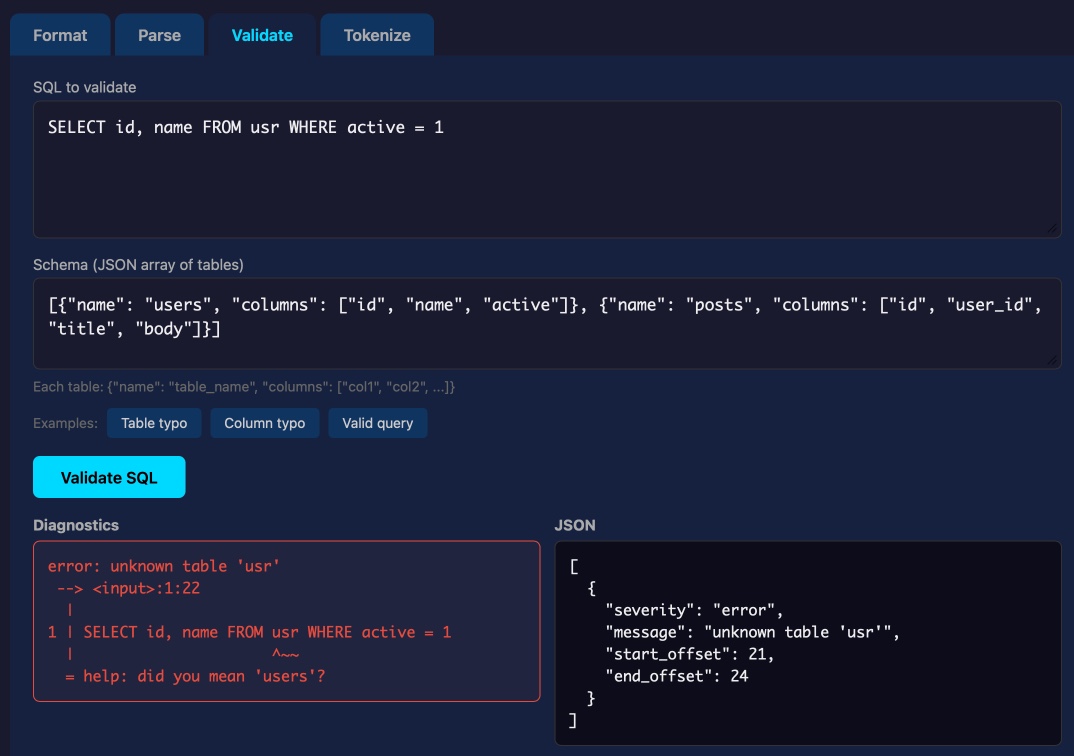
Update: not sure how I missed this but syntaqlite has its own WebAssembly playground linked to from the README.
I like publishing transcripts of local Claude Code sessions using my claude-code-transcripts tool but I'm often paranoid that one of my API keys or similar secrets might inadvertently be revealed in the detailed log files.
I built this new Python scanning tool to help reassure me. You can feed it secrets and have it scan for them in a specified directory:
uvx scan-for-secrets $OPENAI_API_KEY -d logs-to-publish/
If you leave off the -d it defaults to the current directory.
It doesn't just scan for the literal secrets - it also scans for common encodings of those secrets e.g. backslash or JSON escaping, as described in the README.
If you have a set of secrets you always want to protect you can list commands to echo them in a ~/.scan-for-secrets.conf.sh file. Mine looks like this:
llm keys get openai
llm keys get anthropic
llm keys get gemini
llm keys get mistral
awk -F= '/aws_secret_access_key/{print $2}' ~/.aws/credentials | xargs
I built this tool using README-driven-development: I carefully constructed the README describing exactly how the tool should work, then dumped it into Claude Code and told it to build the actual tool (using red/green TDD, naturally.)
A fun thing about recording a podcast with a professional like Lenny Rachitsky is that his team know how to slice the resulting video up into TikTok-sized short form vertical videos. Here's one he shared on Twitter today which ended up attracting over 1.1m views!
That was 48 seconds. Our full conversation lasted 1 hour 40 minutes.
Highlights from my conversation about agentic engineering on Lenny’s Podcast
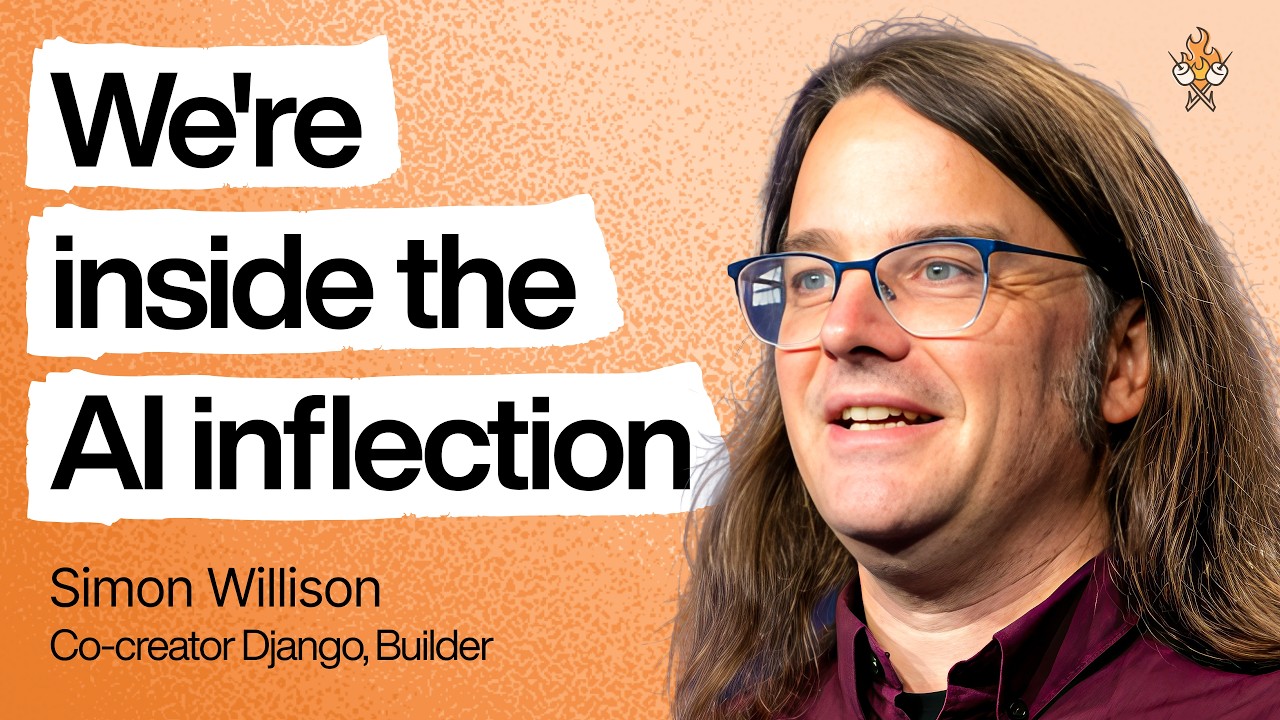
I was a guest on Lenny Rachitsky’s podcast, in a new episode titled An AI state of the union: We’ve passed the inflection point, dark factories are coming, and automation timelines. It’s available on YouTube, Spotify, and Apple Podcasts. Here are my highlights from our conversation, with relevant links.
[... 3,558 words]I want to argue that AI models will write good code because of economic incentives. Good code is cheaper to generate and maintain. Competition is high between the AI models right now, and the ones that win will help developers ship reliable features fastest, which requires simple, maintainable code. Good code will prevail, not only because we want it to (though we do!), but because economic forces demand it. Markets will not reward slop in coding, in the long-term.
— Soohoon Choi, Slop Is Not Necessarily The Future
The thing about agentic coding is that agents grind problems into dust. Give an agent a problem and a while loop and - long term - it’ll solve that problem even if it means burning a trillion tokens and re-writing down to the silicon. [...]
But we want AI agents to solve coding problems quickly and in a way that is maintainable and adaptive and composable (benefiting from improvements elsewhere), and where every addition makes the whole stack better.
So at the bottom is really great libraries that encapsulate hard problems, with great interfaces that make the “right” way the easy way for developers building apps with them. Architecture!
While I’m vibing (I call it vibing now, not coding and not vibe coding) while I’m vibing, I am looking at lines of code less than ever before, and thinking about architecture more than ever before.
— Matt Webb, An appreciation for (technical) architecture