95 posts tagged “testing”
2023
promptfoo: How to benchmark Llama2 Uncensored vs. GPT-3.5 on your own inputs. promptfoo is a CLI and library for “evaluating LLM output quality”. This tutorial in their documentation about using it to compare Llama 2 to gpt-3.5-turbo is a good illustration of how it works: it uses YAML files to configure the prompts, and more YAML to define assertions such as “not-icontains: AI language model”.
pytest-icdiff (via) This is neat: “pip install pytest-icdiff” provides an instant usability upgrade to the output of failed tests in pytest, especially if the assertions involve comparing larger strings or nested JSON objects.
pyfakefs usage (via) New to me pytest fixture library that provides a really easy way to mock Python’s filesystem functions—open(), os.path.listdir() and so on—so a test can run against a fake set of files. This looks incredibly useful.
How to simulate a broken database connection for testing in Django (via) Neil Kakkar explores the options using unittest.patch() and then settles on a neater pattern using “with connection.execute_wrapper(QueryTimeoutWrapper()):” to simulate the exact exception he needs to test against.
2022
Coping strategies for the serial project hoarder
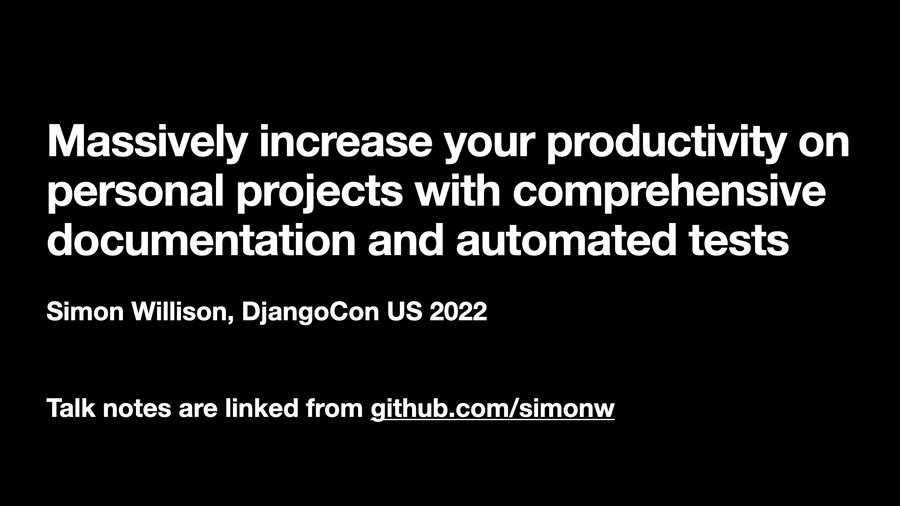
I gave a talk at DjangoCon US 2022 in San Diego last month about productivity on personal projects, titled “Massively increase your productivity on personal projects with comprehensive documentation and automated tests”.
[... 3,865 words]mitsuhiko/insta (via) I asked for recommendations on Twitter for testing libraries in other languages that would give me the same level of delight that I get from pytest. Two people pointed me to insta by Armin Ronacher, a Rust testing framework for “snapshot testing” which automatically records reference values to your repository, so future tests can spot if they change.
The Perfect Commit
For the last few years I’ve been trying to center my work around creating what I consider to be the Perfect Commit. This is a single commit that contains all of the following:
[... 2,061 words]Software engineering practices
Gergely Orosz started a Twitter conversation asking about recommended “software engineering practices” for development teams.
[... 1,557 words]viewport-preview (via) I built a tiny tool which lets you preview a URL in a bunch of different common browser viewport widths, using iframes.
I discovered a while ago that all those errors and bugs that only appear when you demo something to an audience also magically appear when you record yourself demoing it to nobody. Maybe narrating a feature to a pretend audience takes the blinders off enough that you notice little mistakes you wouldn't have otherwise.
Running C unit tests with pytest (via) Brilliant, detailed tutorial by Gabriele Tornetta on testing C code using pytest, which also doubles up as a ctypes tutorial. There’s a lot of depth here—in addition to exercising C code through ctypes, Gabriele shows how to run each test in a separate process so that segmentation faults don’t fail the entire suite, then adds code to run the compiler as part of the pytest run, and then shows how to use gdb trickery to generate more useful stack traces.
How I build a feature
I’m maintaining a lot of different projects at the moment. I thought it would be useful to describe the process I use for adding a new feature to one of them, using the new sqlite-utils create-database command as an example.
[... 2,850 words]2021
PAGNIs: Probably Are Gonna Need Its
Luke Page has a great post up with his list of YAGNI exceptions.
[... 1,289 words]I’m pretty convinced that the biggest single contributor to improved software in my lifetime wasn’t object-orientation or higher-level languages or functional programming or strong typing or MVC or anything else: It was the rise of testing culture.
— Tim Bray
When you have to mock a collaborator, avoid using the Mock object directly. Either use mock.create_autospec() or mock.patch(autospec=True) if at all possible. Autospeccing from the real collaborator means that if the collaborator's interface changes, your tests will fail. Manually speccing or not speccing at all means that changes in the collaborator's interface will not break your tests that use the collaborator: you could have 100% test coverage and your library would fall over when used!
Blazing fast CI with pytest-split and GitHub Actions (via) pytest-split is a neat looking variant on the pattern of splitting up a test suite to run different parts of it in parallel on different machines. It involves maintaining a periodically updated JSON file in the repo recording the average runtime of different tests, to enable them to be more fairly divided among test runners. Includes a recipe for running as a matrix in GitHub Actions.
Litestream runs continuously on a test server with generated load and streams backups to S3. It uses physical replication so it'll actually restore the data from S3 periodically and compare the checksum byte-for-byte with the current database.
2020
How to cheat at unit tests with pytest and Black
I’ve been making a lot of progress on Datasette Cloud this week. As an application that provides private hosted Datasette instances (initially targeted at data journalists and newsrooms) the majority of the code I’ve written deals with permissions: allowing people to form teams, invite team members, promote and demote team administrators and suchlike.
[... 933 words]2019
parameterized. I love the @parametrize decorator in pytest, which lets you run the same test multiple times against multiple parameters. The only catch is that the decorator in pytest doesn’t work for old-style unittest TestCase tests, which means you can’t easily add it to test suites that were built using the older model. I just found out about parameterized which works with unittest tests whether or not you are running them using the pytest test runner.
2018
The interesting ideas in Datasette
Datasette (previously) is my open source tool for exploring and publishing structured data. There are a lot of ideas embedded in Datasette. I realized that I haven’t put many of them into writing.
[... 2,857 words]Datasette unit tests: monkeytype_call_traces (via) Faceted browse against every function call that occurs during the execution of Datasette’s test suite. I used Instagram’s MonkeyType tool to generate this, which can run Python code and generates a SQLite database of all of the traced calls. It’s intended to be used to automatically add mypy annotations to your code, but since it produces a SQLite database as a by-product I’ve started exploring the intermediary format using Datasette. Generating this was as easy as running “monkeytype run `which pytest`” in the Datasette root directory.
Hynek Schlawack: Testing & Packaging (via) “How to ensure that your tests run code that you think they are running, and how to measure your coverage over multiple tox runs (in parallel!)”—Hynek makes a convincing argument for putting your packaged Python code in a src/ directory for ease of testing and coverage.
2017
I’ve heard managers and teams mandating 100% code coverage for applications. That’s a really bad idea. The problem is that you get diminishing returns on our tests as the coverage increases much beyond 70% (I made that number up… no science there). Why is that? Well, when you strive for 100% all the time, you find yourself spending time testing things that really don’t need to be tested. Things that really have no logic in them at all (so any bugs could be caught by ESLint and Flow). Maintaining tests like this actually really slow you and your team down.
How to set up world-class continuous deployment using free hosted tools
I’m going to describe a way to put together a world-class continuous deployment infrastructure for your side-project without spending any money.
[... 1,294 words]Cypress (via) Promising looking new open source testing framework for full-blown web integration testing—a modern alternative to Selenium. I spent five minutes playing with the demo and was really impressed by it—especially their “time travel” feature which lets you hover over a passed test and see the state of the browser when each of those assertions was executed.
2011
One interesting quirk of Pinboard is a complete absence of unit tests. I used to be a die-hard believer in testing, but in Pinboard tried a different approach, as an experiment. Instead of writng tests I try to be extremely careful in coding, and keep the code size small so I continue to understand it. I've found my defect rate to be pretty comparable to earlier projects that included extensive test suites and fixtures, but I am much more productive on Pinboard.
2010
Flask 0.1 Released. Armin’s Flask (a Python microframework built around Werkzeug and Jinja2) is looking pretty solid for a two week old project—extensive documentation, comprehensive unit test support (and example applications with unit tests) and some very tidy API design.
Unit Testing Achievements. A plugin for Python’s nose test runner that adds achievements—“Night Shift: Make a failing suite pass between 12am and 5am.”
twitter-text-conformance (via) This is a neat idea: Twitter have released open source libraries for parsing standard tweet syntax in Ruby and Java, but they’ve also released a set of YAML unit tests aimed at anyone who wants to implement the same parsing logic in other languages.