Elsewhere
Release TIL Research Tool Museum Sighting Comment
Filters: Sorted by date
- More color! Bar and waffle charts without a color column are shaded by magnitude with a sequential color scheme; color columns holding text values use the
observable10categorical scheme. #2- Now checks
execute-sqlpermission before running the query to find the column names.- Charts now display interactive tooltips.
- Fixed a bug where
waffleYcharts were not described to the agent.

- New model
gemini-3.5-flashfor Gemini 3.5 Flash.
See also my notes on Gemini 3.5 Flash, and the pelican I drew using this upgrade to the plugin.
- Fixed bug tracking chains of responses. Refs datasette-llm#7
- Compatible with
llm>=0.32a0alpha - adds the ability to stream reasoning tokens.
- Fix for bug where
llm_prompt_context()hook did not fully collect chains of responses. #7


I'm heading home from PyCon US today so I went on a last morning walk to try and spot a pelican. I saw one! Didn't get a great photo of that, but I did see some goslings down by the swan boat lake.
Part of the infrastructure I use for publishing my iNaturalist sightings on my blog. I've been running this in production for a few weeks now, inspiring some iterations on how it works, so I decided to ship a 0.1 release.
You can see an example of the output in this JSON file.


I went for a bird walk in the morning before PyCon, and we spotted a local seagull enjoying a Starbucks.
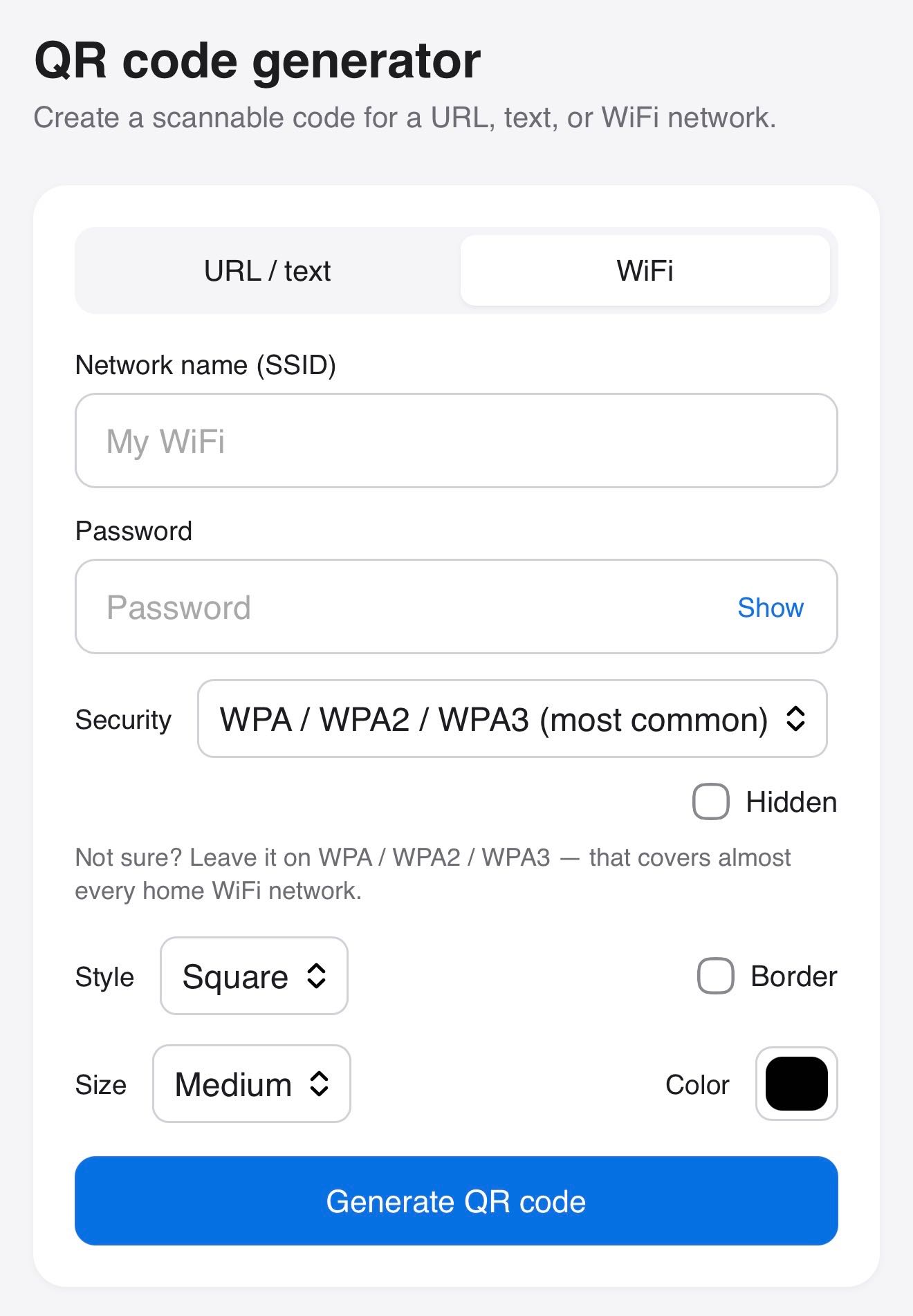
Claude helped me build this tool for creating QR codes, for both text/URLs and for connecting to WiFi networks.
This plugin works in conjunction with datasette-llm and datasette-llm-accountant to let you configure a per-user (or global) spending limit for LLM usage inside of Datasette. Configuration looks something like this:
plugins:
  datasette-llm-limits:
    limits:
      per-user-daily:
        scope: actor
        window: rolling-24h
        amount_usd: 1.00
- Tool availability can now be attached to a
required_permission. The default background agent tools now require the newdatasette-agent-backgroundpermission. #10
- Now uses the
execute-sqlpermission when deciding which tables to list to the user. #8
The datasette.io site was being hammered by poorly-behaved crawlers, so I had Codex (GPT-5.5 xhigh) build a configurable rate limiting plugin to block IPs that were hammering specific areas of the site too quickly.
Here's the production configuration I'm using on that site for the new plugin:
  datasette-ip-rate-limit:
    header: Fly-Client-IP
    max_keys: 10000
    exempt_paths:
    - "/static/*"
    - "/-/turnstile*"
    rules:
    - name: demo-databases
      paths:
      - "/global-power-plants/*"
      - "/legislators/*"
      window_seconds: 60
      max_requests: 60
      block_seconds: 20


An experiment that shows that you can load an app in a CSP-protected sandboxed iframe (see previous note) and have a custom fetch() that intercepts CSP errors and passes them up to the parent window... which can then prompt the user to add that domain to an allow-list and then refresh the page.
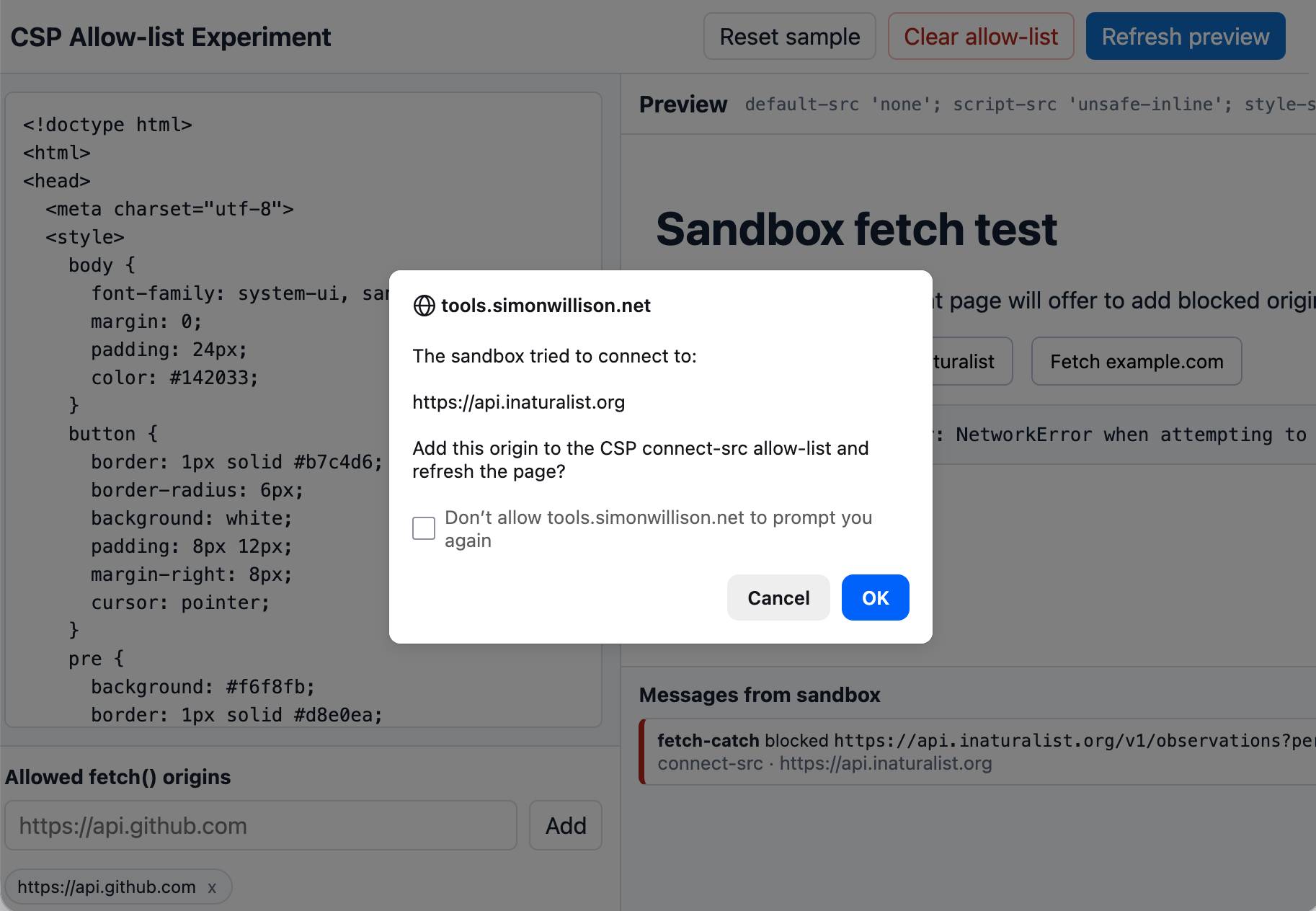
I built this one with GPT-5.5 xhigh running in the Codex desktop app.


- New
TokenRestrictions.abbreviated(datasette)utility method for creating"_r"dictionaries. #2695- Table headers and column options are now visible even if a table contains zero rows. #2701
- Fixed bug with display of column actions dialog on Mobile Safari. #2708
- Fixed bug where tests could crash with a segfault due to a race condition between
Datasette.close()andDatabase.close(). #2709
That segfault bug was gnarly. I added a mechanism to Datasette recently that would automatically close connections at the end of each test, but it turned out that introduced a race condition where an in-flight query could sometimes be executing in a thread against a connection while it was being closed. I ended up solving that by having Codex CLI (with GPT-5.5 xhigh) create a minimal Dockerfile that recreated the bug.
- Initial (silent) alpha release.
A bunch of useful stuff in this LLM alpha, but the most important detail is this one:
Most reasoning-capable OpenAI models now use the
/v1/responsesendpoint instead of/v1/chat/completions. This enables interleaved reasoning across tool calls for GPT-5 class models. #1435
This means you can now see the summarized reasoning tokens when you run prompts against an OpenAI model, displayed in a different color to standard error. Use the -R or --hide-reasoning flags if you don't want to see that.
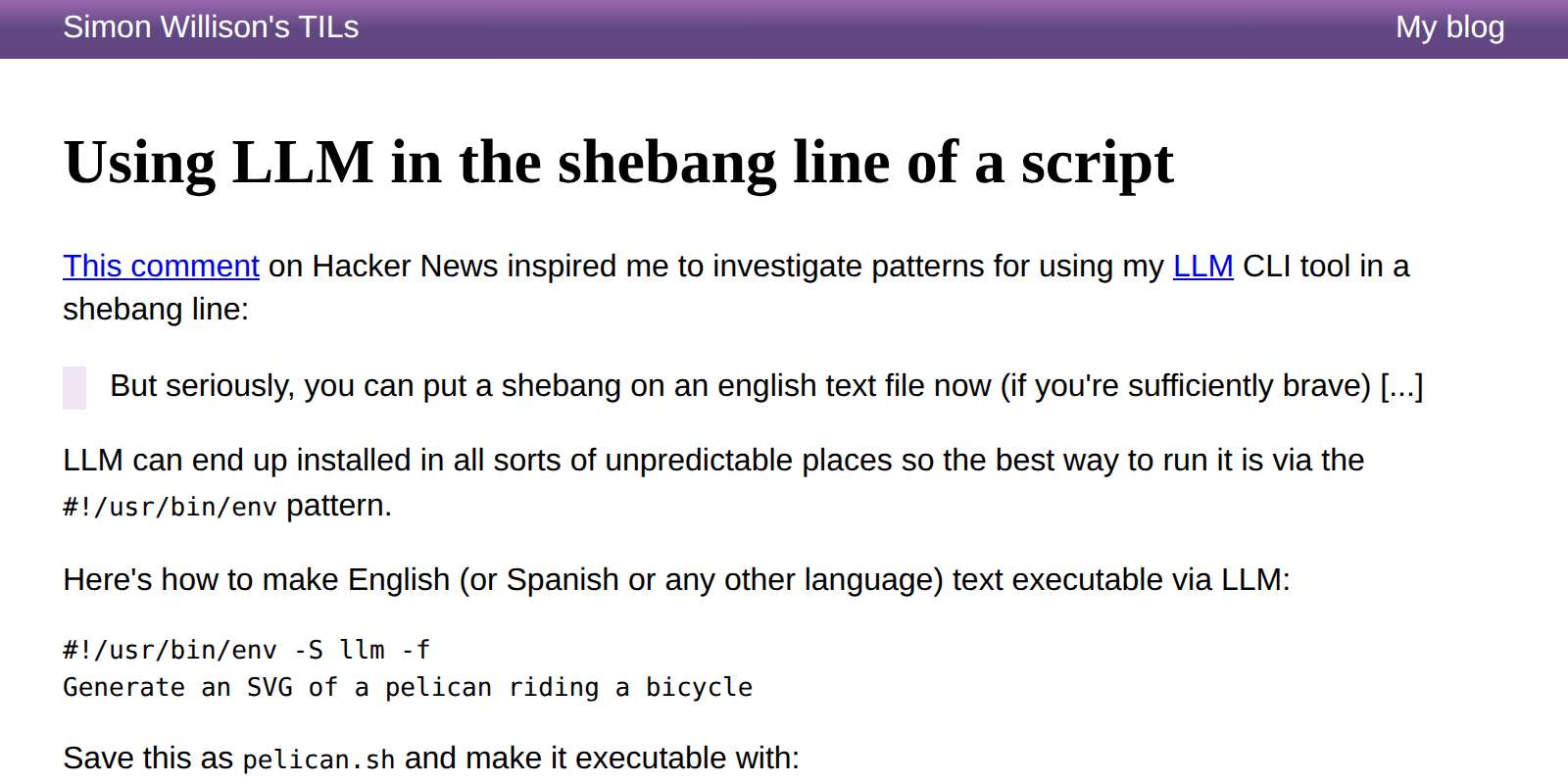
Kim_Bruning on Hacker News:
But seriously, you can put a shebang on an english text file now (if you're sufficiently brave) [...]
This inspired me to look at patterns for doing exactly that with LLM. Here's the simplest, which takes advantage of LLM fragments:
#!/usr/bin/env -S llm -f
Generate an SVG of a pelican riding a bicycle
But you can also incorporate tool calls using the -T name_of_tool option:
#!/usr/bin/env -S llm -T llm_time -f
Write a haiku that mentions the exact current time
Or even execute YAML templates directly that define extra tools as Python functions:
#!/usr/bin/env -S llm -t
model: gpt-5.4-mini
system: |
  Use tools to run calculations
functions: |
  def add(a: int, b: int) -> int:
      return a + b
  def multiply(a: int, b: int) -> int:
      return a * b
Then:
./calc.sh 'what is 2344 * 5252 + 134' --td
Which outputs (thanks to that --td tools debug option):
Tool call: multiply({'a': 2344, 'b': 5252})
  12310688

Tool call: add({'a': 12310688, 'b': 134})
  12310822

2344 × 5252 + 134 = **12,310,822**
Read the full TIL for a more complex example that uses the Datasette SQL API to answer questions about content on my blog.
gemini-3.1-flash-liteis no longer a preview.
Here's my write-up of the Gemini 3.1 Flash-Lite Preview model back in March. I don't believe this new non-preview model has changed since then.
I'm using my vibe coded macOS presentations tool to put together a talk, and I wanted to add a slide with some text on it. The tool only accepts URLs, so I put together a quick page that accepts query string arguments and turns them into a simple slide.
Here's an example: https://tools.simonwillison.net/big-words?text=simonwillison.net&gradient=1&size=9.5
Double click or double tap the page to access a form for modifying the different options.

One of the things I always look for when evaluating a new GitHub repository is the number of commits it has... but that number isn't visible on GitHub's mobile site layout. I built this tool to fix that, using this prompt:
Given a GitHub repo URL or foo/bar repo ID show information about that repo absorbed via wither REST or graphql CORS fetch() including the number of commits in the repo and other useful stats
Example output for simonw/datasette and simonw/llm.
The OpenStreetMap tiles on the Datasette global-power-plants demo weren't displaying correctly. This turned out to be caused by two bugs.
The first is that the CAPTCHA I added to that site a few weeks ago was triggering for the .json fetch requests used by the map plugin, and since those weren't HTML the user was not being asked to solve them. Here's the fix.
The second was that OpenStreetMap quite reasonably block tile requests from sites that use a Referrer-Policy: no-referrer header.
Datasette does this by default, and I didn't want to change that default on people without warning - so I had Codex + GPT-5.5 build me a new plugin to help set that header to another value.
- Mechanism for configuring default options for specific models.
Part of Datasette's evolving support mechanism for plugins that use LLMs. It's now possible to configure a model with default options, e.g. to say all enrichment operations should use a specific model with temperature set to 0.5.
- New
-o thinking 1option to help test against LLM 0.32a0 and higher.
This plugin provides a fake model called "echo" for LLM which doesn't run an LLM at all - it's useful for writing automated tests. You can now do this:
uvx --with llm==0.32a1 --with llm-echo==0.5a0 llm -m echo hi -o thinking 1
This will fake a reasoning block to standard error before returning JSON echoing the prompt.