Elsewhere
Release TIL Research Tool Museum Sighting Comment
Filters: Sorted by date
If it's good enough for antirez to add to Redis I figured Ville Laurikari's TRE regular expression engine was worth exploring in a little more detail.
I had Claude Code build an experimental Python binding (it used ctypes) and try some malicious regular expression attacks against the library. TRE handles those much better than Python's standard library implementation, thanks mainly to the lack of support for backtracking.
Salvatore Sanfilippo submitted a PR adding a new data type - arrays - to Redis.
The new commands are ARCOUNT, ARDEL, ARDELRANGE, ARGET, ARGETRANGE, ARGREP, ARINFO, ARINSERT, ARLASTITEMS, ARLEN, ARMGET, ARMSET, ARNEXT, AROP, ARRING, ARSCAN, ARSEEK, ARSET.
The implementation is currently available in a branch, so I had Claude Code for web build this interactive playground for trying out the new commands in a WASM-compiled build of a subset of Redis running in the browser.
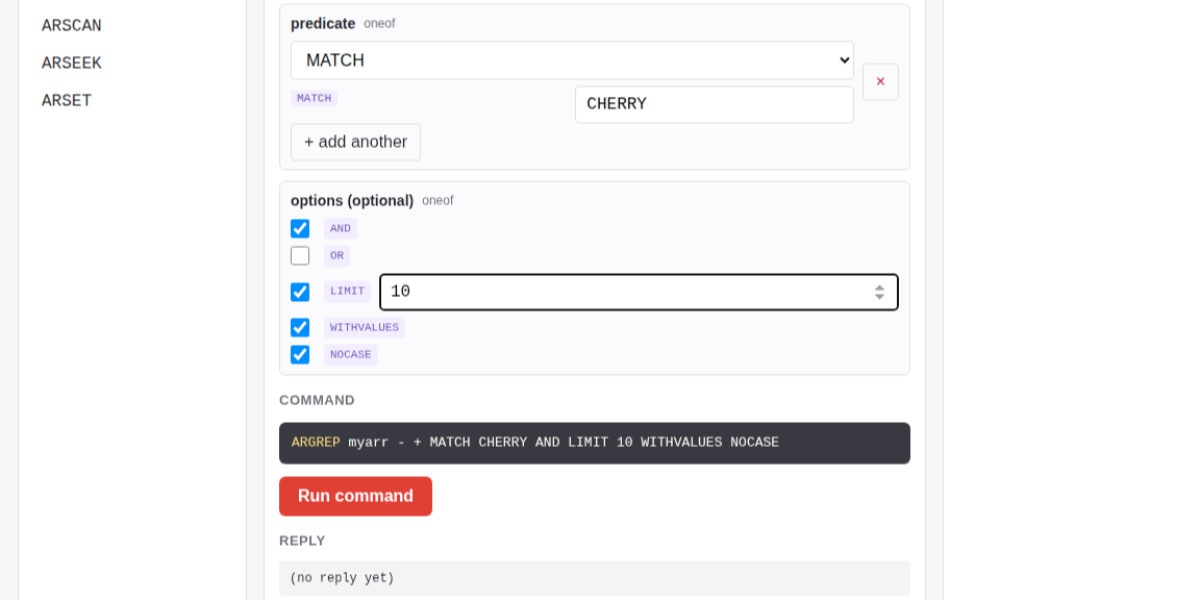
The most interesting new command is ARGREP which can run a server-side grep against a range of values in the array using the newly vendored TRE regex library.
Salvatore wrote more about the AI-assisted development process for the array type in Redis array type: short story of a long development.


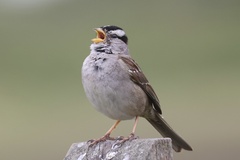
I wanted to see my iNaturalist observations - across two separate accounts - grouped by when they occurred. I'm camping this weekend so I built this entirely on my phone using Claude Code for web.
I started by building an inaturalist-clumper Python CLI for fetching and "clumping" observations - by default clumps use observations within 2 hours and 5km of each other.
Then I setup simonw/inaturalist-clumps as a Git scraping repository to run that tool and record the result to clumps.json.
That JSON file is hosted on GitHub, which means it can be fetched by JavaScript using CORS.
Finally I ran this prompt against my simonw/tools repo:
Build inat-sightings.html - an app that does a fetch() against https://raw.githubusercontent.com/simonw/inaturalist-clumps/refs/heads/main/clumps.json and then displays all of the observations on one page using the https://static.inaturalist.org/photos/538073008/small.jpg small.jpg URLs for the thumbnails - with loading=lazy - but when a thumbnail is clicked showing the large.jpg in an HTML modal. Both small and large should include the common species names if available


- Fixed a bug in 0.32a0 where tool-calling conversations were not correctly reinflated from SQLite. #1426


- New GPT-5.5 OpenAI model:
llm -m gpt-5.5. #1418- New option to set the text verbosity level for GPT-5+ OpenAI models:
-o verbosity low. Values arelow,medium,high.- New option for setting the image detail level used for image attachments to OpenAI models:
-o image_detail low- values arelow,highandauto, and GPT-5.4 and 5.5 also acceptoriginal.- Models listed in
extra-openai-models.yamlare now also registered as asynchronous. #1395
LLM reports prompt durations in milliseconds and I got fed up of having to think about how to convert those to seconds and minutes.
Hijacks your Codex CLI credentials to make API calls with LLM, as described in my post about GPT-5.5.
llm openrouter refreshcommand for refreshing the list of available models without waiting for the cache to expire.
I added this feature so I could try Kimi 2.6 on OpenRouter as soon as it became available there.
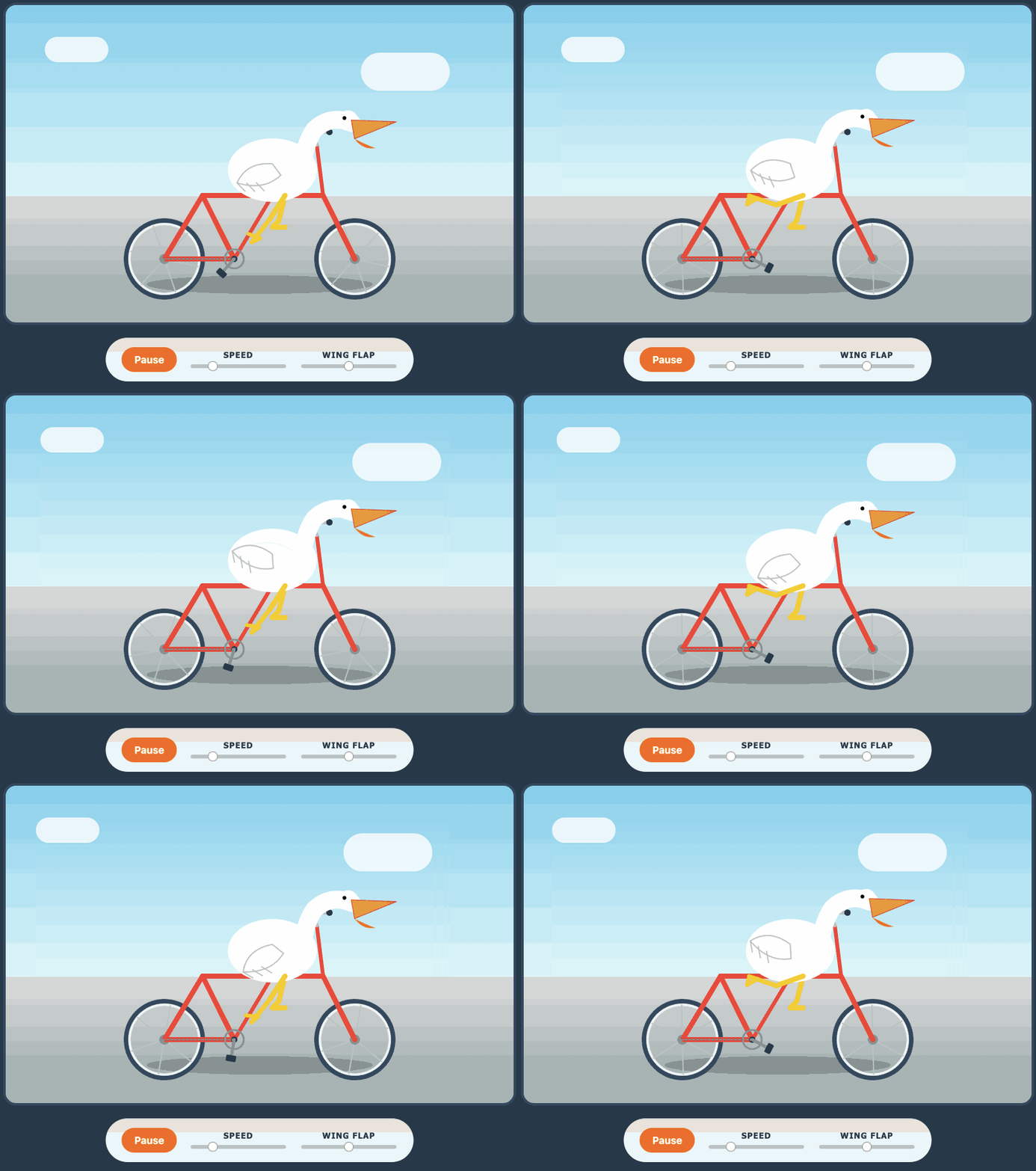
Here's its pelican - this time as an HTML page because Kimi chose to include an HTML and JavaScript UI to control the animation. Transcript here.
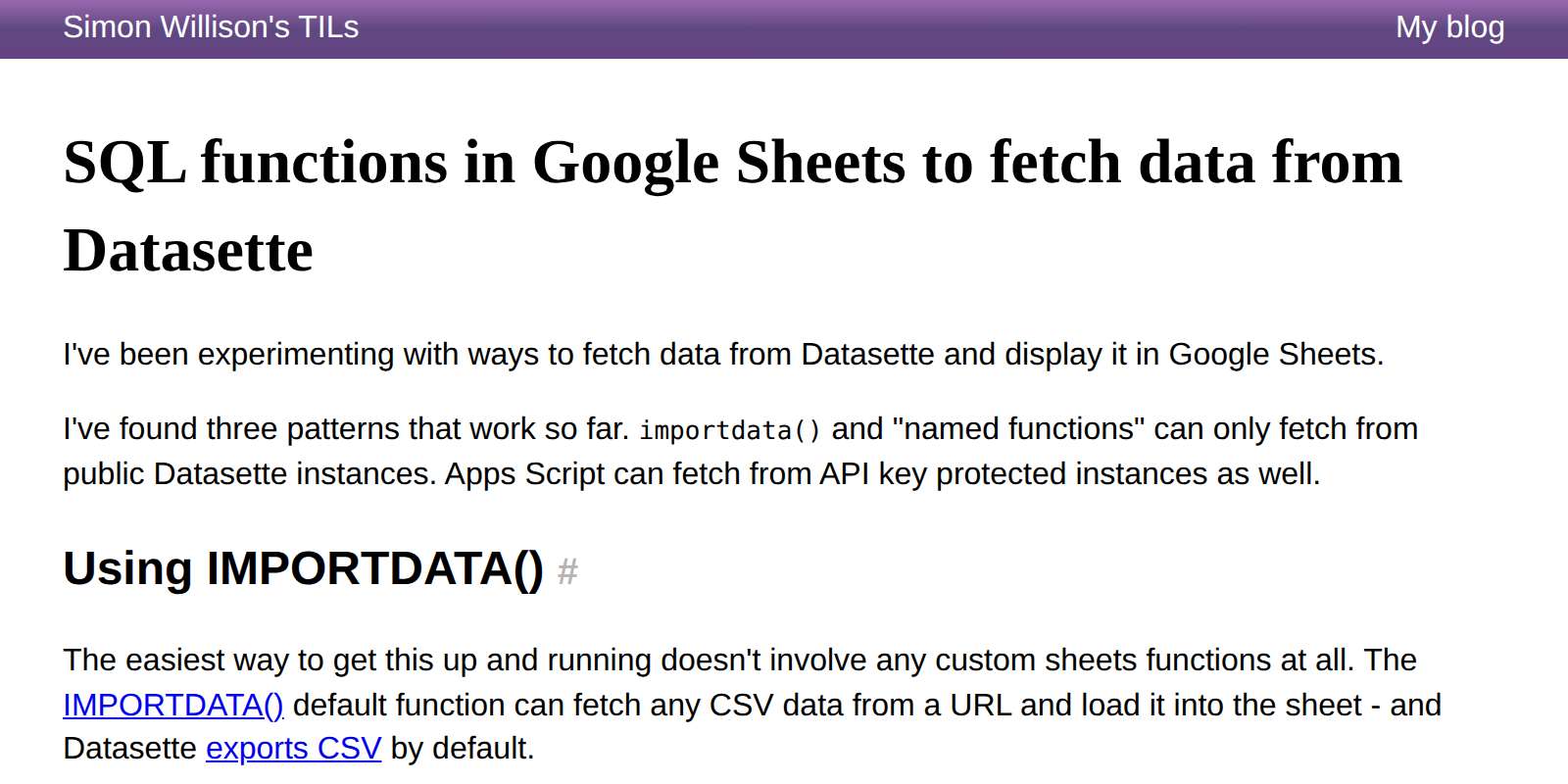
I put together some notes on patterns for fetching data from a Datasette instance directly into Google Sheets - using the importdata() function, a "named function" that wraps it or a Google Apps Script if you need to send an API token in an HTTP header (not supported by importdata().)
Here's an example sheet demonstrating all three methods.
Anthropic publish the system prompts for Claude chat and make that page available as Markdown. I had Claude Code turn that page into separate files for each model and model family with fake git commit dates to enable browsing the changes via the GitHub commit view.
I used this to write my own detailed notes on the changes between Opus 4.6 and 4.7.
I was upgrading Datasette Cloud to 1.0a27 and discovered a nasty collection of accidental breakages caused by changes in that alpha. This new alpha addresses those directly:
- Fixed a compatibility bug introduced in 1.0a27 where
execute_write_fn()callbacks with a parameter name other thanconnwere seeing errors. (#2691)- The database.close() method now also shuts down the write connection for that database.
- New datasette.close() method for closing down all databases and resources associated with a Datasette instance. This is called automatically when the server shuts down. (#2693)
- Datasette now includes a pytest plugin which automatically calls
datasette.close()on temporary instances created in function-scoped fixtures and during tests. See Automatic cleanup of Datasette instances for details. This helps avoid running out of file descriptors in plugin test suites that were written before theDatabase(is_temp_disk=True)feature introduced in Datasette 1.0a27. (#2692)
Most of the changes in this release were implemented using Claude Code and the newly released Claude Opus 4.7.
- New model:
claude-opus-4.7, which supportsthinking_effort:xhigh. #66- New
thinking_displayandthinking_adaptiveboolean options.thinking_displaysummarized output is currently only available in JSON output or JSON logs.- Increased default
max_tokensto the maximum allowed for each model.- No longer uses obsolete
structured-outputs-2025-11-13beta header for older models.
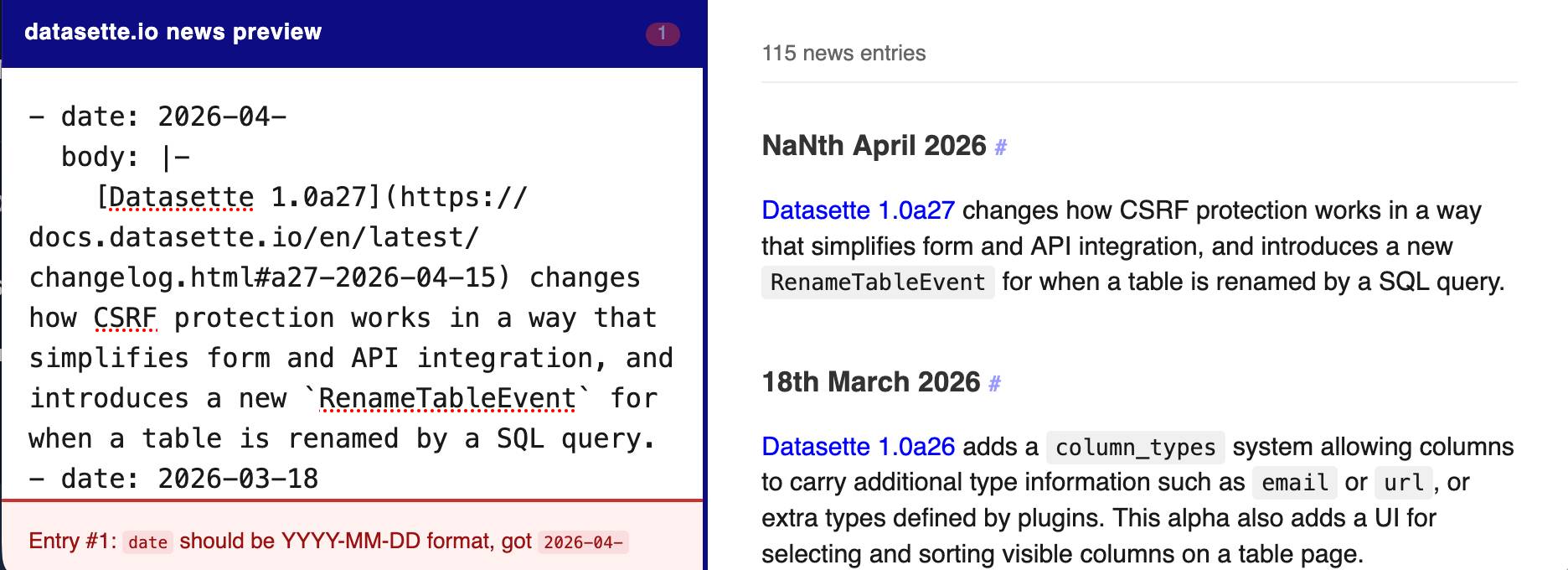
The datasette.io website has a news section built from this news.yaml file in the underlying GitHub repository. The YAML format looks like this:
- date: 2026-04-15
  body: |-
    [Datasette 1.0a27](https://docs.datasette.io/en/latest/changelog.html#a27-2026-04-15) changes how CSRF protection works in a way that simplifies form and API integration, and introduces a new `RenameTableEvent` for when a table is renamed by a SQL query.
- date: 2026-03-18
  body: |-
    ...
This format is a little hard to edit, so I finally had Claude build a custom preview UI to make checking for errors have slightly less friction.
I built it using standard claude.ai and Claude Artifacts, taking advantage of Claude's ability to clone GitHub repos and look at their content as part of a regular chat:
Clone https://github.com/simonw/datasette.io and look at the news.yaml file and how it is rendered on the homepage. Build an artifact I can paste that YAML into which previews what it will look like, and highlights any markdown errors or YAML errors
This plugin was using the ds_csrftoken cookie as part of a custom signed URL, which needed upgrading now that Datasette 1.0a27 no longer sets that cookie.
Two major changes in this new Datasette alpha. I covered the first of those in detail yesterday - Datasette no longer uses Django-style CSRF form tokens, instead using modern browser headers as described by Filippo Valsorda.
The second big change is that Datasette now fires a new RenameTableEvent any time a table is renamed during a SQLite transaction. This is useful because some plugins (like datasette-comments) attach additional data to table records by name, so a renamed table requires them to react in appropriate ways.
Here are the rest of the changes in the alpha:
- New actor= parameter for
datasette.clientmethods, allowing internal requests to be made as a specific actor. This is particularly useful for writing automated tests. (#2688)- New
Database(is_temp_disk=True)option, used internally for the internal database. This helps resolve intermittent database locked errors caused by the internal database being in-memory as opposed to on-disk. (#2683) (#2684)- The
/<database>/<table>/-/upsertAPI (docs) now rejects rows withnullprimary key values. (#1936)- Improved example in the API explorer for the
/-/upsertendpoint (docs). (#1936)- The
/<database>.jsonendpoint now includes an"ok": truekey, for consistency with other JSON API responses.- call_with_supported_arguments() is now documented as a supported public API. (#2678)
See my notes on Google's new Gemini 3.1 Flash TTS text-to-speech model.
A small update for my tool for helping me figure out what all of the Datasette instances on my laptop are up to.
- Show working directory derived from each PID
- Show the full path to each database file
Output now looks like this:
http://127.0.0.1:8007/ - v1.0a26
  Directory: /Users/simon/dev/blog
  Databases:
    simonwillisonblog: /Users/simon/dev/blog/simonwillisonblog.db
  Plugins:
    datasette-llm
    datasette-secrets
http://127.0.0.1:8001/ - v1.0a26
  Directory: /Users/simon/dev/creatures
  Databases:
    creatures: /tmp/creatures.db


In Servo is now available on crates.io the Servo team announced the initial release of the servo crate, which packages their browser engine as an embeddable library.
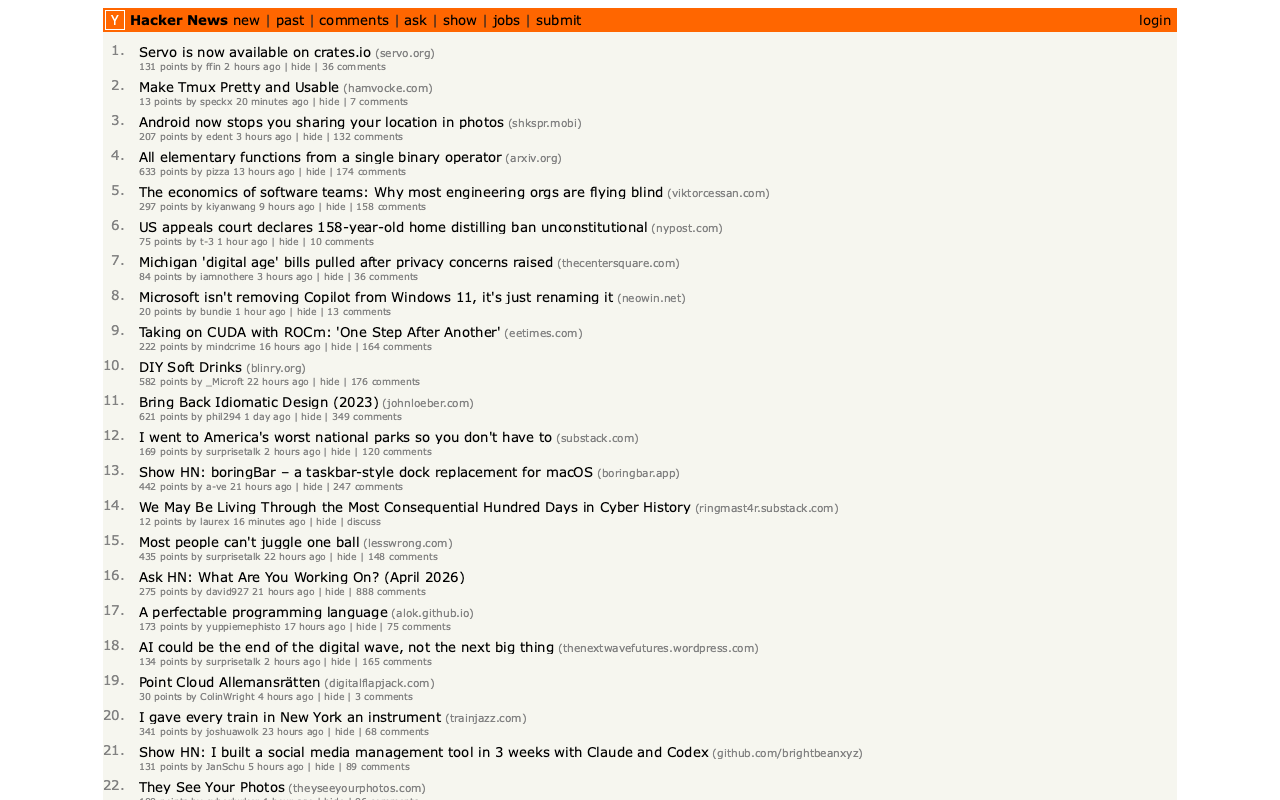
I set Claude Code for web the task of figuring out what it can do, building a CLI tool for taking screenshots using it and working out if it could be compiled to WebAssembly.
The servo-shot Rust tool it built works pretty well:
git clone https://github.com/simonw/research
cd research/servo-crate-exploration/servo-shot
cargo build
./target/debug/servo-shot https://news.ycombinator.com/
Here's the result:
Compiling Servo itself to WebAssembly is not feasible due to its heavy use of threads and dependencies like SpiderMonkey, but Claude did build me this playground page for trying out a WebAssembly build of the html5ever and markup5ever_rcdom crates, providing a tool for turning fragments of HTML into a parse tree.