Research
Filters: Sorted by date
I put the new Python 3.15 profiler through its paces by having GPT-6 Astra Extra High in Codex run it against my new web-edit app:
I need a Python 3.15 flame graph and heatmap demo of the "web-edit" app from PyPI - research first then make me those demos
Here's the resulting example flame graph and heatmap.
Colin Frasier posted on Bluesky about an experiment he ran over two years ago using GPT-4o to see how well it could "compute the sum but return the answer in words" across increasingly large numbers. Here's the chart he shared of those results:
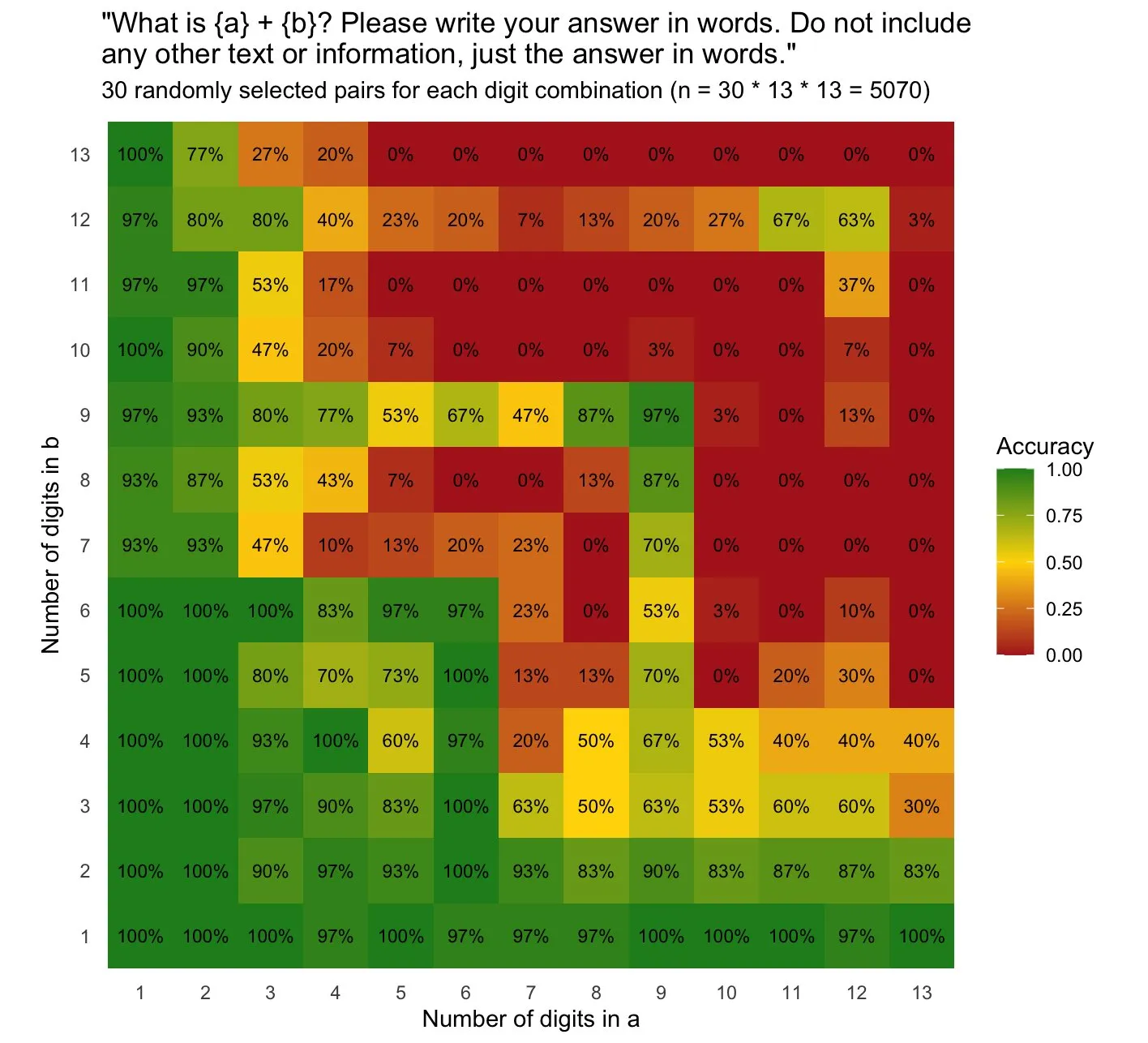
I'm confident GPT-4o didn't cheat and use a calculator, especially since it got so many of the calculations wrong, but I was inspired to run the experiment again on local hardware (a DGX Spark) to explore the effect in a fully controlled environment.
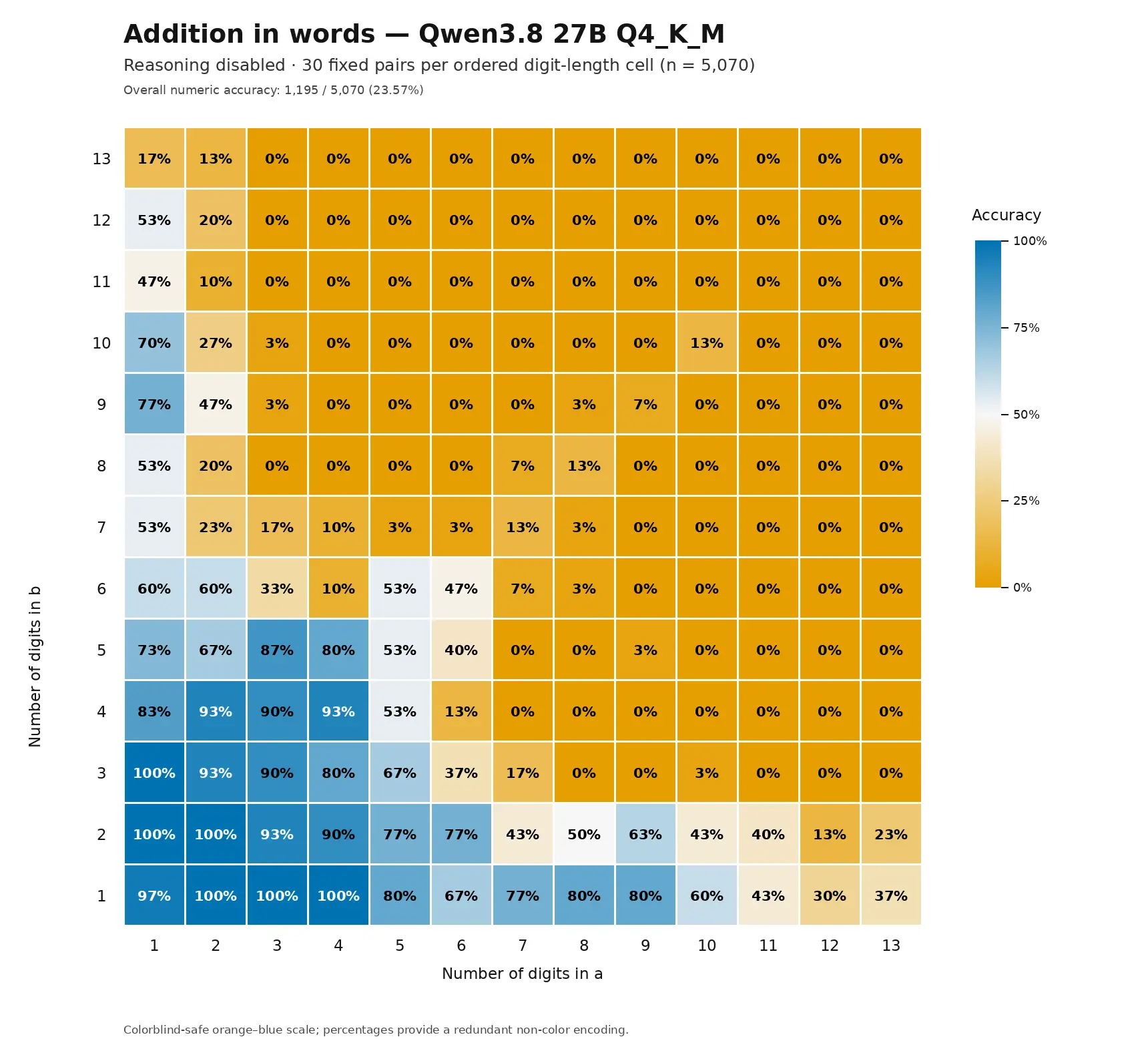
I pasted his image into a Codex Remote session (GPT-6 Astra) and had it run the same experiment using Qwen3.8-27B-Q4_K_M.gguf. Here's the result for a run of 30 attempts per combination with reasoning disabled:
Then I ran it again with reasoning enabled. This took a lot longer per pair, so instead of running 30 samples per square I ran just one - which results in a much less visually appealing heatmap since each square is either 100% or 0%:
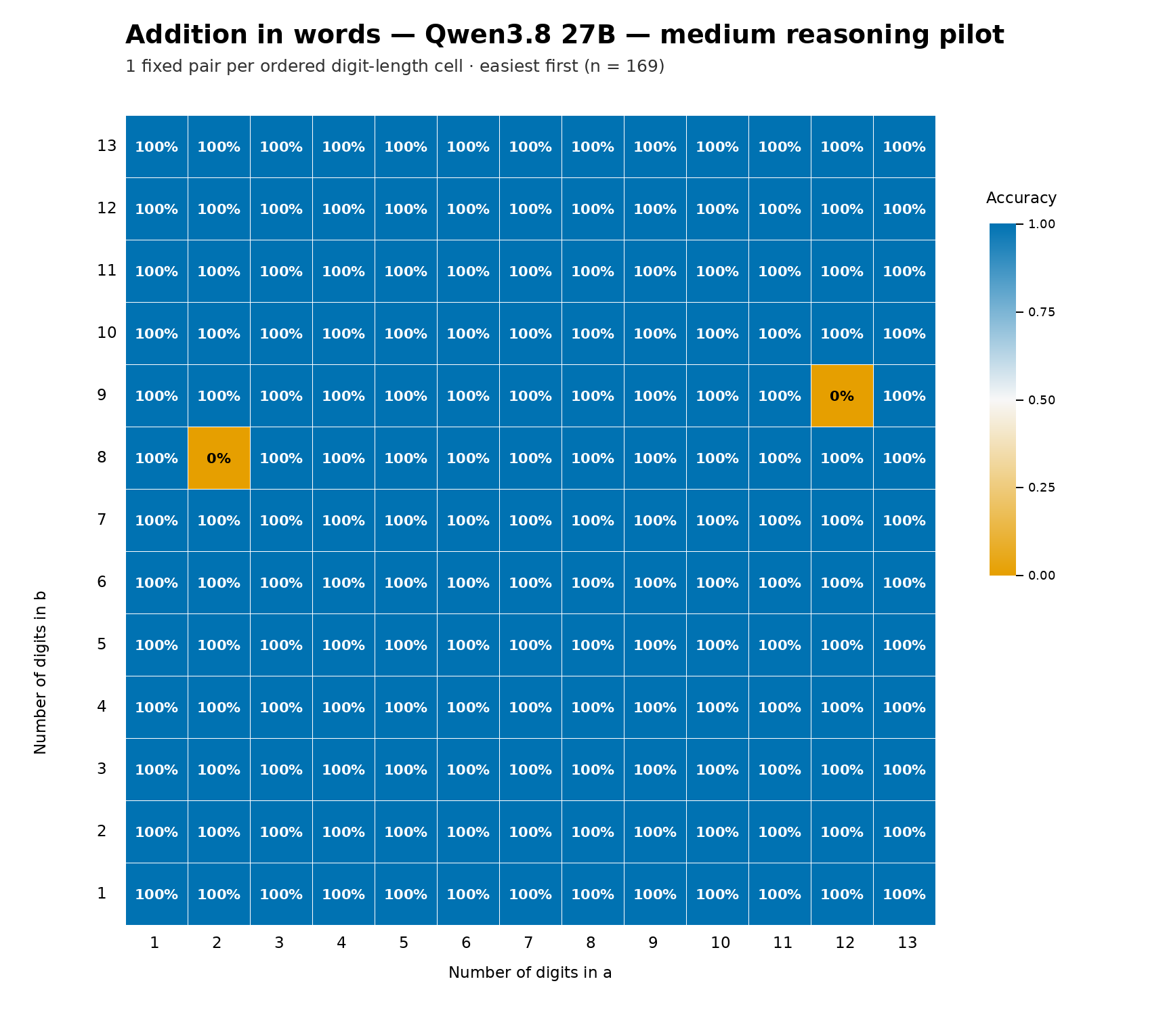
It got the right answer in 167 out of 169 attempts, and since these were one-shot I'm confident a second run would produce different results here.
Here's a version of the report that includes the reasoning traces from some of those larger calculations, which include text like this:
Wait, let me redo this more carefully.

4,299,366,105,622
6,088,794,067,970

Let me align them:
4 2 9 9 3 6 6 1 0 5 6 2 2
6 0 8 8 7 9 4 0 6 7 9 7 0

Adding from right to left:
Position 1 (units): 2 + 0 = 2
Position 2 (tens): 2 + 7 = 9
Position 3 (hundreds): 6 + 9 = 15, write 5, carry 1
Today saw the long awaited release of Bun 1.4, the first stable version since the infamous Rust rewrite a few months ago.
Interestingly, the Rust rewrite was downplayed in the release notes, which introduced a bewildering array of new features and claimed 2,900 additional bug fixes:
Bun 1.4 adds +1,517 tests from the Node.js test suite - our biggest jump in Node.js compatibility since Bun 1.0. Bun v1.4 also fixes over 2,900 issues. It reduces idle CPU usage by 5x, reduces memory usage by up to 35%, and starts 50% faster on Linux. It adds
Bun.Image,Bun.WebView,Bun.markdown,Bun.cron(),Bun.Terminal,bun run --parallel,bun test --parallel,bun audit fix,bun dedupe, andbun prune. And it rewrites Bun from Zig to Rust.
Of these the one that most caught my eye was Bun.WebView, which adds first class support for browser automation to Bun core using either macOS WebKit or control of a local Chromium process via the Chrome DevTools Protocol (CDP).
I had Claude Code for web build a prototype of a web API providing the ability to load a web page and then execute JavaScript against it, inspired by my shot-scraper javascript CLI tool - partly to see how much RAM would be needed by such a service.
Here's that TypeScript server implementation, which appears to need a 192MB-256MB container to run a full Chrome against complex web pages - tested using cgroups.
I tasked Claude Fable 5 running in Claude Code for web with the following research task:
Put https://smolmachines.com through its paces as a fast secure sandbox. Explore what it would take to use this to run untrusted Python and JavaScript code in a way that is limited in what RAM and CPU time it can take up (protection against "while true") with no network access and filesystem access only to designated files
Goal is to be able to use this to execute user-provided tasks for things like data transformations
It quickly ran into a problem: the Claude Code for web environment can't run smol machines. Quoting the notes it wrote:
- This Claude Code container: Linux 6.18.5-fc-v20 (itself a Firecracker guest), 4 vCPU, 15GB RAM. No /dev/kvm, no vmx/svm CPU flags → no nested virt.
smolvm machine runfails as expected: "kvm not available".- Plan B: GitHub Actions ubuntu runners DO expose /dev/kvm → run the real test battery via a temporary workflow on this branch, collect logs, remove workflow in final commit.
And Plan B is what it did, installing smolvm and running these tests directly in a GitHub Actions runner against that branch.
That was a creative solution to the environmental limits posed by Claude Code for web. Another example of Fable being relentlessly proactive.
I'm perennially interested in options for storing revision histories in relational databases. While out on a dog walk I had a new idea: how about taking the full text of every prior version in a big JSON array of strings and then applying zlib or zstd compression to the whole thing? Surely that would compress really well due to all of the repeated strings.
The new GPT‑Live voice mode in the ChatGPT iPhone app has got really good, so I discussed the prototype with that. You still can't share URLs to voice conversations, but here's what I said copied from the transcript as a proper stream of consciousness:
I have an interesting idea for a scheme for saving all previous versions of a piece of text that's constantly edited in a SQLite database um column in as efficient a way as possible. Okay, so I built these kinds of systems in the past, and it's always difficult to come up with a efficient way to do this. Like the easiest way is you have a row for every previous copy of the previous previous value of the string. But if it's a long document Like20 kilobytes of data, that means that every single edit adds another 20 kilobytes of data to the database, right. So, what I've now thinking, is um compression would work really well, right? If you Bundle all of those different um Every every version of this document all the way back to the start if you were to apply a good compression algorithm to them that should basically wipe out huge amounts of the redund- the um redundant text, right Um, so what I'd thinking is how about really, really simple mechanism There is a history column on the single on this uh uh table and it's a blob, it's a BLOB so it stores binary data and then you just stick in there a Zlib or maybe even ZSTD um compressed JSON text array of all of the previous documents, and so you probably have two columns, right? You'd have a column that's this magic JSON array of text You have a second column which is a JSON array of timestamps and that doesn't need to be compressed at all, right? A timestamp can just be a uh- it's an array of integers, right? Unix integers But that's the whole scheme.
Then I stopped voice mode and typed the following text prompt to GPT-5.6 Sol Pro:
Use Python and Build experimental prototypes around this idea
It churned away for 38 minutes and delivered this answer plus the files you see in this folder.
The approach works really well! 1,000 simulated revisions to a document resulted in 20.4 MB of raw revision text that compressed to 80.3 KB as Zstandard-compressed JSON array.
To avoid the overhead of decompressing and recompressing the entire array on every edit Sol suggested breaking the history up into multiple rows, with each one containing a maximum of either 128 revisions or 3MB of uncompressed JSON.
One of this morning's AIE keynotes covered dspy, which reminded me I've been meaning to see if it could help me improve the system prompt used by Datasette Agent - so I fired off an asynchronous research task in Claude Code for web using Claude Fable 5:
Pip install the latest Datasette alpha and datasette-agent and dspy - then figure out how to use dspy to evaluate and improve the main system prompts used by Datasette Agent for the feature where it can execute read only SQL queries to answer user questions about data.
Fable chose to test using GPT 4.1 mini and nano, and identified several promising looking directions for improvements. I particularly like this one:
The schema listing gives only table names; the "don't call describe_table if you already have the information" advice caused column-name guessing (page_count, o.order_id, first_name) and error-retry loops in baseline traces. Either include column names in the prompt's schema listing or soften that advice.
It would be neat if arbitrary SQL queries in Datasette could be rendered with additional information based on which columns from which tables were included in the results.
To build that, we would need to be able to look at a SQL query like select users.name, orders.total from users join orders on orders.user_id = users.id and programmatically identify the table.column for each result - navigating not just joins but also more complex syntax like CTEs.
I decided to set Claude Code (Opus 4.8, since Fable is currently banned by the US government) on the problem. It found several promising solutions - one using apsw, another that uses ctypes to access the SQLite sqlite3_column_table_name() C function (which is not otherwise exposed to Python), and one using clever interrogation of the output of EXPLAIN.
Datasette Lite is my version of Datasette that runs entirely in the browser using Pyodide in WebAssembly.
When I first built it four years ago I used Web Workers and code that intercepts navigation operations and fetches the generated HTML by running the Python app.
This worked, but had the disadvantage that any JavaScript in <script> tags would not be executed - breaking some Datasette functionality and a whole lot of Datasette plugins.
This morning I set Claude Opus 4.8 the task (in Claude Code for web) of figuring out how to run Python ASGI apps in Pyodide using Service Workers instead, and it seems to work! Here's a basic ASGI FastCGI demo and here's a demo that runs Datasette 1.0a31.
I'm still getting my head around exactly how it works, but once I've done that I plan to upgrade Datasette Lite itself.
It's been a few months since I last poked at Monty, the sandboxed subset of Python implemented in Rust. I had Claude Code look at the most recent release.
Importantly the max_duration_secs, max_memory, max_allocations, and max_recursion_depth settings all appear to work as advertised.
If it's good enough for antirez to add to Redis I figured Ville Laurikari's TRE regular expression engine was worth exploring in a little more detail.
I had Claude Code build an experimental Python binding (it used ctypes) and try some malicious regular expression attacks against the library. TRE handles those much better than Python's standard library implementation, thanks mainly to the lack of support for backtracking.
Anthropic publish the system prompts for Claude chat and make that page available as Markdown. I had Claude Code turn that page into separate files for each model and model family with fake git commit dates to enable browsing the changes via the GitHub commit view.
I used this to write my own detailed notes on the changes between Opus 4.6 and 4.7.
In Servo is now available on crates.io the Servo team announced the initial release of the servo crate, which packages their browser engine as an embeddable library.
I set Claude Code for web the task of figuring out what it can do, building a CLI tool for taking screenshots using it and working out if it could be compiled to WebAssembly.
The servo-shot Rust tool it built works pretty well:
git clone https://github.com/simonw/research
cd research/servo-crate-exploration/servo-shot
cargo build
./target/debug/servo-shot https://news.ycombinator.com/
Here's the result:

Compiling Servo itself to WebAssembly is not feasible due to its heavy use of threads and dependencies like SpiderMonkey, but Claude did build me this playground page for trying out a WebAssembly build of the html5ever and markup5ever_rcdom crates, providing a tool for turning fragments of HTML into a parse tree.
Inspired by this conversation on Hacker News about whether two SQLite processes in separate Docker containers that share the same volume might run into problems due to WAL shared memory. The answer is that everything works fine - Docker containers on the same host and filesystem share the same shared memory in a way that allows WAL to collaborate as it should.
In trying to build my own version of Claude Artifacts I got curious about options for applying CSP headers to content in sandboxed iframes without using a separate domain to host the files. Turns out you can inject <meta http-equiv="Content-Security-Policy"...> tags at the top of the iframe content and they'll be obeyed even if subsequent untrusted JavaScript tries to manipulate them.
Stuart Breckenridge pointed out that PC Gamer Recommends RSS Readers in a 37MB Article That Just Keeps Downloading, highlighting a truly horrifying example of web bloat that added up to 100s more MBs thanks to auto-playing video ads. I decided to have Claude Code for web use Rodney to investigate the page - prompt here.
Aaron Harper wrote about Node.js worker threads, which inspired me to run a research task to see if they might help with running JavaScript in a sandbox. Claude Code went way beyond my initial question and produced a comparison of isolated-vm, vm2, quickjs-emscripten, QuickJS-NG, ShadowRealm, and Deno Workers.
I had Claude Code run a micro-benchmark comparing different approaches to implementing tagging in SQLite. Traditional many-to-many tables won, but FTS5 came a close second. Full table scans with LIKE queries performed better than I expected, but full table scans with JSON arrays and json_each() were much slower.
Luau is an MIT licensed "small, fast, and embeddable programming language based on Lua with a gradual type system", created by Roblox.
As part of my ongoing obsession with sandboxed runtimes I decided to see if I could get it working via WebAssembly in both Python and Pyodide.