Elsewhere
Release TIL Research Tool Museum Sighting Comment
Filters: Sorted by date
See my notes on SQLite 3.53.0. This playground provides a UI for trying out the various rendering options for SQL result tables from the new Query Result Formatter library, compiled to WebAssembly.
GitHub doesn't tell you the repo size in the UI, but it's available in the CORS-friendly API. Paste a repo into this tool to see the size, for example for simonw/datasette (8.1MB).
I ran into trouble deploying a new feature using SSE to a production Datasette instance, and it turned out that instance was using datasette-gzip which uses asgi-gzip which was incorrectly compressing event/text-stream responses.
asgi-gzip was extracted from Starlette, and has a GitHub Actions scheduled workflow to check Starlette for updates that need to be ported to the library... but that action had stopped running and hence had missed Starlette's own fix for this issue.
I ran the workflow and integrated the new fix, and now datasette-gzip and asgi-gzip both correctly handle text/event-stream in SSE responses.

Inspired by this conversation on Hacker News about whether two SQLite processes in separate Docker containers that share the same volume might run into problems due to WAL shared memory. The answer is that everything works fine - Docker containers on the same host and filesystem share the same shared memory in a way that allows WAL to collaborate as it should.
- No longer requires Datasette - running
uvx datasette-portsnow works as well.- Installing it as a Datasette plugin continues to provide the
datasette portscommand.
- New
-r/--redactoption which shows the list of matches, asks for confirmation and then replaces every match withREDACTED, taking escaping rules into account.- New Python function
redact_file(file_path: str | Path, secrets: list[str], replacement: str = "REDACTED") -> int.
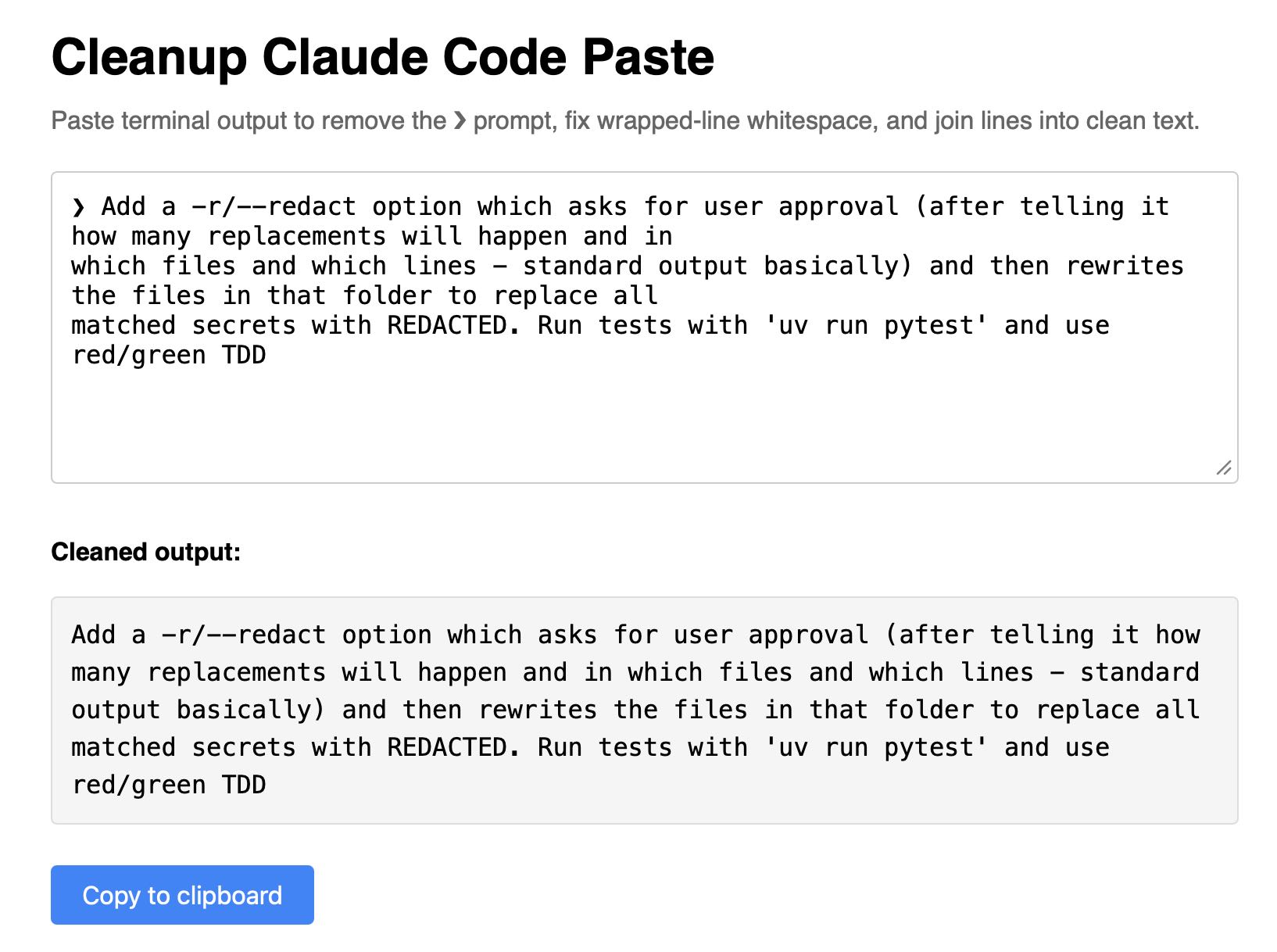
Super-niche tool this. I sometimes copy prompts out of the Claude Code terminal app and they come out with a bunch of weird additional whitespace. This tool cleans that up.
Another example of README-driven development, this time solving a problem that might be unique to me.
I often find myself running a bunch of different Datasette instances with different databases and different in-development plugins, spreads across dozens of different terminal windows - enough that I frequently lose them!
Now I can run this:
datasette install datasette-ports
datasette ports
And get a list of every running instance that looks something like this:
http://127.0.0.1:8333/ - v1.0a26
  Databases: data
  Plugins: datasette-enrichments, datasette-enrichments-llm, datasette-llm, datasette-secrets
http://127.0.0.1:8001/ - v1.0a26
  Databases: creatures
  Plugins: datasette-extract, datasette-llm, datasette-secrets
http://127.0.0.1:8900/ - v0.65.2
  Databases: logs
Lalit Maganti's syntaqlite is currently being discussed on Hacker News thanks to Eight years of wanting, three months of building with AI, a deep dive into how it was built.
This inspired me to revisit a research project I ran when Lalit first released it a couple of weeks ago, where I tried it out and then compiled it to a WebAssembly wheel so it could run in Pyodide in a browser (the library itself uses C and Rust).
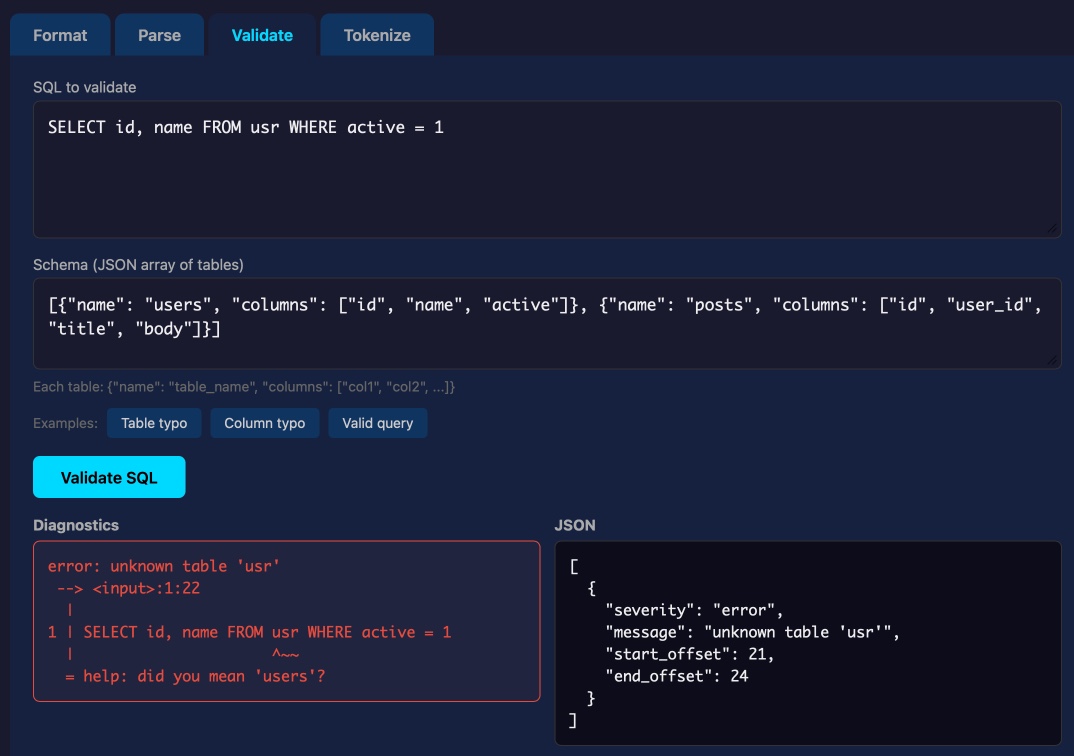
This new playground loads up the Python library and provides a UI for trying out its different features: formating, parsing into an AST, validating, and tokenizing SQLite SQL queries.
Update: not sure how I missed this but syntaqlite has its own WebAssembly playground linked to from the README.
- CLI tool now streams results as they are found rather than waiting until the end, which is better for large directories.
-d/--directoryoption can now be used multiple times to scan multiple directories.- New
-f/--fileoption for specifying one or more individual files to scan. - New
scan_directory_iter(),scan_file()andscan_file_iter()Python API functions. - New
-v/--verboseoption which shows each directory that is being scanned.
- Added documentation of the escaping schemes that are also scanned.
- Removed unnecessary
represcaping scheme, which was already covered byjson.
I like publishing transcripts of local Claude Code sessions using my claude-code-transcripts tool but I'm often paranoid that one of my API keys or similar secrets might inadvertently be revealed in the detailed log files.
I built this new Python scanning tool to help reassure me. You can feed it secrets and have it scan for them in a specified directory:
uvx scan-for-secrets $OPENAI_API_KEY -d logs-to-publish/
If you leave off the -d it defaults to the current directory.
It doesn't just scan for the literal secrets - it also scans for common encodings of those secrets e.g. backslash or JSON escaping, as described in the README.
If you have a set of secrets you always want to protect you can list commands to echo them in a ~/.scan-for-secrets.conf.sh file. Mine looks like this:
llm keys get openai
llm keys get anthropic
llm keys get gemini
llm keys get mistral
awk -F= '/aws_secret_access_key/{print $2}' ~/.aws/credentials | xargs
I built this tool using README-driven-development: I carefully constructed the README describing exactly how the tool should work, then dumped it into Claude Code and told it to build the actual tool (using red/green TDD, naturally.)
I'm working on a major change to my LLM Python library and CLI tool. LLM provides an abstraction layer over hundreds of different LLMs from dozens of different vendors thanks to its plugin system, and some of those vendors have grown new features over the past year which LLM's abstraction layer can't handle, such as server-side tool execution.
To help design that new abstraction layer I had Claude Code read through the Python client libraries for Anthropic, OpenAI, Gemini and Mistral and use those to help craft curl commands to access the raw JSON for both streaming and non-streaming modes across a range of different scenarios. Both the scripts and the captured outputs now live in this new repo.
In trying to build my own version of Claude Artifacts I got curious about options for applying CSP headers to content in sandboxed iframes without using a separate domain to host the files. Turns out you can inject <meta http-equiv="Content-Security-Policy"...> tags at the top of the iframe content and they'll be obeyed even if subsequent untrusted JavaScript tries to manipulate them.
New models gemini-3.1-flash-lite-preview, gemma-4-26b-a4b-it and gemma-4-31b-it. See my notes on Gemma 4.
- The same model ID no longer needs to be repeated in both the default model and allowed models lists - setting it as a default model automatically adds it to the allowed models list. #6
- Improved documentation for Python API usage.
- The
actorwho triggers an enrichment is now passed to thellm.mode(... actor=actor)method. #3
- Now uses datasette-llm to manage model configuration, which means you can control which models are available for extraction tasks using the
extractpurpose and LLM model configuration. #38
- This plugin now uses datasette-llm to configure and manage models. This means it's possible to specify which models should be made available for enrichments, using the new
enrichmentspurpose.
- Removed features relating to allowances and estimated pricing. These are now the domain of datasette-llm-accountant.
- Now depends on datasette-llm for model configuration. #3
- Full prompts and responses and tool calls can now be logged to the
llm_usage_prompt_logtable in the internal database if you set the newdatasette-llm-usage.log_promptsplugin configuration setting.- Redesigned the
/-/llm-usage-simple-promptpage, which now requires thellm-usage-simple-promptpermission.
- The
llm_prompt_context()plugin hook wrapper mechanism now tracks prompts executed within a chain as well as one-off prompts, which means it can be used to track tool call loops. #5