15 posts tagged “november-2025-inflection”
November 2025 felt like an inflection point for coding agents, with Opus 4.5 and GPT 5.1 (and GPT-5.1 Codex) increasing the utility of those agents in a very noticeable way.
2026
I think Anthropic and OpenAI have found product-market fit
Anthropic are strongly rumored to be about to have their first profitable quarter. Stories are circulating of companies surprised at how expensive their LLM bills are becoming from usage by their staff. I think this is because OpenAI and Anthropic have both found product-market fit.
[... 1,931 words]Shopify/liquid: Performance: 53% faster parse+render, 61% fewer allocations (via) PR from Shopify CEO Tobias Lütke against Liquid, Shopify's open source Ruby template engine that was somewhat inspired by Django when Tobi first created it back in 2005.
Tobi found dozens of new performance micro-optimizations using a variant of autoresearch, Andrej Karpathy's new system for having a coding agent run hundreds of semi-autonomous experiments to find new effective techniques for training nanochat.
Tobi's implementation started two days ago with this autoresearch.md prompt file and an autoresearch.sh script for the agent to run to execute the test suite and report on benchmark scores.
The PR now lists 93 commits from around 120 automated experiments. The PR description lists what worked in detail - some examples:
- Replaced StringScanner tokenizer with
String#byteindex. Single-bytebyteindexsearching is ~40% faster than regex-basedskip_until. This alone reduced parse time by ~12%.- Pure-byte
parse_tag_token. Eliminated the costlyStringScanner#string=reset that was called for every{% %}token (878 times). Manual byte scanning for tag name + markup extraction is faster than resetting and re-scanning via StringScanner. [...]- Cached small integer
to_s. Pre-computed frozen strings for 0-999 avoid 267Integer#to_sallocations per render.
This all added up to a 53% improvement on benchmarks - truly impressive for a codebase that's been tweaked by hundreds of contributors over 20 years.
I think this illustrates a number of interesting ideas:
- Having a robust test suite - in this case 974 unit tests - is a massive unlock for working with coding agents. This kind of research effort would not be possible without first having a tried and tested suite of tests.
- The autoresearch pattern - where an agent brainstorms a multitude of potential improvements and then experiments with them one at a time - is really effective.
- If you provide an agent with a benchmarking script "make it faster" becomes an actionable goal.
- CEOs can code again! Tobi has always been more hands-on than most, but this is a much more significant contribution than anyone would expect from the leader of a company with 7,500+ employees. I've seen this pattern play out a lot over the past few months: coding agents make it feasible for people in high-interruption roles to productively work with code again.
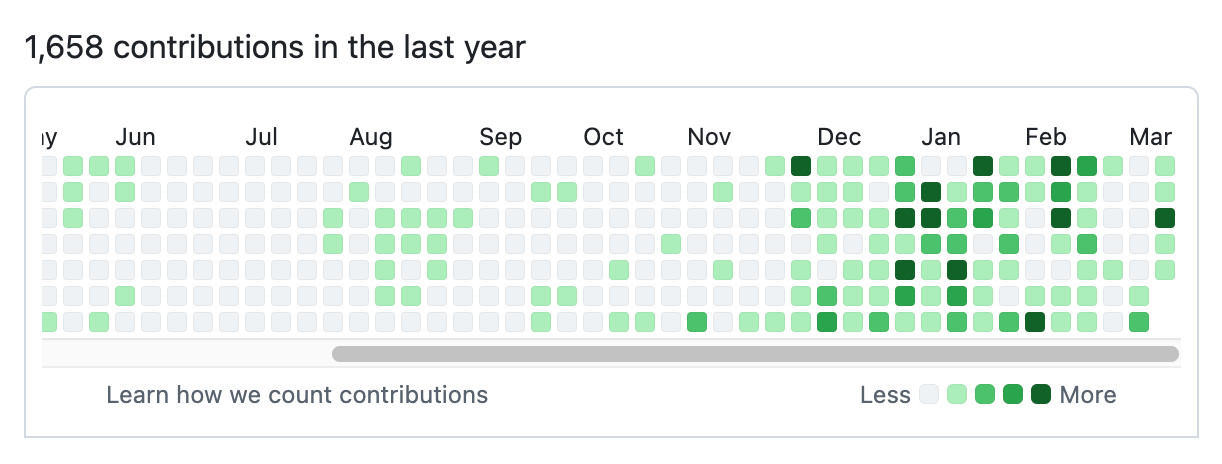
Here's Tobi's GitHub contribution graph for the past year, showing a significant uptick following that November 2025 inflection point when coding agents got really good.
He used Pi as the coding agent and released a new pi-autoresearch plugin in collaboration with David Cortés, which maintains state in an autoresearch.jsonl file like this one.
Perhaps not Boring Technology after all
A recurring concern I’ve seen regarding LLMs for programming is that they will push our technology choices towards the tools that are best represented in their training data, making it harder for new, better tools to break through the noise.
[... 391 words]Shock! Shock! I learned yesterday that an open problem I'd been working on for several weeks had just been solved by Claude Opus 4.6 - Anthropic's hybrid reasoning model that had been released three weeks earlier! It seems that I'll have to revise my opinions about "generative AI" one of these days. What a joy it is to learn not only that my conjecture has a nice solution but also to celebrate this dramatic advance in automatic deduction and creative problem solving.
— Donald Knuth, Claude's Cycles
An AI agent coding skeptic tries AI agent coding, in excessive detail. Another in the genre of "OK, coding agents got good in November" posts, this one is by Max Woolf and is very much worth your time. He describes a sequence of coding agent projects, each more ambitious than the last - starting with simple YouTube metadata scrapers and eventually evolving to this:
It would be arrogant to port Python's scikit-learn — the gold standard of data science and machine learning libraries — to Rust with all the features that implies.
But that's unironically a good idea so I decided to try and do it anyways. With the use of agents, I am now developing
rustlearn(extreme placeholder name), a Rust crate that implements not only the fast implementations of the standard machine learning algorithms such as logistic regression and k-means clustering, but also includes the fast implementations of the algorithms above: the same three step pipeline I describe above still works even with the more simple algorithms to beat scikit-learn's implementations.
Max also captures the frustration of trying to explain how good the models have got to an existing skeptical audience:
The real annoying thing about Opus 4.6/Codex 5.3 is that it’s impossible to publicly say “Opus 4.5 (and the models that came after it) are an order of magnitude better than coding LLMs released just months before it” without sounding like an AI hype booster clickbaiting, but it’s the counterintuitive truth to my personal frustration. I have been trying to break this damn model by giving it complex tasks that would take me months to do by myself despite my coding pedigree but Opus and Codex keep doing them correctly.
A throwaway remark in this post inspired me to ask Claude Code to build a Rust word cloud CLI tool, which it happily did.
It is hard to communicate how much programming has changed due to AI in the last 2 months: not gradually and over time in the "progress as usual" way, but specifically this last December. There are a number of asterisks but imo coding agents basically didn’t work before December and basically work since - the models have significantly higher quality, long-term coherence and tenacity and they can power through large and long tasks, well past enough that it is extremely disruptive to the default programming workflow. [...]
I vibe coded my dream macOS presentation app
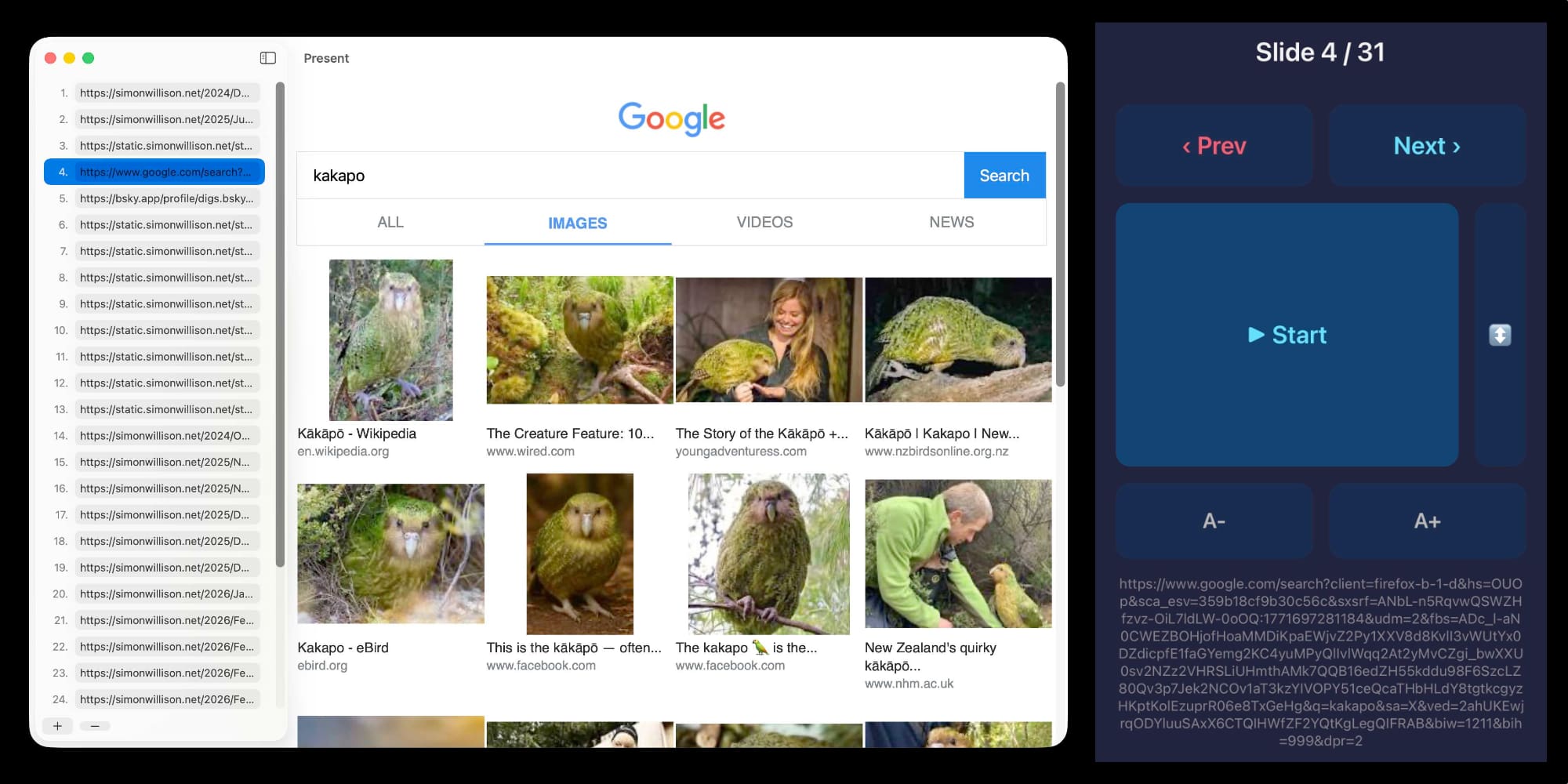
I gave a talk this weekend at Social Science FOO Camp in Mountain View. The event was a classic unconference format where anyone could present a talk without needing to propose it in advance. I grabbed a slot for a talk I titled “The State of LLMs, February 2026 edition”, subtitle “It’s all changed since November!”. I vibe coded a custom macOS app for the presentation the night before.
[... 1,613 words]The A.I. Disruption We’ve Been Waiting for Has Arrived. New opinion piece from Paul Ford in the New York Times. Unsurprisingly for a piece by Paul it's packed with quoteworthy snippets, but a few stood out for me in particular.
Paul describes the November moment that so many other programmers have observed, and highlights Claude Code's ability to revive old side projects:
[Claude Code] was always a helpful coding assistant, but in November it suddenly got much better, and ever since I’ve been knocking off side projects that had sat in folders for a decade or longer. It’s fun to see old ideas come to life, so I keep a steady flow. Maybe it adds up to a half-hour a day of my time, and an hour of Claude’s.
November was, for me and many others in tech, a great surprise. Before, A.I. coding tools were often useful, but halting and clumsy. Now, the bot can run for a full hour and make whole, designed websites and apps that may be flawed, but credible. I spent an entire session of therapy talking about it.
And as the former CEO of a respected consultancy firm (Postlight) he's well positioned to evaluate the potential impact:
When you watch a large language model slice through some horrible, expensive problem — like migrating data from an old platform to a modern one — you feel the earth shifting. I was the chief executive of a software services firm, which made me a professional software cost estimator. When I rebooted my messy personal website a few weeks ago, I realized: I would have paid $25,000 for someone else to do this. When a friend asked me to convert a large, thorny data set, I downloaded it, cleaned it up and made it pretty and easy to explore. In the past I would have charged $350,000.
That last price is full 2021 retail — it implies a product manager, a designer, two engineers (one senior) and four to six months of design, coding and testing. Plus maintenance. Bespoke software is joltingly expensive. Today, though, when the stars align and my prompts work out, I can do hundreds of thousands of dollars worth of work for fun (fun for me) over weekends and evenings, for the price of the Claude $200-a-month plan.
He also neatly captures the inherent community tension involved in exploring this technology:
All of the people I love hate this stuff, and all the people I hate love it. And yet, likely because of the same personality flaws that drew me to technology in the first place, I am annoyingly excited.
We gotta talk about AI as a programming tool for the arts. Chris Ashworth is the creator and CEO of QLab, a macOS software package for “cue-based, multimedia playback” which is designed to automate lighting and audio for live theater productions.
I recently started following him on TikTok where he posts about his business and theater automation in general - Chris founded the Voxel theater in Baltimore which QLab use as a combined performance venue, teaching hub and research lab (here's a profile of the theater), and the resulting videos offer a fascinating glimpse into a world I know virtually nothing about.
This latest TikTok describes his Claude Opus moment, after he used Claude Code to build a custom lighting design application for a very niche project and put together a useful application in just a few days that he would never have been able to spare the time for otherwise.
Chris works full time in the arts and comes at generative AI from a position of rational distrust. It's interesting to see him working through that tension to acknowledge that there are valuable applications here to build tools for the community he serves.
I have been at least gently skeptical about all this stuff for the last two years. Every time I checked in on it, I thought it was garbage, wasn't interested in it, wasn't useful. [...] But as a programmer, if you hear something like, this is changing programming, it's important to go check it out once in a while. So I went and checked it out a few weeks ago. And it's different. It's astonishing. [...]
One thing I learned in this exercise is that it can't make you a fundamentally better programmer than you already are. It can take a person who is a bad programmer and make them faster at making bad programs. And I think it can take a person who is a good programmer and, from what I've tested so far, make them faster at making good programs. [...] You see programmers out there saying, "I'm shipping code I haven't looked at and don't understand." I'm terrified by that. I think that's awful. But if you're capable of understanding the code that it's writing, and directing, designing, editing, deleting, being quality control on it, it's kind of astonishing. [...]
The positive thing I see here, and I think is worth coming to terms with, is this is an application that I would never have had time to write as a professional programmer. Because the audience is three people. [...] There's no way it was worth it to me to spend my energy of 20 years designing and implementing software for artists to build an app for three people that is this level of polish. And it took me a few days. [...]
I know there are a lot of people who really hate this technology, and in some ways I'm among them. But I think we've got to come to terms with this is a career-changing moment. And I really hate that I'm saying that because I didn't believe it for the last two years. [...] It's like having a room full of power tools. I wouldn't want to send an untrained person into a room full of power tools because they might chop off their fingers. But if someone who knows how to use tools has the option to have both hand tools and a power saw and a power drill and a lathe, there's a lot of work they can do with those tools at a lot faster speed.
LLM predictions for 2026, shared with Oxide and Friends

I joined a recording of the Oxide and Friends podcast on Tuesday to talk about 1, 3 and 6 year predictions for the tech industry. This is my second appearance on their annual predictions episode, you can see my predictions from January 2025 here. Here’s the page for this year’s episode, with options to listen in all of your favorite podcast apps or directly on YouTube.
[... 1,773 words]It genuinely feels to me like GPT-5.2 and Opus 4.5 in November represent an inflection point - one of those moments where the models get incrementally better in a way that tips across an invisible capability line where suddenly a whole bunch of much harder coding problems open up.
2025
I ported JustHTML from Python to JavaScript with Codex CLI and GPT-5.2 in 4.5 hours

I wrote about JustHTML yesterday—Emil Stenström’s project to build a new standards compliant HTML5 parser in pure Python code using coding agents running against the comprehensive html5lib-tests testing library. Last night, purely out of curiosity, I decided to try porting JustHTML from Python to JavaScript with the least amount of effort possible, using Codex CLI and GPT-5.2. It worked beyond my expectations.
[... 1,818 words]Claude Opus 4.5, and why evaluating new LLMs is increasingly difficult

Anthropic released Claude Opus 4.5 this morning, which they call “best model in the world for coding, agents, and computer use”. This is their attempt to retake the crown for best coding model after significant challenges from OpenAI’s GPT-5.1-Codex-Max and Google’s Gemini 3, both released within the past week!
[... 1,120 words]Building more with GPT-5.1-Codex-Max (via) Hot on the heels of yesterday's Gemini 3 Pro release comes a new model from OpenAI called GPT-5.1-Codex-Max.
(Remember when GPT-5 was meant to bring in a new era of less confusing model names? That didn't last!)
It's currently only available through their Codex CLI coding agent, where it's the new default model:
Starting today, GPT‑5.1-Codex-Max will replace GPT‑5.1-Codex as the default model in Codex surfaces. Unlike GPT‑5.1, which is a general-purpose model, we recommend using GPT‑5.1-Codex-Max and the Codex family of models only for agentic coding tasks in Codex or Codex-like environments.
It's not available via the API yet but should be shortly.
The timing of this release is interesting given that Gemini 3 Pro appears to have aced almost all of the benchmarks just yesterday. It's reminiscent of the period in 2024 when OpenAI consistently made big announcements that happened to coincide with Gemini releases.
OpenAI's self-reported SWE-Bench Verified score is particularly notable: 76.5% for thinking level "high" and 77.9% for the new "xhigh". That was the one benchmark where Gemini 3 Pro was out-performed by Claude Sonnet 4.5 - Gemini 3 Pro got 76.2% and Sonnet 4.5 got 77.2%. OpenAI now have the highest scoring model there by a full .7 of a percentage point!
They also report a score of 58.1% on Terminal Bench 2.0, beating Gemini 3 Pro's 54.2% (and Sonnet 4.5's 42.8%.)
The most intriguing part of this announcement concerns the model's approach to long context problems:
GPT‑5.1-Codex-Max is built for long-running, detailed work. It’s our first model natively trained to operate across multiple context windows through a process called compaction, coherently working over millions of tokens in a single task. [...]
Compaction enables GPT‑5.1-Codex-Max to complete tasks that would have previously failed due to context-window limits, such as complex refactors and long-running agent loops by pruning its history while preserving the most important context over long horizons. In Codex applications, GPT‑5.1-Codex-Max automatically compacts its session when it approaches its context window limit, giving it a fresh context window. It repeats this process until the task is completed.
There's a lot of confusion on Hacker News about what this actually means. Claude Code already does a version of compaction, automatically summarizing previous turns when the context runs out. Does this just mean that Codex-Max is better at that process?
I had it draw me a couple of pelicans by typing "Generate an SVG of a pelican riding a bicycle" directly into the Codex CLI tool. Here's thinking level medium:

And here's thinking level "xhigh":

I also tried xhigh on the my longer pelican test prompt, which came out like this:

Also today: GPT-5.1 Pro is rolling out today to all Pro users. According to the ChatGPT release notes:
GPT-5.1 Pro is rolling out today for all ChatGPT Pro users and is available in the model picker. GPT-5 Pro will remain available as a legacy model for 90 days before being retired.
That's a pretty fast deprecation cycle for the GPT-5 Pro model that was released just three months ago.
Introducing GPT-5.1 for developers. OpenAI announced GPT-5.1 yesterday, calling it a smarter, more conversational ChatGPT. Today they've added it to their API.
We actually got four new models today:
There are a lot of details to absorb here.
GPT-5.1 introduces a new reasoning effort called "none" (previous were minimal, low, medium, and high) - and none is the new default.
This makes the model behave like a non-reasoning model for latency-sensitive use cases, with the high intelligence of GPT‑5.1 and added bonus of performant tool-calling. Relative to GPT‑5 with 'minimal' reasoning, GPT‑5.1 with no reasoning is better at parallel tool calling (which itself increases end-to-end task completion speed), coding tasks, following instructions, and using search tools---and supports web search in our API platform.
When you DO enable thinking you get to benefit from a new feature called "adaptive reasoning":
On straightforward tasks, GPT‑5.1 spends fewer tokens thinking, enabling snappier product experiences and lower token bills. On difficult tasks that require extra thinking, GPT‑5.1 remains persistent, exploring options and checking its work in order to maximize reliability.
Another notable new feature for 5.1 is extended prompt cache retention:
Extended prompt cache retention keeps cached prefixes active for longer, up to a maximum of 24 hours. Extended Prompt Caching works by offloading the key/value tensors to GPU-local storage when memory is full, significantly increasing the storage capacity available for caching.
To enable this set "prompt_cache_retention": "24h" in the API call. Weirdly there's no price increase involved with this at all. I asked about that and OpenAI's Steven Heidel replied:
with 24h prompt caching we move the caches from gpu memory to gpu-local storage. that storage is not free, but we made it free since it moves capacity from a limited resource (GPUs) to a more abundant resource (storage). then we can serve more traffic overall!
The most interesting documentation I've seen so far is in the new 5.1 cookbook, which also includes details of the new shell and apply_patch built-in tools. The apply_patch.py implementation is worth a look, especially if you're interested in the advancing state-of-the-art of file editing tools for LLMs.
I'm still working on integrating the new models into LLM. The Codex models are Responses-API-only.
I got this pelican for GPT-5.1 default (no thinking):

And this one with reasoning effort set to high:

These actually feel like a regression from GPT-5 to me. The bicycles have less spokes!