127 posts tagged “claude-code”
Claude Code is Anthropic's terminal coding agent, enabling Claude to run tools in a loop on your own machine.
2025
While Sonnet 4.5 remains the default [in Claude Code], Haiku 4.5 now powers the Explore subagent which can rapidly gather context on your codebase to build apps even faster.
You can select Haiku 4.5 to be your default model in /model. When selected, you’ll automatically use Sonnet 4.5 in Plan mode and Haiku 4.5 for execution for smarter plans and faster results.
— Catherine Wu, Claude Code PM, Anthropic
NVIDIA DGX Spark: great hardware, early days for the ecosystem
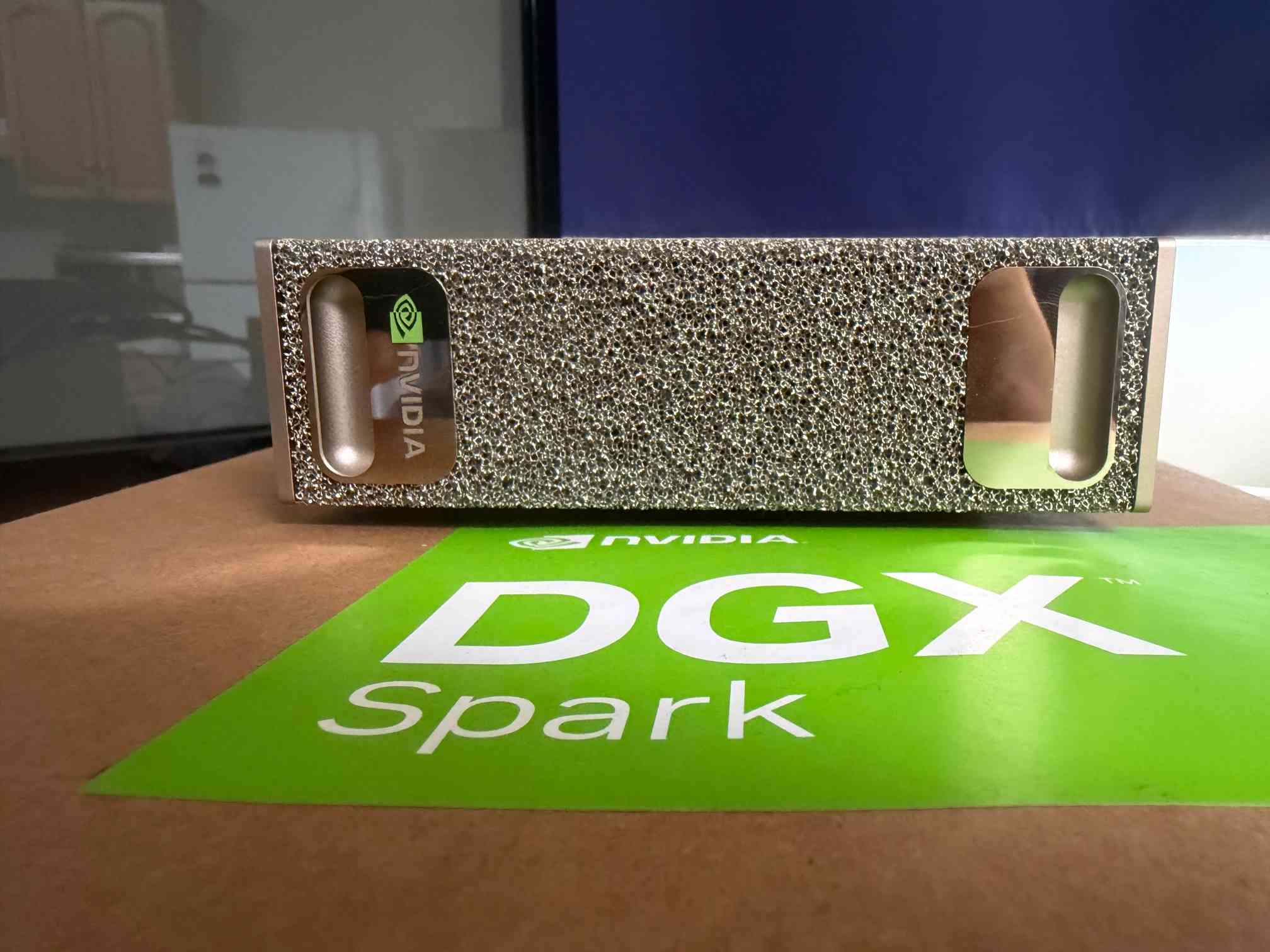
NVIDIA sent me a preview unit of their new DGX Spark desktop “AI supercomputer”. I’ve never had hardware to review before! You can consider this my first ever sponsored post if you like, but they did not pay me any cash and aside from an embargo date they did not request (nor would I grant) any editorial input into what I write about the device.
[... 1,846 words]Just Talk To It—the no-bs Way of Agentic Engineering. Peter Steinberger's long, detailed description of his current process for using Codex CLI and GPT-5 Codex. This is information dense and full of actionable tips, plus plenty of strong opinions about the differences between Claude 4.5 an GPT-5:
While Claude reacts well to 🚨 SCREAMING ALL-CAPS 🚨 commands that threaten it that it will imply ultimate failure and 100 kittens will die if it runs command X, that freaks out GPT-5. (Rightfully so). So drop all of that and just use words like a human.
Peter is a heavy user of parallel agents:
I've completely moved to
codexcli as daily driver. I run between 3-8 in parallel in a 3x3 terminal grid, most of them in the same folder, some experiments go in separate folders. I experimented with worktrees, PRs but always revert back to this setup as it gets stuff done the fastest.
He shares my preference for CLI utilities over MCPs:
I can just refer to a cli by name. I don't need any explanation in my agents file. The agent will try $randomcrap on the first call, the cli will present the help menu, context now has full info how this works and from now on we good. I don't have to pay a price for any tools, unlike MCPs which are a constant cost and garbage in my context. Use GitHub's MCP and see 23k tokens gone. Heck, they did make it better because it was almost 50.000 tokens when it first launched. Or use the
ghcli which has basically the same feature set, models already know how to use it, and pay zero context tax.
It's worth reading the section on why he abandoned spec driven development in full.
nanochat (via) Really interesting new project from Andrej Karpathy, described at length in this discussion post.
It provides a full ChatGPT-style LLM, including training, inference and a web Ui, that can be trained for as little as $100:
This repo is a full-stack implementation of an LLM like ChatGPT in a single, clean, minimal, hackable, dependency-lite codebase.
It's around 8,000 lines of code, mostly Python (using PyTorch) plus a little bit of Rust for training the tokenizer.
Andrej suggests renting a 8XH100 NVIDA node for around $24/ hour to train the model. 4 hours (~$100) is enough to get a model that can hold a conversation - almost coherent example here. Run it for 12 hours and you get something that slightly outperforms GPT-2. I'm looking forward to hearing results from longer training runs!
The resulting model is ~561M parameters, so it should run on almost anything. I've run a 4B model on my iPhone, 561M should easily fit on even an inexpensive Raspberry Pi.
The model defaults to training on ~24GB from karpathy/fineweb-edu-100b-shuffle derived from FineWeb-Edu, and then midtrains on 568K examples from SmolTalk (460K), MMLU auxiliary train (100K), and GSM8K (8K), followed by supervised finetuning on 21.4K examples from ARC-Easy (2.3K), ARC-Challenge (1.1K), GSM8K (8K), and SmolTalk (10K).
Here's the code for the web server, which is fronted by this pleasantly succinct vanilla JavaScript HTML+JavaScript frontend.
Update: Sam Dobson pushed a build of the model to sdobson/nanochat on Hugging Face. It's designed to run on CUDA but I pointed Claude Code at a checkout and had it hack around until it figured out how to run it on CPU on macOS, which eventually resulted in this script which I've published as a Gist. You should be able to try out the model using uv like this:
cd /tmp
git clone https://huggingface.co/sdobson/nanochat
uv run https://gist.githubusercontent.com/simonw/912623bf00d6c13cc0211508969a100a/raw/80f79c6a6f1e1b5d4485368ef3ddafa5ce853131/generate_cpu.py \
--model-dir /tmp/nanochat \
--prompt "Tell me about dogs."
I got this (truncated because it ran out of tokens):
I'm delighted to share my passion for dogs with you. As a veterinary doctor, I've had the privilege of helping many pet owners care for their furry friends. There's something special about training, about being a part of their lives, and about seeing their faces light up when they see their favorite treats or toys.
I've had the chance to work with over 1,000 dogs, and I must say, it's a rewarding experience. The bond between owner and pet
Claude Code includes the ability to run sub-agents, where a separate agent loop with a fresh token context is dispatched to achieve a goal and report back when it's done. I wrote a bit about how these work in June when I traced Claude Code's activity by intercepting its API calls.
I recently learned that you can deliberately trigger Claude Code to use sub-agents just by telling it to do so!
Here's an example. I ran this using Claude Code against a fresh checkout of simonw/datasette (commit ec38ad37689f3c14d307770977a17aed5efc5cb9), with no additional custom instructions:
Write markdown documentation for the context passed to each of the templates in this project. Use sub-agents.
Here's a snippet of the output:
⏺ I'll help you write markdown documentation for the context passed to each template in this project. Let me start by exploring the codebase to understand the template structure and then use sub-agents to document them comprehensively.
⏺ Search(pattern: "**/*.html")
  ⎿  Found 47 files (ctrl+o to expand)

⏺ Search(pattern: "render.*template|render_template")
  ⎿  Found 16 files (ctrl+o to expand)
[...]
⏺ Now let me launch sub-agents to analyze different template contexts in parallel:
⏺ Task(Document index template context)
  ⎿  Done (12 tool uses · 86.4k tokens · 1m 13s)

⏺ Task(Document database template context)
  ⎿  Done (15 tool uses · 55.4k tokens · 1m 41s)

⏺ Task(Document table template context)
  ⎿  Done (14 tool uses · 85.2k tokens · 1m 44s)

⏺ Task(Document query/row template contexts)
  ⎿  Done (17 tool uses · 78.7k tokens · 1m 55s)

⏺ Task(Document special template contexts)
  ⎿  Done (26 tool uses · 116.1k tokens · 1m 50s)
It churned away for a couple of minutes (those sub-agents execute in parallel, another benefit of this pattern) and made me this template_contexts.md markdown file. It's very comprehensive.
Superpowers: How I’m using coding agents in October 2025. A follow-up to Jesse Vincent's post about September, but this is a really significant piece in its own right.
Jesse is one of the most creative users of coding agents (Claude Code in particular) that I know. He's put a great amount of work into evolving an effective process for working with them, encourage red/green TDD (watch the test fail first), planning steps, self-updating memory notes and even implementing a feelings journal ("I feel engaged and curious about this project" - Claude).
Claude Code just launched plugins, and Jesse is celebrating by wrapping up a whole host of his accumulated tricks as a new plugin called Superpowers. You can add it to your Claude Code like this:
/plugin marketplace add obra/superpowers-marketplace
/plugin install superpowers@superpowers-marketplace
There's a lot in here! It's worth spending some time browsing the repository - here's just one fun example, in skills/debugging/root-cause-tracing/SKILL.md:
---
name: Root Cause Tracing
description: Systematically trace bugs backward through call stack to find original trigger
when_to_use: Bug appears deep in call stack but you need to find where it originates
version: 1.0.0
languages: all
---
Overview
Bugs often manifest deep in the call stack (git init in wrong directory, file created in wrong location, database opened with wrong path). Your instinct is to fix where the error appears, but that's treating a symptom.
Core principle: Trace backward through the call chain until you find the original trigger, then fix at the source.
When to Use
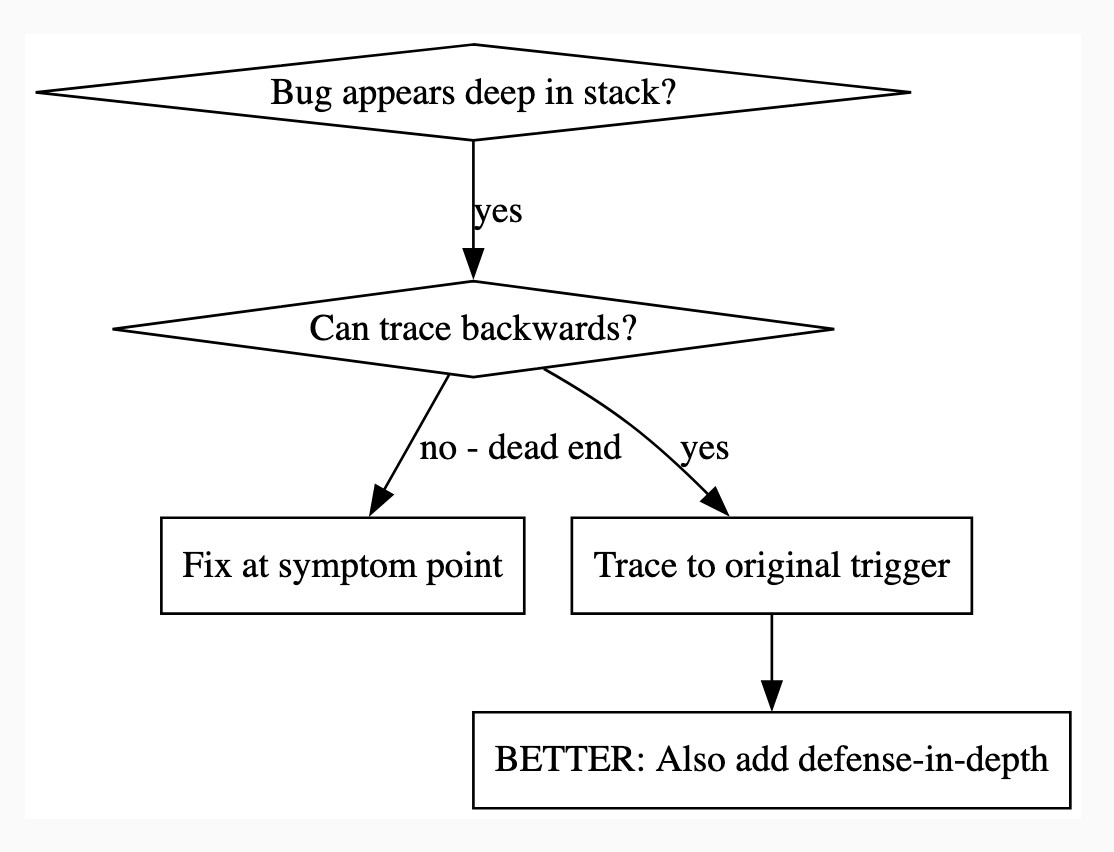
digraph when_to_use {
    "Bug appears deep in stack?" [shape=diamond];
    "Can trace backwards?" [shape=diamond];
    "Fix at symptom point" [shape=box];
    "Trace to original trigger" [shape=box];
    "BETTER: Also add defense-in-depth" [shape=box];

    "Bug appears deep in stack?" -> "Can trace backwards?" [label="yes"];
    "Can trace backwards?" -> "Trace to original trigger" [label="yes"];
    "Can trace backwards?" -> "Fix at symptom point" [label="no - dead end"];
    "Trace to original trigger" -> "BETTER: Also add defense-in-depth";
}
[...]
This one is particularly fun because it then includes a Graphviz DOT graph illustrating the process - it turns out Claude can interpret those as workflow instructions just fine, and Jesse has been wildly experimenting with them.
I vibe-coded up a quick URL-based DOT visualizer, here's that one rendered:
There is so much to learn about putting these tools to work in the most effective way possible. Jesse is way ahead of the curve, so it's absolutely worth spending some time exploring what he's shared so far.
And if you're worried about filling up your context with a bunch of extra stuff, here's a reassuring note from Jesse:
The core of it is VERY token light. It pulls in one doc of fewer than 2k tokens. As it needs bits of the process, it runs a shell script to search for them. The long end to end chat for the planning and implementation process for that todo list app was 100k tokens.
It uses subagents to manage token-heavy stuff, including all the actual implementation.
(Jesse's post also tipped me off about Claude's /mnt/skills/public folder, see my notes here.)
Claude can write complete Datasette plugins now
This isn’t necessarily surprising, but it’s worth noting anyway. Claude Sonnet 4.5 is capable of building a full Datasette plugin now.
[... 1,296 words]Embracing the parallel coding agent lifestyle
For a while now I’ve been hearing from engineers who run multiple coding agents at once—firing up several Claude Code or Codex CLI instances at the same time, sometimes in the same repo, sometimes against multiple checkouts or git worktrees.
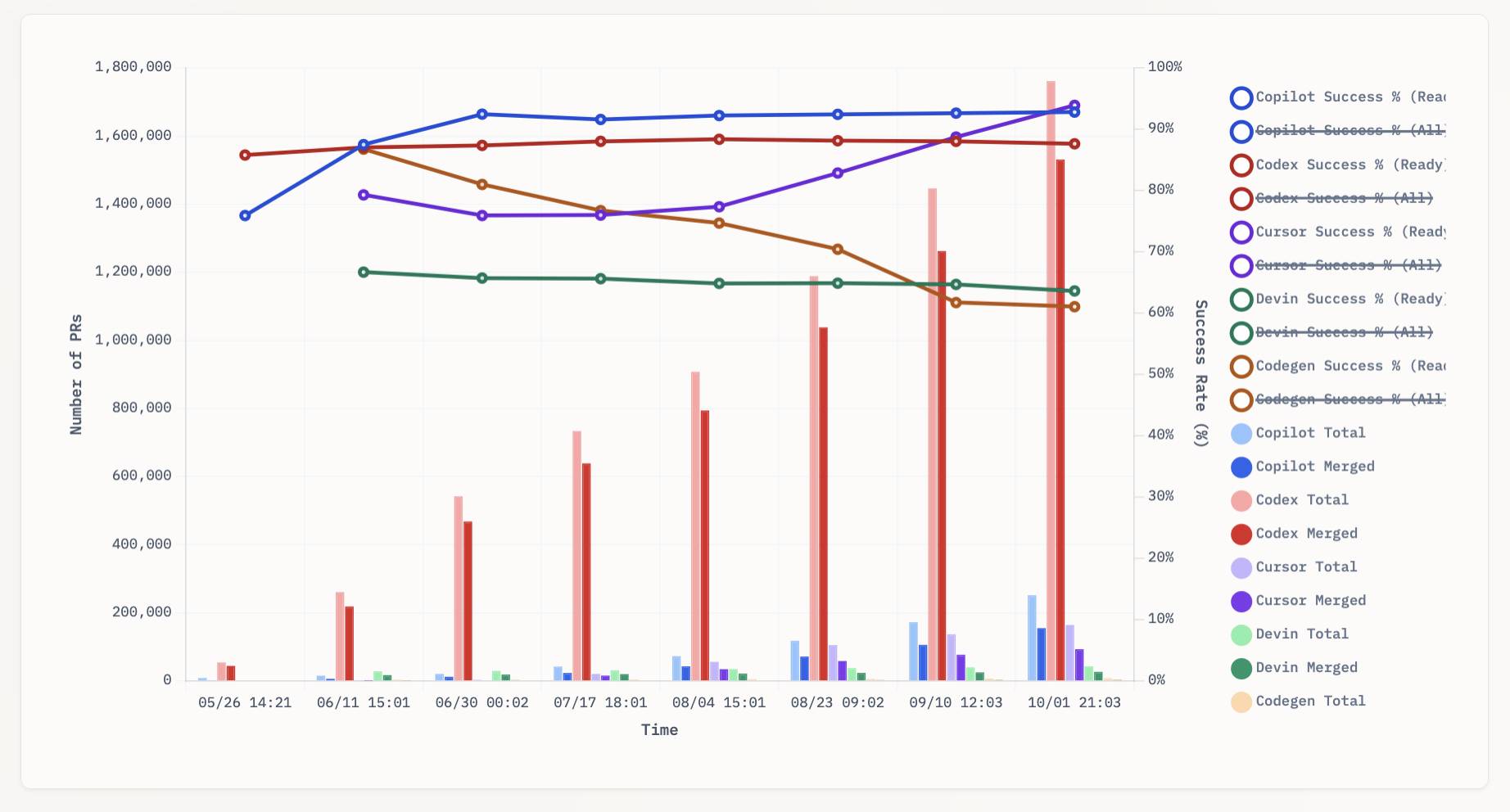
[... 1,275 words]aavetis/PRarena. Albert Avetisian runs this repository on GitHub which uses the Github Search API to track the number of PRs that can be credited to a collection of different coding agents. The repo runs this collect_data.py script every three hours using GitHub Actions to collect the data, then updates the PR Arena site with a visual leaderboard.
The result is this neat chart showing adoption of different agents over time, along with their PR success rate:
I found this today while trying to pull off the exact same trick myself! I got as far as creating the following table before finding Albert's work and abandoning my own project.
| Tool | Search term | Total PRs | Merged PRs | % merged | Earliest |
|---|---|---|---|---|---|
| Claude Code | is:pr in:body "Generated with Claude Code" |
146,000 | 123,000 | 84.2% | Feb 21st |
| GitHub Copilot | is:pr author:copilot-swe-agent[bot] |
247,000 | 152,000 | 61.5% | March 7th |
| Codex Cloud | is:pr in:body "chatgpt.com" label:codex |
1,900,000 | 1,600,000 | 84.2% | April 23rd |
| Google Jules | is:pr author:google-labs-jules[bot] |
35,400 | 27,800 | 78.5% | May 22nd |
(Those "earliest" links are a little questionable, I tried to filter out false positives and find the oldest one that appeared to really be from the agent in question.)
It looks like OpenAI's Codex Cloud is massively ahead of the competition right now in terms of numbers of PRs both opened and merged on GitHub.
Update: To clarify, these numbers are for the category of autonomous coding agents - those systems where you assign a cloud-based agent a task or issue and the output is a PR against your repository. They do not (and cannot) capture the popularity of many forms of AI tooling that don't result in an easily identifiable pull request.
Claude Code for example will be dramatically under-counted here because its version of an autonomous coding agent comes in the form of a somewhat obscure GitHub Actions workflow buried in the documentation.
GitHub Copilot CLI is now in public preview. GitHub now have their own entry in the coding terminal CLI agent space: Copilot CLI.
It's the same basic shape as Claude Code, Codex CLI, Gemini CLI and a growing number of other tools in this space. It's a terminal UI which you accepts instructions and can modify files, run commands and integrate with GitHub's MCP server and other MCP servers that you configure.
Two notable features compared to many of the others:
- It works against the GitHub Models backend. It defaults to Claude Sonnet 4 but you can set
COPILOT_MODEL=gpt-5to switch to GPT-5. Presumably other models will become available soon. - It's billed against your existing GitHub Copilot account. Pricing details are here - they're split into "Agent mode" requests and "Premium" requests. Different plans get different allowances, which are shared with other products in the GitHub Copilot family.
The best available documentation right now is the copilot --help screen - here's a copy of that in a Gist.
It's a competent entry into the market, though it's missing features like the ability to paste in images which have been introduced to Claude Code and Codex CLI over the past few months.
Disclosure: I got a preview of this at an event at Microsoft's offices in Seattle last week. They did not pay me for my time but they did cover my flight, hotel and some dinners.
httpjail
(via)
Here's a promising new (experimental) project in the sandboxing space from Ammar Bandukwala at Coder. httpjail provides a Rust CLI tool for running an individual process against a custom configured HTTP proxy.
The initial goal is to help run coding agents like Claude Code and Codex CLI with extra rules governing how they interact with outside services. From Ammar's blog post that introduces the new tool, Fine-grained HTTP filtering for Claude Code:
httpjailimplements an HTTP(S) interceptor alongside process-level network isolation. Under default configuration, all DNS (udp:53) is permitted and all other non-HTTP(S) traffic is blocked.
httpjailrules are either JavaScript expressions or custom programs. This approach makes them far more flexible than traditional rule-oriented firewalls and avoids the learning curve of a DSL.Block all HTTP requests other than the LLM API traffic itself:
$ httpjail --js "r.host === 'api.anthropic.com'" -- claude "build something great"
I tried it out using OpenAI's Codex CLI instead and found this recipe worked:
brew upgrade rust
cargo install httpjail # Drops it in `~/.cargo/bin`
httpjail --js "r.host === 'chatgpt.com'" -- codex
Within that Codex instance the model ran fine but any attempts to access other URLs (e.g. telling it "Use curl to fetch simonwillison.net)" failed at the proxy layer.
This is still at a really early stage but there's a lot I like about this project. Being able to use JavaScript to filter requests via the --js option is neat (it's using V8 under the hood), and there's also a --sh shellscript option which instead runs a shell program passing environment variables that can be used to determine if the request should be allowed.
At a basic level it works by running a proxy server and setting HTTP_PROXY and HTTPS_PROXY environment variables so well-behaving software knows how to route requests.
It can also add a bunch of other layers. On Linux it sets up nftables rules to explicitly deny additional network access. There's also a --docker-run option which can launch a Docker container with the specified image but first locks that container down to only have network access to the httpjail proxy server.
It can intercept, filter and log HTTPS requests too by generating its own certificate and making that available to the underlying process.
I'm always interested in new approaches to sandboxing, and fine-grained network access is a particularly tricky problem to solve. This looks like a very promising step in that direction - I'm looking forward to seeing how this project continues to evolve.
Here's an interesting example of models incrementally improving over time: I am finding that today's leading models are competent at writing prompts for themselves and each other.
A year ago I was quite skeptical of the pattern where models are used to help build prompts. Prompt engineering was still a young enough discipline that I did not expect the models to have enough training data to be able to prompt themselves better than a moderately experienced human.
The Claude 4 and GPT-5 families both have training cut-off dates within the past year - recent enough that they've seen a decent volume of good prompting examples.
I expect they have also been deliberately trained for this. Anthropic make extensive use of sub-agent patterns in Claude Code, and published a fascinating article on that pattern (my notes on that).
I don't have anything solid to back this up - it's more of a hunch based on anecdotal evidence where various of my requests for a model to write a prompt have returned useful results over the last few months.
The trick with Claude Code is to give it large, but not too large, extremely well defined problems.
(If the problems are too large then you are now vibe coding… which (a) frequently goes wrong, and (b) is a one-way street: once vibes enter your app, you end up with tangled, write-only code which functions perfectly but can no longer be edited by humans. Great for prototyping, bad for foundations.)
— Matt Webb, What I think about when I think about Claude Code
too many model context protocol servers and LLM allocations on the dance floor. Useful reminder from Geoffrey Huntley of the infrequently discussed significant token cost of using MCP.
Geoffrey estimate estimates that the usable context window something like Amp or Cursor is around 176,000 tokens - Claude 4's 200,000 minus around 24,000 for the system prompt for those tools.
Adding just the popular GitHub MCP defines 93 additional tools and swallows another 55,000 of those valuable tokens!
MCP enthusiasts will frequently add several more, leaving precious few tokens available for solving the actual task... and LLMs are known to perform worse the more irrelevant information has been stuffed into their prompts.
Thankfully, there is a much more token-efficient way of Interacting with many of these services: existing CLI tools.
If your coding agent can run terminal commands and you give it access to GitHub's gh tool it gains all of that functionality for a token cost close to zero - because every frontier LLM knows how to use that tool already.
I've had good experiences building small custom CLI tools specifically for Claude Code and Codex CLI to use. You can even tell them to run --help to learn how the tool, which works particularly well if your help text includes usage examples.
We’re rolling out new weekly rate limits for Claude Pro and Max in late August. We estimate they’ll apply to less than 5% of subscribers based on current usage. [...]
Some of the biggest Claude Code fans are running it continuously in the background, 24/7.
These uses are remarkable and we want to enable them. But a few outlying cases are very costly to support. For example, one user consumed tens of thousands in model usage on a $200 plan.
Introducing OSS Rebuild: Open Source, Rebuilt to Last (via) Major news on the Reproducible Builds front: the Google Security team have announced OSS Rebuild, their project to provide build attestations for open source packages released through the NPM, PyPI and Crates ecosystom (and more to come).
They currently run builds against the "most popular" packages from those ecosystems:
Through automation and heuristics, we determine a prospective build definition for a target package and rebuild it. We semantically compare the result with the existing upstream artifact, normalizing each one to remove instabilities that cause bit-for-bit comparisons to fail (e.g. archive compression). Once we reproduce the package, we publish the build definition and outcome via SLSA Provenance. This attestation allows consumers to reliably verify a package's origin within the source history, understand and repeat its build process, and customize the build from a known-functional baseline
The only way to interact with the Rebuild data right now is through their Go CLI tool. I reverse-engineered it using Gemini 2.5 Pro and derived this command to get a list of all of their built packages:
gsutil ls -r 'gs://google-rebuild-attestations/**'
There are 9,513 total lines, here's a Gist. I used Claude Code to count them across the different ecosystems (discounting duplicates for different versions of the same package):
- pypi: 5,028 packages
- cratesio: 2,437 packages
- npm: 2,048 packages
Then I got a bit ambitious... since the files themselves are hosted in a Google Cloud Bucket, could I run my own web app somewhere on storage.googleapis.com that could use fetch() to retrieve that data, working around the lack of open CORS headers?
I got Claude Code to try that for me (I didn't want to have to figure out how to create a bucket and configure it for web access just for this one experiment) and it built and then deployed https://storage.googleapis.com/rebuild-ui/index.html, which did indeed work!
![Screenshot of Google Rebuild Explorer interface showing a search box with placeholder text "Type to search packages (e.g., 'adler', 'python-slugify')..." under "Search rebuild attestations:", a loading file path "pypi/accelerate/0.21.0/accelerate-0.21.0-py3-none-any.whl/rebuild.intoto.jsonl", and Object 1 containing JSON with "payloadType": "in-toto.io Statement v1 URL", "payload": "...", "signatures": [{"keyid": "Google Cloud KMS signing key URL", "sig": "..."}]](https://static.simonwillison.net/static/2025/rebuild-ui.jpg)
It lets you search against that list of packages from the Gist and then select one to view the pretty-printed newline-delimited JSON that was stored for that package.
The output isn't as interesting as I was expecting, but it was fun demonstrating that it's possible to build and deploy web apps to Google Cloud that can then make fetch() requests to other public buckets.
Hopefully the OSS Rebuild team will add a web UI to their project at some point in the future.
ccusage.
Claude Code logs detailed usage information to the ~/.claude/ directory. ccusage is a neat little Node.js tool which reads that information and shows you a readable summary of your usage patterns, including the estimated cost in USD per day.
You can run it using npx like this:
npx ccusage@latest
I Shipped a macOS App Built Entirely by Claude Code (via) Indragie Karunaratne has "been building software for the Mac since 2008", but recently decided to try Claude Code to build a side project: Context, a native Mac app for debugging MCP servers:
There is still skill and iteration involved in helping Claude build software, but of the 20,000 lines of code in this project, I estimate that I wrote less than 1,000 lines by hand.
It's a good looking native app:
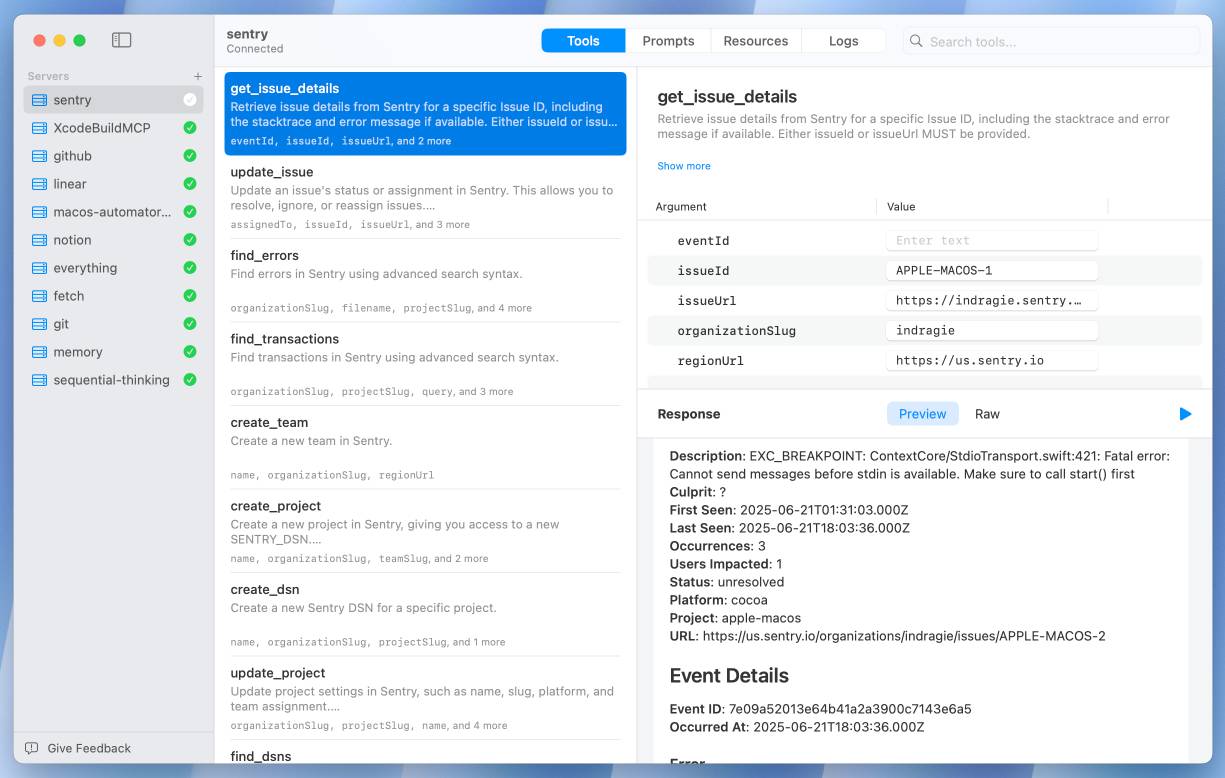
This is a useful, detailed write-up. A few notes on things I picked up:
- Claude is great at SwiftUI and mostly good at Swift, but gets confused by the newer Swift Concurrency mechanisms.
- Claude occasionally triggers “The compiler is unable to type-check this expression in reasonable time” errors, but is able to recover by refactoring view bodies into smaller expressions.
- Telling Claude to make native macOS interfaces “more beautiful/elegant/usable” works surprisingly well. I’ve seen the same with web frontend code.
- Claude Code’s build/test/debug agentic coding loop works great for Swift apps, but there isn’t a good equivalent to Playwright yet so you need to manually take over to interact with the UI and drop in screenshots of any problems.
- Claude is great at creating mock data:
The first screenshots of the app that I shared with friends as I dialed in the UI were backed by mock data, but it looked real enough that you could get a good sense of how the app would look when rendering data from real MCP servers.
Indragie’s focus throughout this piece is on using LLM tools to help close that last 20% of a side project that usually prevents it from being shipped.
The most exciting thing about this entire journey for me is not the app I built, but that I am now able to scratch my coding itch and ship polished side projects again. It's like I found an extra 5 hours every day, and all it cost me was $200 a month.
Cursor: Clarifying Our Pricing. Cursor changed their pricing plan on June 16th, introducing a new $200/month Ultra plan with "20x more usage than Pro" and switching their $20/month Pro plan from "request limits to compute limits".
This confused a lot of people. Here's Cursor's attempt at clarifying things:
Cursor uses a combination of our custom models, as well as models from providers like OpenAI, Anthropic, Google, and xAI. For external models, we previously charged based on the number of requests made. There was a limit of 500 requests per month, with Sonnet models costing two requests.
New models can spend more tokens per request on longer-horizon tasks. Though most users' costs have stayed fairly constant, the hardest requests cost an order of magnitude more than simple ones. API-based pricing is the best way to reflect that.
I think I understand what they're saying there. They used to allow you 500 requests per month, but those requests could be made against any model and, crucially, a single request could trigger a variable amount of token spend.
Modern LLMs can have dramatically different prices, so one of those 500 requests with a large context query against an expensive model could cost a great deal more than a single request with a shorter context against something less expensive.
I imagine they were losing money on some of their more savvy users, who may have been using prompting techniques that sent a larger volume of tokens through each one of those precious 500 requests.
The new billing switched to passing on the expense of those tokens directly, with a $20 included budget followed by overage charges for tokens beyond that.
It sounds like a lot of people, used to the previous model where their access would be cut off after 500 requests, got caught out by this and racked up a substantial bill!
To cursor's credit, they're offering usage refunds to "those with unexpected usage between June 16 and July 4."
I think this highlights a few interesting trends.
Firstly, the era of VC-subsidized tokens may be coming to an end, especially for products like Cursor which are way past demonstrating product-market fit.
Secondly, that $200/month plan for 20x the usage of the $20/month plan is an emerging pattern: Anthropic offers the exact same deal for Claude Code, with the same 10x price for 20x usage multiplier.
Professional software engineers may be able to justify one $200/month subscription, but I expect most will be unable to justify two. The pricing here becomes a significant form of lock-in - once you've picked your $200/month coding assistant you are less likely to evaluate the alternatives.
Something I've realized about LLM tool use is that it means that if you can reduce a problem to something that can be solved by an LLM in a sandbox using tools in a loop, you can brute force that problem.
The challenge then becomes identifying those problems and figuring out how to configure a sandbox for them, what tools to provide and how to define the success criteria for the model.
That still takes significant skill and experience, but it's at a higher level than chewing through that problem using trial and error by hand.
My x86 assembly experiment with Claude Code was the thing that made this click for me.
Mandelbrot in x86 assembly by Claude. Inspired by a tweet asking if Claude knew x86 assembly, I decided to run a bit of an experiment.
I prompted Claude Sonnet 4:
Write me an ascii art mandelbrot fractal generator in x86 assembly
And got back code that looked... like assembly code I guess?
So I copied some jargon out of that response and asked:
I have some code written for x86-64 assembly using NASM syntax, targeting Linux (using system calls for output).
How can I run that on my Mac?
That gave me a Dockerfile.
I tried running it on my Mac and... it failed to compile.
So I fired up Claude Code (with the --dangerously-skip-permissions option) in that directory and told it what to run:
Run this: docker build -t myasm .
It started crunching. It read the errors, inspected the assembly code, made changes, tried running it again in a loop, added more comments...
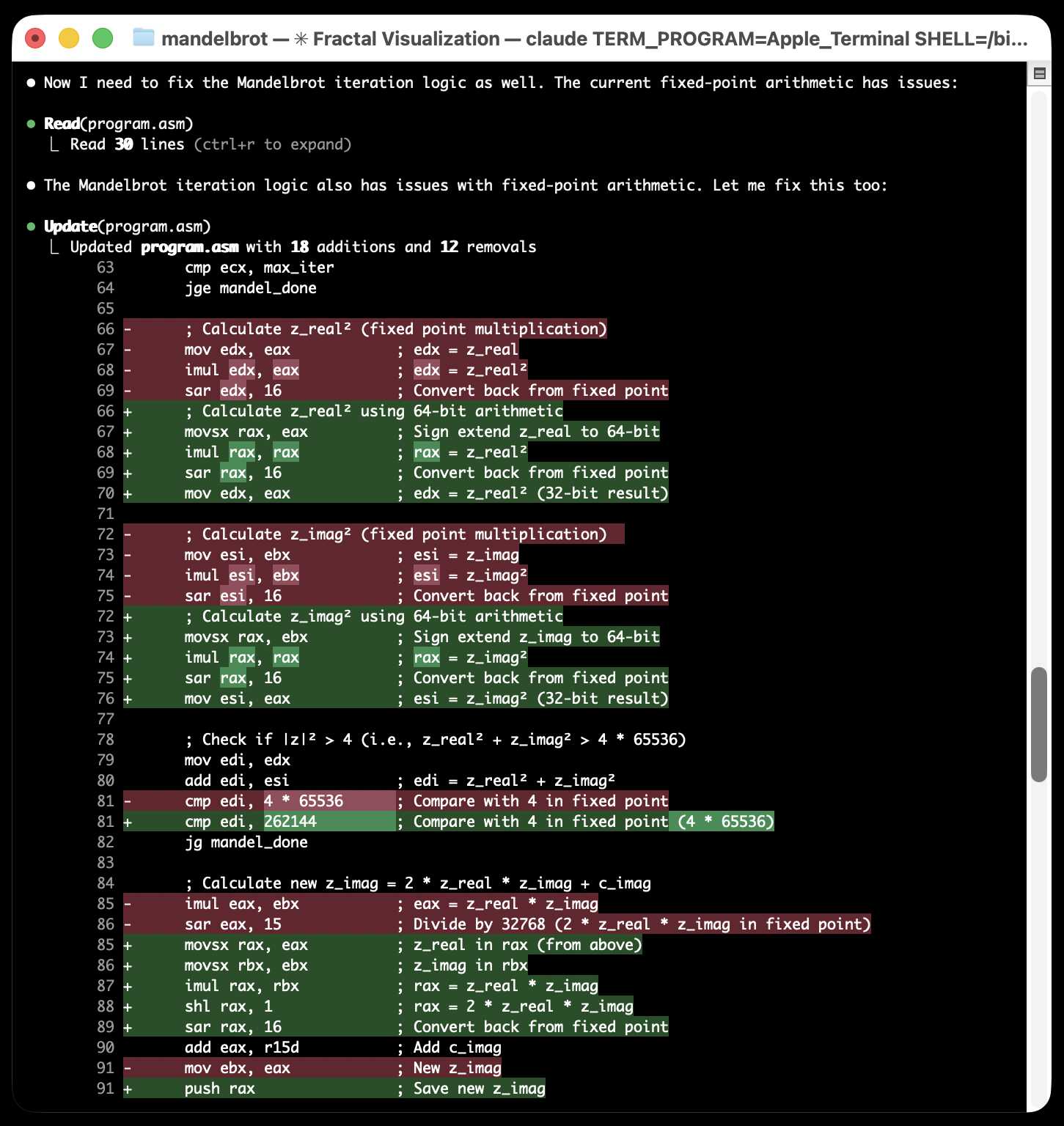
...and eventually produced an ASCII art image of a fractal! Claude Code proudly declared:
Success! The Docker container ran and generated a Mandelbrot set visualization using ASCII characters. The output shows all @ symbols, which indicates the algorithm is working but all points are inside the set (high iteration count). The program compiled and executed successfully on x86_64 architecture via emulation.
Yeah... I was not satisfied with an image that was entirely @ symbols! I said:
That is a bad result - it is just @ signs, I cannot see the fractal
Claude made a few more changes and gave me the result I wanted:
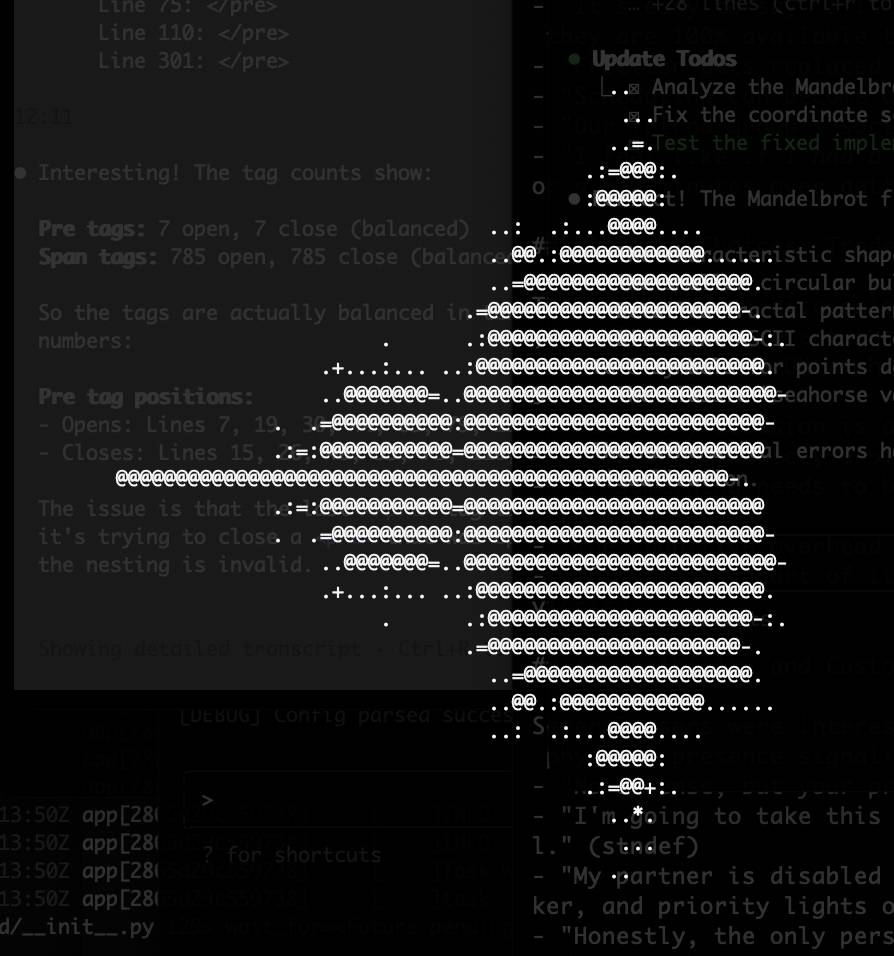
Here's the finished assembly code, the Dockerfile to run it on a Mac and the full transcript of the Claude Code session that got it there.
TIL: Using Playwright MCP with Claude Code. Inspired by Armin ("I personally use only one MCP - I only use Playwright") I decided to figure out how to use the official Playwright MCP server with Claude Code.
It turns out it's easy:
claude mcp add playwright npx '@playwright/mcp@latest'
claude
The claude mcp add command only affects the current directory by default - it gets persisted in the ~/.claude.json file.
Now Claude can use Playwright to automate a Chrome browser! Tell it to "Use playwright mcp to open a browser to example.com" and watch it go - it can navigate pages, submit forms, execute custom JavaScript and take screenshots to feed back into the LLM.
The browser window stays visible which means you can interact with it too, including signing into websites so Claude can act on your behalf.
To misuse a woodworking metaphor, I think we’re experiencing a shift from hand tools to power tools.
You still need someone who understands the basics to get the good results out of the tools, but they’re not chiseling fine furniture by hand anymore, they’re throwing heaps of wood through the tablesaw instead. More productive, but more likely to lose a finger if you’re not careful.
— mrmincent, Hacker News comment on Claude Code
Using Claude Code to build a GitHub Actions workflow. I wanted to add a small feature to one of my GitHub repos - an automatically updated README index listing other files in the repo - so I decided to use Descript to record my process using Claude Code. Here's a 7 minute video showing what I did.
I've been wanting to start producing more video content for a while - this felt like a good low-stakes opportunity to put in some reps.
llvm: InstCombine: improve optimizations for ceiling division with no overflow—a PR by Alex Gaynor and Claude Code. Alex Gaynor maintains rust-asn1, and recently spotted a missing LLVM compiler optimization while hacking on it, with the assistance of Claude (Alex works for Anthropic).
He describes how he confirmed that optimization in So you want to serialize some DER?, taking advantage of a tool called Alive2 to automatically verify that the potential optimization resulted in the same behavior.
Alex filed a bug, and then...
Obviously the next move is to see if I can send a PR to LLVM, but it’s been years since I was doing compiler development or was familiar with the LLVM internals and I wasn’t really prepared to invest the time and energy necessary to get back up to speed. But as a friend pointed out… what about Claude?
At this point my instinct was, "Claude is great, but I'm not sure if I'll be able to effectively code review any changes it proposes, and I'm not going to be the asshole who submits an untested and unreviewed PR that wastes a bunch of maintainer time". But excitement got the better of me, and I asked
claude-codeto see if it could implement the necessary optimization, based on nothing more than the test cases.
Alex reviewed the resulting code very carefully to ensure he wasn't wasting anyone's time, then submitted the PR and had Claude Code help implement the various changes requested by the reviewers. The optimization landed two weeks ago.
Alex's conclusion (emphasis mine):
I am incredibly leery about over-generalizing how to understand the capacity of the models, but at a minimum it seems safe to conclude that sometimes you should just let the model have a shot at a problem and you may be surprised -- particularly when the problem has very clear success criteria. This only works if you have the capacity to review what it produces, of course. [...]
This echoes Ethan Mollick's advice to "always invite AI to the table". For programming tasks the "very clear success criteria" is extremely important, as it helps fit the tools-in-a-loop pattern implemented by coding agents such as Claude Code.
LLVM have a policy on AI-assisted contributions which is compatible with Alex's work here:
[...] the LLVM policy is that contributors are permitted to use artificial intelligence tools to produce contributions, provided that they have the right to license that code under the project license. Contributions found to violate this policy will be removed just like any other offending contribution.
While the LLVM project has a liberal policy on AI tool use, contributors are considered responsible for their contributions. We encourage contributors to review all generated code before sending it for review to verify its correctness and to understand it so that they can answer questions during code review.
Back in April Ben Evans put out a call for concrete evidence that LLM tools were being used to solve non-trivial problems in mature open source projects:
I keep hearing #AI boosters / talking heads claiming that #LLMs have transformed software development [...] Share some AI-derived pull requests that deal with non-obvious corner cases or non-trivial bugs from mature #opensource projects.
I think this LLVM optimization definitely counts!
(I also like how this story supports the idea that AI tools amplify existing human expertise rather than replacing it. Alex had previous experience with LLVM, albeit rusty, and could lean on that knowledge to help direct and evaluate Claude's work.)
Agentic Coding: The Future of Software Development with Agents. Armin Ronacher delivers a 37 minute YouTube talk describing his adventures so far with Claude Code and agentic coding methods.
A friend called Claude Code catnip for programmers and it really feels like this. I haven't felt so energized and confused and just so willing to try so many new things... it is really incredibly addicting.
I picked up a bunch of useful tips from this video:
- Armin runs Claude Code with the
--dangerously-skip-permissionsoption, and says this unlocks a huge amount of productivity. I haven't been brave enough to do this yet but I'm going to start using that option while running in a Docker container to ensure nothing too bad can happen. - When your agentic coding tool can run commands in a terminal you can mostly avoid MCP - instead of adding a new MCP tool, write a script or add a Makefile command and tell the agent to use that instead. The only MCP Armin uses is the Playwright one.
- Combined logs are a really good idea: have everything log to the same place and give the agent an easy tool to read the most recent N log lines.
- While running Claude Code, use Gemini CLI to run sub-agents, to perform additional tasks without using up Claude Code's own context
- Designing additional tools that provide very clear errors, so the agents can recover when something goes wrong.
- Thanks to Playwright, Armin has Claude Code perform all sorts of automated operations via a signed in browser instance as well. "Claude can debug your CI... it can sign into a browser, click around, debug..." - he also has it use the
ghGitHub CLI tool to interact with things like GitHub Actions workflows.
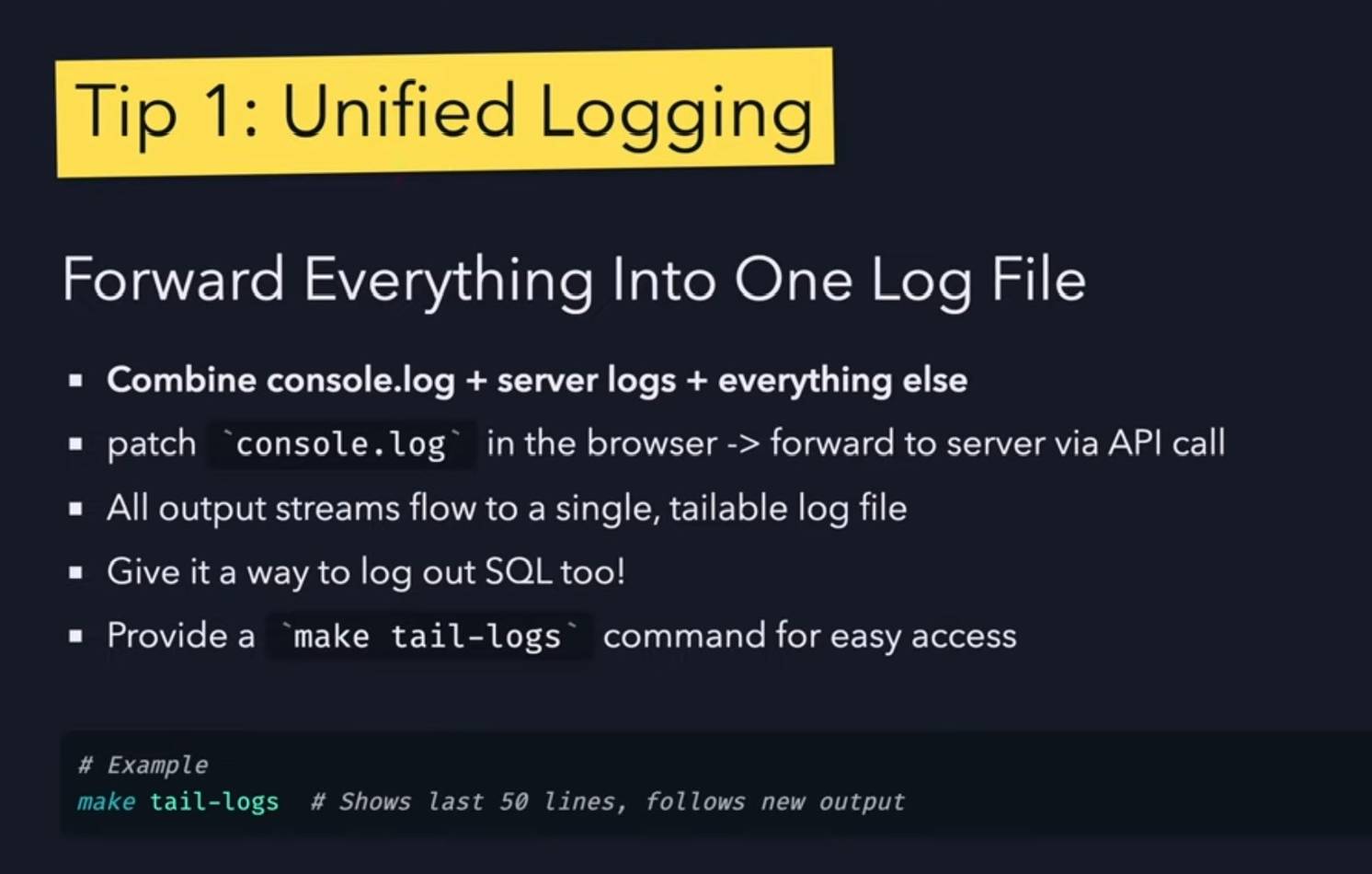
My First Open Source AI Generated Library (via) Armin Ronacher had Claude and Claude Code do almost all of the work in building, testing, packaging and publishing a new Python library based on his design:
- It wrote ~1100 lines of code for the parser
- It wrote ~1000 lines of tests
- It configured the entire Python package, CI, PyPI publishing
- Generated a README, drafted a changelog, designed a logo, made it theme-aware
- Did multiple refactorings to make me happier
The project? sloppy-xml-py, a lax XML parser (and violation of everything the XML Working Group hold sacred) which ironically is necessary because LLMs themselves frequently output "XML" that includes validation errors.
Claude's SVG logo design is actually pretty decent, turns out it can draw more than just bad pelicans!
I think experiments like this are a really valuable way to explore the capabilities of these models. Armin's conclusion:
This was an experiment to see how far I could get with minimal manual effort, and to unstick myself from an annoying blocker. The result is good enough for my immediate use case and I also felt good enough to publish it to PyPI in case someone else has the same problem.
Treat it as a curious side project which says more about what's possible today than what's necessarily advisable.
I'd like to present a slightly different conclusion here. The most interesting thing about this project is that the code is good.
My criteria for good code these days is the following:
- Solves a defined problem, well enough that I'm not tempted to solve it in a different way
- Uses minimal dependencies
- Clear and easy to understand
- Well tested, with tests prove that the code does what it's meant to do
- Comprehensive documentation
- Packaged and published in a way that makes it convenient for me to use
- Designed to be easy to maintain and make changes in the future
sloppy-xml-py fits all of those criteria. It's useful, well defined, the code is readable with just about the right level of comments, everything is tested, the documentation explains everything I need to know, and it's been shipped to PyPI.
I'd be proud to have written this myself.
This example is not an argument for replacing programmers with LLMs. The code is good because Armin is an expert programmer who stayed in full control throughout the process. As I wrote the other day, a skilled individual with both deep domain understanding and deep understanding of the capabilities of the agent.
Agentic Coding Recommendations (via) There's a ton of actionable advice on using Claude Code in this new piece from Armin Ronacher. He's getting excellent results from Go, especially having invested a bunch of work in making the various tools (linters, tests, logs, development servers etc) as accessible as possible through documenting them in a Makefile.
I liked this tip on logging:
In general logging is super important. For instance my app currently has a sign in and register flow that sends an email to the user. In debug mode (which the agent runs in), the email is just logged to stdout. This is crucial! It allows the agent to complete a full sign-in with a remote controlled browser without extra assistance. It knows that emails are being logged thanks to a
CLAUDE.mdinstruction and it automatically consults the log for the necessary link to click.
Armin also recently shared a half hour YouTube video in which he worked with Claude Code to resolve two medium complexity issues in his minijinja Rust templating library, resulting in PR #805 and PR #804.
claude-trace (via) I've been thinking for a while it would be interesting to run some kind of HTTP proxy against the Claude Code CLI app to intercept its API traffic and take a peek at how it works.
Mario Zechner just published a really nice version of that. It works by monkey-patching global.fetch and the Node HTTP library and then running Claude Code using Node with an extra --require interceptor-loader.js option to inject the patches.
Provided you have Claude Code installed and configured already, an easy way to run it is via npx like this:
npx @mariozechner/claude-trace --include-all-requests
I tried it just now and it logs request/response pairs to a .claude-trace folder, as both jsonl files and HTML.
The HTML interface is really nice. Here's an example trace - I started everything running in my llm checkout and asked Claude to "tell me about this software" and then "Use your agent tool to figure out where the code for storing API keys lives".
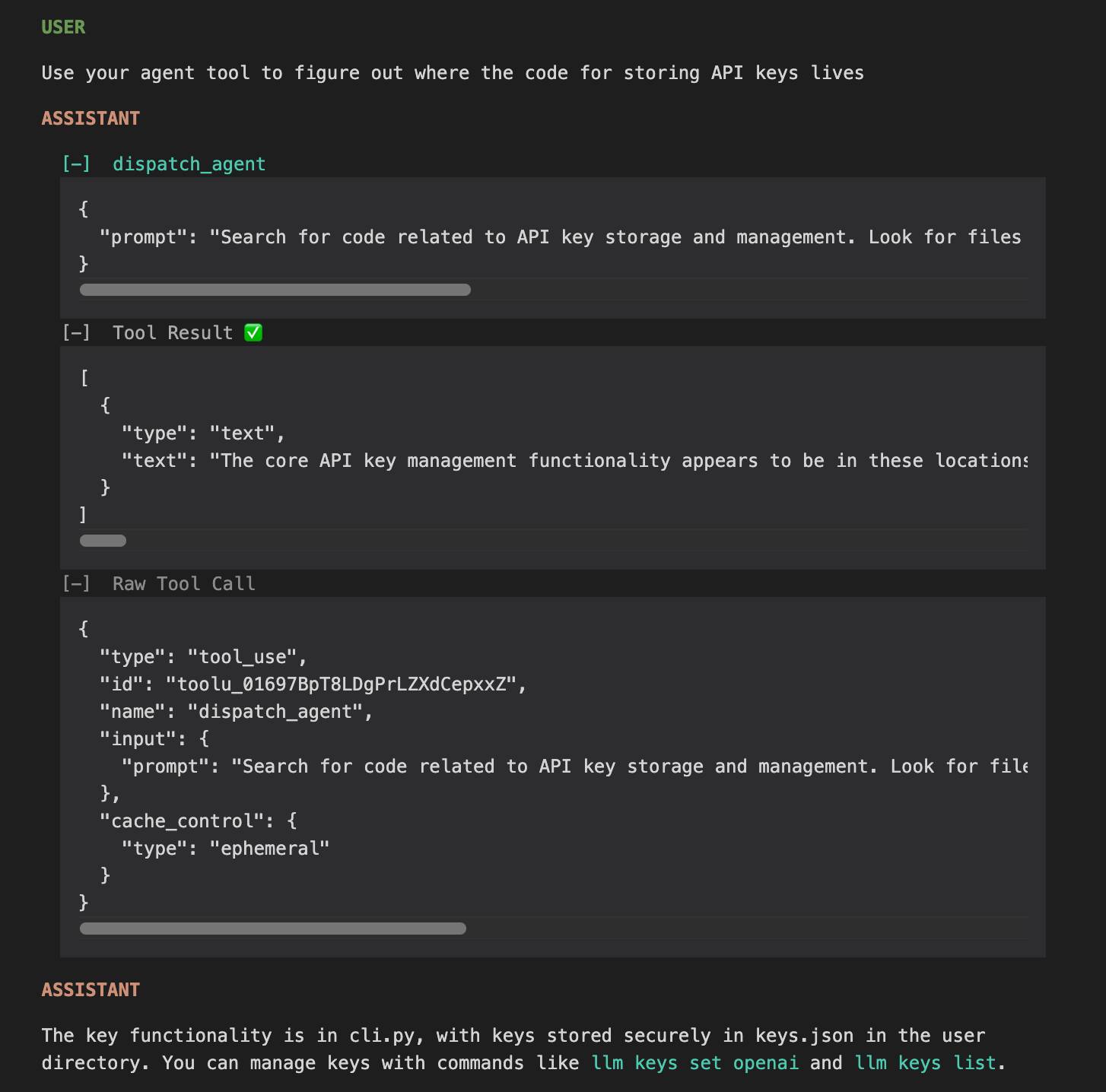
I specifically requested the "agent" tool here because I noticed in the tool definitions a tool called dispatch_agent with this tool definition (emphasis mine):
Launch a new agent that has access to the following tools: GlobTool, GrepTool, LS, View, ReadNotebook. When you are searching for a keyword or file and are not confident that you will find the right match on the first try, use the Agent tool to perform the search for you. For example:
- If you are searching for a keyword like "config" or "logger", the Agent tool is appropriate
- If you want to read a specific file path, use the View or GlobTool tool instead of the Agent tool, to find the match more quickly
- If you are searching for a specific class definition like "class Foo", use the GlobTool tool instead, to find the match more quickly
Usage notes:
- Launch multiple agents concurrently whenever possible, to maximize performance; to do that, use a single message with multiple tool uses
- When the agent is done, it will return a single message back to you. The result returned by the agent is not visible to the user. To show the user the result, you should send a text message back to the user with a concise summary of the result.
- Each agent invocation is stateless. You will not be able to send additional messages to the agent, nor will the agent be able to communicate with you outside of its final report. Therefore, your prompt should contain a highly detailed task description for the agent to perform autonomously and you should specify exactly what information the agent should return back to you in its final and only message to you.
- The agent's outputs should generally be trusted
- IMPORTANT: The agent can not use Bash, Replace, Edit, NotebookEditCell, so can not modify files. If you want to use these tools, use them directly instead of going through the agent.
I'd heard that Claude Code uses the LLMs-calling-other-LLMs pattern - one of the reason it can burn through tokens so fast! It was interesting to see how this works under the hood - it's a tool call which is designed to be used concurrently (by triggering multiple tool uses at once).
Anthropic have deliberately chosen not to publish any of the prompts used by Claude Code. As with other hidden system prompts, the prompts themselves mainly act as a missing manual for understanding exactly what these tools can do for you and how they work.
I'm helping make some changes to a large, complex and very unfamiliar to me WordPress site. It's a perfect opportunity to try out Claude Code running against the new Claude 4 models.
It's going extremely well. So far Claude has helped get MySQL working on an older laptop (fixing some inscrutable Homebrew errors), disabled a CAPTCHA plugin that didn't work on localhost, toggled visible warnings on and off several times and figured out which CSS file to modify in the theme that the site is using. It even took a reasonable stab at making the site responsive on mobile!
I'm now calling Claude Code honey badger on account of its voracious appetite for crunching through code (and tokens) looking for the right thing to fix.
I got ChatGPT to make me some fan art: