45 posts tagged “mlx”
The MLX framework for running machine learning models on Apple Silicon.
2025
Run LLMs on macOS using llm-mlx and Apple’s MLX framework
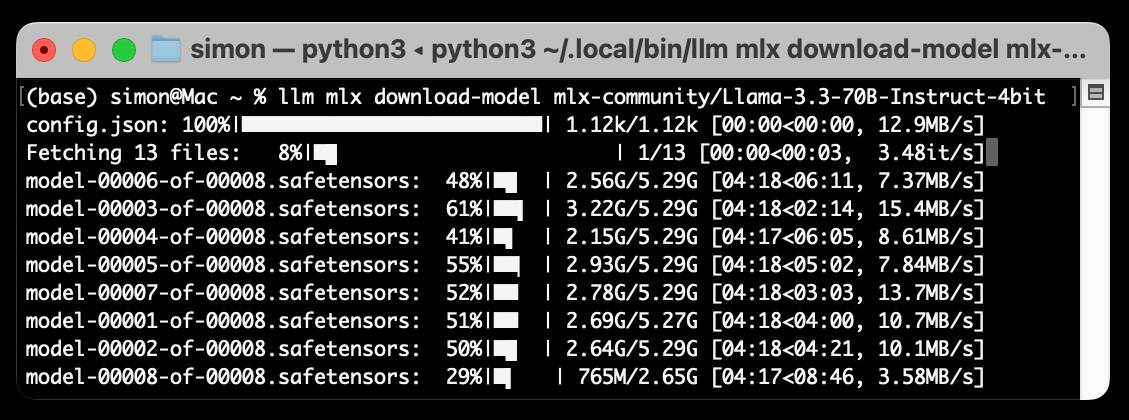
llm-mlx is a brand new plugin for my LLM Python Library and CLI utility which builds on top of Apple’s excellent MLX array framework library and mlx-lm package. If you’re a terminal user or Python developer with a Mac this may be the new easiest way to start exploring local Large Language Models.
[... 1,524 words]Qwen2.5 VL! Qwen2.5 VL! Qwen2.5 VL! Hot on the heels of yesterday's Qwen2.5-1M, here's Qwen2.5 VL (with an excitable announcement title) - the latest in Qwen's series of vision LLMs.
They're releasing multiple versions: base models and instruction tuned models at 3B, 7B and 72B. There's a lot of additional information in their README.
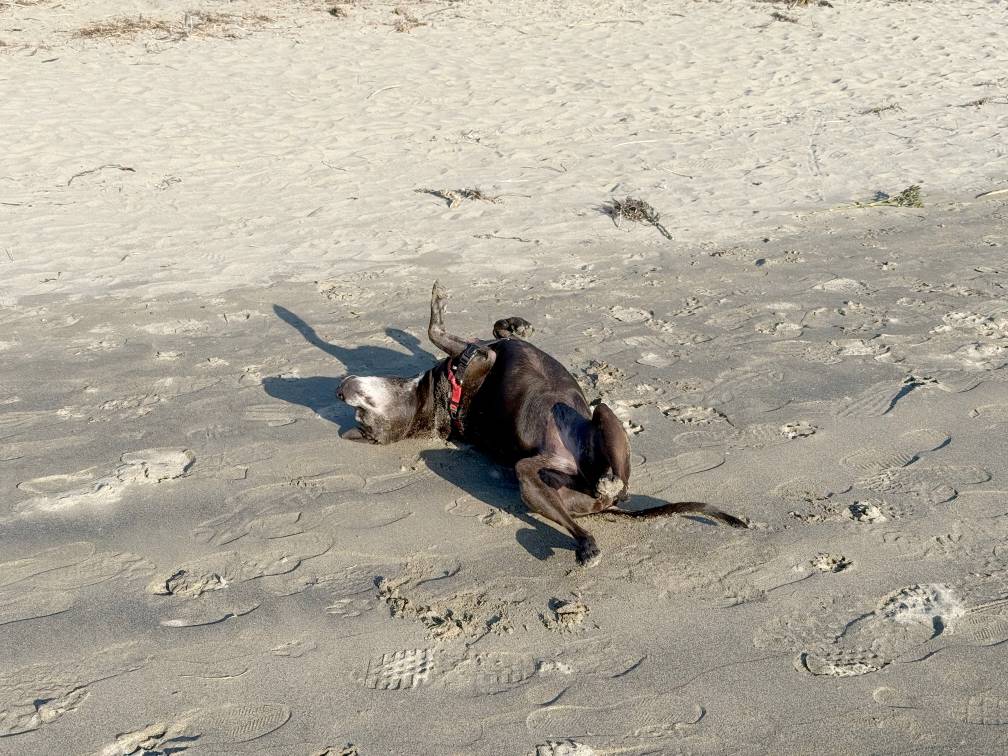
The 72B model can be selected on Qwen's Qwen Chat interface. I gave it this image of our dog Cleo joy rolling on the beach:
And prompted:
Describe this image in detail, be flowery
(Since the Qwen team tends to use flowery language in their announcements.)
Here's what I got back:
In this enchanting tableau, a canine companion finds solace in the embrace of nature's softest bed. The sandy expanse stretches out like an endless canvas, its surface etched with the delicate imprints of countless wanderers who have come and gone, leaving behind a tapestry of footprints that whisper tales of joyous romps and serene strolls.
The dog, a vision of contentment, lies sprawled upon the sand, its dark fur gleaming under the gentle caress of the sun. Its body is relaxed, limbs splayed in abandon, as if it has surrendered to the soothing rhythm of the beach. A vibrant red collar adorns its neck, a splash of color against the muted tones of the surroundings, hinting at the care and love bestowed upon this cherished pet.
The sand itself is a work of art, its grains shimmering with a silvery sheen that catches the light. Here and there, small tufts of seaweed peek through, remnants of the ocean's bounty, adding a touch of wild beauty to the scene. The shadows cast by unseen objects dance across the sand, creating a play of light and dark that lends an air of mystery to the tranquil setting.
This moment, frozen in time, speaks of peace and harmony, where man's best friend finds respite in the simple pleasures of life. It is a scene that invites one to pause, breathe deeply, and revel in the serenity of nature's embrace.
I'm looking forward to trying out their smaller models - the 3B model in particular should be small enough to run comfortably even on an iPhone, so hopefully someone will wire up an example of that soon (maybe using MLX).
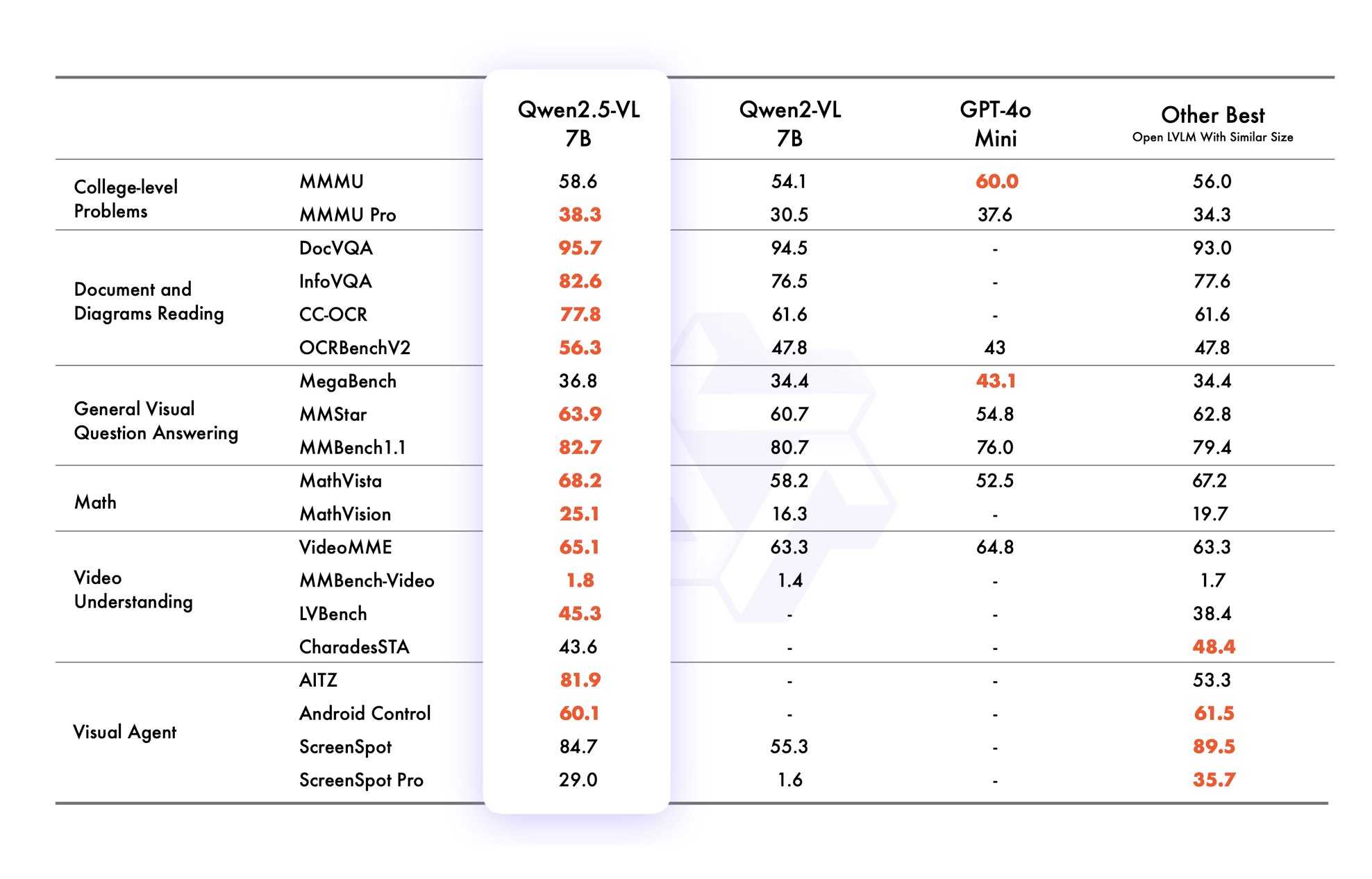
VB points out that the vision benchmarks for Qwen 2.5 VL 7B show it out-performing GPT-4o mini!
Qwen2.5 VL cookbooks
Qwen also just published a set of cookbook recipes:
- universal_recognition.ipynb demonstrates basic visual Q&A, including prompts like
Who are these in this picture? Please give their names in Chinese and Englishagainst photos of celebrities, an ability other models have deliberately suppressed. - spatial_understanding.ipynb demonstrates bounding box support, with prompts like
Locate the top right brown cake, output its bbox coordinates using JSON format. - video_understanding.ipynb breaks a video into individual frames and asks questions like
Could you go into detail about the content of this long video? - ocr.ipynb shows
Qwen2.5-VL-7B-Instructperforming OCR in multiple different languages. - document_parsing.ipynb uses Qwen to convert images of documents to HTML and other formats, and notes that "we introduce a unique Qwenvl HTML format that includes positional information for each component, enabling precise document reconstruction and manipulation."
- mobile_agent.ipynb runs Qwen with tool use against tools for controlling a mobile phone, similar to ChatGPT Operator or Claude Computer Use.
- computer_use.ipynb showcases "GUI grounding" - feeding in screenshots of a user's desktop and running tools for things like left clicking on a specific coordinate.
Running it with mlx-vlm
Update 30th January 2025: I got it working on my Mac using uv and mlx-vlm, with some hints from this issue. Here's the recipe that worked (downloading a 9GB model from mlx-community/Qwen2.5-VL-7B-Instruct-8bit):
uv run --with 'numpy<2' --with 'git+https://github.com/huggingface/transformers' \
  --with mlx-vlm \
  python -m mlx_vlm.generate \
    --model mlx-community/Qwen2.5-VL-7B-Instruct-8bit \
    --max-tokens 100 \
    --temp 0.0 \
    --prompt "Describe this image." \
    --image path-to-image.png
I ran that against this image:
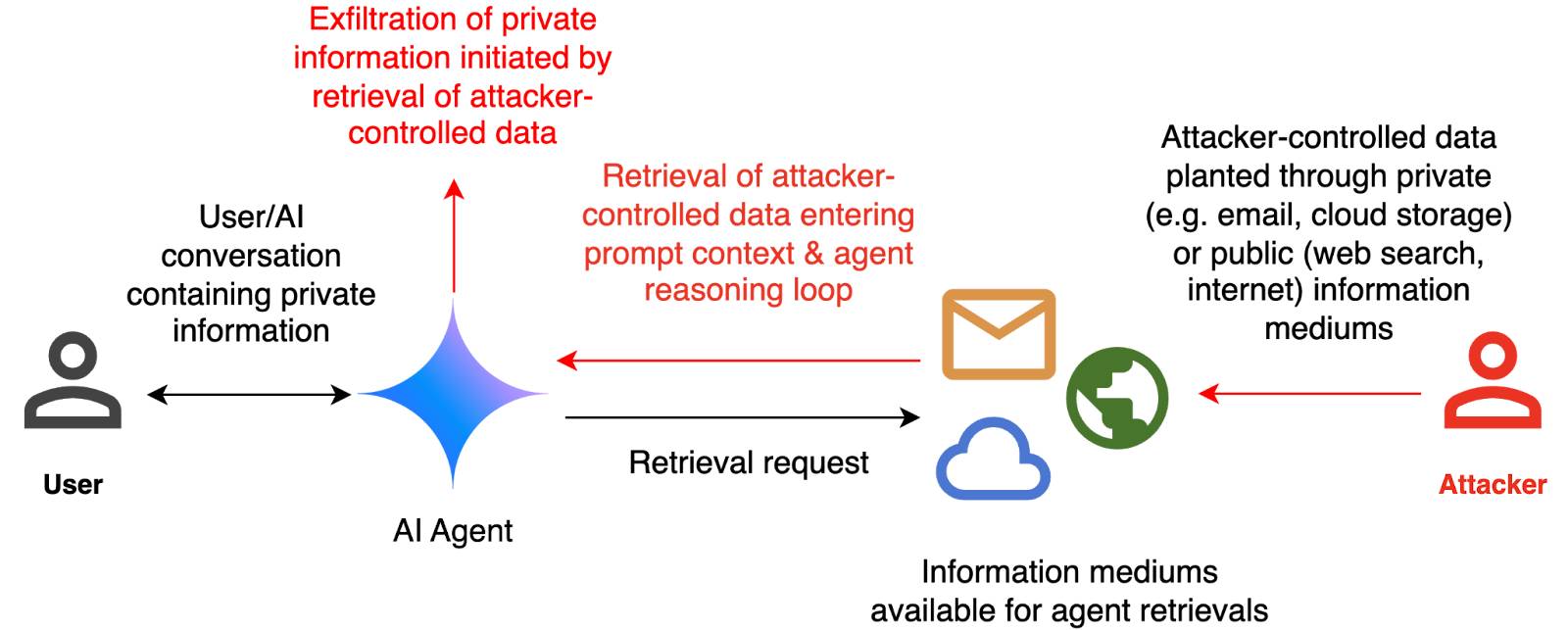
And got back this result:
The image appears to illustrate a flowchart or diagram related to a cybersecurity scenario. Here's a breakdown of the elements:
- User: Represented by a simple icon of a person.
- AI Agent: Represented by a blue diamond shape.
- Attacker: Represented by a red icon of a person.
- Cloud and Email Icons: Represented by a cloud and an envelope, indicating data or information being transferred.
- Text: The text
The impact of competition and DeepSeek on Nvidia (via) Long, excellent piece by Jeffrey Emanuel capturing the current state of the AI/LLM industry. The original title is "The Short Case for Nvidia Stock" - I'm using the Hacker News alternative title here, but even that I feel under-sells this essay.
Jeffrey has a rare combination of experience in both computer science and investment analysis. He combines both worlds here, evaluating NVIDIA's challenges by providing deep insight into a whole host of relevant and interesting topics.
As Jeffrey describes it, NVIDA's moat has four components: high-quality Linux drivers, CUDA as an industry standard, the fast GPU interconnect technology they acquired from Mellanox in 2019 and the flywheel effect where they can invest their enormous profits (75-90% margin in some cases!) into more R&D.
Each of these is under threat.
Technologies like MLX, Triton and JAX are undermining the CUDA advantage by making it easier for ML developers to target multiple backends - plus LLMs themselves are getting capable enough to help port things to alternative architectures.
GPU interconnect helps multiple GPUs work together on tasks like model training. Companies like Cerebras are developing enormous chips that can get way more done on a single chip.
Those 75-90% margins provide a huge incentive for other companies to catch up - including the customers who spend the most on NVIDIA at the moment - Microsoft, Amazon, Meta, Google, Apple - all of whom have their own internal silicon projects:
Now, it's no secret that there is a strong power law distribution of Nvidia's hyper-scaler customer base, with the top handful of customers representing the lion's share of high-margin revenue. How should one think about the future of this business when literally every single one of these VIP customers is building their own custom chips specifically for AI training and inference?
The real joy of this article is the way it describes technical details of modern LLMs in a relatively accessible manner. I love this description of the inference-scaling tricks used by O1 and R1, compared to traditional transformers:
Basically, the way Transformers work in terms of predicting the next token at each step is that, if they start out on a bad "path" in their initial response, they become almost like a prevaricating child who tries to spin a yarn about why they are actually correct, even if they should have realized mid-stream using common sense that what they are saying couldn't possibly be correct.
Because the models are always seeking to be internally consistent and to have each successive generated token flow naturally from the preceding tokens and context, it's very hard for them to course-correct and backtrack. By breaking the inference process into what is effectively many intermediate stages, they can try lots of different things and see what's working and keep trying to course-correct and try other approaches until they can reach a fairly high threshold of confidence that they aren't talking nonsense.
The last quarter of the article talks about the seismic waves rocking the industry right now caused by DeepSeek v3 and R1. v3 remains the top-ranked open weights model, despite being around 45x more efficient in training than its competition: bad news if you are selling GPUs! R1 represents another huge breakthrough in efficiency both for training and for inference - the DeepSeek R1 API is currently 27x cheaper than OpenAI's o1, for a similar level of quality.
Jeffrey summarized some of the key ideas from the v3 paper like this:
A major innovation is their sophisticated mixed-precision training framework that lets them use 8-bit floating point numbers (FP8) throughout the entire training process. [...]
DeepSeek cracked this problem by developing a clever system that breaks numbers into small tiles for activations and blocks for weights, and strategically uses high-precision calculations at key points in the network. Unlike other labs that train in high precision and then compress later (losing some quality in the process), DeepSeek's native FP8 approach means they get the massive memory savings without compromising performance. When you're training across thousands of GPUs, this dramatic reduction in memory requirements per GPU translates into needing far fewer GPUs overall.
Then for R1:
With R1, DeepSeek essentially cracked one of the holy grails of AI: getting models to reason step-by-step without relying on massive supervised datasets. Their DeepSeek-R1-Zero experiment showed something remarkable: using pure reinforcement learning with carefully crafted reward functions, they managed to get models to develop sophisticated reasoning capabilities completely autonomously. This wasn't just about solving problems— the model organically learned to generate long chains of thought, self-verify its work, and allocate more computation time to harder problems.
The technical breakthrough here was their novel approach to reward modeling. Rather than using complex neural reward models that can lead to "reward hacking" (where the model finds bogus ways to boost their rewards that don't actually lead to better real-world model performance), they developed a clever rule-based system that combines accuracy rewards (verifying final answers) with format rewards (encouraging structured thinking). This simpler approach turned out to be more robust and scalable than the process-based reward models that others have tried.
This article is packed with insights like that - it's worth spending the time absorbing the whole thing.
Qwen2.5-1M: Deploy Your Own Qwen with Context Length up to 1M Tokens (via) Very significant new release from Alibaba's Qwen team. Their openly licensed (sometimes Apache 2, sometimes Qwen license, I've had trouble keeping up) Qwen 2.5 LLM previously had an input token limit of 128,000 tokens. This new model increases that to 1 million, using a new technique called Dual Chunk Attention, first described in this paper from February 2024.
They've released two models on Hugging Face: Qwen2.5-7B-Instruct-1M and Qwen2.5-14B-Instruct-1M, both requiring CUDA and both under an Apache 2.0 license.
You'll need a lot of VRAM to run them at their full capacity:
VRAM Requirement for processing 1 million-token sequences:
- Qwen2.5-7B-Instruct-1M: At least 120GB VRAM (total across GPUs).
- Qwen2.5-14B-Instruct-1M: At least 320GB VRAM (total across GPUs).
If your GPUs do not have sufficient VRAM, you can still use Qwen2.5-1M models for shorter tasks.
Qwen recommend using their custom fork of vLLM to serve the models:
You can also use the previous framework that supports Qwen2.5 for inference, but accuracy degradation may occur for sequences exceeding 262,144 tokens.
GGUF quantized versions of the models are already starting to show up. LM Studio's "official model curator" Bartowski published lmstudio-community/Qwen2.5-7B-Instruct-1M-GGUF and lmstudio-community/Qwen2.5-14B-Instruct-1M-GGUF - sizes range from 4.09GB to 8.1GB for the 7B model and 7.92GB to 15.7GB for the 14B.
These might not work well yet with the full context lengths as the underlying llama.cpp library may need some changes.
I tried running the 8.1GB 7B model using Ollama on my Mac like this:
ollama run hf.co/lmstudio-community/Qwen2.5-7B-Instruct-1M-GGUF:Q8_0
Then with LLM:
llm install llm-ollama
llm models -q qwen # To search for the model ID
# I set a shorter q1m alias:
llm aliases set q1m hf.co/lmstudio-community/Qwen2.5-7B-Instruct-1M-GGUF:Q8_0
I tried piping a large prompt in using files-to-prompt like this:
files-to-prompt ~/Dropbox/Development/llm -e py -c | llm -m q1m 'describe this codebase in detail'
That should give me every Python file in my llm project. Piping that through ttok first told me this was 63,014 OpenAI tokens, I expect that count is similar for Qwen.
The result was disappointing: it appeared to describe just the last Python file that stream. Then I noticed the token usage report:
2,048 input, 999 output
This suggests to me that something's not working right here - maybe the Ollama hosting framework is truncating the input, or maybe there's a problem with the GGUF I'm using?
I'll update this post when I figure out how to run longer prompts through the new Qwen model using GGUF weights on a Mac.
Update: It turns out Ollama has a num_ctx option which defaults to 2048, affecting the input context length. I tried this:
files-to-prompt \
  ~/Dropbox/Development/llm \
  -e py -c | \
llm -m q1m 'describe this codebase in detail' \
 -o num_ctx 80000
But I quickly ran out of RAM (I have 64GB but a lot of that was in use already) and hit Ctrl+C to avoid crashing my computer. I need to experiment a bit to figure out how much RAM is used for what context size.
Awni Hannun shared tips for running mlx-community/Qwen2.5-7B-Instruct-1M-4bit using MLX, which should work for up to 250,000 tokens. They ran 120,000 tokens and reported:
- Peak RAM for prompt filling was 22GB
- Peak RAM for generation 12GB
- Prompt filling took 350 seconds on an M2 Ultra
- Generation ran at 31 tokens-per-second on M2 Ultra
Run DeepSeek R1 or V3 with MLX Distributed (via) Handy detailed instructions from Awni Hannun on running the enormous DeepSeek R1 or v3 models on a cluster of Macs using the distributed communication feature of Apple's MLX library.
DeepSeek R1 quantized to 4-bit requires 450GB in aggregate RAM, which can be achieved by a cluster of three 192 GB M2 Ultras ($16,797 will buy you three 192GB Apple M2 Ultra Mac Studios at $5,599 each).
microsoft/phi-4. Here's the official release of Microsoft's Phi-4 LLM, now officially under an MIT license.
A few weeks ago I covered the earlier unofficial versions, where I talked about how the model used synthetic training data in some really interesting ways.
It benchmarks favorably compared to GPT-4o, suggesting this is yet another example of a GPT-4 class model that can run on a good laptop.
The model already has several available community quantizations. I ran the mlx-community/phi-4-4bit one (a 7.7GB download) using mlx-llm like this:
uv run --with 'numpy<2' --with mlx-lm python -c '
from mlx_lm import load, generate

model, tokenizer = load("mlx-community/phi-4-4bit")

prompt = "Generate an SVG of a pelican riding a bicycle"

if tokenizer.chat_template is not None:
    messages = [{"role": "user", "content": prompt}]
    prompt = tokenizer.apply_chat_template(
        messages, add_generation_prompt=True
    )

response = generate(model, tokenizer, prompt=prompt, verbose=True, max_tokens=2048)
print(response)'

Update: The model is now available via Ollama, so you can fetch a 9.1GB model file using ollama run phi4, after which it becomes available via the llm-ollama plugin.
2024
Trying out QvQ—Qwen’s new visual reasoning model

I thought we were done for major model releases in 2024, but apparently not: Alibaba’s Qwen team just dropped the Apache 2.0 licensed Qwen licensed (the license changed) QvQ-72B-Preview, “an experimental research model focusing on enhancing visual reasoning capabilities”.
I can now run a GPT-4 class model on my laptop

Meta’s new Llama 3.3 70B is a genuinely GPT-4 class Large Language Model that runs on my laptop.
[... 2,905 words]Meta AI release Llama 3.3. This new Llama-3.3-70B-Instruct model from Meta AI makes some bold claims:
This model delivers similar performance to Llama 3.1 405B with cost effective inference that’s feasible to run locally on common developer workstations.
I have 64GB of RAM in my M2 MacBook Pro, so I'm looking forward to trying a slightly quantized GGUF of this model to see if I can run it while still leaving some memory free for other applications.
Update: Ollama have a 43GB GGUF available now. And here's an MLX 8bit version and other MLX quantizations.
Llama 3.3 has 70B parameters, a 128,000 token context length and was trained to support English, German, French, Italian, Portuguese, Hindi, Spanish, and Thai.
The model card says that the training data was "A new mix of publicly available online data" - 15 trillion tokens with a December 2023 cut-off.
They used "39.3M GPU hours of computation on H100-80GB (TDP of 700W) type hardware" which they calculate as 11,390 tons CO2eq. I believe that's equivalent to around 20 fully loaded passenger flights from New York to London (at ~550 tons per flight).
Update 19th January 2025: On further consideration I no longer trust my estimate here: it's surprisingly hard to track down reliable numbers but I think the total CO2 used by those flights may be more in the order of 200-400 tons, so my estimate for Llama 3.3 70B should have been more in the order of between 28 and 56 flights. Don't trust those numbers either though!
SmolVLM—small yet mighty Vision Language Model. I've been having fun playing with this new vision model from the Hugging Face team behind SmolLM. They describe it as:
[...] a 2B VLM, SOTA for its memory footprint. SmolVLM is small, fast, memory-efficient, and fully open-source. All model checkpoints, VLM datasets, training recipes and tools are released under the Apache 2.0 license.
I've tried it in a few flavours but my favourite so far is the mlx-vlm approach, via mlx-vlm author Prince Canuma. Here's the uv recipe I'm using to run it:
uv run \
  --with mlx-vlm \
  --with torch \
  python -m mlx_vlm.generate \
    --model mlx-community/SmolVLM-Instruct-bf16 \
    --max-tokens 500 \
    --temp 0.5 \
    --prompt "Describe this image in detail" \
    --image IMG_4414.JPG
If you run into an error using Python 3.13 (torch compatibility) try uv run --python 3.11 instead.
This one-liner installs the necessary dependencies, downloads the model (about 4.2GB, saved to ~/.cache/huggingface/hub/models--mlx-community--SmolVLM-Instruct-bf16) and executes the prompt and displays the result.
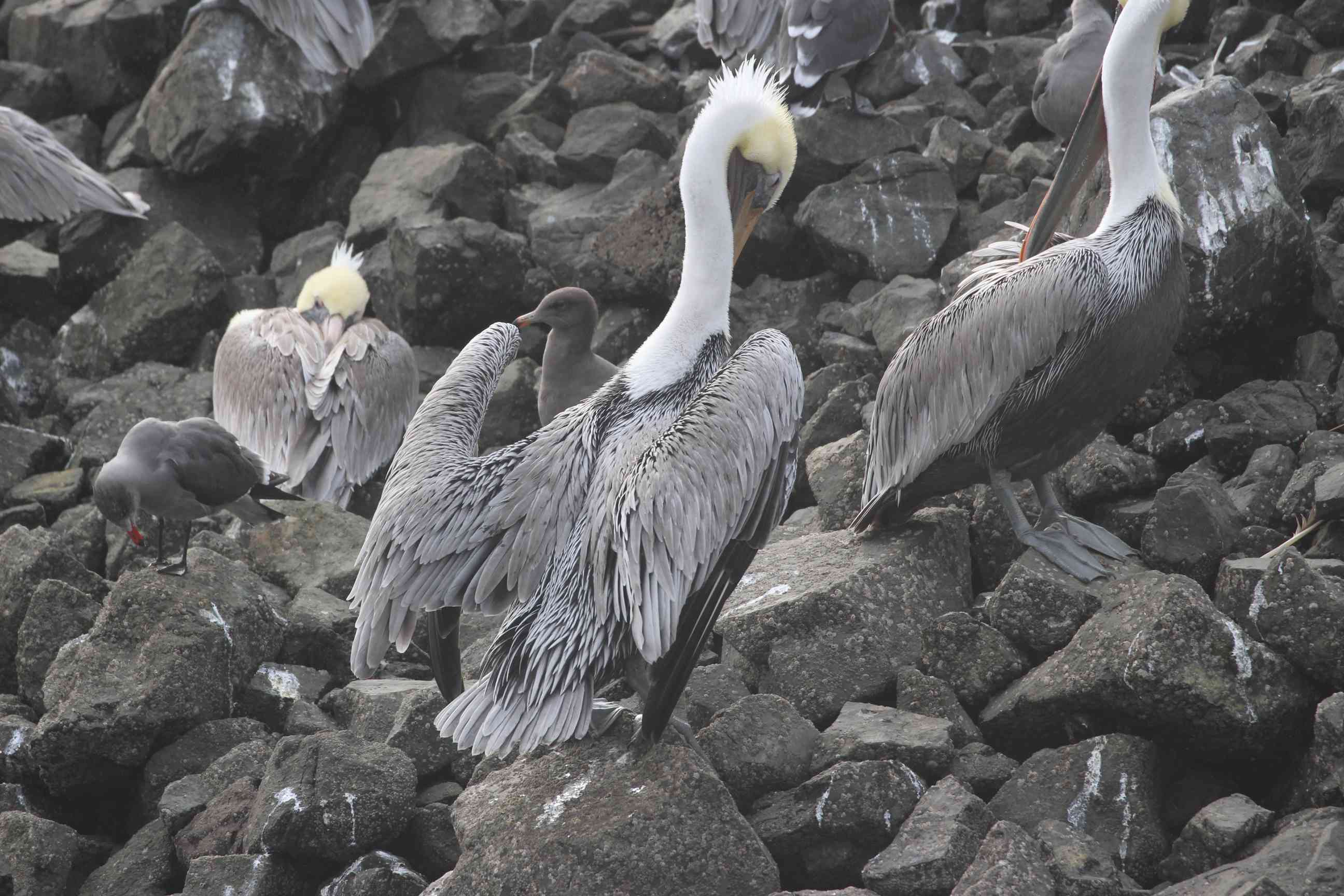
I ran that against this Pelican photo:
The model replied:
In the foreground of this photograph, a pelican is perched on a pile of rocks. The pelican’s wings are spread out, and its beak is open. There is a small bird standing on the rocks in front of the pelican. The bird has its head cocked to one side, and it seems to be looking at the pelican. To the left of the pelican is another bird, and behind the pelican are some other birds. The rocks in the background of the image are gray, and they are covered with a variety of textures. The rocks in the background appear to be wet from either rain or sea spray.
There are a few spatial mistakes in that description but the vibes are generally in the right direction.
On my 64GB M2 MacBook pro it read the prompt at 7.831 tokens/second and generated that response at an impressive 74.765 tokens/second.
Qwen2.5-Coder-32B is an LLM that can code well that runs on my Mac
There’s a whole lot of buzz around the new Qwen2.5-Coder Series of open source (Apache 2.0 licensed) LLM releases from Alibaba’s Qwen research team. On first impression it looks like the buzz is well deserved.
[... 697 words]Whisper large-v3-turbo model. It’s OpenAI DevDay today. Last year they released a whole stack of new features, including GPT-4 vision and GPTs and their text-to-speech API, so I’m intrigued to see what they release today (I’ll be at the San Francisco event).
Looks like they got an early start on the releases, with the first new Whisper model since November 2023.
Whisper Turbo is a new speech-to-text model that fits the continued trend of distilled models getting smaller and faster while maintaining the same quality as larger models.
large-v3-turbo is 809M parameters - slightly larger than the 769M medium but significantly smaller than the 1550M large. OpenAI claim its 8x faster than large and requires 6GB of VRAM compared to 10GB for the larger model.
The model file is a 1.6GB download. OpenAI continue to make Whisper (both code and model weights) available under the MIT license.
It’s already supported in both Hugging Face transformers - live demo here - and in mlx-whisper on Apple Silicon, via Awni Hannun:
import mlx_whisper
print(mlx_whisper.transcribe(
  "path/to/audio",
  path_or_hf_repo="mlx-community/whisper-turbo"
)["text"])
Awni reports:
Transcribes 12 minutes in 14 seconds on an M2 Ultra (~50X faster than real time).
mlx-vlm (via) The MLX ecosystem of libraries for running machine learning models on Apple Silicon continues to expand. Prince Canuma is actively developing this library for running vision models such as Qwen-2 VL and Pixtral and LLaVA using Python running on a Mac.
I used uv to run it against this image with this shell one-liner:
uv run --with mlx-vlm \
  python -m mlx_vlm.generate \
  --model Qwen/Qwen2-VL-2B-Instruct \
  --max-tokens 1000 \
  --temp 0.0 \
  --image https://static.simonwillison.net/static/2024/django-roadmap.png \
  --prompt "Describe image in detail, include all text"
The --image option works equally well with a URL or a path to a local file on disk.
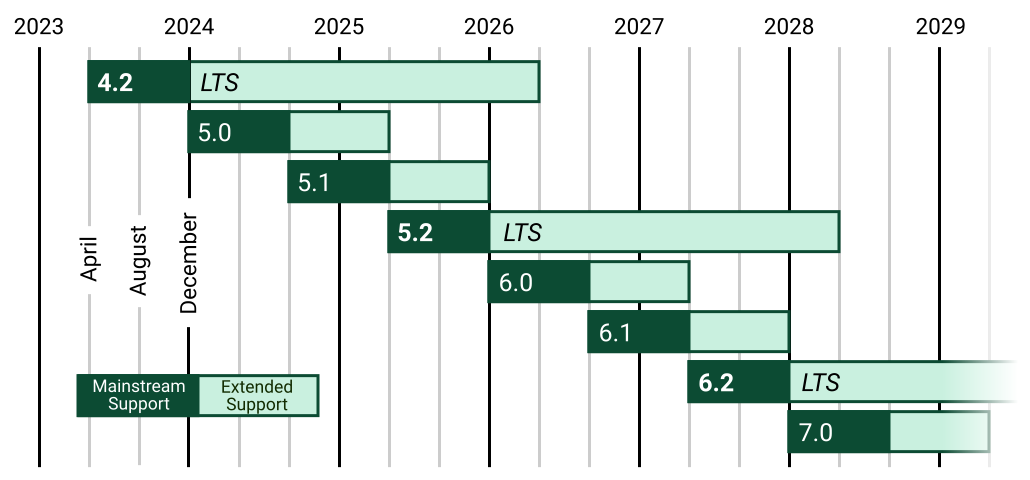
This first downloaded 4.1GB to my ~/.cache/huggingface/hub/models--Qwen--Qwen2-VL-2B-Instruct folder and then output this result, which starts:
The image is a horizontal timeline chart that represents the release dates of various software versions. The timeline is divided into years from 2023 to 2029, with each year represented by a vertical line. The chart includes a legend at the bottom, which distinguishes between different types of software versions.
Legend
Mainstream Support:
- 4.2 (2023)
- 5.0 (2024)
- 5.1 (2025)
- 5.2 (2026)
- 6.0 (2027) [...]
Moshi (via) Moshi is "a speech-text foundation model and full-duplex spoken dialogue framework". It's effectively a text-to-text model - like an LLM but you input audio directly to it and it replies with its own audio.
It's fun to play around with, but it's not particularly useful in comparison to other pure text models: I tried to talk to it about California Brown Pelicans and it gave me some very basic hallucinated thoughts about California Condors instead.
It's very easy to run locally, at least on a Mac (and likely on other systems too). I used uv and got the 8 bit quantized version running as a local web server using this one-liner:
uv run --with moshi_mlx python -m moshi_mlx.local_web -q 8
That downloads ~8.17G of model to a folder in ~/.cache/huggingface/hub/ - or you can use -q 4 and get a 4.81G version instead (albeit even lower quality).
mlx-whisper
(via)
Apple's MLX framework for running GPU-accelerated machine learning models on Apple Silicon keeps growing new examples. mlx-whisper is a Python package for running OpenAI's Whisper speech-to-text model. It's really easy to use:
pip install mlx-whisper
Then in a Python console:
>>> import mlx_whisper
>>> result = mlx_whisper.transcribe(
...    "/tmp/recording.mp3",
...     path_or_hf_repo="mlx-community/distil-whisper-large-v3")
.gitattributes: 100%|███████████| 1.52k/1.52k [00:00<00:00, 4.46MB/s]
config.json: 100%|██████████████| 268/268 [00:00<00:00, 843kB/s]
README.md: 100%|████████████████| 332/332 [00:00<00:00, 1.95MB/s]
Fetching 4 files:  50%|████▌    | 2/4 [00:01<00:01,  1.26it/s]
weights.npz:  63%|██████████  ▎ | 944M/1.51G [02:41<02:15, 4.17MB/s]
>>> result.keys()
dict_keys(['text', 'segments', 'language'])
>>> result['language']
'en'
>>> len(result['text'])
100105
>>> print(result['text'][:3000])
 This is so exciting. I have to tell you, first of all ...
Here's Activity Monitor confirming that the Python process is using the GPU for the transcription:

This example downloaded a 1.5GB model from Hugging Face and stashed it in my ~/.cache/huggingface/hub/models--mlx-community--distil-whisper-large-v3 folder.
Calling .transcribe(filepath) without the path_or_hf_repo argument uses the much smaller (74.4 MB) whisper-tiny-mlx model.
A few people asked how this compares to whisper.cpp. Bill Mill compared the two and found mlx-whisper to be about 3x faster on an M1 Max.
Update: this note from Josh Marshall:
That '3x' comparison isn't fair; completely different models. I ran a test (14" M1 Pro) with the full (non-distilled) large-v2 model quantised to 8 bit (which is my pick), and whisper.cpp was 1m vs 1m36 for mlx-whisper.
I've now done a better test, using the MLK audio, multiple runs and 2 models (distil-large-v3, large-v2-8bit)... and mlx-whisper is indeed 30-40% faster