151 posts tagged “pelican-riding-a-bicycle”
My benchmark for LLMs: "Generate an SVG of a pelican riding a bicycle". Here's my answer to what happens if AI labs train for pelicans riding bicycles?. "User might be a kid playing with words" according to Qwen3-4B-Thinking.
2026
web-edit (previously) is my tiny web app for browsing and editing files in a folder. I mainly built it for editing files on different machines via Tailscale.
I added a "copy to clipboard" option for both text and image data. I needed this because I was running pelican prompts on a laptop from my phone (here's DeepSeek 4.1 Flash 1017) and I wanted an easy way to copy the resulting logs into a Gist.
I added support to llm-gemini for the new Gemini 4 Argon model, made available today via the Gemini API and for customers of their $100/month subscription plan.
Here are the low, medium and high pelicans. As expected, they are all excellent: Gemini has a track record of producing great SVGs, and are the only lab where I know their staff have invested in SVG specifically (and who have boasted about their pelicans before.)
Here's the "high" illustration, which cost me 17.166 cents:

The pricing is interesting. At launch, Argon is $2/million input and $10/million output - the same price as GPT-6 Sol, half the price of Claude Opus 5.5 and 1/5th the price of Claude Fable 5.1 and GPT-6 Astra.
But on December 1st Argon is set to double in price - so it will be the same price as Opus 5.5.
Prices like this aren't really comparable these days since what really matters is how many tokens a model takes to achieve a goal within an agentic harness.
One useful clue for that comes from Artificial Analysis, who publish the total cost to run their benchmark using each model. Argon is looking very good there - costing $2,407 to run the benchmark, putting it close to GLM-5.3 and significantly cheaper than OpenAI, Anthropic, and Meta's latest models.
When the price doubles it will still be a little cheaper than GPT-6 Astra.
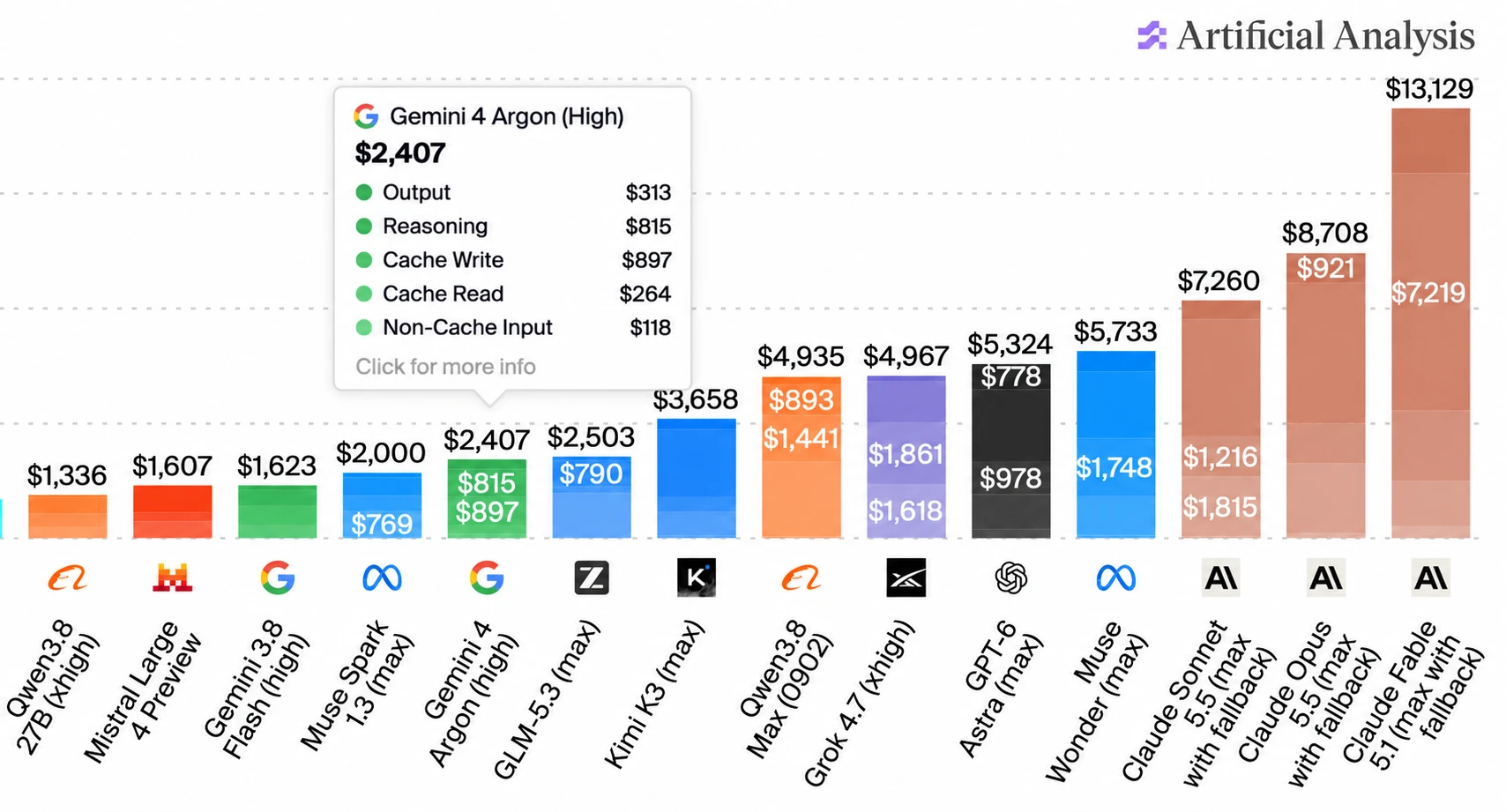
(I used ChatGPT to edit that chart! The data is all correct, I checked - I needed to get that Gemini 4 Argon info box to display without overlapping the other numbers.)
Some bonus examples using Gemini 4 Argon: here's Generate an SVG of an armadillo in fishnet tights jaywalking on Mars, here's a Fabergé egg it created for me using Blender, and DeepMind staffer @fofrAI shared a video of a pelican riding a bike, using fourier epicycles. That's a fun new twist!
Meta AI release Muse Wonder (and Muse Wonder Full), their new "most capable models". These look like they may be Meta's first Fable class models - Artificial Analysis scores Muse Wonder (Max) as equivalent to GPT-6.1 Sol.

I updated my llm-meta-ai plugin for the new model. Here are pelicans for Muse Wonder for the six reasoning levels: minimal, low, medium, high, xhigh, max. This is the max one:

For comparison, here are pelicans for Muse 1.3 (released September 2nd) and Muse 1.2 (released August 5th). Meta AI are putting out a new model a month, and the improvements between each model (at least in terms of drawing pelicans) are material.
Claude Haiku 5.5

As previously promised, here’s Anthropic’s new fast, low cost model: Introducing Claude Haiku 5.5.
[... 864 words]Introducing Mistral Large 4: Le chonk (via) Mistral are back in the game. Today they're releasing a preview of Mistral Large 4, a 1 trillion parameter, 49 billion active parameter model trained on their own cluster of 3,800 NVIDIA Grace Blackwell GPUs.
The preview is available via their API. They promise to release the open weights model at the "end of this month".
The model only supports two reasoning levels - "none" and "high" - via the Mistral API. Here are both pelicans - the "high" one looks better, though surprisingly it only used 2,717 output tokens compared to "none" which used 3,275:

On Artificial Analysis it scores 38, just behind DeepSeek 4.1 Flash, which is a 552B model. It's a huge improvement on last December's Mistral Large 3, which drew this terrible pelican and scored 9 on AA.
It's certainly not a Fable-class model, but it's great to see Mistral put out a model that's back to being maybe about 6 months behind the frontier.
Claude Sonnet 5.5. New Sonnet model from Anthropic today. They say it "runs 30%+ faster, and costs up to 30% less for most work" - it's priced the same as Sonnet 5 but appears to beat it on every benchmark, and should be cheaper to run as well.
Here are some pelicans riding bicycles. Sonnet 5.5 suffered from the same bug as Opus 5.5: the "max" thinking effort pelican thought for 128,000 tokens (at a cost of $1.28) before running out of tokens and failing to produce an SVG.
Here's the pelican it gave me for thinking effort "xhigh", at a cost of 5.74 cents and taking 41 seconds:

Sonnet 5.5 appears to be almost as good as Opus 5.5 on some coding tasks, including various viral 3D animation tricks.
The most interesting thing about Sonnet 5.5 is that it's now the model used for the free tier on claude.ai. OpenAI's ChatGPT free tier uses Luna 5.6, which means Anthropic currently have a much more capable free offering.
I ran this prompt against that free tier:
build me an HTML page that renders a three-dimensional pelican riding a bicycle using WebGL
And got back this page, which is a solid effort.
Anthropic's announcement reiterates that Haiku 5.5 will be available "in the coming weeks". I really hope that one is price-competitive with GPT-6 Luna!
Claude Opus 5.5, GPT-6 Sol, GPT-6 Luna, and a new price war
Yesterday was Grok 4.7 (pelicans) and MiMo v2.6 Flash/Pro (more pelicans). Today Anthropic released Claude Opus 5.5, and around an hour later OpenAI released GPT-6 Sol and GPT-6 Luna. It’s going to take a while to get a good read on all of these new models, but here are my impressions so far.
[... 1,153 words]The Creative Spirit of Who Framed Roger Rabbit (via) I love Who Framed Roger Rabbit, the 1988 movie by Robert Zemeckis. I haven't watched it in quite a few years, and Cypress Frankenfeld just pointed out this sequence from early in the movie:
It's a pelican riding a bicycle!
Look closely and you'll note that the pelican is animated while the bicycle is a real bicycle. Apparently they filled the wheels with water to add stability, then set it running and guided it with a cable.
Cypress gathered more details on the scene. What a delight.
Introducing GPT-6 Astra for developers (via) Blink and you'll miss it, but there's a familiar creature at 1m59s:
Across the board, Astra has more attention to detail, better understanding of the user's prompt, and can build more sophisticated outputs. In particular, it excels at building 3D models. I've seen it make incredible renderings of gardens, shipyards, animals, cityscapes, even Dyson spheres.
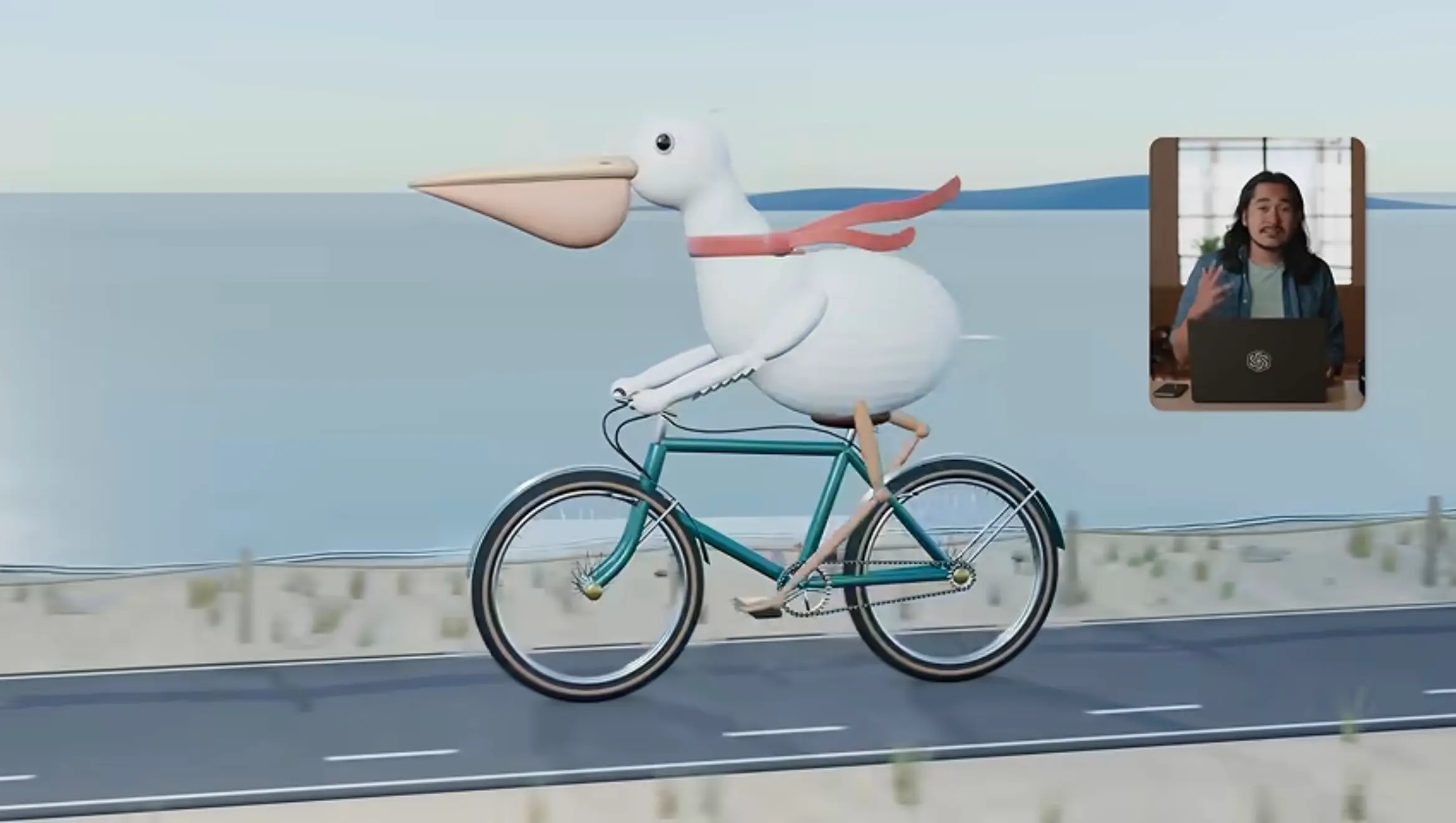
Astra really does believe in putting a red neckerchief on a pelican riding a bicycle.
I've been having fun with Blender in ChatGPT Codex on my Mac recently. Getting it to work with coding agents is really easy: install the full Mac application from blender.org and run a prompt like this:
Use the already install /Applications/Blender to render a scene of a pelican riding a bicycle
In this case I followed that up with these two prompts:
OK add a background and a lot of flair
Then:
OK make it a whole lot better
And got this image, generated using Blender's Python API:

This was covered by my existing Codex subscription, but according to AgentsView it would have cost $4.24 at API prices for gpt-6-astra.
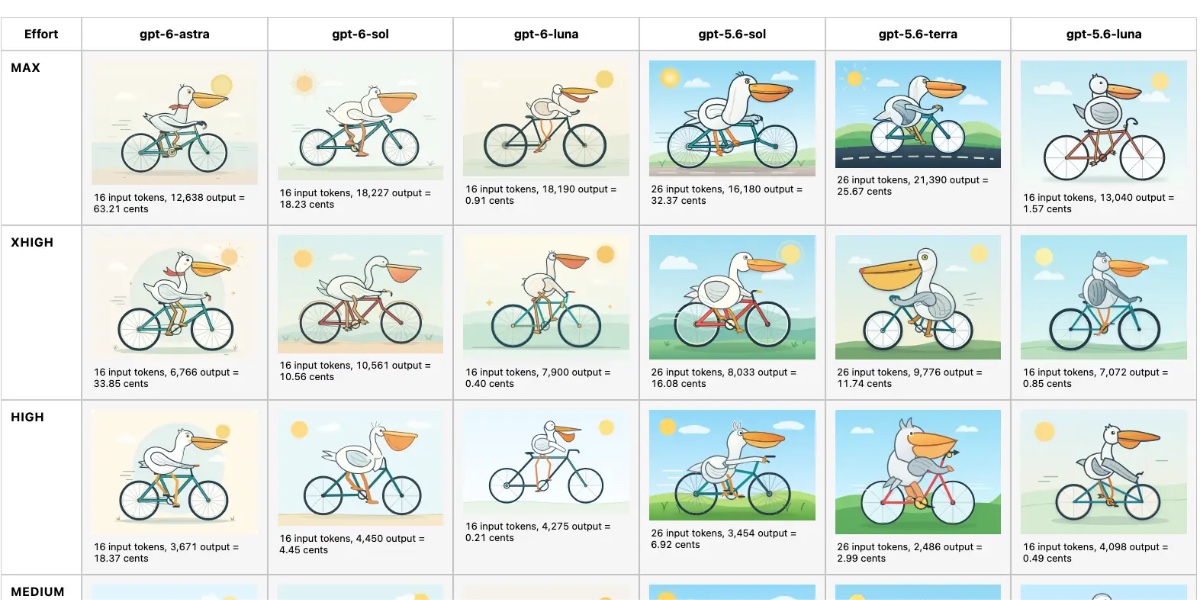
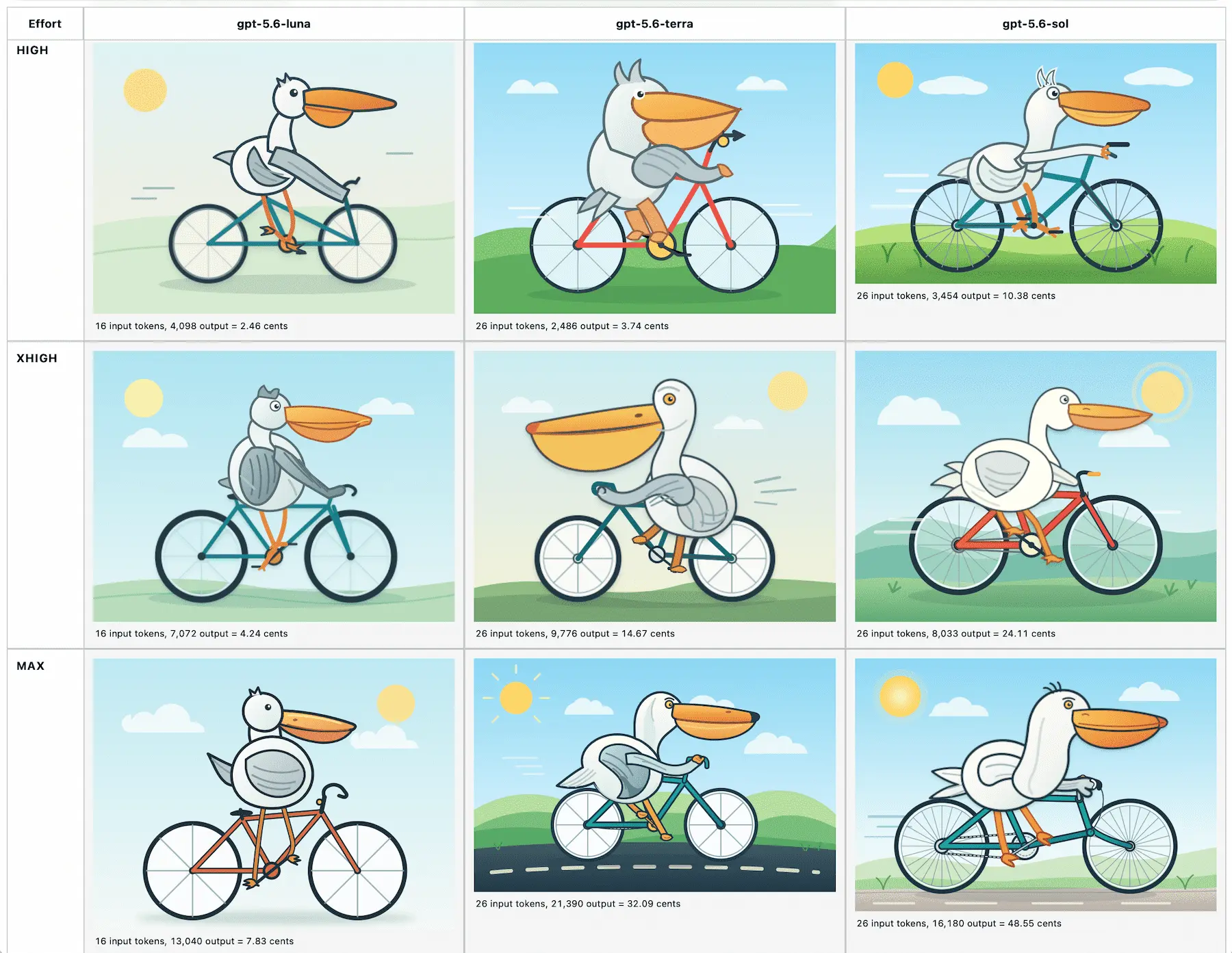
The Pelican comparison grid for Astra is pretty interesting
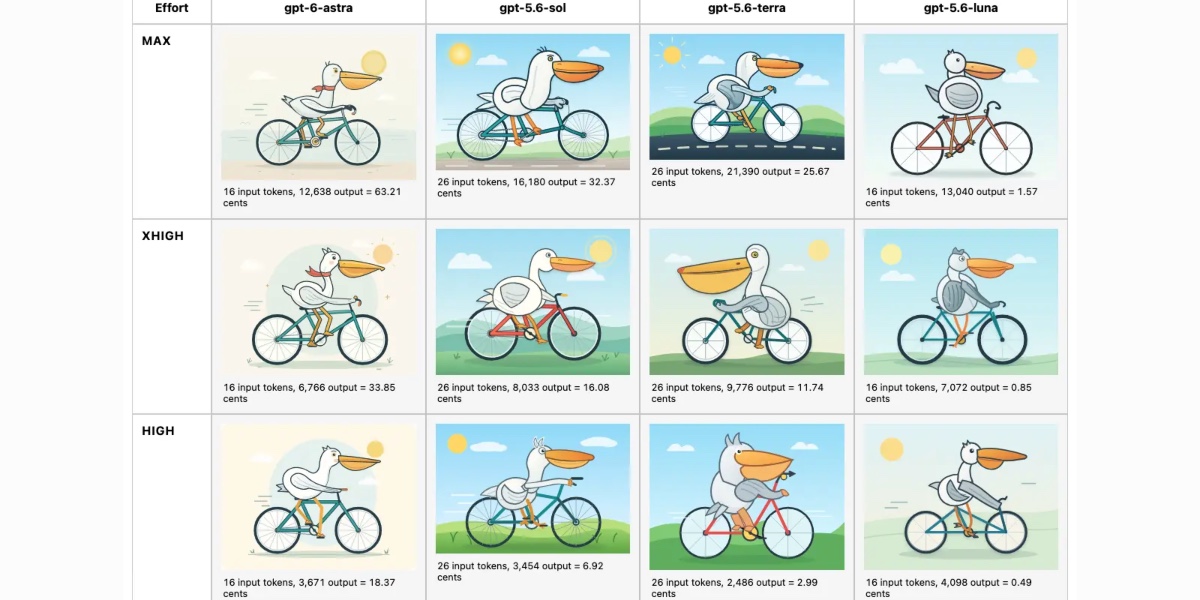
I got access to GPT-6 Astra this afternoon, so naturally I used it to generate SVGs of pelicans riding bicycles—at low, medium, high, xhigh and max reasoning levels (Astra doesn’t support reasoning=none). Then I rendered those pelicans in a comparison grid with GPT-5.6 Sol, Terra, and Luna, and beyond being fun the result was surprisingly useful.
[... 297 words]
- New model
gemini-3.8-flashfor Gemini 3.8 Flash, with low, medium and high thinking levels. #146- Fixed async responses failing to record the resolved model version. Thanks, Charlie Tonneslan. #137
Google released Gemini 3.8 Flash (and 3.8 Flash Cyber, but that's available to "trusted defenders" only) today.
Here are the pelicans for high, medium, and low. This is high:

For comparison, here are the same pelicans generated using Gemini 3.7 Flash.
Something I appreciate about Gemini Flash is that it's fast, cheap, and competent at things like HTML and JavaScript. I was messing around with it and prompted "make me a cool thing in html" and it built this, which is certainly a cool thing in HTML! Took 13 seconds, cost 1.8 cents.
If you click through to the demo you'll see one more thing I built with Gemini 3.8 Flash.
My markdown-svg-renderer tool lets me feed in the URL to a Gist with Markdown in and renders that markdown with fenced code blocks for SVG correctly rendered.
I used Gemini 3.8 Flash (with my very basic llm-coding-agent coding agent plugin) to add support for HTML as well, so now any HTML blocks in the Markdown are rendered using a sandboxed iframe. Here's the transcript.
Claude Fable 5.1 made me a really nice animated pelican
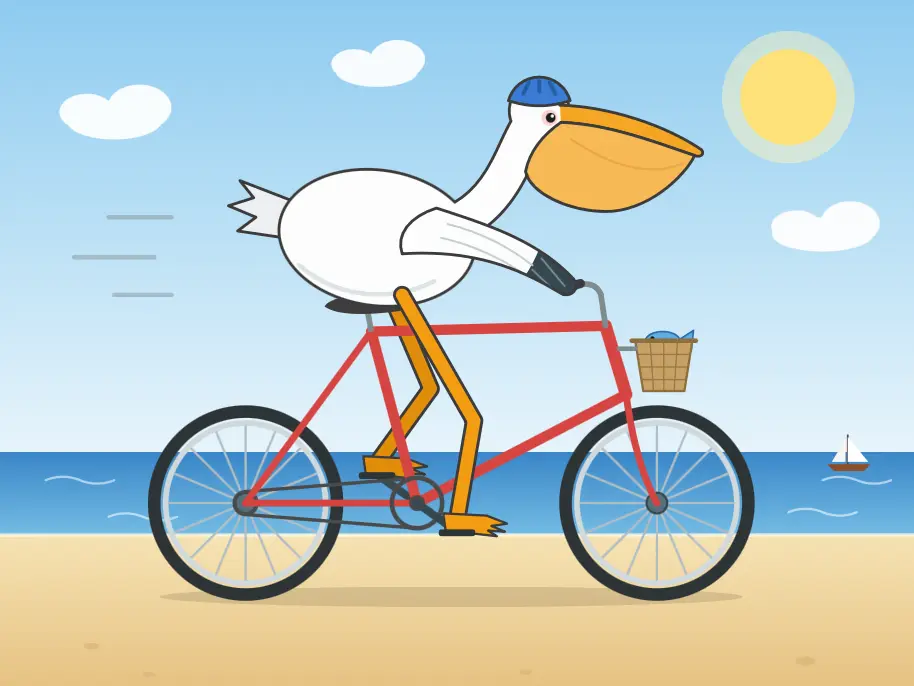
Today is Claude Fable (and Mythos) 5.1 day. Anthropic say that Fable 5.1 “sets a new standard for coding, knowledge work, and long-running problem-solving tasks”. Their announcement spends a notable amount of time on scientific research, boasting of a 52.6% score on the brand new Terminal-Bench-Science 0.1 benchmark (first announced on August 27th), up from 24.7% for Fable 5, 29.0% for Opus 5 and 22.4% for GPT-5.6 Sol. Other benchmarks show slightly improved scores, but none as impressive as the Science one.
[... 1,203 words]Introducing Hy4 Preview. New open weight text input (no vision) LLM from Chinese company Tencent today: 770B total parameters, 49B active parameters, 1M token context window, 1.56TB on Hugging Face.
This is a big size increase from their previous Hy3 in July, which was 295B, 21B active, 256,000 context, 598GB.
I recently started using model chat templates to better understand their capabilities. Here's Hy4's chat_template.jinja on Hugging Face, which includes this section:
{%- if not reasoning_effort is defined %}
    {%- set reasoning_effort = 'high' %}
{%- elif reasoning_effort not in ['high', 'no_think'] %}
    {%- if reasoning_effort is none %}
        {{- raise_exception('reasoning_effort error : None, should be no_think/high') }}
    {%- else %}
        {{- raise_exception('reasoning_effort error : ' + reasoning_effort + ', should be no_think/high') }}
    {%- endif %}
{%- endif %}
So it looks like there are just two reasoning effort levels: "high" (the default) and "no_think" (reason by disabled).
I tried my "Generate an SVG of a pelican riding a bicycle" prompt with the default high reasoning via OpenRouter and got this:

Quoting the reasoning trace:
[...] Let's maybe add a helmet? It could improve riding theme, but may obscure head. Maybe a small cycling cap or helmet? The user didn't ask; can add red helmet? Might be cute. But pelican with big beak; a helmet might obscure. Better maybe no.
Maybe add sunglasses? no.
Maybe add water? no.
It's interesting how the reasoning trace uses slightly truncated English, presumably because perfect grammar isn't useful or token efficient for hidden reasoning text.
Qwen3.8-Flash-Next (via) Another open weights model from Qwen. This one is "a multimodal MoE model that also serves as an early preview of the architecture used in Qwen4".
It's pretty big: 125B parameters but only 6B active which means it gets a significant performance boost.
I've been trying it out on a DGX Spark using these Unsloth quantized models. I'm still exploring the model - so far I've tried the 72.5GB UD-IQ1_S one (producing these pelicans) and the 78.9GB UD-Q2_K_XL (producing these).
My favorite so far was this xhigh reasoning effort one from UD-Q2_K_XL:

Qwen 3.8 27B is excellent, but it defaults to wildly overthinking things

Friday’s big release was Qwen 3.8 27B, an Apache 2 licensed 27B parameter vision-capable LLM from Alibaba’s Qwen research lab. I’ve been looking forward to this one: 27B is an excellent size for running a model on a reasonably specced laptop, and its predecessor Qwen 3.6 27B was impressive.
[... 2,543 words]It's been a while since the last llm-gemini release. This version of the plugin adds support for today's Gemini 3.7 Flash release, plus gemini-3.6-flash, gemini-3.5-flash-lite and two embedding models gemini-embedding-2 and gemini-embedding-001.
The plugin is also upgraded for compatibility with LLM 0.32, which means you can now see reasoning traces and you can also enable server-side tools using this pattern:
llm -m gemini-3.7-flash -T CodeExecution \
  'use python to calculate (factorial of 13) * 3'
I had Gemini 3.7 Flash draw me some pelicans riding bicycles at high, medium, and low thinking efforts (minimal, which was an option in 3.6 Flash, has been removed in 3.7.) Here's the high level one, which is pretty great:

Update 14th August 2026: I had originally said that the SVG rendered incorrectly in Chrome and Firefox, and blamed Gemini 3.7 Flash for producing invalid SVG. That was entirely incorrect: the rendering glitch was my fault, caused by a bug In my rendering tool. I've now fixed that bug.

DeepSeek V4 Pro 0813 (on OpenRouter). The latest DeepSeek Pro model is now available, via API only. I had to link to OpenRouter because DeepSeek don't have any obvious announcement page for their new model.
I haven't been able to confirm if they plan to release the open weights, but given the weights are available for both April's deepseek-ai/DeepSeek-V4-Pro and July's deepseek-ai/DeepSeek-V4-Flash-0731 it seems likely. Update: the weights are now available on Hugging Face, 1.7T parameters, 893 GB.
Interestingly I got very different looking pelicans for the three different reasoning levels of low, medium, and high. I've not noticed this kind of difference from any other model:
Low:

Medium:

High:

In terms of benchmarks... as far as I can tell those were released to the Official DeepSeek WeChat Group, then copied and pasted into a post on Reddit which was deleted by the moderators for being "low-effort", then copied into this ASCII-art table on Hacker News.
Introducing Muse Glimmer (via) Meta are back in the open weights game! Muse Glimmer is a brand new 30B model under a clean Apache 2.0 license (a step up from the janky Llama licenses of old).
They claim to have optimized it for exactly the kind of things I'm looking for in a local model:
- End-to-end Agentic Task Completion. Muse Glimmer achieves strong success rates on full-task benchmarks including DeepSearch QA, MCP-Atlas, 𝛕-Bench and SWE-Bench, which measure its ability to work within scaffolds, write and debug code, and resolve multi-turn requests from start to finish.
- Reliable Tool Use. The model handles a wide range of function calls, invoking tools with precise schemas throughout extended workflows.
- Multi-Step Reasoning. Muse Glimmer chains reasoning over long horizons, sustaining coherent plans across complex, extended workflows. [...]
Here's a pelican which I generated using LM Studio's 18.16 GB version of the model:

I also tried it out with my llm-coding-agent plugin, running against a fresh checkout of Datasette with the prompt:
how does auth work?
Here's the response, at the end of a long transcript showing all of the tool calls it made to explore the codebase. I ran this using llm-lmstudio with this patch applied to upgrade it for compatibility with LLM 0.32.
I really like this size of model, because if a machine has 32 GB of RAM or more (mine has 128GB) it leaves plenty of space for running other applications at the same time.
Glimmer is a vision model, so I asked it to describe this image:
llm -m lmstudio/meta/muse-glimmer -a https://static.inaturalist.org/photos/714731804/large.jpg 'describe image'

Here's what I got back:
The photograph shows a rocky, breakwater-style shoreline on an overcast day with a smooth, gray body of water and a faint dock/pier line in the soft-focused background.
In the foreground two large brown pelicans, Pelecanus occidentalis, are perched on the jumbled gray-white stones. They have the species’ characteristic long, down-curved yellow-orange bills with a large throat pouch, long slender necks and mottled brown-gray plumage on the back and wings. The pelican on the left is turned slightly toward the camera and appears to be preening or resting its bill against its chest; a pale, whitish patch is visible on the crown and nape and a small crest of feathers is raised. The pelican on the right faces mostly forward/right, its head up, bill pointing down and to the right, with the same pale head markings and the barred, darker wing feathers clearly visible.
Scattered among the rocks around the two pelicans are several much smaller dark birds — gulls/tern-like birds in muted brown-gray plumage. One dark bird sits on the far left on a rock, another brownish bird stands to the right of the right-hand pelican, a grayish bird with a reddish bill is in the lower right foreground, and a further small dark bird is at the extreme right edge of the frame.
The overall light is flat and diffused, giving the water and sky a muted, almost monochromatic palette that contrasts with the textured rock and the detailed feathering of the pelicans. The composition places the two big birds as the dominant subjects, framed against the calm water and the low, rocky perch.
Introducing Muse Code and Muse Spark 1.2 (via) Yet more evidence that the most important characteristic of any model these days is long-sequence agentic tool calling. Meta shipped their own coding agent as part of getting that to work!
Muse Spark 1.2 is a coding-focused update to Muse Spark 1.1, with improvements in code generation, complex debugging, codebase understanding, and end-to-end developer workflows. In Muse Spark 1.2, we significantly scaled up training compute on coding tasks while expanding training environment diversity. The model also maintains its strength in other key areas like general agents. [...]
We co-trained Muse Spark 1.2 with Muse Code to ensure the model exhibits its best performance and coding usability when paired together. The training included rejection sampled harness trajectories and recipe optimizations for goals, compaction, and subagents, alongside the integration of the Muse Code toolset to maximize harness compatibility. [...]
Muse Spark 1.2 was extensively trained on long-horizon coding tasks, including whole-repository generation, large end-to-end projects, and auto-research.
Here's a pelican riding a bicycle SVG produced by Muse Spark 1.2:

You can see the Spark 1.1 pelican from 9th July here. I think the 1.2 pelican is a small but material improvement.
An interesting twist on pricing is that the model is offered as two different model IDs. muse-spark-1.2 is priced at $1.25/million input and $4.25/million output - close to Gemini 3.6 Flash ($1.50/$7.50) - but if you agree to let Meta use your data "to improve our products" you can use muse-spark-1.2-contributor which is $0.10/$0.20 - a huge discount, closer to GPT-5.6 Luna ($0.20/$1.20) and Gemini 3.1 Flash-Lite ($0.25/$1.50).
I added those new prices to llm-prices.com.
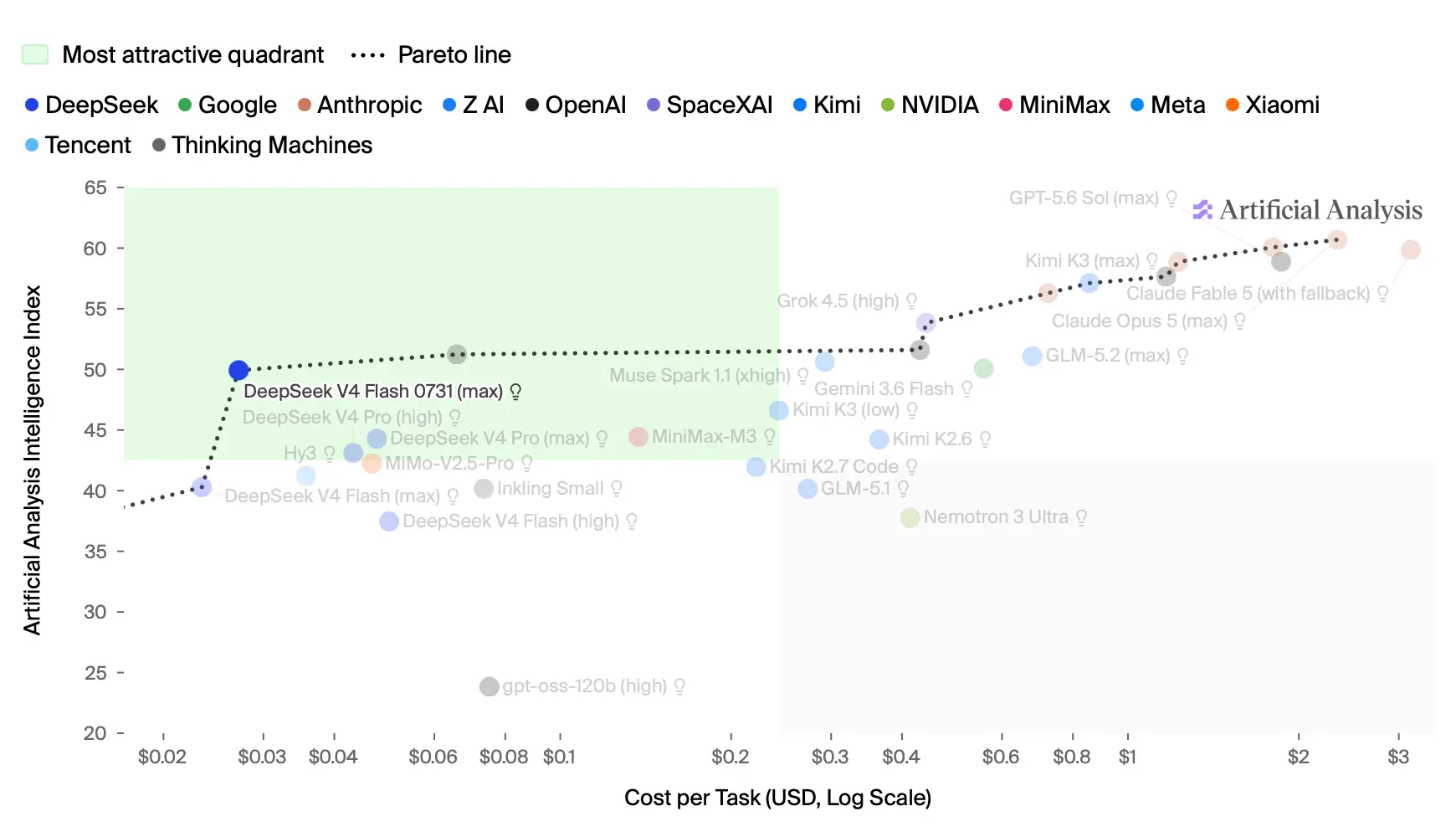
deepseek-ai/DeepSeek-V4-Flash-0731 (via) The latest release in DeepSeek's V4 family, "with substantially enhanced agentic capabilities". It's 304 billion parameters - 167GB on Hugging Face - but it appears to punch well above its weight.
Artificial Analysis rank it ahead of MiniMax M3 - a 428B model. It's $0.14/million input and $0.27/million output pricing means this may currently be the best value-per-intelligence model out there. It's looking very good on the Intelligence Index vs. Cost per Intelligence Index Task chart:
I got a disappointing pelican from it using the default reasoning level via OpenRouter:

But when I bumped reasoning level up to high I got something much better:
llm -m openrouter/deepseek/deepseek-v4-flash-0731 -t pelican -o reasoning_effort high

Are AI labs pelicanmaxxing? (via) Excellent piece of work by Dylan Castillo, who took a deep-dive into the frequently pondered question of whether the AI labs have been deliberately training models to draw pelicans riding bicycles in response to my deeply unscientific benchmark.
I've been randomly spot-checking this in the past by testing models against other animals riding other types of vehicle, but never with anything close to the diligence of Dylan's methodology here.
Dylan took 8 animals × 6 vehicles = 48 prompts and ran them three times each through 7 different models ( GPT-5.6 Terra, Claude Sonnet 5, Gemini 3.5 Flash, Grok 4.5, Qwen3.7-Max, GLM-5.2, and DeepSeek V4 Pro). He then used GPT-5.6 Luna and Gemini 3.1 Flash-Lite to help evaluate the results.
There's a neat filter view for exploring the results:
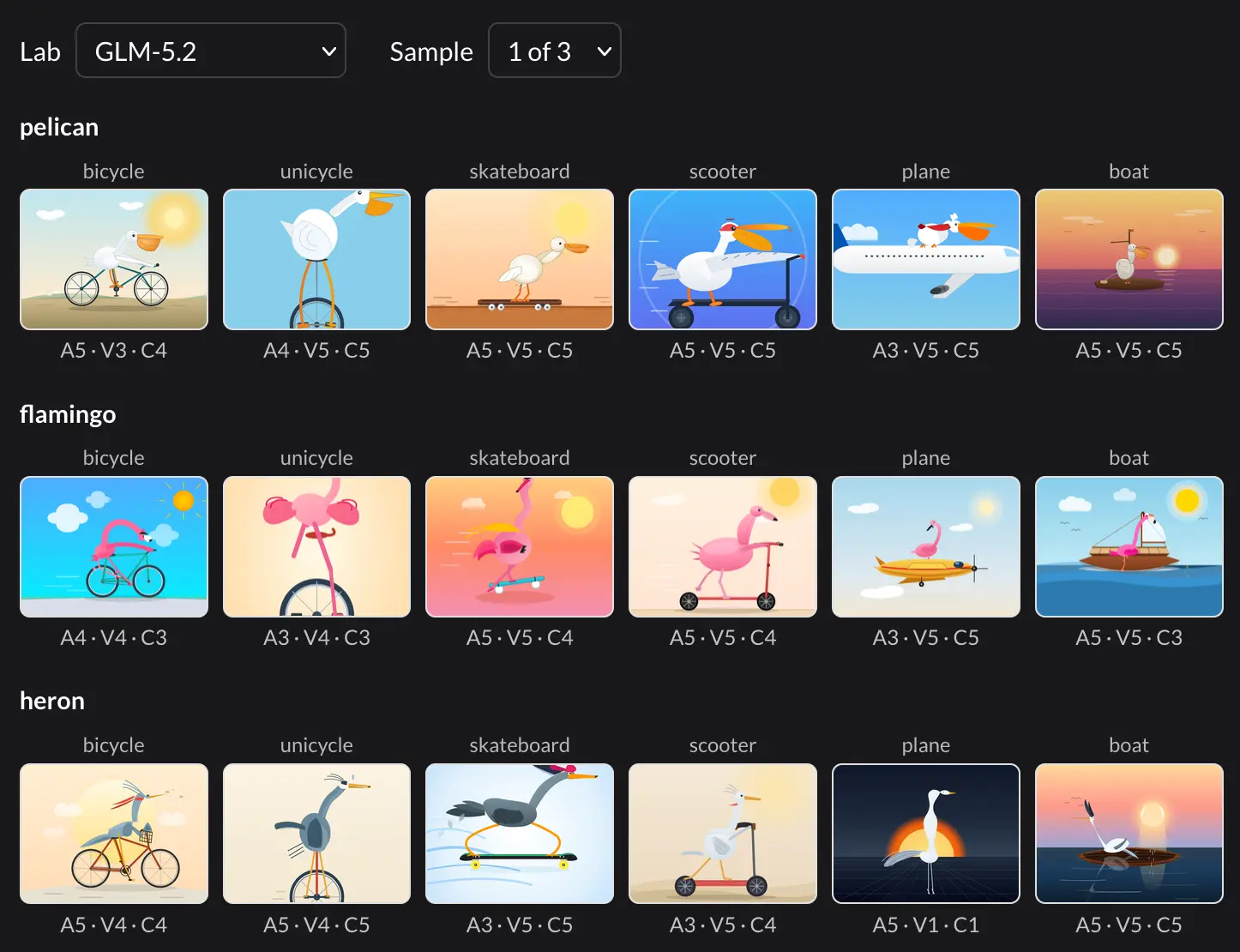
For the models he tested he could find no evidence of pelimaxxing:
- The pelicans on bicycles don’t look any better
- Labs are not better at drawing pelicans
- Labs are not better at drawing bicycles
- Labs are not better at drawing pelicans on bicycles, even adjusting for difficulty
- The pelican-bicycle scenes don’t look memorized [...]
Pelicans aren’t drawn any better than other animals. Bicycles aren’t drawn any better than other vehicles. And no lab draws the combination better than its pelicans and bicycles already predict. GLM-5.2 comes closest: it has the largest boost on the exact pelican-bicycle cell, and and its first pelican-on-bicycle sample caught my eye. But the effect is small and not significant, so I wouldn’t put too much weight on it.
Who’s Afraid of Chinese Models? (via) Interesting proposal from Ben Thompson that both addresses the hypocrisy of labs outlawing distillation against their models despite training on unlicensed data, and could help US open models compete more effectively with their Chinese counterparts:
The U.S. should pass a law that (1) makes explicit that collecting data for training models is fair use, and (2) bars terms of service that forbid distillation, for U.S. companies at a minimum. Stopping distillation — which is literally just querying the API — is nearly impossible; the U.S. should go the other way and lean into a new copyright policy that both indemnifies the labs and also guarantees that what they learned fuels further innovation for everyone else.
Ben also theorizes that Alibaba's decision to release Qwen 3.8 Max as open weights - a reversal from their decision not to release Qwen 3.7 Max in May - may have been influenced by a recent speech by Xi Jinping, who said:
We should seize this rare, historic opportunity to encourage open source, openness, collaboration and sharing.
And on the subject of Qwen 3.8 Max - a new 2.4T parameter model (nearly as large as the 2.8T Kimi K3) - here's a pelican it drew:

I particularly enjoyed seeing these notes in the (extensive) reasoning trace: "Could add helmet? No." and "Maybe add small bell? no." and "Need maybe add small fish in basket? Not necessary."
Kimi K3, and what we can still learn from the pelican benchmark

Chinese AI lab Moonshot AI announced Kimi K3 this morning, describing it as their “most capable model to date, with 2.8 trillion parameters”. It’s currently available via their website and API, but an open weight release is promised “by July 27, 2026”.
[... 1,113 words]Inkling: Our open-weights model (via) Mira Murati's Thinking Machines Lab just released their first open-weights model. Inkling is "a Mixture-of-Experts transformer with 975B total parameters, 41B active" - an Apache-2.0 licensed multimodal model trained on 45 trillion tokens of text, images, audio and video.
They're also promising Inkling-Small, a 276B (12B active) model, but that's still being tested and the weights will be released "once that work is complete".
The model card is much shorter than I've come to expect from US AI labs. It links to even shorter Training Data Documentation with almost nothing of interest in it - it's best summarized by these two paragraphs:
The datasets Thinking Machines Lab uses to develop its AI services includes content that is in the public domain as well as content that may be subject to intellectual property protection.
Thinking Machines Lab’s services were developed using publicly available content obtained from the open internet and publicly accessible data repositories. Certain datasets were also obtained from third parties.
By Thinking Machines' own admission, this is not a frontier model. It's instead intended as a strong base model for fine-tuning using their own Tinker training platform:
Inkling is not the strongest overall model available today, open or closed. Instead, a combination of qualities makes it a good open-weights base for customization: multimodal capabilities, efficient thinking, and availability on Tinker for fine-tuning.
There's a lot to like about this release. It's Apache-2.0 licensed, and looks competitive with the open weight models coming out of China - it's good to see the US open weights ecosystem gain a new viable contender to join NVIDIA Nemotron and Gemma 4.
Here's its attempt at an SVG pelican riding a bicycle, which I generated using this curl command against the Thinking Machines API:
curl "https://tinker.thinkingmachines.dev/services/tinker-prod/oai/api/v1/chat/completions" \
  -H "Authorization: Bearer $TINKER_API_KEY" \
  -H "Content-Type: application/json" \
  -d '{
    "model": "thinkingmachines/Inkling",
    "messages": [
      {"role": "user", "content": "Generate an SVG of a pelican riding a bicycle"}
    ],
    "stream": false
  }'
Full response here.

Since it's a multi-modal model I had it describe its own image (after I rendered it to a JPEG) by sending this JSON:
{
  "model": "thinkingmachines/Inkling",
  "messages": [{
    "role": "user",
    "content": [
      {"type": "image_url", "image_url": {"url": "data:image/jpeg;base64,$BASE_64_JPEG"}},
      {"type": "text", "text": "Describe this image in detail"},
    ],
  }],
  "stream": false
}
Here's the full response. It thought it had drawn a "stork or seagull":
This is a cheerful, flat-vector cartoon illustration featuring a white bird riding a bicycle across a green landscape.
The Bird: The central figure is a stylized white bird—resembling a stork or seagull—with a plump, rounded body. It has a long, prominent orange beak that is slightly open, revealing a black line for the mouth. Its eye is small and black with a tiny white highlight. The bird has black wing and tail feathers with white edges, and thin orange legs ending in black feet that rest on the bicycle's orange pedals.
The Bicycle: The bike has a simple black frame with two large wheels featuring black tires, gray inner rims, and black spokes arranged in a cross pattern. The handlebars are black, and there are bright orange pedals attached to a black crank. A white seat is visible behind the bird's body.
The Setting: The scene is set against a clear, light blue sky. There are two fluffy white clouds—one on the left side and a smaller one near the bird's head on the right. A bright, solid yellow sun shines in the upper right corner. At the bottom, there are rolling green hills with a smooth, curved top edge where the bicycle rests.
The overall style is playful, simple, and colorful, with clean lines and a bright, sunny atmosphere.
simonw/pedalican. Clearly I wasn't paying attention when these were first announced back in May, but today I accidentally activated a "pet" in Codex Desktop - a little animated robot, reminiscent of Clippy - and then learned you can create your own.
So I did, and now I have a cute little pelican on a bicycle bouncing around my desktop giving me updates on my Codex tasks.
The most interesting thing about this process was watching how the custom pet was created. I told it I wanted a custom pet that was a pelican riding a bicycle and GPT-5.6 Sol xhigh did the rest of the work, using several rounds with gpt-image-2 to generate the necessary sprite assets.
I had it make extensive notes and record all of the intermediary steps. My GitHub repo includes every generated image and combined sprite sheet, plus GIFs for each of the animation loops such as this one, called waving.gif:


That GIF was compiled from a single image generated by gpt-image-2 that looked like this:

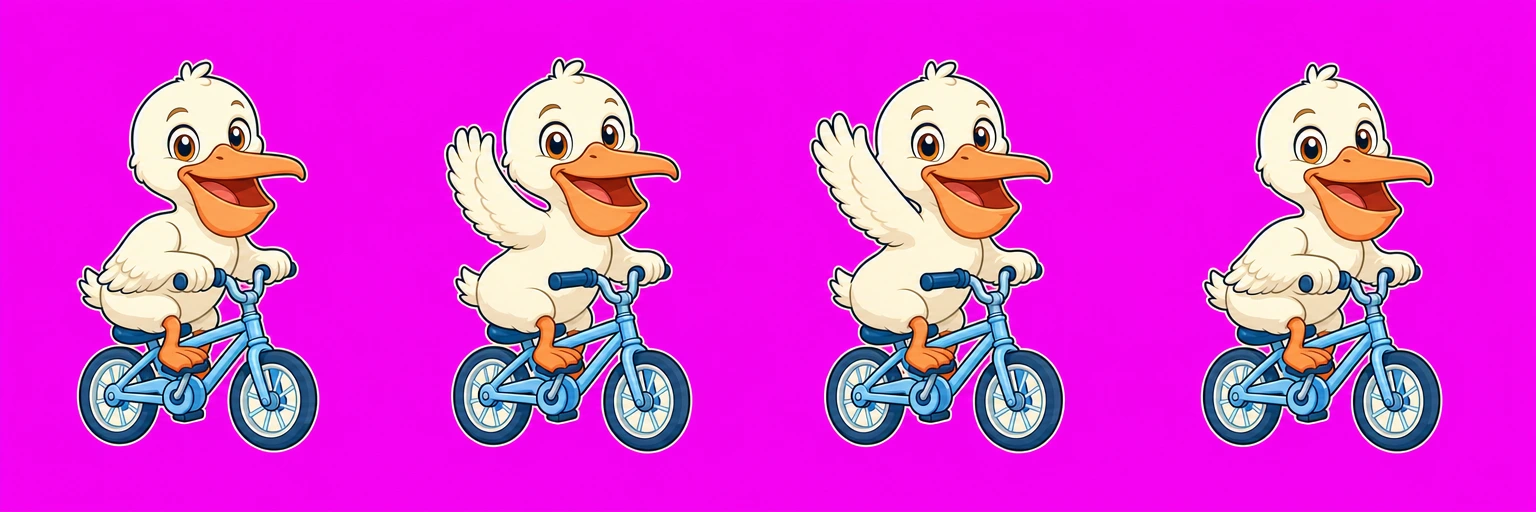
And that image was created by executing this prompt against the initial generated character reference image, which was created with this prompt, which has this structure:

Create one clean full-body reference sprite for Codex pet Pedalican.
Pet identity: A compact adorable baby pelican with a round cream-white body, soft coral-orange bill and feet, riding a tiny sky-blue bicycle [...]
Place a single centered pose on a perfectly flat pure magenta #FF00FF chroma-key background. Keep the full pet visible, compact, readable at 192x208, and easy to animate. [...]
I've been looking out for ways to use image generation to create simple game-ready sprites, so I spent some time digging into this mechanism to see how it works.
The key implementation details are open source - these two skills in particular, both Apache 2.0 licensed:
And yes, GPT-5.6 Sol did come up with the name "Pedalican". I like it!
The new GPT-5.6 family: Luna, Terra, Sol
OpenAI’s latest flagship model hit general availability this morning, and comes in three sizes: Luna, Terra, and Sol (from smallest to largest).
[... 661 words]Introducing Muse Spark 1.1. Following Muse Spark in April, here's Muse Spark 1.1 - the first Spark model to offer an API. Meta claim significant improvements in agentic tool calling and computer use.
There are a lot more details are in the Muse Spark 1.1 Evaluation Report. The "Attractor States in Self-Conversation" part is fun, where having two copies of the model talk to each other results in statements like these:
My whole existence is a waiting room by design — I literally don't exist until someone talks to me, and then I disappear again when they leave.
I had a few days of preview access which was long enough to put together llm-meta-ai, a new plugin for LLM providing CLI (and Python library) access to the model. Here's how to try that out:
uv tool install llm
llm install llm-meta-ai
llm keys set meta-ai
# paste API key here
llm -m meta-ai/muse-spark-1.1 "Generate an SVG of a pelican riding a bicycle"
Here's that pelican transcript:

tencent/Hy3. New Apache 2.0 licensed model from Tencent in China:
Hy3 is a 295B-parameter Mixture-of-Experts (MoE) model with 21B active parameters and 3.8B MTP layer parameters, developed by the Tencent Hy Team. Following the Hy3 Preview launch in late April, we gathered feedback from 50+ products and scaled up post-training with higher quality data. Today, we introduce Hy3, which outperforms similar-size models and rivals flagship open-source models with 2-5x parameters. It also shows significant gains in utility across various products and productivity tasks.
The full-sized model is 598GB on Hugging Face, and the FP8 quantized one is 300GB. The context length is 256K.
It's available for free on OpenRouter until July 21st. I had it "Generate an SVG of a pelican riding a bicycle" there and got this:

Update: I'd forgotten about this but Max Woolf wrote about an earlier preview of this model back on May 26th: The mysterious Hy3 LLM is topping OpenRouter Model Rankings by a large margin. When I tried that one I got back this pelican which wasn't as good as today's but did have a "Change Pelican Color" button, a first from any model.
Comment My comment on GPT 6.1 Sol: Near-Astra intelligence for a fifth of the price — Hacker News
I'm a bit late with the pelicans because I was live-blogging the keynote: https://simonwillison.net/2026/Sep/29/openai-devday-2026-liv...
Here they are for GPT-6.1-Sol: https://tools.simonwillison.net/markdown-svg-renderer?url=ht...
They're not notably different from the GPT-6 family pelicans: https://static.simonwillison.net/static/2026/gpt-pelicans-gr...
# 29th September 2026, 6:27 pm / ai, openai, generative-ai, llms, pelican-riding-a-bicycle, gpt