83 posts tagged “careers”
2026
The cost of writing code collapsed, and the cost of reviewing, fixing and operating it is following, and I'm assuming it gets there. What's left of making software is finding out what people actually want, defining it precisely, and making it pleasant to use. That cost is per piece of software and doesn't transfer, so as the amount of software goes to infinity, which it will because there's no ceiling on demand, that cost becomes the whole job.
— Laurie Voss, We are all Product Engineers now
Years ago, we didn’t have SQL. There were people whose job was to generate software that would query large data sets. Their job title was COBOL programmer.
Then SQL comes along—I’m simplifying this only a little bit—and it gives you this convenient way so people could just specify. With a very simple specification, you can generate all of that code that you had to pay the expensive COBOL programmer to do before.
That didn’t mean programmers went away. It just meant the job changed a little bit.
I just launched my third course, Whimsical Animations, and so far, it’s on track to sell roughly ⅓ as many copies as a typical course launch.
It’s a similar story with my two existing courses. Sales are down significantly from last year.
There are likely a lot of reasons for this, but I think the biggest is AI. There’s sort of a double whammy with AI:
- Many people are wondering whether developer jobs will even exist in a few months, so they’re reluctant to spend time/money learning new dev skills.
- Even if they do want to learn new dev skills, LLMs can provide personalized tutoring, so there’s less incentive to buy a paid course.
[...] I’ve spoken to a few course creators now, and we’re all seeing the same trend. Revenue down 50%+. Fewer people engaging with our content. People switching to LLMs, which slurp up all of our work and regurgitate it, without consent or compensation.
— Josh W. Comeau, via Salma Alam-Naylor
Hack Your Summer. I learned about this initiative from DJ Patil this morning:
It’s a 4-week, high-velocity production sprint for undergraduate students, graduate students, and recent graduates who want to build something real this summer.
You’ll learn how to identify a project, make steady progress, get support from mentors and peers, and create tangible, public-facing work you can actually show future employers.
Hack Your Summer is partly a reaction to the internship crisis facing US college students this year. There are way fewer available internships than usual, as companies have reduced their hiring ambitions and teams have less capacity to coach interns.
Hack Your Summer provides an alternative path for the many students who didn't catch one of those rare internships.
A second (free) cohort starts on July 13th, and the deadline for students to apply is July 8th. They're also accepting volunteers to help mentor the students.
In the last few months, I've started to see [job applications] that were clearly cowritten by an LLM, link to an LLM-generated portfolio site, which then links to LLM-generated GitHub projects, with purely LLM-generated commit messages. [...]
My other reaction is that I don't know anything about these people.
They haven't put themselves out there. They haven't said anything true. [...]
The perfected, generated, prompted resume is generic and impersonal. It tells me nothing about this person, other than that they use particular tools.
— Tom MacWright, Accidental anonymity
Why AI hasn’t replaced software engineers, and won’t. Arvind Narayanan and Sayash Kappor take on the question of AI job losses through the lens of a profession that is uniquely suited to AI disruption - software engineering.
In this essay, we argue that there is enough evidence to reject the narrative that once AI capabilities reach a certain threshold, it will cause mass layoffs. Given that this is true even in a sector with very few regulatory barriers, most other professions are likely to be even more cushioned.
The first good news is that the data still doesn't support the idea that AI is causing mass unemployment.
In March 2025, New York became the first U.S. state to add an AI disclosure checkbox to WARN Act filings. In the full first year, more than 160 companies filed WARN notices. Not a single one checked the AI box
AI speeds up the typing-code-into-a-computer phase, but it turns out software engineering is about a whole lot more than that:
If writing code isn’t the bottleneck, what is? The task-breakdown surveys point at things like meetings or debugging. This just leads to more questions: what are developers doing in those meetings and why can’t it be done by AI? Won’t debugging get automated as capabilities improve? To understand the real bottlenecks, we have to get qualitative, and dig into software engineers’ own understanding of what it is they do that resists automation.
When we did this analysis, it revealed three things as the real bottlenecks (1) deciding and specifying what to build, (2) verifying and being accountable for what is delivered, and (3) the deep human understanding — of the codebase, the business, and the environment — required to carry out both of these.
I'm finding AI assistance also helps me with the deciding and verifying steps, but it's the "deep human understanding" that remains key to the value I provide. Give me all of the AI assistance in the world and the value I produce will still be reliant on how deeply I understand both the problems and the solutions that the agents are building for them.
Now, if your CEO has never heard the phrase Ralph Loop, oh man, you are less than 30 days away from your next promotion. I'm not even exaggerating. Walk into his office, close the door, and say, hey chief, been experimenting with something. It's called Ralph Loops. And I think it could change literally everything. And he's gonna say, what's a Ralph loop? And you will say, give me $18,000 worth of API credits and I'll show you. Now you won't actually do anything, because you can't do anything. Because nobody can, because nobody knows what they're doing. But by the time he figures that out, you'll have a new title, and equity bump. [...]
Talk about automation constantly. Nothing arouses the slumbering capitalists than the mention of automation. Drop names too, bro. Like talk about specific team members you can automate out of existence. Be like, yo, I automated Gary, bro. Tag Gary in the message. Tag him in Slack in a very public channel. Be like, yo, I just automated @Gary. His function has been Ralph Looped. And tag your CEO in the same message. You think you're getting laid off after that?
— Mo Bitar, The Unethical Guide to Surviving AI Layoffs, TikTok
GitLab Act 2 (via) There's a lot going on in this announcement from GitLab about the "workforce reduction" and "structural and strategic decisions" they are making with respect to the agentic era.
- They're "planning to reduce the number of countries by up to 30% where we have small teams". One of the most interesting things about GitLab is that they have employees spread across a large number of countries - 18 are listed in their public employee handbook but this post says they are "operating in nearly 60 countries". That handbook used to document their payroll workflows for those countries too - they stopped publishing that in 2023 but the last public version (hooray for version control) remains a fascinating read. Since we don't know which of those 60 countries have small teams, we can't calculate how many countries that 30% applies to.
- "We're planning to flatten the organization, removing up to three layers of management in some functions so leaders are closer to the work." - this isn't the first announcement of this type I've seen that's trimming management. Coinbase recently announced a much more aggressive version of this: they were "flattening our org structure to 5 layers max below" and "No pure managers: Every leader at Coinbase must also be a strong and active individual contributor. Managers should be like player-coaches".
- In terms of team structure: "We're re-organizing R&D to create roughly 60 smaller, more empowered teams with end-to-end ownership, nearly doubling the number of independent teams." I've always loved the idea of individual teams that can ship features unblocked by other teams, and it makes sense to me that agentic engineering can increase the capability of such teams. The 37signals public employee handbook used to have a section on working In self-sufficient, independent teams which perfectly captured this for me, I'm sad to see they removed that detail in January 2024!
- Tucked away towards the bottom: "We will be retiring CREDIT as our values framework" - that's the values framework described on this page: "Collaboration, Results for Customers, Efficiency, Diversity, Inclusion & Belonging, Iteration, and Transparency". The new values are "Speed with Quality, Ownership Mindset, Customer Outcomes". The fact that "Diversity" is no longer in there is likely to attract a whole lot of attention, so it's worth noting that a sub-bullet under Customer Outcomes reads "Interpersonal excellence: individuals who are good humans, embrace diversity, inclusion and belonging, assume good intent and treat everyone with respect".
Here's the part of their new strategy that most resonated with me:
The agentic era multiplies demand for software. Software has been the force multiplier behind nearly every business transformation of the last two decades. The constraint was the cost and time of producing and managing it. That constraint is collapsing. As the cost of producing software collapses, demand for it will expand. Last year, the developer platform market used to be measured in tens of dollars per user per month, this year it is hundreds/user/month and headed to thousands. Not only is the value of software for builders increasing, but we believe there will be more software and builders than ever, and we will serve an increasing volume of both.
That very much encapsulates my own optimistic, Jevons-paradox-inspired hope for how this will all work out.
Their opinion on this does need to be taken with a big grain of salt though. GitLab's stock price was ~$52 a year ago and is ~$26 today, and it's plausible that the drop corresponds to uncertainty about GitLab's continued growth as agentic engineering eats its way through their core market.
If your entire business depends on software engineering growing as a field and producing larger volumes of more lucrative seats, you have a strong incentive to believe that agents will have that effect!
One could say in the first quarter-century of my life, that while I was always fascinated by programming, I could never overcome the guilt of not really knowing whether the tool I am building right now isn’t already superceded by some much better implementation someone else has already written 30 or 40 years ago; I could write a TSV-aware search and replace, or I could find out about
awkand solve that entire class of problems in one fell swoop, for example. My central conceit is that this is a trap. You need to reinvent a couple of wheels to get to the edge of what we know about wheel-making, not a thousand wheels, and not zero; probably four or five is sufficient in most domains, maybe closer to twenty or thirty in the most epistemically rigorous and developed fields like mathematics or computer science. Each wheel you reinvent, and every directed question you ask along the way, will propel you faster to the true frontier than that same amount of time spend in idle study, or even five times that amount.
— Andrew Quinn, footnote on Replacing a 3 GB SQLite database with a 10 MB FST (finite state transducer) binary
I think we will see some people employed (though perhaps not explicitly) as meat shields: people who are accountable for ML systems under their supervision. The accountability may be purely internal, as when Meta hires human beings to review the decisions of automated moderation systems. It may be external, as when lawyers are penalized for submitting LLM lies to the court. It may involve formalized responsibility, like a Data Protection Officer. It may be convenient for a company to have third-party subcontractors, like Buscaglia, who can be thrown under the bus when the system as a whole misbehaves.
— Kyle Kingsbury, The Future of Everything is Lies, I Guess: New Jobs
Vulnerability Research Is Cooked. Thomas Ptacek's take on the sudden and enormous impact the latest frontier models are having on the field of vulnerability research.
Within the next few months, coding agents will drastically alter both the practice and the economics of exploit development. Frontier model improvement won’t be a slow burn, but rather a step function. Substantial amounts of high-impact vulnerability research (maybe even most of it) will happen simply by pointing an agent at a source tree and typing “find me zero days”.
Why are agents so good at this? A combination of baked-in knowledge, pattern matching ability and brute force:
You can't design a better problem for an LLM agent than exploitation research.
Before you feed it a single token of context, a frontier LLM already encodes supernatural amounts of correlation across vast bodies of source code. Is the Linux KVM hypervisor connected to the
hrtimersubsystem,workqueue, orperf_event? The model knows.Also baked into those model weights: the complete library of documented "bug classes" on which all exploit development builds: stale pointers, integer mishandling, type confusion, allocator grooming, and all the known ways of promoting a wild write to a controlled 64-bit read/write in Firefox.
Vulnerabilities are found by pattern-matching bug classes and constraint-solving for reachability and exploitability. Precisely the implicit search problems that LLMs are most gifted at solving. Exploit outcomes are straightforwardly testable success/failure trials. An agent never gets bored and will search forever if you tell it to.
The article was partly inspired by this episode of the Security Cryptography Whatever podcast, where David Adrian, Deirdre Connolly, and Thomas interviewed Anthropic's Nicholas Carlini for 1 hour 16 minutes.
I just started a new tag here for ai-security-research - it's up to 11 posts already.
I have been doing this for years, and the hardest parts of the job were never about typing out code. I have always struggled most with understanding systems, debugging things that made no sense, designing architectures that wouldn't collapse under heavy load, and making decisions that would save months of pain later.
None of these problems can be solved LLMs. They can suggest code, help with boilerplate, sometimes can act as a sounding board. But they don't understand the system, they don't carry context in their "minds", and they certianly don't know why a decision is right or wrong.
And the most importantly, they don't choose. That part is still yours. The real work of software development, the part that makes someone valuable, is knowing what should exist in the first place, and why.
— David Abram, The machine didn't take your craft. You gave it up.
My fireside chat about agentic engineering at the Pragmatic Summit
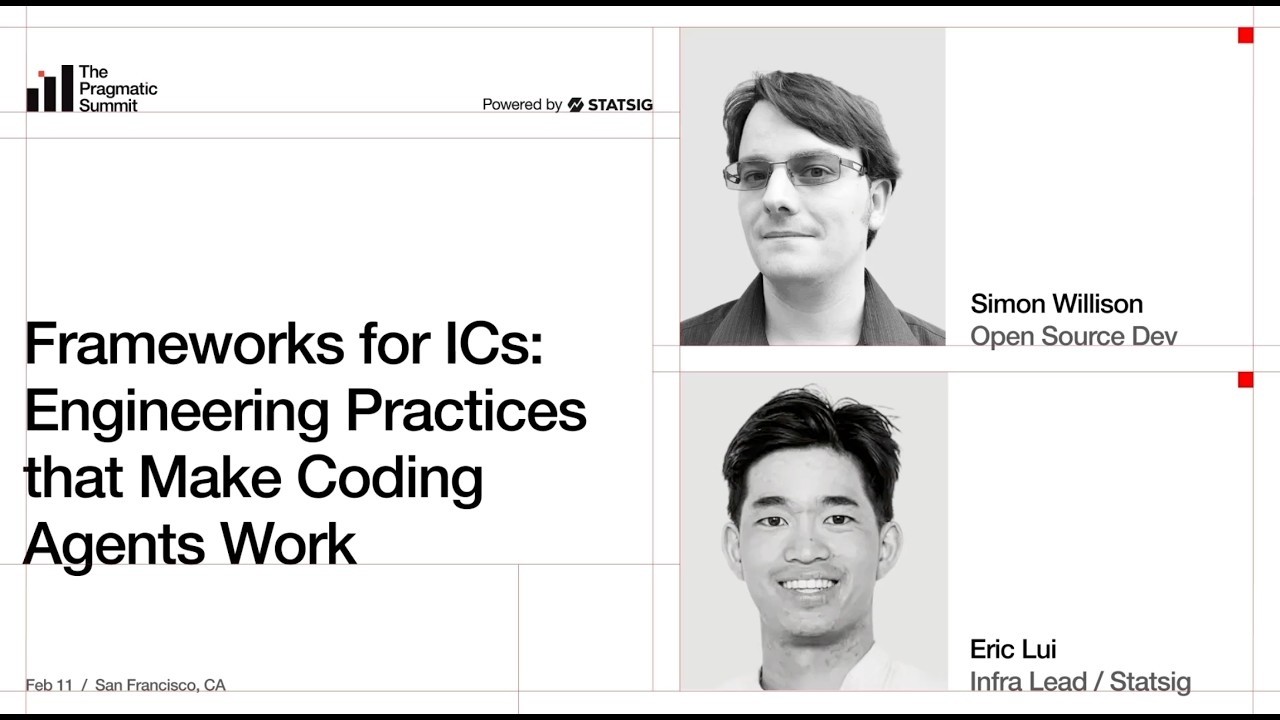
I was a speaker last month at the Pragmatic Summit in San Francisco, where I participated in a fireside chat session about Agentic Engineering hosted by Eric Lui from Statsig.
[... 3,350 words]Coding After Coders: The End of Computer Programming as We Know It. Epic piece on AI-assisted development by Clive Thompson for the New York Times Magazine, who spoke to more than 70 software developers from companies like Google, Amazon, Microsoft, Apple, plus other individuals including Anil Dash, Thomas Ptacek, Steve Yegge, and myself.
I think the piece accurately and clearly captures what's going on in our industry right now in terms appropriate for a wider audience.
I talked to Clive a few weeks ago. Here's the quote from me that made it into the piece.
Given A.I.’s penchant to hallucinate, it might seem reckless to let agents push code out into the real world. But software developers point out that coding has a unique quality: They can tether their A.I.s to reality, because they can demand the agents test the code to see if it runs correctly. “I feel like programmers have it easy,” says Simon Willison, a tech entrepreneur and an influential blogger about how to code using A.I. “If you’re a lawyer, you’re screwed, right?” There’s no way to automatically check a legal brief written by A.I. for hallucinations — other than face total humiliation in court.
The piece does raise the question of what this means for the future of our chosen line of work, but the general attitude from the developers interviewed was optimistic - there's even a mention of the possibility that the Jevons paradox might increase demand overall.
One critical voice came from an Apple engineer:
A few programmers did say that they lamented the demise of hand-crafting their work. “I believe that it can be fun and fulfilling and engaging, and having the computer do it for you strips you of that,” one Apple engineer told me. (He asked to remain unnamed so he wouldn’t get in trouble for criticizing Apple’s embrace of A.I.)
That request to remain anonymous is a sharp reminder that corporate dynamics may be suppressing an unknown number of voices on this topic.
Here's what I think is happening: AI-assisted coding is exposing a divide among developers that was always there but maybe less visible.
Before AI, both camps were doing the same thing every day. Writing code by hand. Using the same editors, the same languages, the same pull request workflows. The craft-lovers and the make-it-go people sat next to each other, shipped the same products, looked indistinguishable. The motivation behind the work was invisible because the process was identical.
Now there's a fork in the road. You can let the machine write the code and focus on directing what gets built, or you can insist on hand-crafting it. And suddenly the reason you got into this in the first place becomes visible, because the two camps are making different choices at that fork.
— Les Orchard, Grief and the AI Split
The A.I. Disruption We’ve Been Waiting for Has Arrived. New opinion piece from Paul Ford in the New York Times. Unsurprisingly for a piece by Paul it's packed with quoteworthy snippets, but a few stood out for me in particular.
Paul describes the November moment that so many other programmers have observed, and highlights Claude Code's ability to revive old side projects:
[Claude Code] was always a helpful coding assistant, but in November it suddenly got much better, and ever since I’ve been knocking off side projects that had sat in folders for a decade or longer. It’s fun to see old ideas come to life, so I keep a steady flow. Maybe it adds up to a half-hour a day of my time, and an hour of Claude’s.
November was, for me and many others in tech, a great surprise. Before, A.I. coding tools were often useful, but halting and clumsy. Now, the bot can run for a full hour and make whole, designed websites and apps that may be flawed, but credible. I spent an entire session of therapy talking about it.
And as the former CEO of a respected consultancy firm (Postlight) he's well positioned to evaluate the potential impact:
When you watch a large language model slice through some horrible, expensive problem — like migrating data from an old platform to a modern one — you feel the earth shifting. I was the chief executive of a software services firm, which made me a professional software cost estimator. When I rebooted my messy personal website a few weeks ago, I realized: I would have paid $25,000 for someone else to do this. When a friend asked me to convert a large, thorny data set, I downloaded it, cleaned it up and made it pretty and easy to explore. In the past I would have charged $350,000.
That last price is full 2021 retail — it implies a product manager, a designer, two engineers (one senior) and four to six months of design, coding and testing. Plus maintenance. Bespoke software is joltingly expensive. Today, though, when the stars align and my prompts work out, I can do hundreds of thousands of dollars worth of work for fun (fun for me) over weekends and evenings, for the price of the Claude $200-a-month plan.
He also neatly captures the inherent community tension involved in exploring this technology:
All of the people I love hate this stuff, and all the people I hate love it. And yet, likely because of the same personality flaws that drew me to technology in the first place, I am annoyingly excited.
LLMs are eating specialty skills. There will be less use of specialist front-end and back-end developers as the LLM-driving skills become more important than the details of platform usage. Will this lead to a greater recognition of the role of Expert Generalists? Or will the ability of LLMs to write lots of code mean they code around the silos rather than eliminating them?
— Martin Fowler, tidbits from the Thoughtworks Future of Software Development Retreat, via HN)
Deep Blue

We coined a new term on the Oxide and Friends podcast last month (primary credit to Adam Leventhal) covering the sense of psychological ennui leading into existential dread that many software developers are feeling thanks to the encroachment of generative AI into their field of work.
[... 971 words]Someone has to prompt the Claudes, talk to customers, coordinate with other teams, decide what to build next. Engineering is changing and great engineers are more important than ever.
— Boris Cherny, Claude Code creator, on why Anthropic are still hiring developers
The retreat challenged the narrative that AI eliminates the need for junior developers. Juniors are more profitable than they have ever been. AI tools get them past the awkward initial net-negative phase faster. They serve as a call option on future productivity. And they are better at AI tools than senior engineers, having never developed the habits and assumptions that slow adoption.
The real concern is mid-level engineers who came up during the decade-long hiring boom and may not have developed the fundamentals needed to thrive in the new environment. This population represents the bulk of the industry by volume, and retraining them is genuinely difficult. The retreat discussed whether apprenticeship models, rotation programs and lifelong learning structures could address this gap, but acknowledged that no organization has solved it yet.
— Thoughtworks, findings from a retreat concerning "the future of software engineering", conducted under Chatham House rules
AI Doesn’t Reduce Work—It Intensifies It (via) Aruna Ranganathan and Xingqi Maggie Ye from Berkeley Haas School of Business report initial findings in the HBR from their April to December 2025 study of 200 employees at a "U.S.-based technology company".
This captures an effect I've been observing in my own work with LLMs: the productivity boost these things can provide is exhausting.
AI introduced a new rhythm in which workers managed several active threads at once: manually writing code while AI generated an alternative version, running multiple agents in parallel, or reviving long-deferred tasks because AI could “handle them” in the background. They did this, in part, because they felt they had a “partner” that could help them move through their workload.
While this sense of having a “partner” enabled a feeling of momentum, the reality was a continual switching of attention, frequent checking of AI outputs, and a growing number of open tasks. This created cognitive load and a sense of always juggling, even as the work felt productive.
I'm frequently finding myself with work on two or three projects running parallel. I can get so much done, but after just an hour or two my mental energy for the day feels almost entirely depleted.
I've had conversations with people recently who are losing sleep because they're finding building yet another feature with "just one more prompt" irresistible.
The HBR piece calls for organizations to build an "AI practice" that structures how AI is used to help avoid burnout and counter effects that "make it harder for organizations to distinguish genuine productivity gains from unsustainable intensity".
I think we've just disrupted decades of existing intuition about sustainable working practices. It's going to take a while and some discipline to find a good new balance.
I don't know why this week became the tipping point, but nearly every software engineer I've talked to is experiencing some degree of mental health crisis.
[...] Many people assuming I meant job loss anxiety but that's just one presentation. I'm seeing near-manic episodes triggered by watching software shift from scarce to abundant. Compulsive behaviors around agent usage. Dissociative awe at the temporal compression of change. It's not fear necessarily just the cognitive overload from living in an inflection point.
— Tom Dale
With enough users, every observable behavior becomes a dependency - regardless of what you promised. Someone is scraping your API, automating your quirks, caching your bugs.
This creates a career-level insight: you can’t treat compatibility work as “maintenance” and new features as “real work.” Compatibility is product.
Design your deprecations as migrations with time, tooling, and empathy. Most “API design” is actually “API retirement.”
— Addy Osmani, 21 lessons from 14 years at Google
Something I like about our weird new LLM-assisted world is the number of people I know who are coding again, having mostly stopped as they moved into management roles or lost their personal side project time to becoming parents.
AI assistance means you can get something useful done in half an hour, or even while you are doing other stuff. You don't need to carve out 2-4 hours to ramp up anymore.
If you have significant previous coding experience - even if it's a few years stale - you can drive these things really effectively. Especially if you have management experience, quite a lot of which transfers to "managing" coding agents - communicate clearly, set achievable goals, provide all relevant context. Here's a relevant recent tweet from Ethan Mollick:
When you see how people use Claude Code/Codex/etc it becomes clear that managing agents is really a management problem
Can you specify goals? Can you provide context? Can you divide up tasks? Can you give feedback?
These are teachable skills. Also UIs need to support management
This note started as a comment.
2025
The hard part of computer programming isn't expressing what we want the machine to do in code. The hard part is turning human thinking -- with all its wooliness and ambiguity and contradictions -- into computational thinking that is logically precise and unambiguous, and that can then be expressed formally in the syntax of a programming language.
That was the hard part when programmers were punching holes in cards. It was the hard part when they were typing COBOL code. It was the hard part when they were bringing Visual Basic GUIs to life (presumably to track the killer's IP address). And it's the hard part when they're prompting language models to predict plausible-looking Python.
The hard part has always been – and likely will continue to be for many years to come – knowing exactly what to ask for.
— Jason Gorman, The Future of Software Development Is Software Developers
Jevons paradox is coming to knowledge work. By making it far cheaper to take on any type of task that we can possibly imagine, we’re ultimately going to be doing far more. The vast majority of AI tokens in the future will be used on things we don't even do today as workers: they will be used on the software projects that wouldn't have been started, the contracts that wouldn't have been reviewed, the medical research that wouldn't have been discovered, and the marketing campaign that wouldn't have been launched otherwise.
— Aaron Levie, Jevons Paradox for Knowledge Work
Your job is to deliver code you have proven to work
In all of the debates about the value of AI-assistance in software development there’s one depressing anecdote that I keep on seeing: the junior engineer, empowered by some class of LLM tool, who deposits giant, untested PRs on their coworkers—or open source maintainers—and expects the “code review” process to handle the rest.
[... 840 words]I’ve been watching junior developers use AI coding assistants well. Not vibe coding—not accepting whatever the AI spits out. Augmented coding: using AI to accelerate learning while maintaining quality. [...]
The juniors working this way compress their ramp dramatically. Tasks that used to take days take hours. Not because the AI does the work, but because the AI collapses the search space. Instead of spending three hours figuring out which API to use, they spend twenty minutes evaluating options the AI surfaced. The time freed this way isn’t invested in another unprofitable feature, though, it’s invested in learning. [...]
If you’re an engineering manager thinking about hiring: The junior bet has gotten better. Not because juniors have changed, but because the genie, used well, accelerates learning.
— Kent Beck, The Bet On Juniors Just Got Better
Copywriters reveal how AI has decimated their industry. Brian Merchant has been collecting personal stories for his series AI Killed My Job - previously covering tech workers, translators, and artists - and this latest piece includes anecdotes from 12 professional copywriters all of whom have had their careers devastated by the rise of AI-generated copywriting tools.
It's a tough read. Freelance copywriting does not look like a great place to be right now.
AI is really dehumanizing, and I am still working through issues of self-worth as a result of this experience. When you go from knowing you are valuable and valued, with all the hope in the world of a full career and the ability to provide other people with jobs... To being relegated to someone who edits AI drafts of copy at a steep discount because “most of the work is already done” ...
The big question for me is if a new AI-infested economy creates new jobs that are a great fit for people affected by this. I would hope that clear written communication skills are made even more valuable, but the people interviewed here don't appear to be finding that to be the case.
If the part of programming you enjoy most is the physical act of writing code, then agents will feel beside the point. You’re already where you want to be, even just with some Copilot or Cursor-style intelligent code auto completion, which makes you faster while still leaving you fully in the driver’s seat about the code that gets written.
But if the part you care about is the decision-making around the code, agents feel like they clear space. They take care of the mechanical expression and leave you with judgment, tradeoffs, and intent. Because truly, for someone at my experience level, that is my core value offering anyway. When I spend time actually typing code these days with my own fingers, it feels like a waste of my time.
— Obie Fernandez, What happens when the coding becomes the least interesting part of the work