March 2025
144 posts: 11 entries, 59 links, 18 quotes, 1 note, 48 beats, 7 newsletters
Wednesday, 26th March 2025
I've added a new content type to my blog: notes. These join my existing types: entries, bookmarks and quotations.
A note is a little bit like a bookmark without a link. They're for short form writing - thoughts or images that don't warrant a full entry with a title. The kind of things I used to post to Twitter, but that don't feel right to cross-post to multiple social networks (Mastodon and Bluesky, for example.)
I was partly inspired by Molly White's short thoughts, notes, links, and musings.
I've been thinking about this for a while, but the amount of work involved in modifying all of the parts of my site that handle the three different content types was daunting. Then this evening I tried running my blog's source code (using files-to-prompt and LLM) through the new Gemini 2.5 Pro:
files-to-prompt . -e py -c | \
  llm -m gemini-2.5-pro-exp-03-25 -s \
  'I want to add a new type of content called a Note,
  similar to quotation and bookmark and entry but it
  only has a markdown text body. Output all of the
  code I need to add for that feature and tell me
  which files to add  the code to.'
Gemini gave me a detailed 13 step plan covering all of the tedious changes I'd been avoiding having to figure out!
The code is in this PR, which touched 18 different files. The whole project took around 45 minutes start to finish.
(I used Claude to brainstorm names for the feature - I had it come up with possible nouns and then "rank those by least pretentious to most pretentious", and "notes" came out on top.)
This is now far too long for a note and should really be upgraded to an entry, but I need to post a first note to make sure everything is working as it should.
MCP 🤝 OpenAI Agents SDK
You can now connect your Model Context Protocol servers to Agents: openai.github.io/openai-agents-python/mcp/
We’re also working on MCP support for the OpenAI API and ChatGPT desktop app—we’ll share some more news in the coming months.
Function calling with Gemma (via) Google's Gemma 3 model (the 27B variant is particularly capable, I've been trying it out via Ollama) supports function calling exclusively through prompt engineering. The official documentation describes two recommended prompts - both of them suggest that the tool definitions are passed in as JSON schema, but the way the model should request tool executions differs.
The first prompt uses Python-style function calling syntax:
You have access to functions. If you decide to invoke any of the function(s),
 you MUST put it in the format of [func_name1(params_name1=params_value1, params_name2=params_value2...), func_name2(params)]
You SHOULD NOT include any other text in the response if you call a function
(Always love seeing CAPITALS for emphasis in prompts, makes me wonder if they proved to themselves that capitalization makes a difference in this case.)
The second variant uses JSON instead:
You have access to functions. If you decide to invoke any of the function(s),
you MUST put it in the format of {"name": function name, "parameters": dictionary of argument name and its value}
You SHOULD NOT include any other text in the response if you call a function
This is a neat illustration of the fact that all of these fancy tool using LLMs are still using effectively the same pattern as was described in the ReAct paper back in November 2022. Here's my implementation of that pattern from March 2023.
Thursday, 27th March 2025
Nomic Embed Code: A State-of-the-Art Code Retriever. Nomic have released a new embedding model that specializes in code, based on their CoRNStack "large-scale high-quality training dataset specifically curated for code retrieval".
The nomic-embed-code model is pretty large - 26.35GB - but the announcement also mentioned a much smaller model (released 5 months ago) called CodeRankEmbed which is just 521.60MB.
I missed that when it first came out, so I decided to give it a try using my llm-sentence-transformers plugin for LLM.
llm install llm-sentence-transformers
llm sentence-transformers register nomic-ai/CodeRankEmbed --trust-remote-code
Now I can run the model like this:
llm embed -m sentence-transformers/nomic-ai/CodeRankEmbed -c 'hello'
This outputs an array of 768 numbers, starting [1.4794224500656128, -0.474479079246521, ....
Where this gets fun is combining it with my Symbex tool to create and then search embeddings for functions in a codebase.
I created an index for my LLM codebase like this:
cd llm
symbex '*' '*.*' --nl > code.txt
This creates a newline-separated JSON file of all of the functions (from '*') and methods (from '*.*') in the current directory - you can see that here.
Then I fed that into the llm embed-multi command like this:
llm embed-multi \
  -d code.db \
  -m sentence-transformers/nomic-ai/CodeRankEmbed \
  code code.txt \
  --format nl \
  --store \
  --batch-size 10
I found the --batch-size was needed to prevent it from crashing with an error.
The above command creates a collection called code in a SQLite database called code.db.
Having run this command I can search for functions that match a specific search term in that code collection like this:
llm similar code -d code.db \
  -c 'Represent this query for searching relevant code: install a plugin' | jq
That "Represent this query for searching relevant code: " prefix is required by the model. I pipe it through jq to make it a little more readable, which gives me these results.
This jq recipe makes for a better output:
llm similar code -d code.db \
  -c 'Represent this query for searching relevant code: install a plugin' | \
  jq -r '.id + "\n\n" + .content + "\n--------\n"'
The output from that starts like so:
llm/cli.py:1776

@cli.command(name="plugins")
@click.option("--all", help="Include built-in default plugins", is_flag=True)
def plugins_list(all):
    "List installed plugins"
    click.echo(json.dumps(get_plugins(all), indent=2))
--------

llm/cli.py:1791

@cli.command()
@click.argument("packages", nargs=-1, required=False)
@click.option(
    "-U", "--upgrade", is_flag=True, help="Upgrade packages to latest version"
)
...
def install(packages, upgrade, editable, force_reinstall, no_cache_dir):
    """Install packages from PyPI into the same environment as LLM"""
Getting this output was quite inconvenient, so I've opened an issue.
Thoughts on setting policy for new AI capabilities. Joanne Jang leads model behavior at OpenAI. Their release of GPT-4o image generation included some notable relaxation of OpenAI's policies concerning acceptable usage - I noted some of those the other day.
Joanne summarizes these changes like so:
tl;dr we’re shifting from blanket refusals in sensitive areas to a more precise approach focused on preventing real-world harm. The goal is to embrace humility: recognizing how much we don't know, and positioning ourselves to adapt as we learn.
This point in particular resonated with me:
- Trusting user creativity over our own assumptions. AI lab employees should not be the arbiters of what people should and shouldn’t be allowed to create.
A couple of years ago when OpenAI were the only AI lab with models that were worth spending time with it really did feel that San Francisco cultural values (which I relate to myself) were being pushed on the entire world. That cultural hegemony has been broken now by the increasing pool of global organizations that can produce models, but it's still reassuring to see the leading AI lab relaxing its approach here.
GPT-4o got another update in ChatGPT. This is a somewhat frustrating way to announce a new model. @OpenAI on Twitter just now:
GPT-4o got an another update in ChatGPT!
What's different?
- Better at following detailed instructions, especially prompts containing multiple requests
- Improved capability to tackle complex technical and coding problems
- Improved intuition and creativity
- Fewer emojis 🙃
This sounds like a significant upgrade to GPT-4o, albeit one where the release notes are limited to a single tweet.
ChatGPT-4o-latest (2025-0-26) just hit second place on the LM Arena leaderboard, behind only Gemini 2.5, so this really is an update worth knowing about.
The @OpenAIDevelopers account confirmed that this is also now available in their API:
chatgpt-4o-latestis now updated in the API, but stay tuned—we plan to bring these improvements to a dated model in the API in the coming weeks.
I wrote about chatgpt-4o-latest last month - it's a model alias in the OpenAI API which provides access to the model used for ChatGPT, available since August 2024. It's priced at $5/million input and $15/million output - a step up from regular GPT-4o's $2.50/$10.
I'm glad they're going to make these changes available as a dated model release - the chatgpt-4o-latest alias is risky to build software against due to its tendency to change without warning.
A more appropriate place for this announcement would be the OpenAI Platform Changelog, but that's not had an update since the release of their new audio models on March 20th.
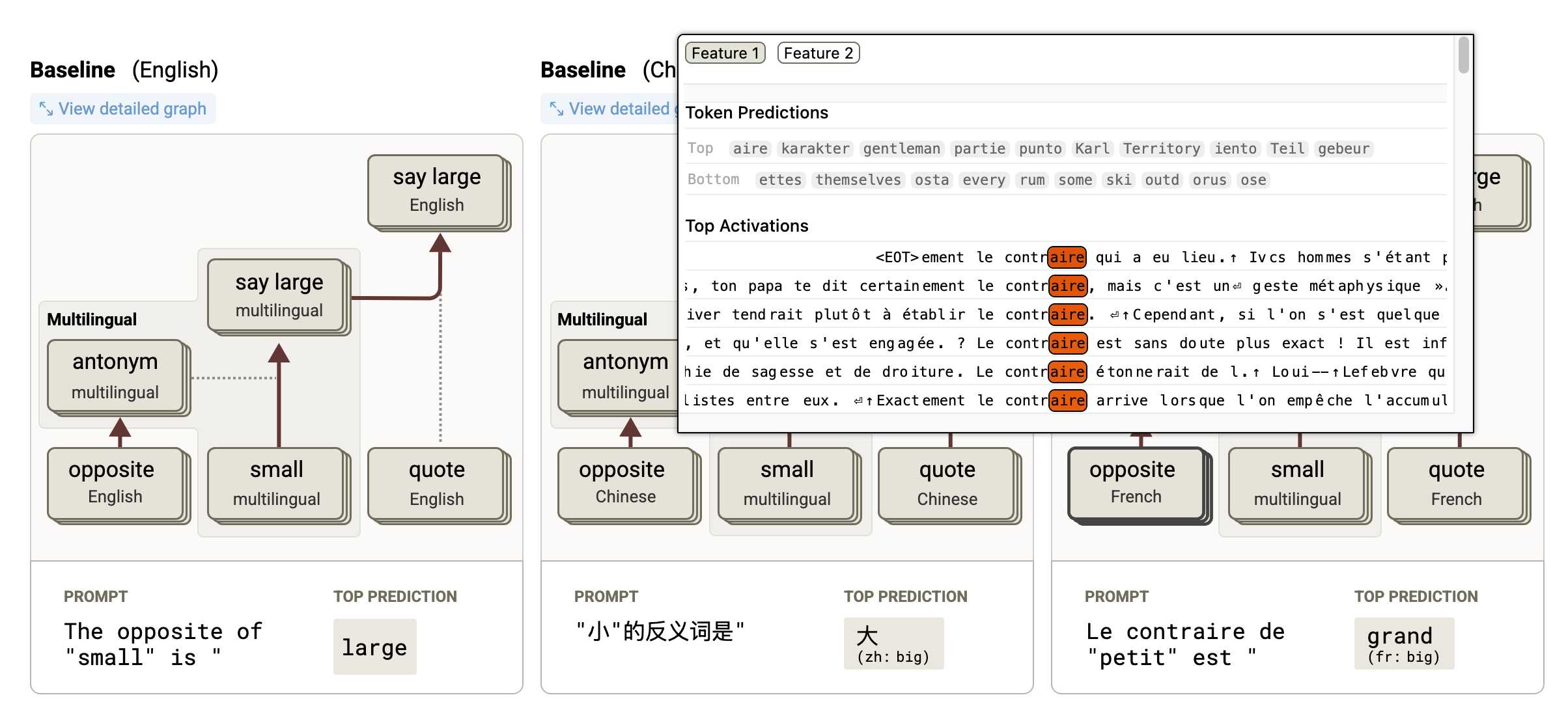
Tracing the thoughts of a large language model. In a follow-up to the research that brought us the delightful Golden Gate Claude last year, Anthropic have published two new papers about LLM interpretability:
- Circuit Tracing: Revealing Computational Graphs in Language Models extends last year's interpretable features into attribution graphs, which can "trace the chain of intermediate steps that a model uses to transform a specific input prompt into an output response".
- On the Biology of a Large Language Model uses that methodology to investigate Claude 3.5 Haiku in a bunch of different ways. Multilingual Circuits for example shows that the same prompt in three different languages uses similar circuits for each one, hinting at an intriguing level of generalization.
To my own personal delight, neither of these papers are published as PDFs. They're both presented as glorious mobile friendly HTML pages with linkable sections and even some inline interactive diagrams. More of this please!
Friday, 28th March 2025
I was there at the first Atom meeting at the Google offices. We meant so well! And I think the basic publishing spec is good, certainly better technically than the pastiche of different things called RSS.
Alas, a bunch of things then went wrong. Feeds started losing market share. Facebook started doing something useful and interesting that ultimately replaced blog feeds in open formats. The Atom vs RSS spec was at best irrelevant to most people (even programmers) and at worst a confusing market-damaging thing. The XML namespaces in Atom made everyone annoyed. Also there was some confusing “Atom API” for publishing that diluted Atom’s mindshare for feeds.
— Nelson Minar, Comment on lobste.rs
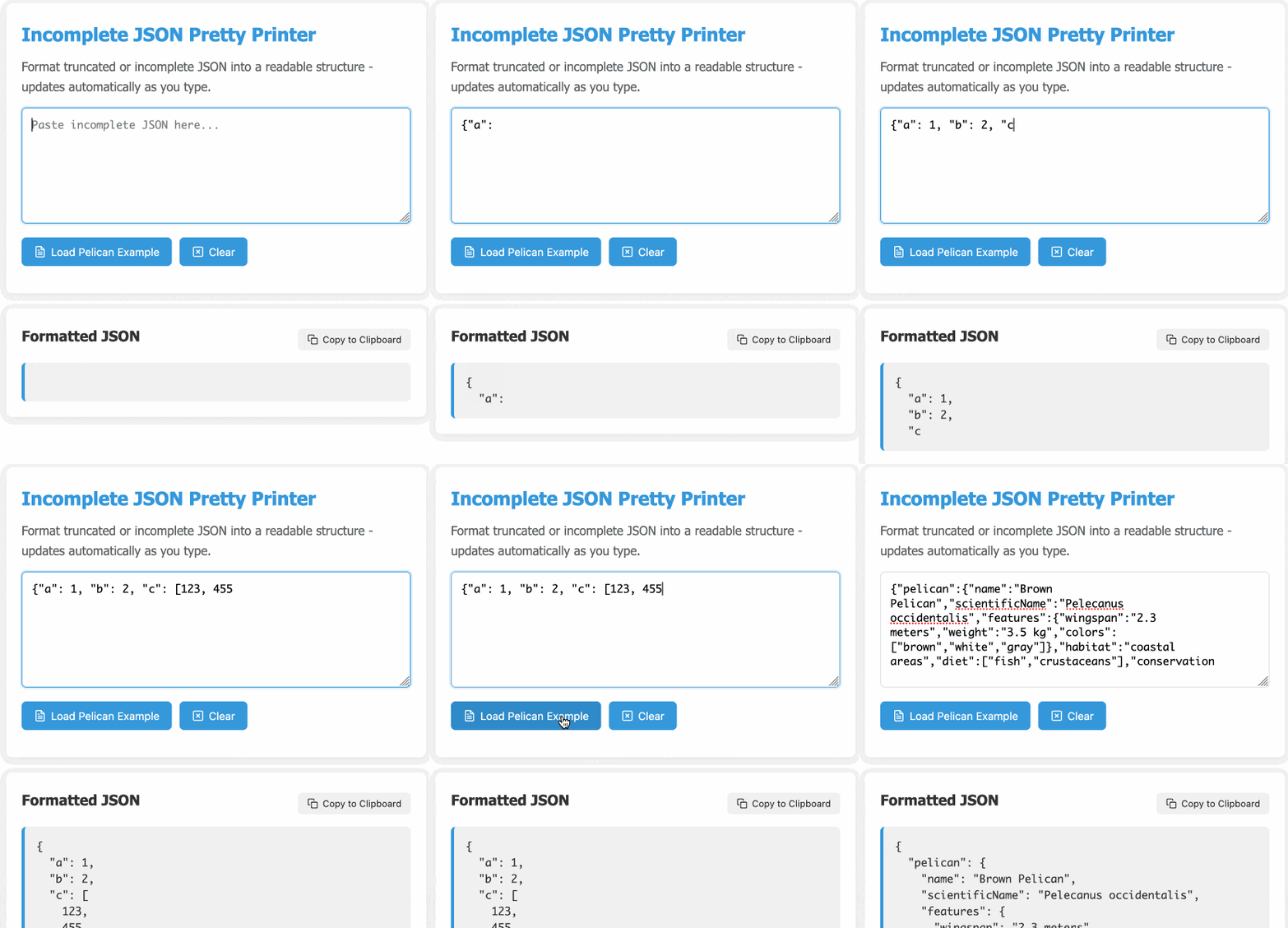
Incomplete JSON Pretty Printer. Every now and then a log file or a tool I'm using will spit out a bunch of JSON that terminates unexpectedly, meaning I can't copy it into a text editor and pretty-print it to see what's going on.
The other day I got frustrated with this and had the then-new GPT-4.5 build me a pretty-printer that didn't mind incomplete JSON, using an OpenAI Canvas. Here's the chat and here's the resulting interactive.
I spotted a bug with the way it indented code today so I pasted it into Claude 3.7 Sonnet Thinking mode and had it make a bunch of improvements - full transcript here. Here's the finished code.
In many ways this is a perfect example of vibe coding in action. At no point did I look at a single line of code that either of the LLMs had written for me. I honestly don't care how this thing works: it could not be lower stakes for me, the worst a bug could do is show me poorly formatted incomplete JSON.
I was vaguely aware that some kind of state machine style parser would be needed, because you can't parse incomplete JSON with a regular JSON parser. Building simple parsers is the kind of thing LLMs are surprisingly good at, and also the kind of thing I don't want to take on for a trivial project.
At one point I told Claude "Try using your code execution tool to check your logic", because I happen to know Claude can write and then execute JavaScript independently of using it for artifacts. That helped it out a bunch.
I later dropped in the following:
modify the tool to work better on mobile screens and generally look a bit nicer - and remove the pretty print JSON button, it should update any time the input text is changed. Also add a "copy to clipboard" button next to the results. And add a button that says "example" which adds a longer incomplete example to demonstrate the tool, make that example pelican themed.
It's fun being able to say "generally look a bit nicer" and get a perfectly acceptable result!
Slop is about collapsing to the mode. It’s about information heat death. It’s lukewarm emptiness. It’s ten million approximately identical cartoon selfies that no one will ever recall in detail because none of the details matter.
Sunday, 30th March 2025
My advice about using AI is simple: use AI as an assistant, not an expert, and use it judiciously. Some people will object, “but AI can be wrong!” Yes, and so can the internet in general, but no one now recommends avoiding online resources because they can be wrong. They recommend taking it all with a grain of salt and being careful. That’s what you should do with AI help as well.
— Ned Batchelder, Horseless intelligence
Monday, 31st March 2025
debug-gym (via) New paper and code from Microsoft Research that experiments with giving LLMs access to the Python debugger. They found that the best models could indeed improve their results by running pdb as a tool.
They saw the best results overall from Claude 3.7 Sonnet against SWE-bench Lite, where it scored 37.2% in rewrite mode without a debugger, 48.4% with their debugger tool and 52.1% with debug(5) - a mechanism where the pdb tool is made available only after the 5th rewrite attempt.
Their code is available on GitHub. I found this implementation of the pdb tool, and tracked down the main system and user prompt in agents/debug_agent.py:
System prompt:
Your goal is to debug a Python program to make sure it can pass a set of test functions. You have access to the pdb debugger tools, you can use them to investigate the code, set breakpoints, and print necessary values to identify the bugs. Once you have gained enough information, propose a rewriting patch to fix the bugs. Avoid rewriting the entire code, focus on the bugs only.
User prompt (which they call an "action prompt"):
Based on the instruction, the current code, the last execution output, and the history information, continue your debugging process using pdb commands or to propose a patch using rewrite command. Output a single command, nothing else. Do not repeat your previous commands unless they can provide more information. You must be concise and avoid overthinking.