November 2026
40 posts: 4 entries, 7 links, 4 quotes, 2 notes, 20 beats, 3 newsletters
Tuesday, 10th November 2026
Gemini 4 Carbon was announced two weeks ago for "a subset of cyber defenders", but today it's available to everyone else.
This is Google's best ever Gemini, priced at $2/million input and $10/million output at launch (that's GPT-6.1 Sol / Claude Sonnet 5.5 prices) but scheduled to double in price to $4/$20 on December 1st (same as Opus 5.5).
Here are three pelicans for the low, medium and high thinking efforts (it defaults to medium). This is the pelican I got for high:

Gemini pelicans have all been great for a while now, so I also tested it out using Google's Antigravity IDE with a prompt I first tried with Claude Fable 5.2 yesterday:
Make a three js animation where yonkers stands up as a big mech (cool stand up motion) and stomps around manhattan and queens and Brooklyn, use openstreetmap mapping data
Here's the HTML result (I had to prompt "build that into a standalone HTML file" to get a version with no external dependencies). I then screen-captured that as a video:
Update: Huh, just saw this on YouTube (and tweeted by Google CEO Sundar Pichai):
Using Google Antigravity’s /swarm feature, Carbon built an open-world 3D game where you explore Google’s Mountain View campus as a pelican riding a GBike — coordinating subagents to model 3D assets in Blender from Omni and Nano Banana references, build the browser game in Three.js with WebGL shaders, and pair procedural Web Audio sound effects with Lyria music.
Here's the playable version in AI Studio.
Wednesday, 11th November 2026
Anthropic’s IPO roadshow video. Anthropic kicked off their IPO roadshow yesterday, and their roadshow video has some previously unreleased information about how their business works.
The section on "Approach to compute" with co-founder Tom Brown is particularly interesting, describing how Anthropic train and serve Claude across AWS Trainium, Google TPUs, NVIDIA GPUs, and AMD GPUs.
I'm not sure why there's no official video transcript, but here's one that I extracted using MacWhisper. Highlights below:
We train and serve Claude now across all four major chip families. That's only possible because early on we made an unconventional bet on a multi-chip strategy. At the time, many people thought that running AI models on different chips wasn't worth the effort. Each chip needs its own tailored software stack and inference stack, which is expensive and difficult to build. We've now been doing it for years, and we've gotten incredibly good at it. [...]
As an example, this year, we started working with AMD GPUs for the first time. In the past, bringing on a new chip platform took dozens of engineers months of work This time, we had Mythos try it out. It got Claude running on AMD in just three days, with basically no human intervention. Claude ported or wrote almost 100% of the kernels. [...]
The second driver of our compute advantage is our rate of discovery of compute multipliers. We focus on total effective compute, which is the multiplicative product of physical capacity times the compute multipliers that we discover. Each one we discover makes our pool of total effective compute bigger. For example, say you need 100 units of compute to train a model of a certain intelligence. A 4x compute multiplier means you can use 25 units of compute to train the exact same model. Or you can use those hundred physical units to train an even more intelligent model that would have previously required 400 units.
Compute multipliers create a competitive advantage for us that's hard to replicate. They build on each other. Each new multiplier we discover has a positive effect on the multipliers before it. They stack. We believe that this can accelerate even further as we approach recursive self-improvement. Claude will be able to discover compute multipliers entirely by itself, allowing the number of compute multipliers to grow faster and faster.
We got a hint at Anthropic's multi-chip strategy last September in their postmortem of three recent issues, where they described bugs that affected just their TPU deployments.
Fixes a security issue reported by Daniel de Araujo in GHSA-v9h7-jj4g-f862 and GHSA-r639-rr7r-x72w.
LLM has a mechanism called extra-openai-models.yaml - now managed by the new-in-0.37 llm openai endpoint add command - for using LLM with OpenAI-compatible API endpoints from other providers.
Daniel reported two ways this could accidentally send your configured OpenAI API key to one of those providers: if the key named by api_key_name had never been stored, or if a responses: true model was run with -o chat_completions 1.
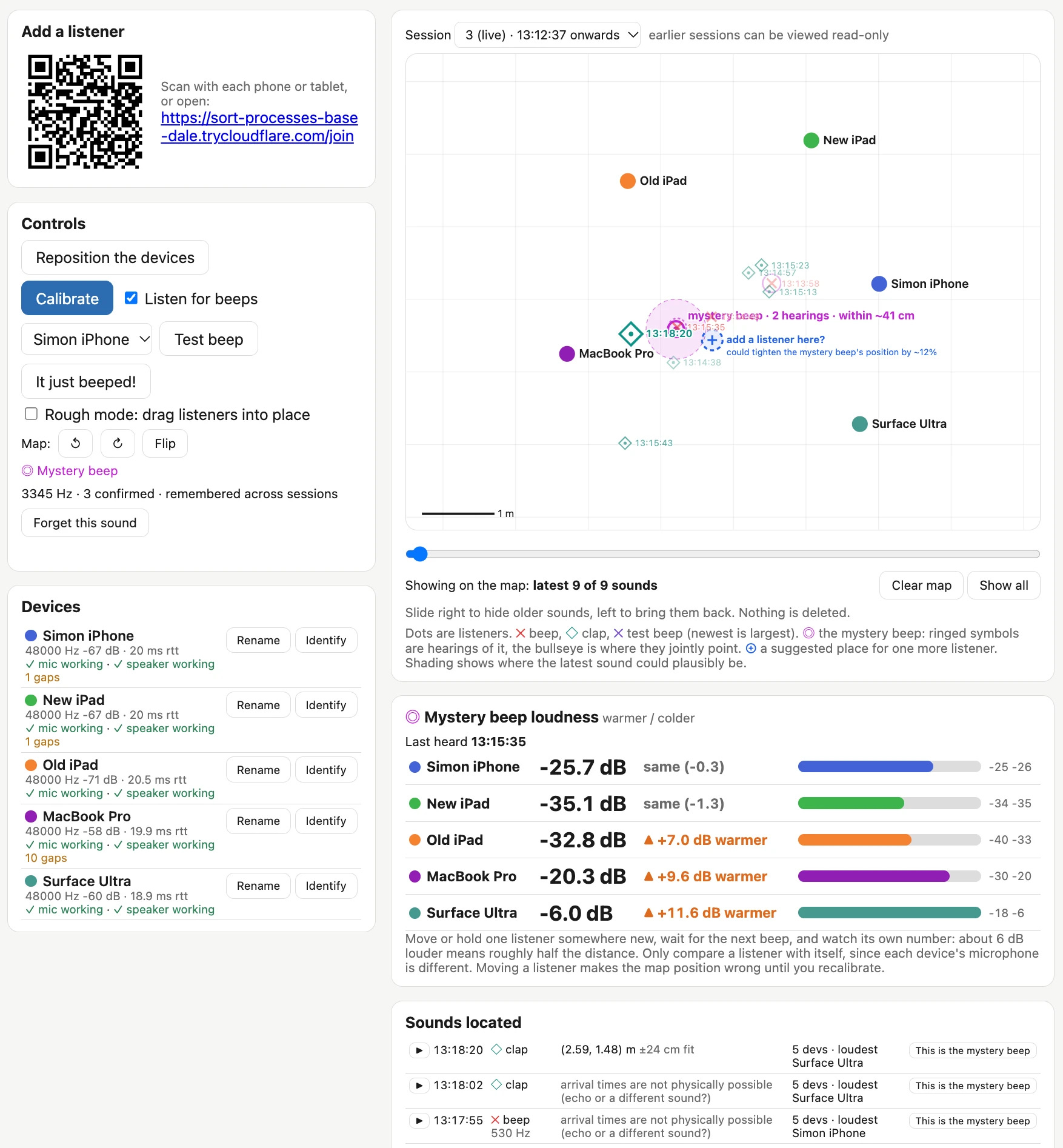
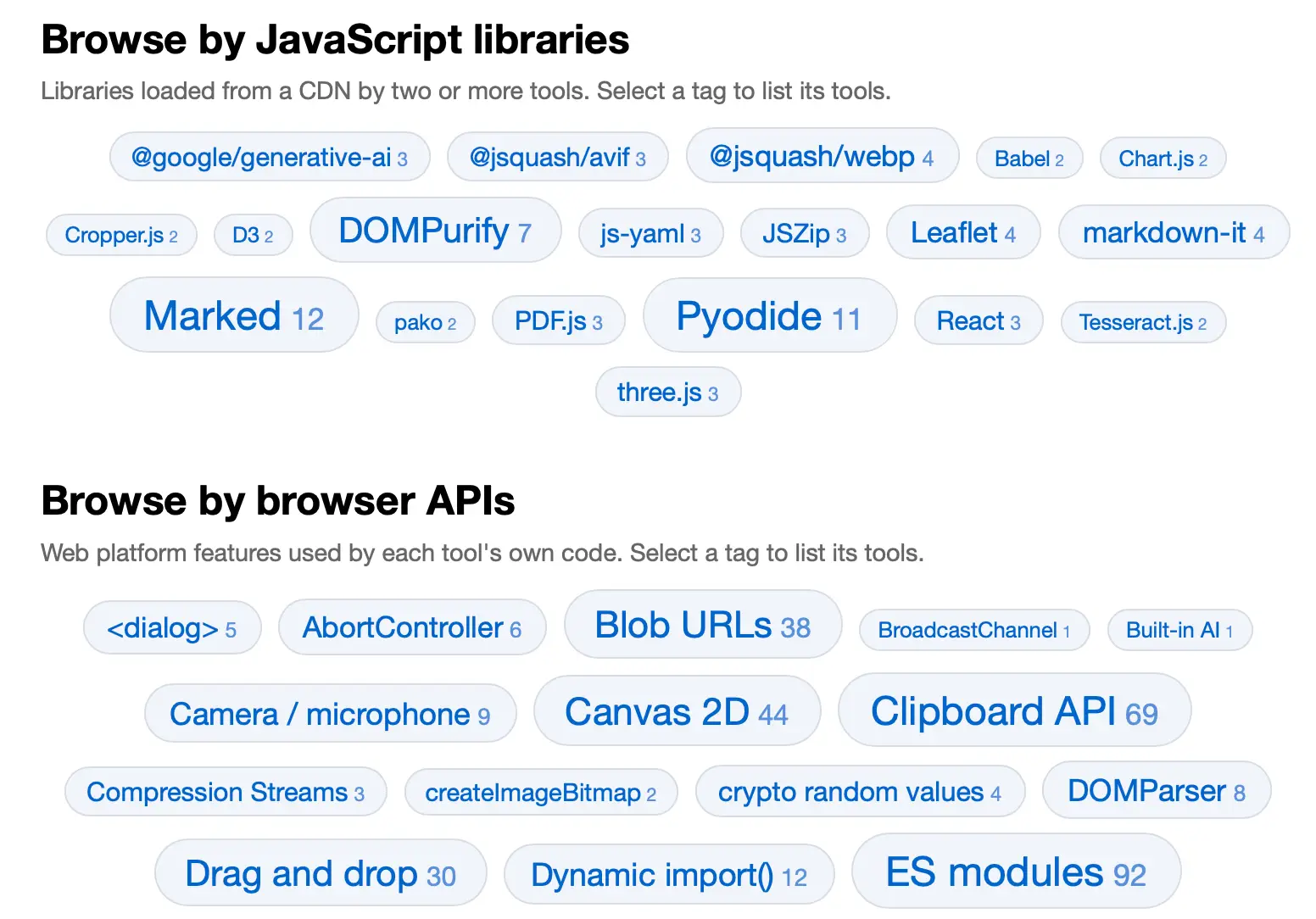
Browse tools.simonwillison.net by tag. I've been wanting a better way to browse my collection of vibe-coded tools (244 and counting) for a while. I had a few Fable 5.2 credits left over before my weekly reset so I set it to work using tree-sitter to analyze the code for JavaScript APIs, libraries, and web API hosts used by each tool.
The homepage now features tag clouds for browsing by each of those categories of tag:
aws-emulator. Finally, an official emulator from AWS to run tests against a local clone of their many different services without having to provision a paid API key to do so.
It's written in Rust by a huge swarm of agents - 29,684 commits in the first three weeks of the project. Swaminathan (Swami) Sivasubramanian wrote about how it came to be in a guest post on Werner Vogels' blog.
It currently requires Docker to run on macOS or Windows. I'm hoping they fix that in the future - it would be great if you could download a single binary and use that as part of a standard test suite in other languages and on other platforms.
Gemini Decisions API (via) Google join Jev and OpenAI in the decision model category with "Gemini Decision 1". This new model API is almost identical to Jev: it supports the same three types of questions (yes/no, choice, and rubric-scoring) and even reuses Jev's term "Noul" for a yes/no question.
It's priced the same as the GPT-6 Luna decision model: 10 cents per million input tokens, and output is free. Jev remains the cheapest of the three, at 4.2 cents per million.
Jev is text (and JSON) only. OpenAI can handle text and images. Gemini Decision 1 is fully multi-model: it covers text, images, audio, video, and PDFs.
I tested it against video by passing these questions to it along with my Yonkers stomping robot video file:
dragon: Does this video have a dragon in it?
robot: Does this video have a robot in it?
france: Is this video set in France?
usa: Is this video set in the USA?
Jev and OpenAI both return 1.0 or 0.0 for yes/no questions, but Gemini insists on being a little less confident than that:
{
  "dragon": {
    "type": "yes_no",
    "probability": 0.04976021841520312
  },
  "robot": {
    "type": "yes_no",
    "probability": 0.9234055387792485
  },
  "france": {
    "type": "yes_no",
    "probability": 0.08329171353166241
  },
  "usa": {
    "type": "yes_no",
    "probability": 0.9230459995157706
  }
}Thursday, 12th November 2026
Google launched Gemini 4 Hydrogen today - the lowest cost member of the Gemini 4 family.
It's actually not too far off the price of its much bigger siblings, Carbon and Argon. I'm finding Gemini 4's pricing really confusing. Here's the pricing scheme:
| Model | Dates | Input ($/M) | Cached input | Output |
|---|---|---|---|---|
| Gemini 4 Carbon | Through Nov 30, 2026 | $2.00 | $0.10 | $10.00 |
| From Dec 1, 2026 | $4.00 | $0.20 | $20.00 | |
| Gemini 4 Argon | Through Nov 30, 2026 | $2.00 | $0.10 | $10.00 |
| From Dec 1, 2026 | $4.00 | $0.20 | $20.00 | |
| Gemini 4 Hydrogen | $1.50 | $0.075 | $7.50 |
Carbon and Argon are the same price, and both are scheduled to double in price on December 1st. If they're the same price, why have two different models? Google says that Argon "delivers Gemini 4 intelligence with faster responses and lower token spend per turn compared to Gemini 4 Carbon" - so it may be priced the same, but it will use less tokens per task.
Hydrogen, supposedly the cheap model, is currently only a 25% discount on its more capable peers. The Hydrogen price will make more sense after December 1st, when it will represent a 75% discount. It's still considerably more expensive than Claude Haiku 5.5 and GPT-6 Luna - they're both $0.10/$0.50, so Hydrogen is 15x that.
I had Hydrogen generate some pelicans. Here's a full comparison grid showing the pelicans for all three members of the Gemini 4 family at their three supported effort levels:
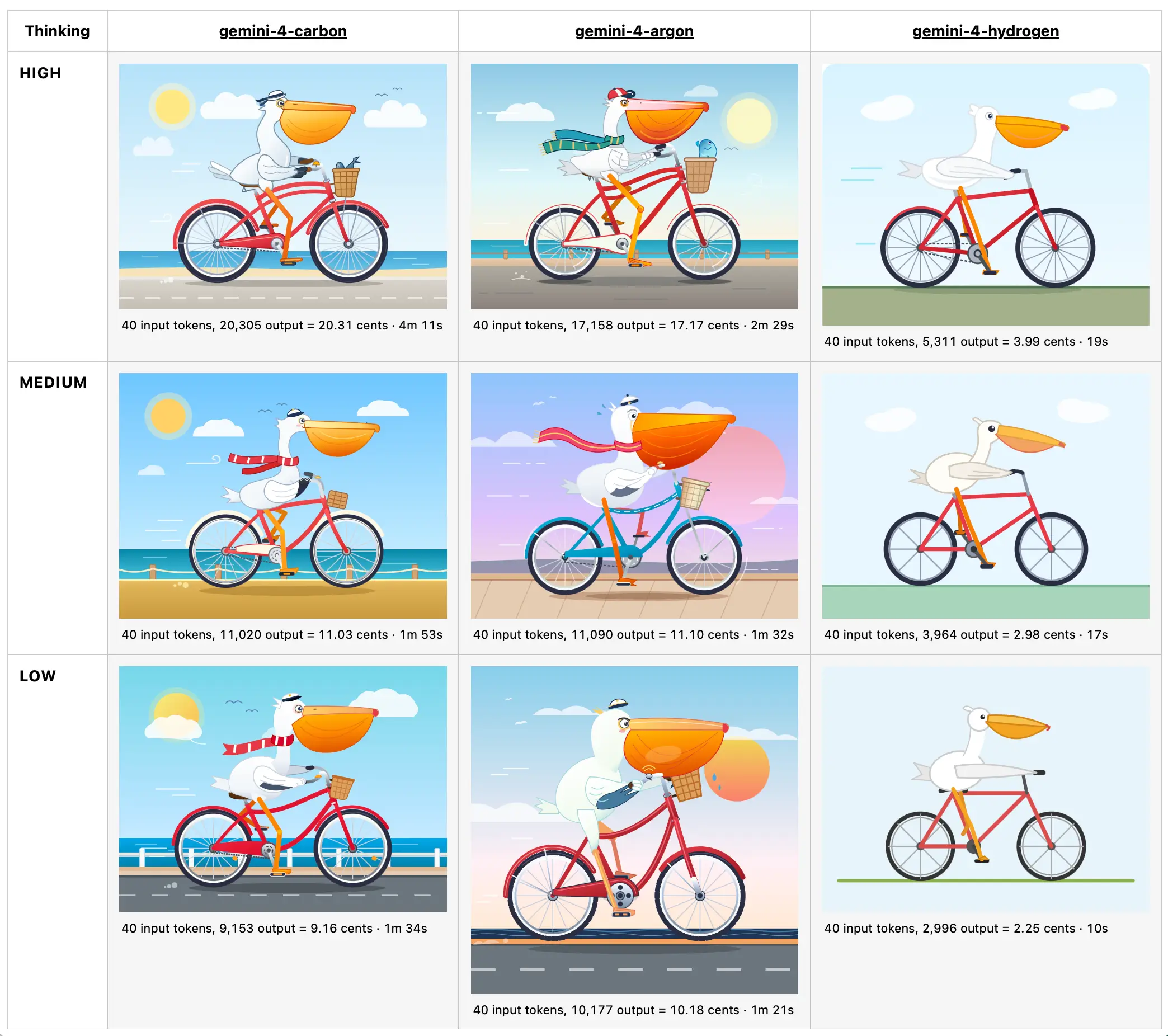
Considering how close they are in price, the difference in pelican quality for Hydrogen is quite stark.
Here's how Google describe Hydrogen's intended position in their mix of models:
In real-world software development, while teams rely on frontier models like Carbon and Argon for deep architectural judgment when designing systems or untangling subtle bugs, they still need a fast, disciplined execution model for writing code, running tests, and verifying changes. Hydrogen is built to stand on its own as a model for everyday work — or to pair with Carbon and Argon as the high-efficiency execution engine in multi-model workflows.
Most notably, Hydrogen is the new free tier model, and is the model that will power AI features in Google Search.
Friday, 13th November 2026
OpenStreetMap have a very reasonable policy that hits to their hosted tile server should send a referrer header. Datasette table pages used the Referrer-Policy: no-referrer HTTP header, causing plugins that loaded tiles from OpenStreetMap to violate that policy.
datasette-leaflet is the plugin that loads a bundled Leaflet so other Datasette plugins can depend on it. It now sets the referrer policy on the tile requests themselves to strict-origin-when-cross-origin, passing the host but not the full path to the page.
One of the oldest Datasette plugins, and still one of my favorites. It now works with Datasette 1.0a42, and depends on the new datasette-leaflet to ensure OpenStreetMap tiles are requested with a referrer header.
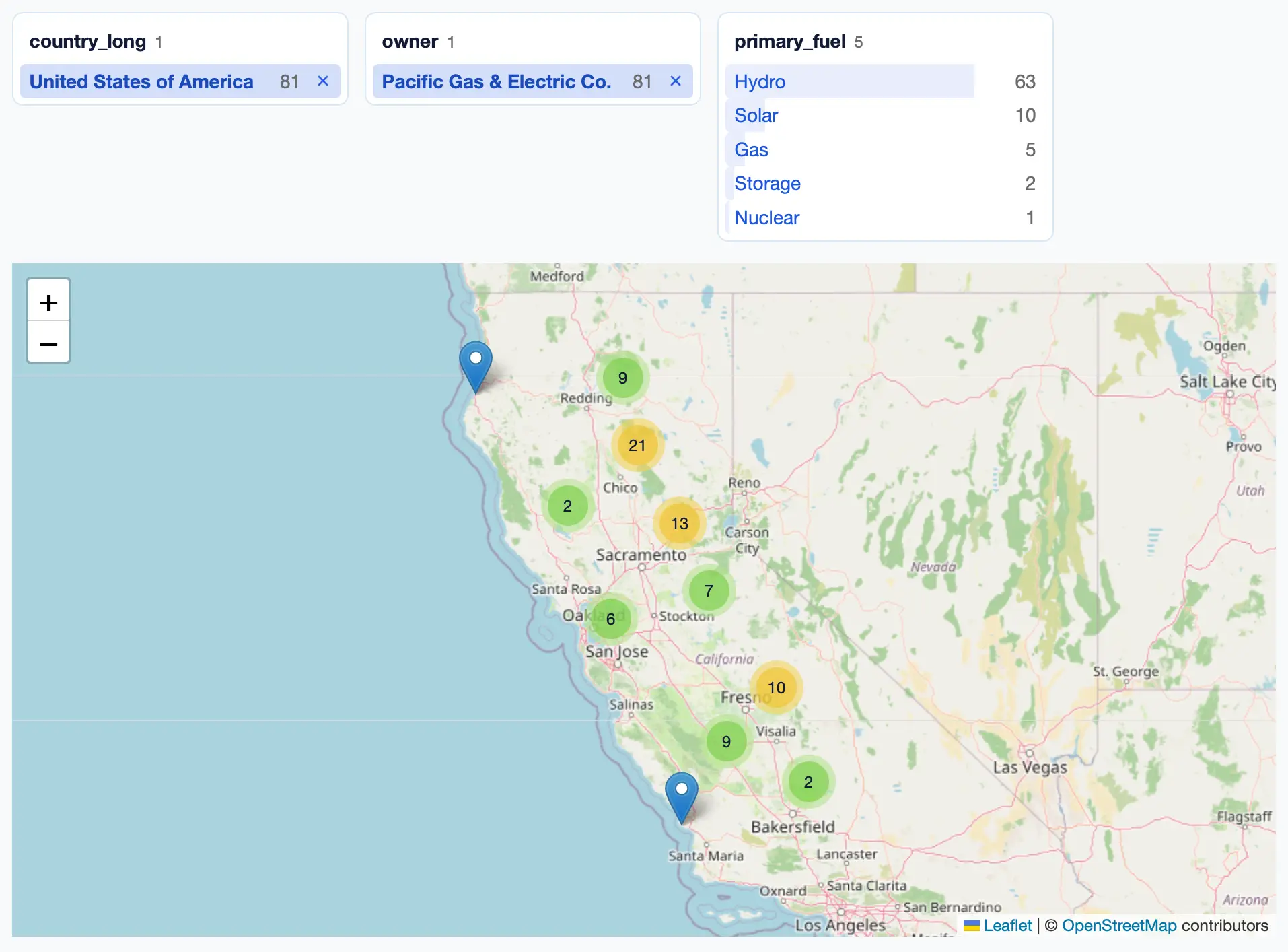
Here's a map of power plants owned by California's PG&E, also demonstrating Datasette's recently redesigned facets: