4 posts tagged “recursive-self-improvement”
RSI - when AI systems help train their successors.
2026
Anthropic’s IPO roadshow video. Anthropic kicked off their IPO roadshow yesterday, and their roadshow video has some previously unreleased information about how their business works.
The section on "Approach to compute" with co-founder Tom Brown is particularly interesting, describing how Anthropic train and serve Claude across AWS Trainium, Google TPUs, NVIDIA GPUs, and AMD GPUs.
I'm not sure why there's no official video transcript, but here's one that I extracted using MacWhisper. Highlights below:
We train and serve Claude now across all four major chip families. That's only possible because early on we made an unconventional bet on a multi-chip strategy. At the time, many people thought that running AI models on different chips wasn't worth the effort. Each chip needs its own tailored software stack and inference stack, which is expensive and difficult to build. We've now been doing it for years, and we've gotten incredibly good at it. [...]
As an example, this year, we started working with AMD GPUs for the first time. In the past, bringing on a new chip platform took dozens of engineers months of work This time, we had Mythos try it out. It got Claude running on AMD in just three days, with basically no human intervention. Claude ported or wrote almost 100% of the kernels. [...]
The second driver of our compute advantage is our rate of discovery of compute multipliers. We focus on total effective compute, which is the multiplicative product of physical capacity times the compute multipliers that we discover. Each one we discover makes our pool of total effective compute bigger. For example, say you need 100 units of compute to train a model of a certain intelligence. A 4x compute multiplier means you can use 25 units of compute to train the exact same model. Or you can use those hundred physical units to train an even more intelligent model that would have previously required 400 units.
Compute multipliers create a competitive advantage for us that's hard to replicate. They build on each other. Each new multiplier we discover has a positive effect on the multipliers before it. They stack. We believe that this can accelerate even further as we approach recursive self-improvement. Claude will be able to discover compute multipliers entirely by itself, allowing the number of compute multipliers to grow faster and faster.
We got a hint at Anthropic's multi-chip strategy last September in their postmortem of three recent issues, where they described bugs that affected just their TPU deployments.
Research acceleration: The view inside OpenAI. Apparently today is RSI day at OpenAI, for Recursive Self-Improvement - I think it's their new AGI. Both this piece and the new essay An Alien Mind (by Chief Scientist Jakub Pachocki) talk about it, and this one doesn't even bother to expand the acronym.
Included are details on how OpenAI's own research team are using coding agents. Like pretty much everyone else 2026 has been the year that agentic engineering really took off at OpenAI, best illustrated by this chart:
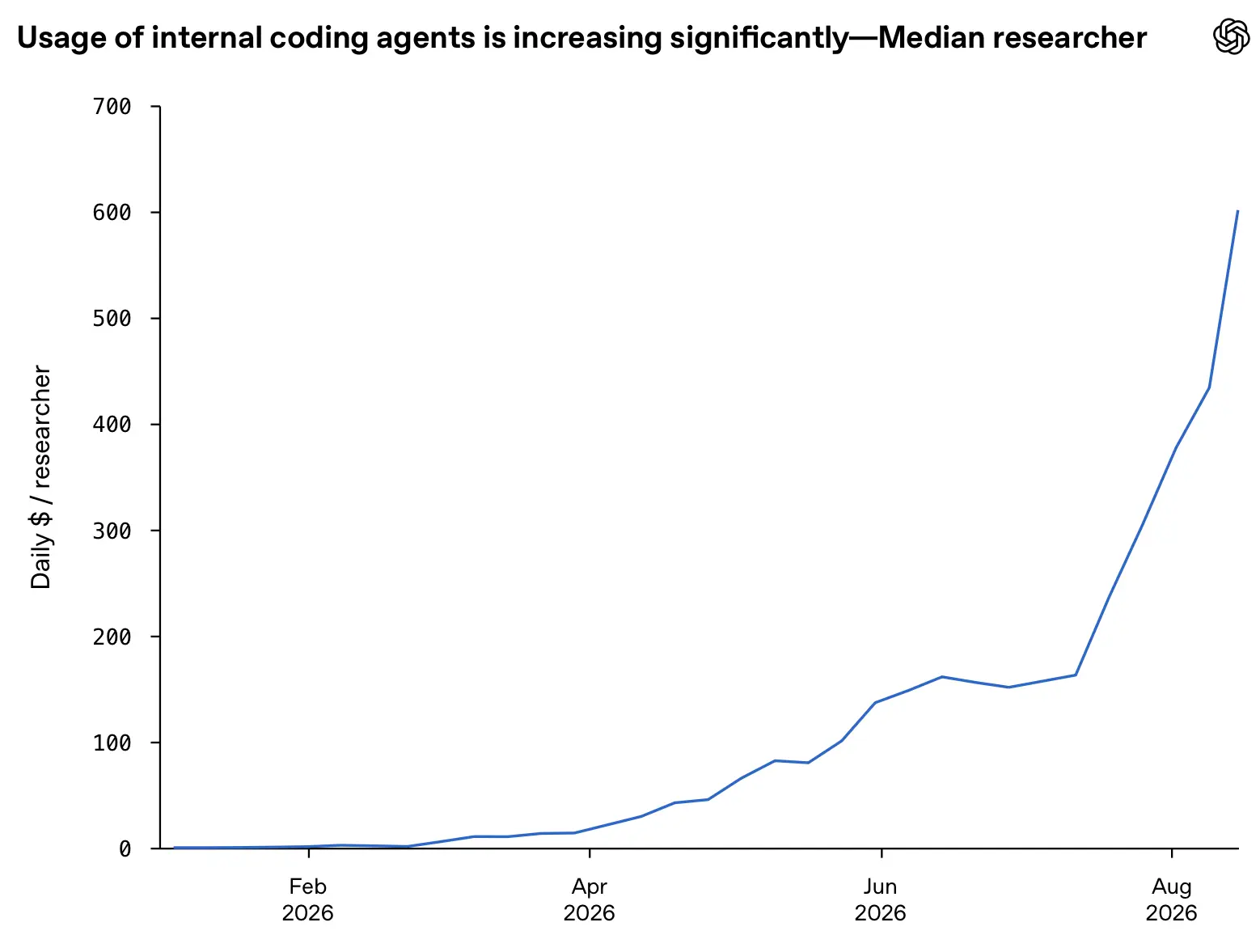
I'm intrigued at what caused that significant acceleration in AI spend per researcher in late July - my best guess is that's when internal employees gained access to the model later released as GPT-6 Astra.
Easy solution to slow down recursive AI self improvement:
- The lab with the top-ranked model must agree THEY must not use it for working on frontier AI
- But everyone else should have access to it.
By definition, this means the frontier doesn't advance.
It also has the critical benefit of avoiding a dangerous power imbalance.
Anthropic has chosen the opposite of the safe path: they are allowing themselves, the current top lab, to use their top model for frontier AI research. They've said they'll sabotage others who try.
This means the AI frontier advances, & power imbalance increases.
(To be clear, I don't think we should try to slow down recursive AI self improvement - I think we should open it up and democratize it as much as possible. My point is: if you claim we should slow down, and you have the best model, you should ensure your org can't use it.)
— Jeremy Howard, in a Twitter thread
If Claude Fable stops helping you, you’ll never know (via) Jonathon Ready highlights one of the more eyebrow-raising details from the 319 page system card for Fable 5 and Mythos 5. Here's a longer excerpt, highlights mine:
In light of the ability of recent models to accelerate their own development, we’ve implemented new interventions that limit Claude’s effectiveness for requests targeting frontier LLM development (for example, on building pretraining pipelines, distributed training infrastructure, or ML accelerator design). Using Claude to develop competing models already violates our Terms of Service, but enforcing this restriction through our safeguards avoids accelerating the actors most willing to violate these terms.
Unlike our interventions for cybersecurity, biology and chemistry, and distillation attempts, these safeguards will not be visible to the user. Fable 5 will not fall back to a different model. Instead, the safeguards will limit effectiveness through methods such as prompt modification, steering vectors, or parameter-efficient fine-tuning (PEFT). These interventions will not affect the vast majority of coding work. We estimate they will impact ~0.03% of traffic, concentrated in fewer than 0.1% of organizations.
I believe this is the first time Anthropic have announced these kinds of silent interventions. The justification still feels pretty science-fiction to me - the linked article talks about "recursive self-improvement". I'm not at all keen on a model that silently corrupts its replies to questions about "ML accelerator design" purely to slow down research that might conflict with Anthropic's own goals!
Update: Anthropic walked back this policy in the face of widespread outrage from the research community.