9 posts tagged “ryan-dahl”
2026
Deno is joining Cloudflare (via) The Deno team released the first version of celld back in August - their open source implementation of the Durable Objects pattern from Cloudflare Workers.
Today, Cloudflare are acquiring Deno outright, with the goal of building on celld to "make workerd self-hosting a first-class supported way to build and run apps using the Workers programming model" (see the Cloudflare blog.)
The bad news is that Deno itself will not be maintained by Cloudflare beyond the next year:
We will support the Deno runtime for another year with monthly releases containing bug fixes and security updates. After that year we will end our development of the Deno runtime. Deno will remain open source, and we welcome others who want to continue its development.
Deno (and Node.js) creator Ryan Dahl explained that decision in a comment on Hacker News:
It's a joint decision and I agree with it. I'm most invested in its success and have put the most work into it - and I no longer think it's where I can do the most important work. There are some good ideas in Deno and it's well engineered - but it ultimately is not solving big problems. It has been sucked into the gravity well of node compatibility, which forces it to behave exactly as Node does. Why reimplement Node? It works. Marginal performance or UX or security benefits are not enough.
I'm interested in building powerful new abstractions. celld has been working remarkably well, depending only on object storage for coordination and persistence. It is not just a slightly different API to interact with the file system or network - it's an entirely new model for server development.
My favorite feature of Deno has long been the permissions system, where you can run a Deno script and specify exactly which files and folders it can read and write to, and which network hosts it can access.
Node.js has a similar permissions model these days, added in Node v20.0.0 in April 2023 and declared stable in Node v22.13.0 in January 2025. They don't yet support allow-listing specific network hosts though - networking is either on or off.
2024
Announcing Deno 2. The big focus of Deno 2 is compatibility with the existing Node.js and npm ecosystem:
Deno 2 takes all of the features developers love about Deno 1.x — zero-config, all-in-one toolchain for JavaScript and TypeScript development, web standard API support, secure by default — and makes it fully backwards compatible with Node and npm (in ESM).
The npm support is documented here. You can write a script like this:
import * as emoji from "npm:node-emoji";
console.log(emoji.emojify(`:sauropod: :heart:  npm`));
And when you run it Deno will automatically fetch and cache the required dependencies:
deno run main.js
Another new feature that caught my eye was this:
deno jupyternow supports outputting images, graphs, and HTML
Deno has apparently shipped with a Jupyter notebook kernel for a while, and it's had a major upgrade in this release.
Here's Ryan Dahl's demo of the new notebook support in his Deno 2 release video.
I tried this out myself, and it's really neat. First you need to install the kernel:
deno juptyer --install
I was curious to find out what this actually did, so I dug around in the code and then further in the Rust runtimed dependency. It turns out installing Jupyter kernels, at least on macOS, involves creating a directory in ~/Library/Jupyter/kernels/deno and writing a kernel.json file containing the following:
{
  "argv": [
    "/opt/homebrew/bin/deno",
    "jupyter",
    "--kernel",
    "--conn",
    "{connection_file}"
  ],
  "display_name": "Deno",
  "language": "typescript"
}
That file is picked up by any Jupyter servers running on your machine, and tells them to run deno jupyter --kernel ... to start a kernel.
I started Jupyter like this:
jupyter-notebook /tmp
Then started a new notebook, selected the Deno kernel and it worked as advertised:
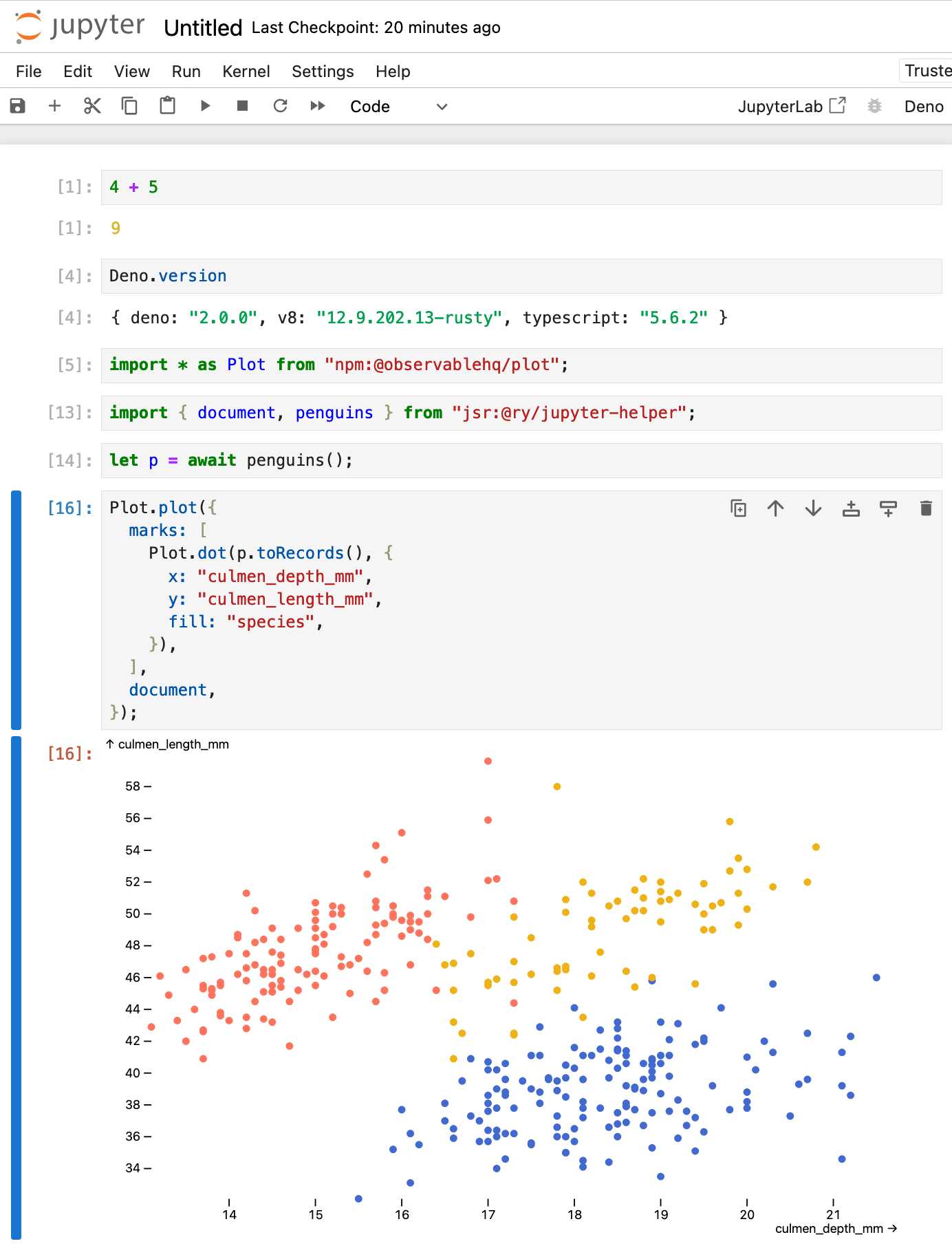
import * as Plot from "npm:@observablehq/plot";
import { document, penguins } from "jsr:@ry/jupyter-helper";
let p = await penguins();

Plot.plot({
  marks: [
    Plot.dot(p.toRecords(), {
      x: "culmen_depth_mm",
      y: "culmen_length_mm",
      fill: "species",
    }),
  ],
  document,
});Oracle, it’s time to free JavaScript. (via) Oracle have held the trademark on JavaScript since their acquisition of Sun Microsystems in 2009. They’ve continued to renew that trademark over the years despite having no major products that use the mark.
Their December 2019 renewal included a screenshot of the Node.js homepage as a supporting specimen!
Now a group lead by a team that includes Ryan Dahl and Brendan Eich is coordinating a legal challenge to have the USPTO treat the trademark as abandoned and “recognize it as a generic name for the world’s most popular programming language, which has multiple implementations across the industry.”
What we got wrong about HTTP imports (via) HTTP imports are one of the most interesting design features of Deno:
import { assertEquals } from "https://deno.land/std@0.224.0/assert/mod.ts";
Six years after their introduction, Ryan Dahl reviews their disadvantages:
- Lengthy (non-memorable) URLs littering the codebase
- A slightly cumbersome
import { concat } from "../../deps.ts";pattern for managing dependencies in one place - Large projects can end up using multiple slightly different versions of the same dependencies
- If a website becomes unavailable, new builds will fail (existing builds will continue to use their cached version)
Deno 2 - due in September - will continue to support them, but will lean much more on the combination of import maps (design borrowed from modern browsers) and the Deno project's JSR npm competitor. An import map like this:
{
  "imports": {
    "@std/assert": "jsr:@std/assert@1"
  }
}
Will then enable import statements that look like this:
import { assertEquals } from "@std/assert";
2021
Deno Deploy Beta 3 (via) I missed Deno Deploy when it first came out back in June: it’s a really interesting new hosting environment for scripts written in Deno, Node.js creator Ryan Dahl’s re-imagining of Node.js. Deno Deploy runs your code using v8 isolates running in 28 regions worldwide, with a clever BroadcastChannel mechanism (inspired by the browser API of the same name) that allows instances of the server-side code running in different regions to send each other messages. See the “via” link for my annotated version of a demo by Ondřej Žára that got me excited about what it can do.
2020
Deno 1.0. Deno is a new take on server-side JavaScript from a team lead by Ryan Dahl, who originally created Node.js. It’s built using Rust and crammed with fascinating ideas—like the ability to import code directly from a URL.
2019
GitHub Actions ci.yml for deno. Spotted this today: it’s one of the cleanest examples I’ve seen of a complex CI configuration for GitHub Actions, testing, linting, benchmarking and building Ryan Dahl’s Deno JavaScript runtime.
2009
Node.js is genuinely exciting
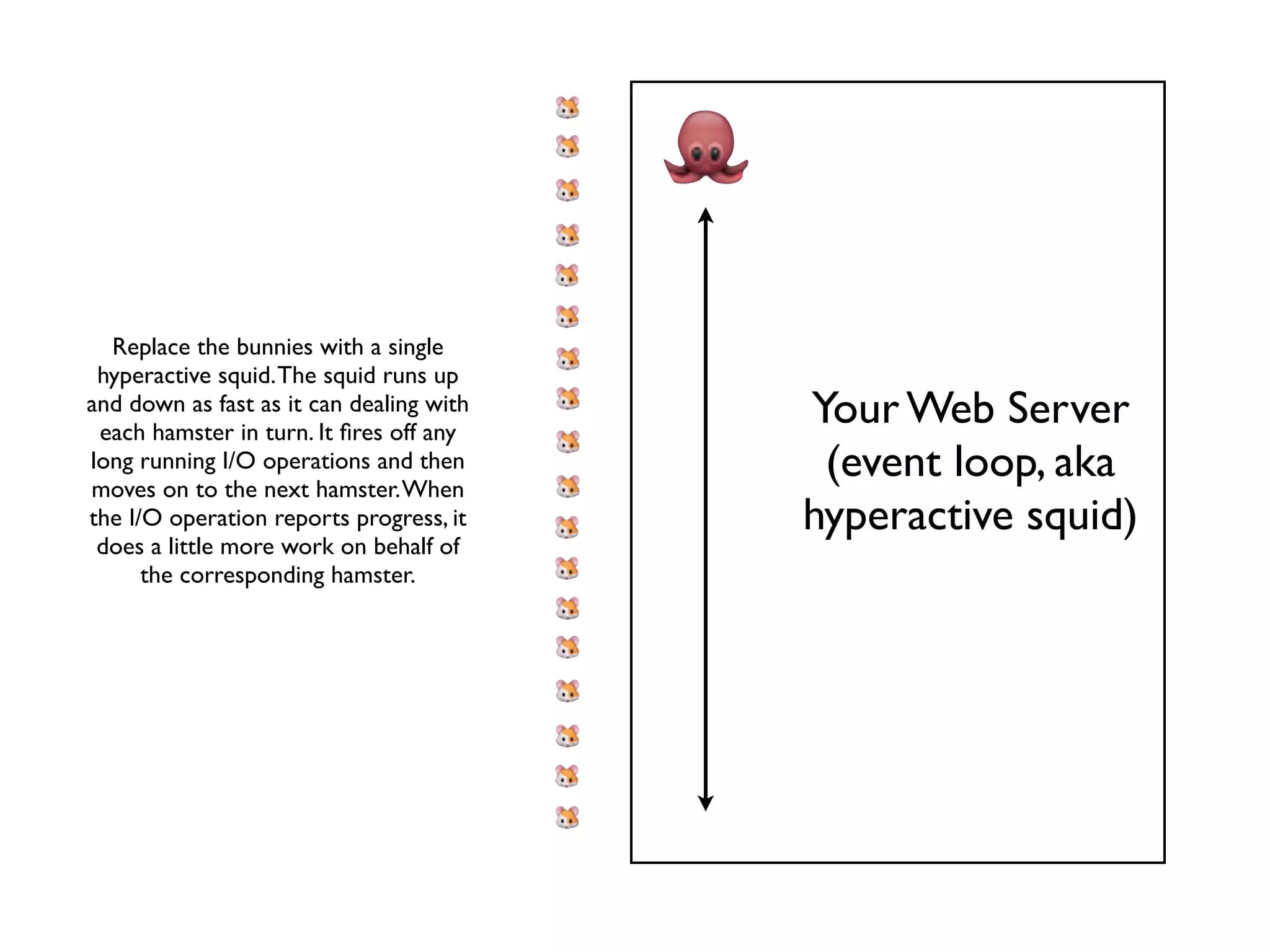
I gave a talk on Friday at Full Frontal, a new one day JavaScript conference in my home town of Brighton. I ended up throwing away my intended topic (JSONP, APIs and cross-domain security) three days before the event in favour of a technology which first crossed my radar less than two weeks ago.
[... 2,025 words]node.js at JSConf.eu (PDF). node.js creator Ryan Dahl’s presentation at this year’s JSConf.eu. The principle philosophy is that I/O in web applications should be asynchronous—for everything. No blocking for database calls, no blocking for filesystem access. JavaScript is a mainstream programming language with a culture of callback APIs (thanks to the DOM) and is hence ideally suited to building asynchronous frameworks.