Wednesday, 10th December 2025
10 Years of Let’s Encrypt (via) Internet Security Research Group co-founder and Executive Director Josh Aas:
On September 14, 2015, our first publicly-trusted certificate went live. [...] Today, Let’s Encrypt is the largest certificate authority in the world in terms of certificates issued, the ACME protocol we helped create and standardize is integrated throughout the server ecosystem, and we’ve become a household name among system administrators. We’re closing in on protecting one billion web sites.
Their growth rate and numbers are wild:
In March 2016, we issued our one millionth certificate. Just two years later, in September 2018, we were issuing a million certificates every day. In 2020 we reached a billion total certificates issued and as of late 2025 we’re frequently issuing ten million certificates per day.
According to their stats the amount of Firefox traffic protected by HTTPS doubled from 39% at the start of 2016 to ~80% today. I think it's difficult to over-estimate the impact Let's Encrypt has had on the security of the web.
I've never been particularly invested dark v.s. light mode but I get enough people complaining that this site is "blinding" that I decided to see if Claude Code for web could produce a useful dark mode from my existing CSS. It did a decent job, using CSS properties, @media (prefers-color-scheme: dark) and a data-theme="dark" attribute based on this prompt:
Add a dark theme which is triggered by user media preferences but can also be switched on using localStorage - then put a little icon in the footer for toggling it between default auto, forced regular and forced dark mode
The site defaults to picking up the user's preferences, but there's also a toggle in the footer which switches between auto, forced-light and forced-dark. Here's an animated demo:
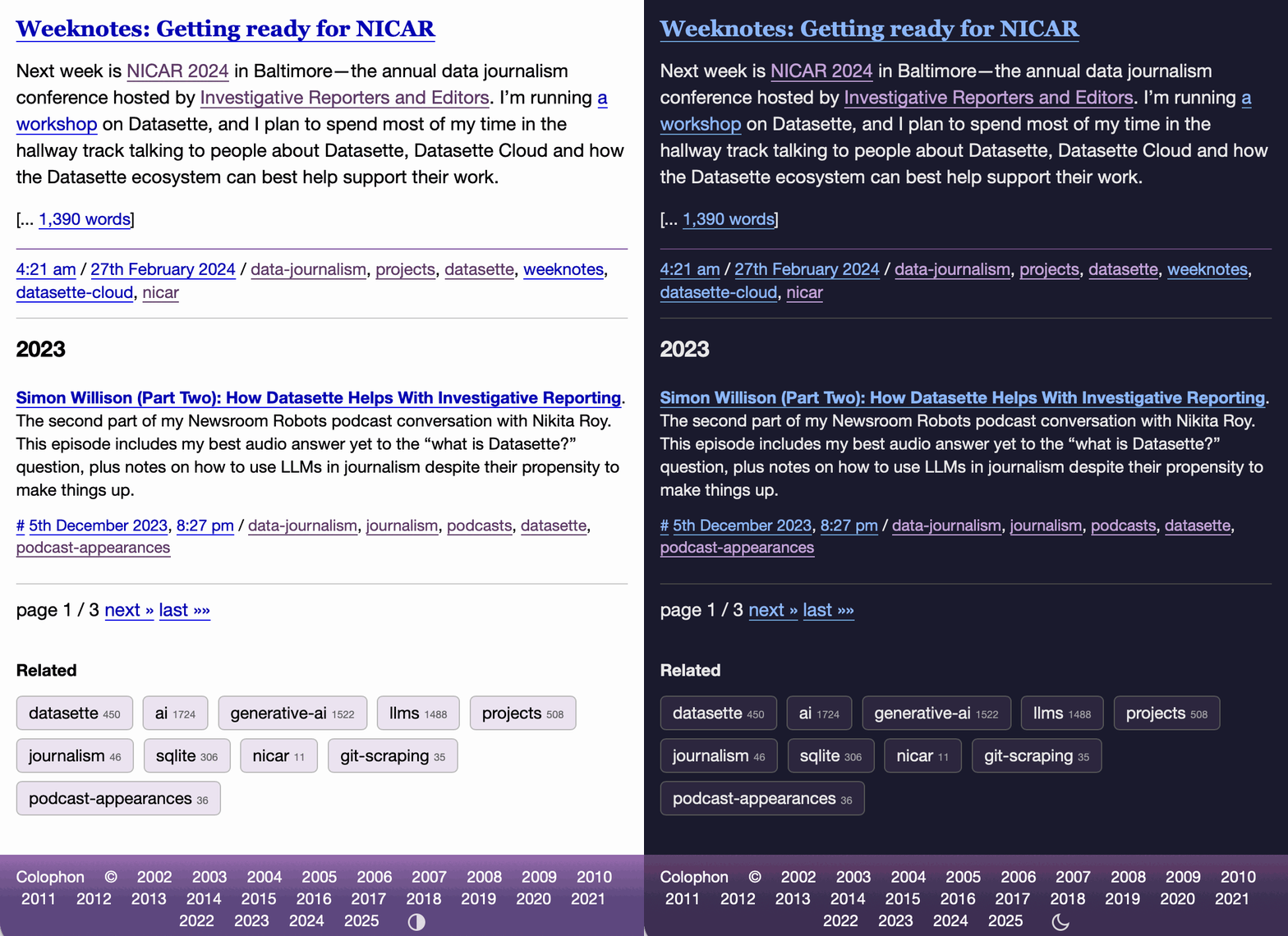
I had Claude Code make me that GIF from two static screenshots - it used this ImageMagick recipe:
magick -delay 300 -loop 0 one.png two.png \
    -colors 128 -layers Optimize dark-mode.gif
The CSS ended up with some duplication due to the need to handle both the media preference and the explicit user selection. We fixed that with Cog.
The Normalization of Deviance in AI. This thought-provoking essay from Johann Rehberger directly addresses something that I’ve been worrying about for quite a while: in the absence of any headline-grabbing examples of prompt injection vulnerabilities causing real economic harm, is anyone going to care?
Johann describes the concept of the “Normalization of Deviance” as directly applying to this question.
Coined by Diane Vaughan, the key idea here is that organizations that get away with “deviance” - ignoring safety protocols or otherwise relaxing their standards - will start baking that unsafe attitude into their culture. This can work fine… until it doesn’t. The Space Shuttle Challenger disaster has been partially blamed on this class of organizational failure.
As Johann puts it:
In the world of AI, we observe companies treating probabilistic, non-deterministic, and sometimes adversarial model outputs as if they were reliable, predictable, and safe.
Vendors are normalizing trusting LLM output, but current understanding violates the assumption of reliability.
The model will not consistently follow instructions, stay aligned, or maintain context integrity. This is especially true if there is an attacker in the loop (e.g indirect prompt injection).
However, we see more and more systems allowing untrusted output to take consequential actions. Most of the time it goes well, and over time vendors and organizations lower their guard or skip human oversight entirely, because “it worked last time.”
This dangerous bias is the fuel for normalization: organizations confuse the absence of a successful attack with the presence of robust security.
Useful patterns for building HTML tools
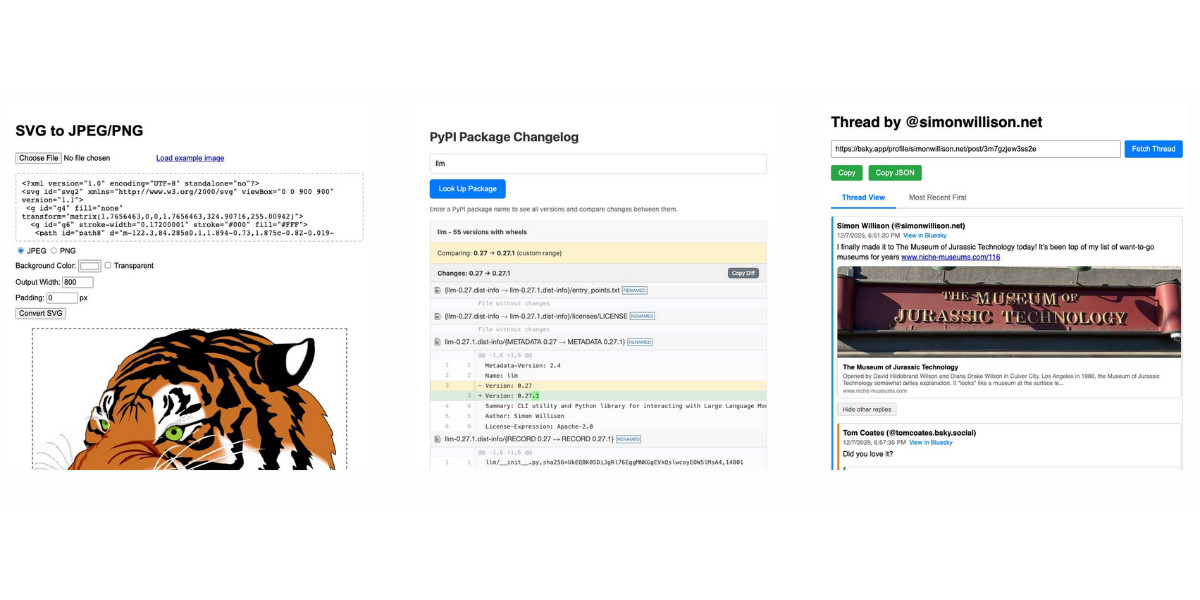
I’ve started using the term HTML tools to refer to HTML applications that I’ve been building which combine HTML, JavaScript, and CSS in a single file and use them to provide useful functionality. I have built over 150 of these in the past two years, almost all of them written by LLMs. This article presents a collection of useful patterns I’ve discovered along the way.
[... 4,231 words]