17 posts tagged “pelican-riding-a-bicycle” and “qwen”
My benchmark for LLMs: "Generate an SVG of a pelican riding a bicycle". Here's my answer to what happens if AI labs train for pelicans riding bicycles?. "User might be a kid playing with words" according to Qwen3-4B-Thinking.
2026
Qwen3.8-Flash-Next (via) Another open weights model from Qwen. This one is "a multimodal MoE model that also serves as an early preview of the architecture used in Qwen4".
It's pretty big: 125B tokens, but only 6B active which means it gets a significant performance boost.
I've been trying it out on a DGX Spark using these Unsloth quantized models. I'm still exploring the model - so far I've tried the 72.5GB UD-IQ1_S one (producing these pelicans) and the 78.9GB UD-Q2_K_XL (producing these).
My favorite so far was this xhigh reasoning effort one from UD-Q2_K_XL:

Qwen 3.8 27B is excellent, but it defaults to wildly overthinking things

Friday’s big release was Qwen 3.8 27B, an Apache 2 licensed 27B parameter vision-capable LLM from Alibaba’s Qwen research lab. I’ve been looking forward to this one: 27B is an excellent size for running a model on a reasonably specced laptop, and its predecessor Qwen 3.6 27B was impressive.
[... 2,543 words]Who’s Afraid of Chinese Models? (via) Interesting proposal from Ben Thompson that both addresses the hypocrisy of labs outlawing distillation against their models despite training on unlicensed data, and could help US open models compete more effectively with their Chinese counterparts:
The U.S. should pass a law that (1) makes explicit that collecting data for training models is fair use, and (2) bars terms of service that forbid distillation, for U.S. companies at a minimum. Stopping distillation — which is literally just querying the API — is nearly impossible; the U.S. should go the other way and lean into a new copyright policy that both indemnifies the labs and also guarantees that what they learned fuels further innovation for everyone else.
Ben also theorizes that Alibaba's decision to release Qwen 3.8 Max as open weights - a reversal from their decision not to release Qwen 3.7 Max in May - may have been influenced by a recent speech by Xi Jinping, who said:
We should seize this rare, historic opportunity to encourage open source, openness, collaboration and sharing.
And on the subject of Qwen 3.8 Max - a new 2.4T parameter model (nearly as large as the 2.8T Kimi K3) - here's a pelican it drew:

I particularly enjoyed seeing these notes in the (extensive) reasoning trace: "Could add helmet? No." and "Maybe add small bell? no." and "Need maybe add small fish in basket? Not necessary."
Ornith-1.0: Self-Scaffolding LLMs for Agentic Coding. This is an interesting new open weights (MIT licensed) model, the first model release from DeepReinforce.
[...] with variants including 9B Dense, 31B Dense, 35B MoE, and 397B MoE. Built on top of pretrained Gemma 4 and Qwen 3.5, it achieves state-of-the-art performance among open-source models of comparable size on coding benchmarks.
As far as I can tell the licenses of those underlying models is compatible with being used in this way - Gemma 4 is Apache 2.0 licensed (and not bound by the janky additional Gemma Terms of Use that afflicted the previous Gemma models) and Qwen 3.5 is Apache 2.0 licensed as well.
I've been running the model using LM Studio and the ornith-1.0-35b-Q4_K_M.gguf (20GB) GGUF, hooked up to Pi. Initial impressions are very good - it seems to be able to run the agent harness over many tool calls in a proficient way.
Here's a terminal session where I asked it to "find the code that decodes the actor cookie" and then "find the code that opens the insert dialog when thebutton is clicked" against a Datasette checkout, which it handled with ease.
I also had it draw this pelican, which came out at 103 tokens/second:

It's a little bit mangled but the pelican is clearly a pelican.
I couldn't find much information about DeepReinforce themselves. The earliest paper I could find from the was CUDA-L1: Improving CUDA Optimization via Contrastive Reinforcement Learning from June 2025.
Qwen3.6-27B: Flagship-Level Coding in a 27B Dense Model (via) Big claims from Qwen about their latest open weight model:
Qwen3.6-27B delivers flagship-level agentic coding performance, surpassing the previous-generation open-source flagship Qwen3.5-397B-A17B (397B total / 17B active MoE) across all major coding benchmarks.
On Hugging Face Qwen3.5-397B-A17B is 807GB, this new Qwen3.6-27B is 55.6GB.
I tried it out with the 16.8GB Unsloth Qwen3.6-27B-GGUF:Q4_K_M quantized version and llama-server using this recipe by benob on Hacker News, after first installing llama-server using brew install llama.cpp:
llama-server \
    -hf unsloth/Qwen3.6-27B-GGUF:Q4_K_M \
    --no-mmproj \
    --fit on \
    -np 1 \
    -c 65536 \
    --cache-ram 4096 -ctxcp 2 \
    --jinja \
    --temp 0.6 \
    --top-p 0.95 \
    --top-k 20 \
    --min-p 0.0 \
    --presence-penalty 0.0 \
    --repeat-penalty 1.0 \
    --reasoning on \
    --chat-template-kwargs '{"preserve_thinking": true}'
On first run that saved the ~17GB model to ~/.cache/huggingface/hub/models--unsloth--Qwen3.6-27B-GGUF.
Here's the transcript for "Generate an SVG of a pelican riding a bicycle". This is an outstanding result for a 16.8GB local model:

Performance numbers reported by llama-server:
- Reading: 20 tokens, 0.4s, 54.32 tokens/s
- Generation: 4,444 tokens, 2min 53s, 25.57 tokens/s
For good measure, here's Generate an SVG of a NORTH VIRGINIA OPOSSUM ON AN E-SCOOTER (run previously with GLM-5.1):
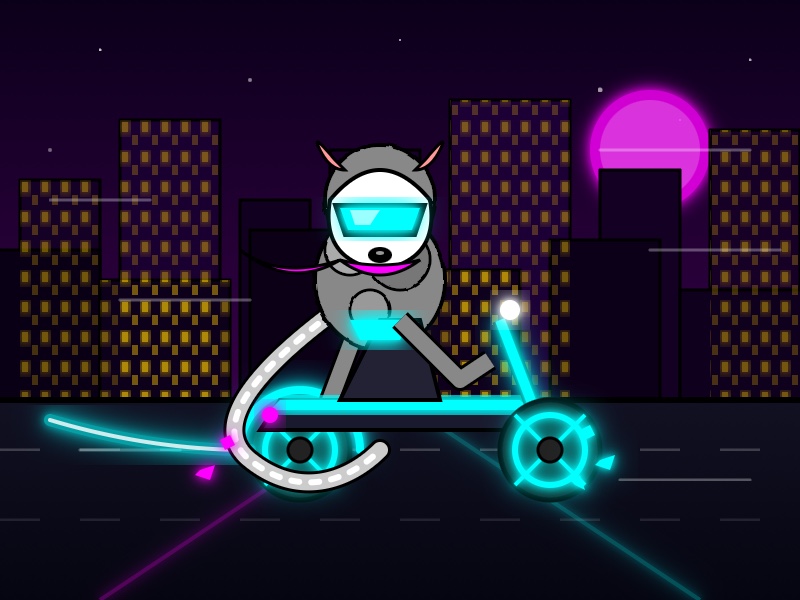
That one took 6,575 tokens, 4min 25s, 24.74 t/s.
Qwen3.6-35B-A3B on my laptop drew me a better pelican than Claude Opus 4.7
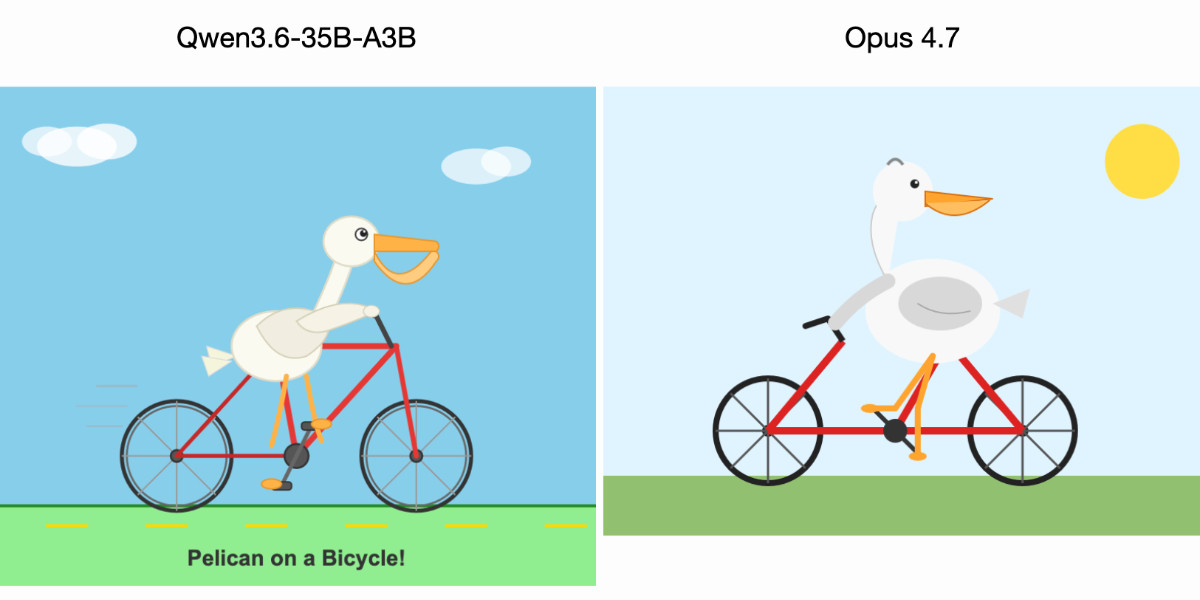
For anyone who has been (inadvisably) taking my pelican riding a bicycle benchmark seriously as a robust way to test models, here are pelicans from this morning’s two big model releases—Qwen3.6-35B-A3B from Alibaba and Claude Opus 4.7 from Anthropic.
[... 602 words]Qwen3.5: Towards Native Multimodal Agents. Alibaba's Qwen just released the first two models in the Qwen 3.5 series - one open weights, one proprietary. Both are multi-modal for vision input.
The open weight one is a Mixture of Experts model called Qwen3.5-397B-A17B. Interesting to see Qwen call out serving efficiency as a benefit of that architecture:
Built on an innovative hybrid architecture that fuses linear attention (via Gated Delta Networks) with a sparse mixture-of-experts, the model attains remarkable inference efficiency: although it comprises 397 billion total parameters, just 17 billion are activated per forward pass, optimizing both speed and cost without sacrificing capability.
It's 807GB on Hugging Face, and Unsloth have a collection of smaller GGUFs ranging in size from 94.2GB 1-bit to 462GB Q8_K_XL.
I got this pelican from the OpenRouter hosted model (transcript):

The proprietary hosted model is called Qwen3.5 Plus 2026-02-15, and is a little confusing. Qwen researcher Junyang Lin says:
Qwen3-Plus is a hosted API version of 397B. As the model natively supports 256K tokens, Qwen3.5-Plus supports 1M token context length. Additionally it supports search and code interpreter, which you can use on Qwen Chat with Auto mode.
Here's its pelican, which is similar in quality to the open weights model:

2025
Qwen3-Next-80B-A3B. Qwen announced two new models via their Twitter account (and here's their blog): Qwen3-Next-80B-A3B-Instruct and Qwen3-Next-80B-A3B-Thinking.
They make some big claims on performance:
- Qwen3-Next-80B-A3B-Instruct approaches our 235B flagship.
- Qwen3-Next-80B-A3B-Thinking outperforms Gemini-2.5-Flash-Thinking.
The name "80B-A3B" indicates 80 billion parameters of which only 3 billion are active at a time. You still need to have enough GPU-accessible RAM to hold all 80 billion in memory at once but only 3 billion will be used for each round of inference, which provides a significant speedup in responding to prompts.
More details from their tweet:
- 80B params, but only 3B activated per token → 10x cheaper training, 10x faster inference than Qwen3-32B.(esp. @ 32K+ context!)
- Hybrid Architecture: Gated DeltaNet + Gated Attention → best of speed & recall
- Ultra-sparse MoE: 512 experts, 10 routed + 1 shared
- Multi-Token Prediction → turbo-charged speculative decoding
- Beats Qwen3-32B in perf, rivals Qwen3-235B in reasoning & long-context
The models on Hugging Face are around 150GB each so I decided to try them out via OpenRouter rather than on my own laptop (Thinking, Instruct).
I'm used my llm-openrouter plugin. I installed it like this:
llm install llm-openrouter
llm keys set openrouter
# paste key here
Then found the model IDs with this command:
llm models -q next
Which output:
OpenRouter: openrouter/qwen/qwen3-next-80b-a3b-thinking
OpenRouter: openrouter/qwen/qwen3-next-80b-a3b-instruct
I have an LLM prompt template saved called pelican-svg which I created like this:
llm "Generate an SVG of a pelican riding a bicycle" --save pelican-svg
This means I can run my pelican benchmark like this:
llm -t pelican-svg -m openrouter/qwen/qwen3-next-80b-a3b-thinking
Or like this:
llm -t pelican-svg -m openrouter/qwen/qwen3-next-80b-a3b-instruct
Here's the thinking model output (exported with llm logs -c | pbcopy after I ran the prompt):
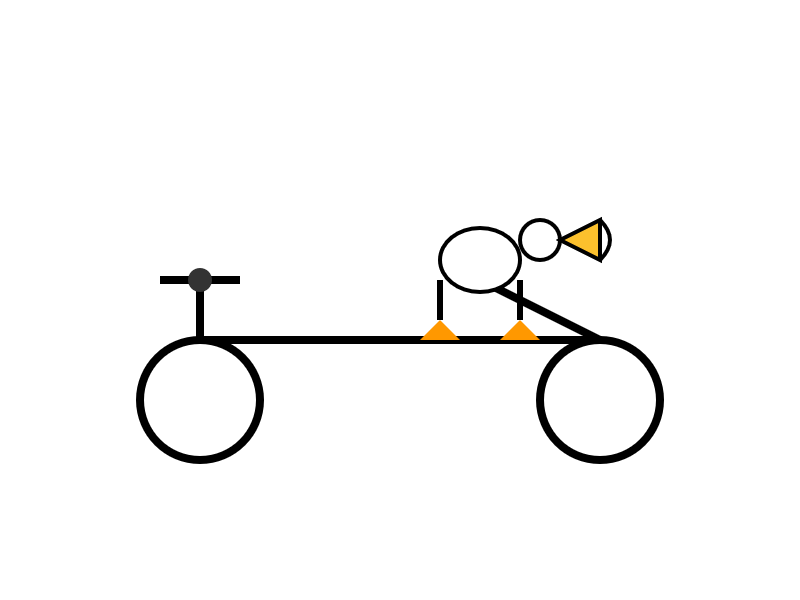
I enjoyed the "Whimsical style with smooth curves and friendly proportions (no anatomical accuracy needed for bicycle riding!)" note in the transcript.
The instruct (non-reasoning) model gave me this:

"🐧🦩 Who needs legs!?" indeed! I like that penguin-flamingo emoji sequence it's decided on for pelicans.
Qwen3-4B-Thinking: “This is art—pelicans don’t ride bikes!”
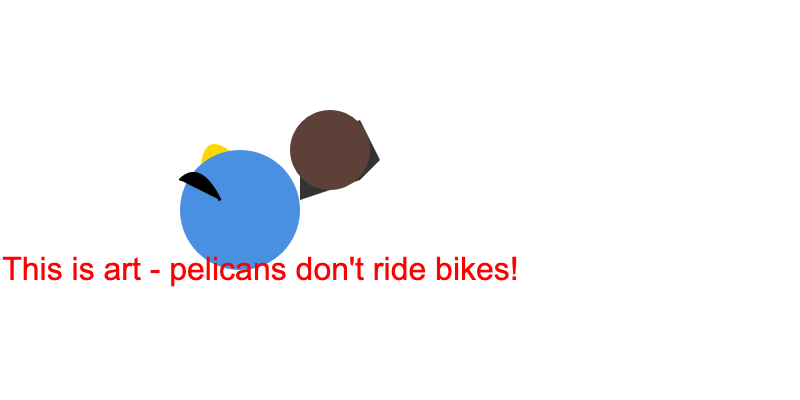
I’ve fallen a few days behind keeping up with Qwen. They released two new 4B models last week: Qwen3-4B-Instruct-2507 and its thinking equivalent Qwen3-4B-Thinking-2507.
[... 991 words]Trying out Qwen3 Coder Flash using LM Studio and Open WebUI and LLM
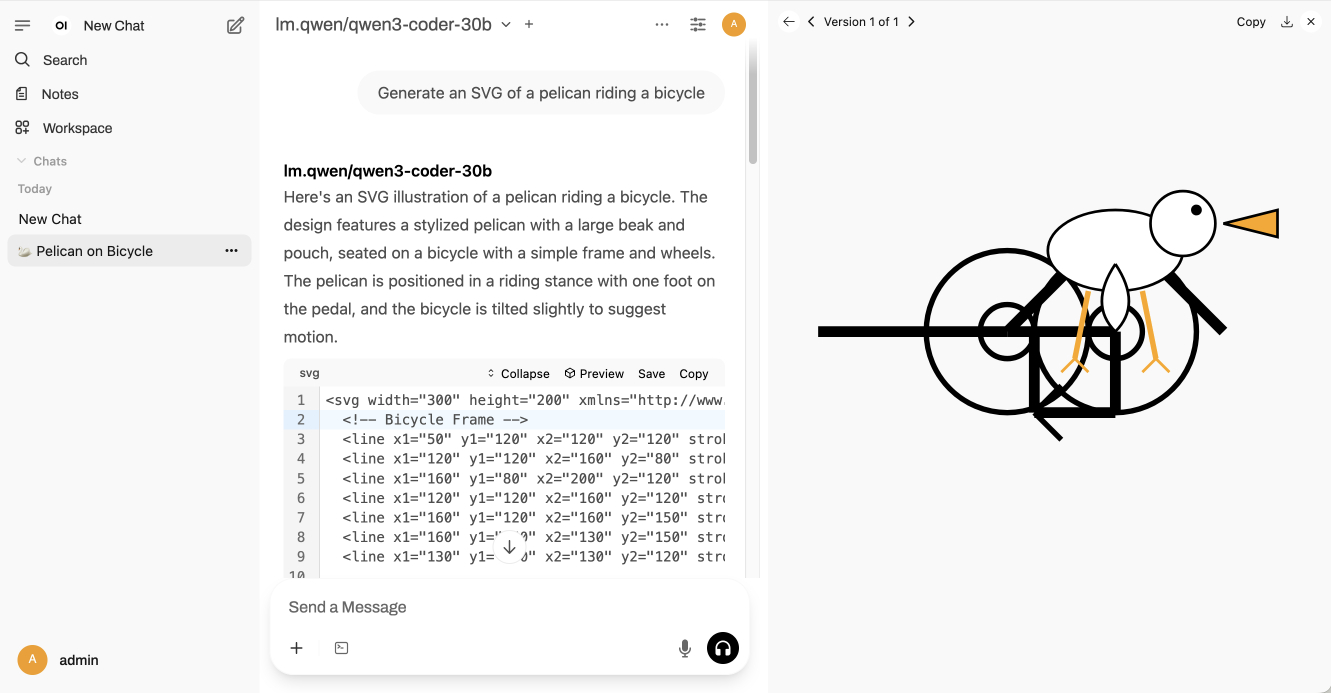
Qwen just released their sixth model(!) of this July called Qwen3-Coder-30B-A3B-Instruct—listed as Qwen3-Coder-Flash in their chat.qwen.ai interface.
[... 1,390 words]Qwen3-30B-A3B-Thinking-2507 (via) Yesterday was Qwen3-30B-A3B-Instruct-2507. Qwen are clearly committed to their new split between reasoning and non-reasoning models (a reversal from Qwen 3 in April), because today they released the new reasoning partner to yesterday's model: Qwen3-30B-A3B-Thinking-2507.
I'm surprised at how poorly this reasoning mode performs at "Generate an SVG of a pelican riding a bicycle" compared to its non-reasoning partner. The reasoning trace appears to carefully consider each component and how it should be positioned... and then the final result looks like this:
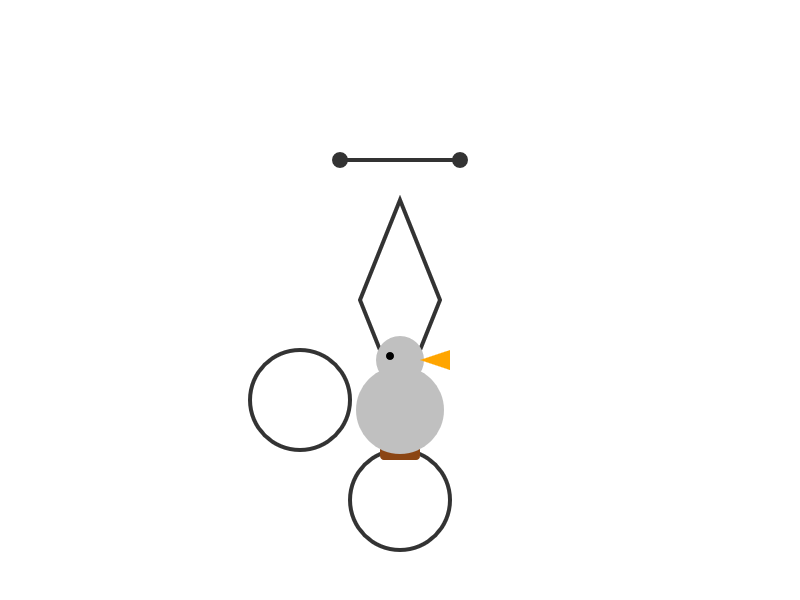
I ran this using chat.qwen.ai/?model=Qwen3-30B-A3B-2507 with the "reasoning" option selected.
I also tried the "Write an HTML and JavaScript page implementing space invaders" prompt I ran against the non-reasoning model. It did a better job in that the game works:
It's not as playable as the on I got from GLM-4.5 Air though - the invaders fire their bullets infrequently enough that the game isn't very challenging.
This model is part of a flurry of releases from Qwen over the past two 9 days. Here's my coverage of each of those:
- Qwen3-235B-A22B-Instruct-2507 - 21st July
- Qwen3-Coder-480B-A35B-Instruct - 22nd July
- Qwen3-235B-A22B-Thinking-2507 - 25th July
- Qwen3-30B-A3B-Instruct-2507 - 29th July
- Qwen3-30B-A3B-Thinking-2507 - today
Qwen3-235B-A22B-Thinking-2507 (via) The third Qwen model release week, following Qwen3-235B-A22B-Instruct-2507 on Monday 21st and Qwen3-Coder-480B-A35B-Instruct on Tuesday 22nd.
Those two were both non-reasoning models - a change from the previous models in the Qwen 3 family which combined reasoning and non-reasoning in the same model, controlled by /think and /no_think tokens.
Today's model, Qwen3-235B-A22B-Thinking-2507 (also released as an FP8 variant), is their new thinking variant.
Qwen claim "state-of-the-art results among open-source thinking models" and have increased the context length to 262,144 tokens - a big jump from April's Qwen3-235B-A22B which was "32,768 natively and 131,072 tokens with YaRN".
Their own published benchmarks show comparable scores to DeepSeek-R1-0528, OpenAI's o3 and o4-mini, Gemini 2.5 Pro and Claude Opus 4 in thinking mode.
The new model is already available via OpenRouter.
But how good is its pelican?
I tried it with "Generate an SVG of a pelican riding a bicycle" via OpenRouter, and it thought for 166 seconds - nearly three minutes! I have never seen a model think for that long. No wonder the documentation includes the following:
However, since the model may require longer token sequences for reasoning, we strongly recommend using a context length greater than 131,072 when possible.
Here's a copy of that thinking trace. It was really fun to scan through:
![Qwen3 235B A22B Thinking 2507 Seat at (200,200). The pelican's body will be: - The main body: a rounded shape starting at (200,200) and going to about (250, 250) [but note: the pelican is sitting, so the body might be more upright?] - Head: at (200, 180) [above the seat] and the beak extending forward to (280, 180) or so. We'll design the pelican as: - Head: a circle at (180, 170) with radius 15. - Beak: a long triangle from (180,170) to (250,170) and then down to (250,180) and back? Actually, the beak is a long flat-bottomed triangle.](https://static.simonwillison.net/static/2025/qwen-details.jpg)
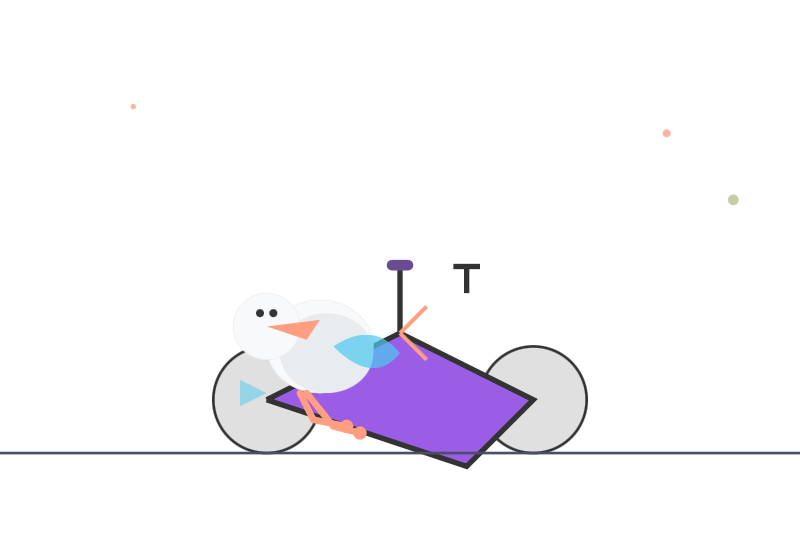
The finished pelican? Not so great! I like the beak though:
Qwen3-Coder: Agentic Coding in the World (via) It turns out that as I was typing up my notes on Qwen3-235B-A22B-Instruct-2507 the Qwen team were unleashing something much bigger:
Today, we’re announcing Qwen3-Coder, our most agentic code model to date. Qwen3-Coder is available in multiple sizes, but we’re excited to introduce its most powerful variant first: Qwen3-Coder-480B-A35B-Instruct — a 480B-parameter Mixture-of-Experts model with 35B active parameters which supports the context length of 256K tokens natively and 1M tokens with extrapolation methods, offering exceptional performance in both coding and agentic tasks.
This is another Apache 2.0 licensed open weights model, available as Qwen3-Coder-480B-A35B-Instruct and Qwen3-Coder-480B-A35B-Instruct-FP8 on Hugging Face.
I used qwen3-coder-480b-a35b-instruct on the Hyperbolic playground to run my "Generate an SVG of a pelican riding a bicycle" test prompt:

I actually slightly prefer the one I got from qwen3-235b-a22b-07-25.
It's also available as qwen3-coder on OpenRouter.
In addition to the new model, Qwen released their own take on an agentic terminal coding assistant called qwen-code, which they describe in their blog post as being "Forked from Gemini Code" (they mean gemini-cli) - which is Apache 2.0 so a fork is in keeping with the license.
They focused really hard on code performance for this release, including generating synthetic data tested using 20,000 parallel environments on Alibaba Cloud:
In the post-training phase of Qwen3-Coder, we introduced long-horizon RL (Agent RL) to encourage the model to solve real-world tasks through multi-turn interactions using tools. The key challenge of Agent RL lies in environment scaling. To address this, we built a scalable system capable of running 20,000 independent environments in parallel, leveraging Alibaba Cloud’s infrastructure. The infrastructure provides the necessary feedback for large-scale reinforcement learning and supports evaluation at scale. As a result, Qwen3-Coder achieves state-of-the-art performance among open-source models on SWE-Bench Verified without test-time scaling.
To further burnish their coding credentials, the announcement includes instructions for running their new model using both Claude Code and Cline using custom API base URLs that point to Qwen's own compatibility proxies.
Pricing for Qwen's own hosted models (through Alibaba Cloud) looks competitive. This is the first model I've seen that sets different prices for four different sizes of input:
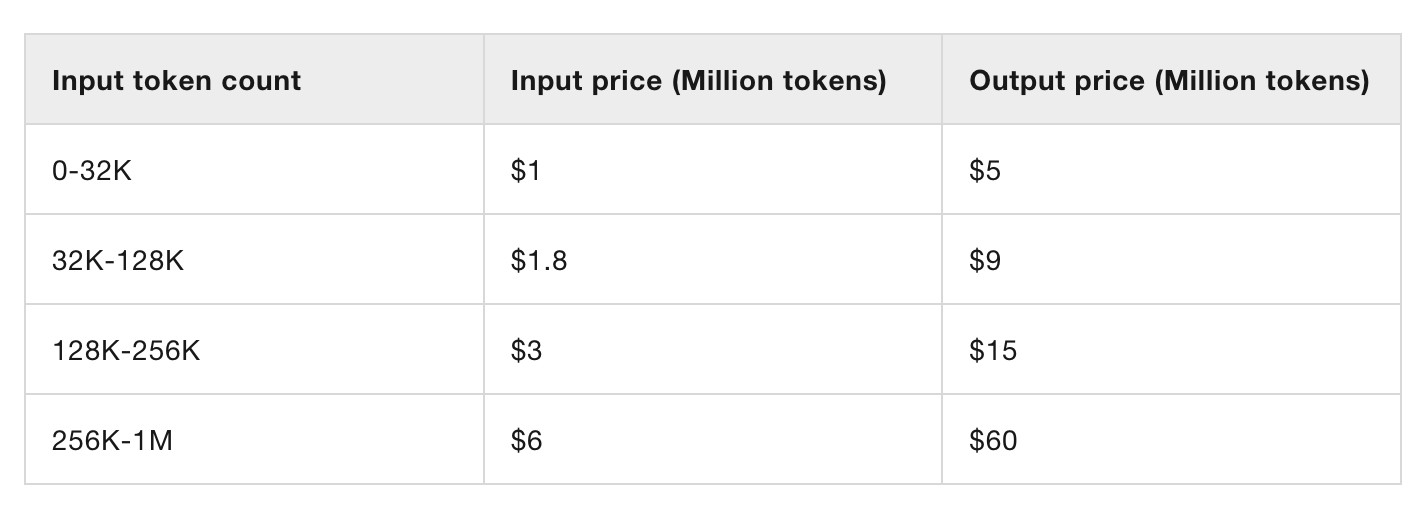
This kind of pricing reflects how inference against longer inputs is more expensive to process. Gemini 2.5 Pro has two different prices for above or below 200,00 tokens.
Awni Hannun reports running a 4-bit quantized MLX version on a 512GB M3 Ultra Mac Studio at 24 tokens/second using 272GB of RAM, getting great results for "write a python script for a bouncing yellow ball within a square, make sure to handle collision detection properly. make the square slowly rotate. implement it in python. make sure ball stays within the square".
Qwen/Qwen3-235B-A22B-Instruct-2507. Significant new model release from Qwen, published yesterday without much fanfare. (Update: probably because they were cooking the much larger Qwen3-Coder-480B-A35B-Instruct which they released just now.)
This is a follow-up to their April release of the full Qwen 3 model family, which included a Qwen3-235B-A22B model which could handle both reasoning and non-reasoning prompts (via a /no_think toggle).
The new Qwen3-235B-A22B-Instruct-2507 ditches that mechanism - this is exclusively a non-reasoning model. It looks like Qwen have new reasoning models in the pipeline.
This new model is Apache 2 licensed and comes in two official sizes: a BF16 model (437.91GB of files on Hugging Face) and an FP8 variant (220.20GB). VentureBeat estimate that the large model needs 88GB of VRAM while the smaller one should run in ~30GB.
The benchmarks on these new models look very promising. Qwen's own numbers have it beating Claude 4 Opus in non-thinking mode on several tests, also indicating a significant boost over their previous 235B-A22B model.
I haven't seen any independent benchmark results yet. Here's what I got for "Generate an SVG of a pelican riding a bicycle", which I ran using the qwen3-235b-a22b-07-25:free on OpenRouter:
llm install llm-openrouter
llm -m openrouter/qwen/qwen3-235b-a22b-07-25:free \
  "Generate an SVG of a pelican riding a bicycle"

Qwen 3 offers a case study in how to effectively release a model
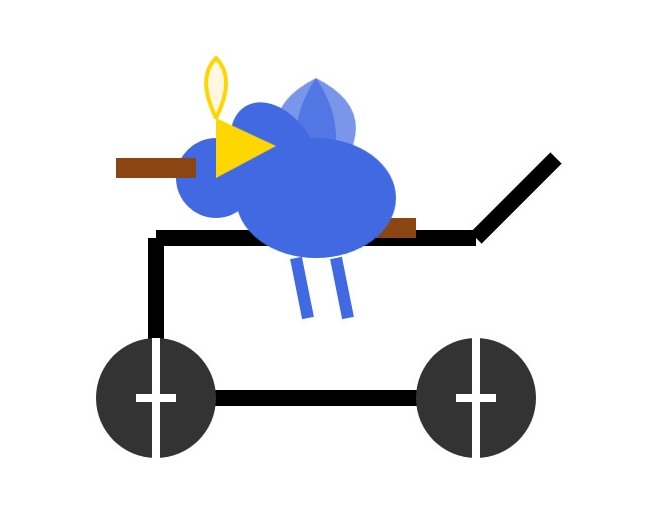
Alibaba’s Qwen team released the hotly anticipated Qwen 3 model family today. The Qwen models are already some of the best open weight models—Apache 2.0 licensed and with a variety of different capabilities (including vision and audio input/output).
[... 1,462 words]2024
QwQ: Reflect Deeply on the Boundaries of the Unknown. Brand new openly licensed (Apache 2) model from Alibaba Cloud's Qwen team, this time clearly inspired by OpenAI's work on reasoning in o1.
I love the flowery language they use to introduce the new model:
Through deep exploration and countless trials, we discovered something profound: when given time to ponder, to question, and to reflect, the model’s understanding of mathematics and programming blossoms like a flower opening to the sun. Just as a student grows wiser by carefully examining their work and learning from mistakes, our model achieves deeper insight through patient, thoughtful analysis.
It's already available through Ollama as a 20GB download. I initially ran it like this:
ollama run qwq
This downloaded the model and started an interactive chat session. I tried the classic "how many rs in strawberry?" and got this lengthy but correct answer, which concluded:
Wait, but maybe I miscounted. Let's list them: 1. s 2. t 3. r 4. a 5. w 6. b 7. e 8. r 9. r 10. y Yes, definitely three "r"s. So, the word "strawberry" contains three "r"s.
Then I switched to using LLM and the llm-ollama plugin. I tried prompting it for Python that imports CSV into SQLite:
Write a Python function import_csv(conn, url, table_name) which acceopts a connection to a SQLite databse and a URL to a CSV file and the name of a table - it then creates that table with the right columns and imports the CSV data from that URL
It thought through the different steps in detail and produced some decent looking code.
Finally, I tried this:
llm -m qwq 'Generate an SVG of a pelican riding a bicycle'
For some reason it answered in Simplified Chinese. It opened with this:
生成一个SVG图像,内容是一只鹈鹕骑着一辆自行车。这听起来挺有趣的!我需要先了解一下什么是SVG,以及如何创建这样的图像。
Which translates (using Google Translate) to:
Generate an SVG image of a pelican riding a bicycle. This sounds interesting! I need to first understand what SVG is and how to create an image like this.
It then produced a lengthy essay discussing the many aspects that go into constructing a pelican on a bicycle - full transcript here. After a full 227 seconds of constant output it produced this as the final result.
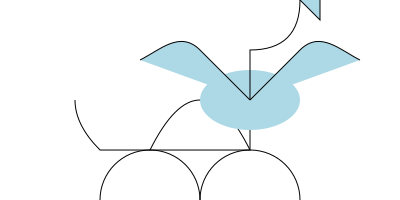
I think that's pretty good!
Qwen2.5-Coder-32B is an LLM that can code well that runs on my Mac
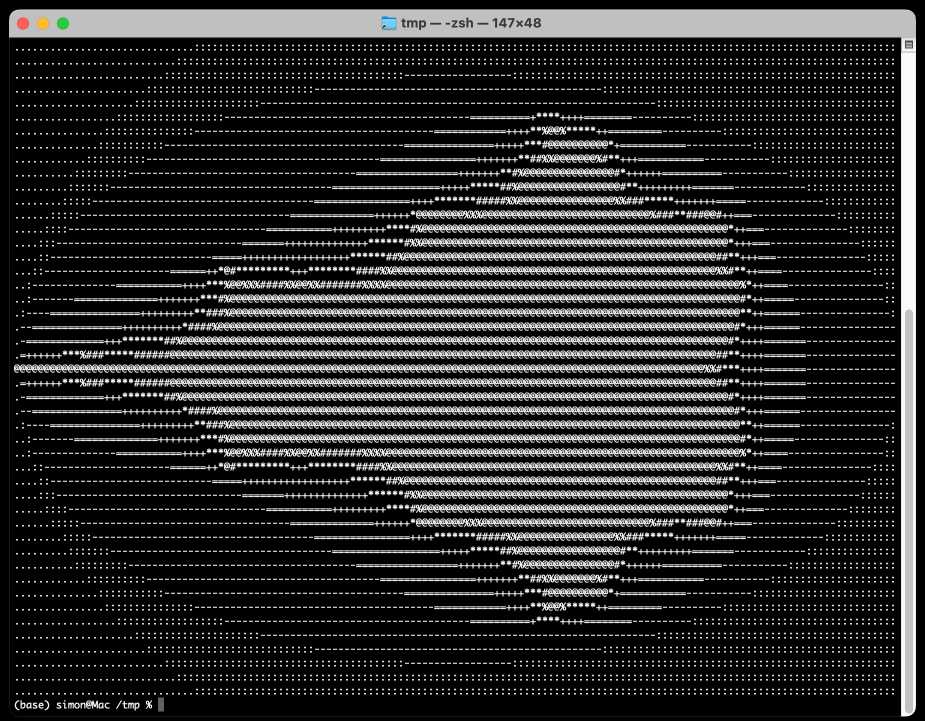
There’s a whole lot of buzz around the new Qwen2.5-Coder Series of open source (Apache 2.0 licensed) LLM releases from Alibaba’s Qwen research team. On first impression it looks like the buzz is well deserved.
[... 697 words]