Tuesday, 27th January 2026
Kimi K2.5: Visual Agentic Intelligence (via) Kimi K2 landed in July as a 1 trillion parameter open weight LLM. It was joined by Kimi K2 Thinking in November which added reasoning capabilities. Now they've made it multi-modal: the K2 models were text-only, but the new 2.5 can handle image inputs as well:
Kimi K2.5 builds on Kimi K2 with continued pretraining over approximately 15T mixed visual and text tokens. Built as a native multimodal model, K2.5 delivers state-of-the-art coding and vision capabilities and a self-directed agent swarm paradigm.
The "self-directed agent swarm paradigm" claim there means improved long-sequence tool calling and training on how to break down tasks for multiple agents to work on at once:
For complex tasks, Kimi K2.5 can self-direct an agent swarm with up to 100 sub-agents, executing parallel workflows across up to 1,500 tool calls. Compared with a single-agent setup, this reduces execution time by up to 4.5x. The agent swarm is automatically created and orchestrated by Kimi K2.5 without any predefined subagents or workflow.
I used the OpenRouter Chat UI to have it "Generate an SVG of a pelican riding a bicycle", and it did quite well:

As a more interesting test, I decided to exercise the claims around multi-agent planning with this prompt:
I want to build a Datasette plugin that offers a UI to upload files to an S3 bucket and stores information about them in a SQLite table. Break this down into ten tasks suitable for execution by parallel coding agents.
Here's the full response. It produced ten realistic tasks and reasoned through the dependencies between them. For comparison here's the same prompt against Claude Opus 4.5 and against GPT-5.2 Thinking.
The Hugging Face repository is 595GB. The model uses Kimi's janky "modified MIT" license, which adds the following clause:
Our only modification part is that, if the Software (or any derivative works thereof) is used for any of your commercial products or services that have more than 100 million monthly active users, or more than 20 million US dollars (or equivalent in other currencies) in monthly revenue, you shall prominently display "Kimi K2.5" on the user interface of such product or service.
Given the model's size, I expect one way to run it locally would be with MLX and a pair of $10,000 512GB RAM M3 Ultra Mac Studios. That setup has been demonstrated to work with previous trillion parameter K2 models.
One Human + One Agent = One Browser From Scratch (via) embedding-shapes was so infuriated by the hype around Cursor's FastRender browser project - thousands of parallel agents producing ~1.6 million lines of Rust - that they were inspired to take a go at building a web browser using coding agents themselves.
The result is one-agent-one-browser and it's really impressive. Over three days they drove a single Codex CLI agent to build 20,000 lines of Rust that successfully renders HTML+CSS with no Rust crate dependencies at all - though it does (reasonably) use Windows, macOS and Linux system frameworks for image and text rendering.
I installed the 1MB macOS binary release and ran it against my blog:
chmod 755 ~/Downloads/one-agent-one-browser-macOS-ARM64
~/Downloads/one-agent-one-browser-macOS-ARM64 https://simonwillison.net/
Here's the result:
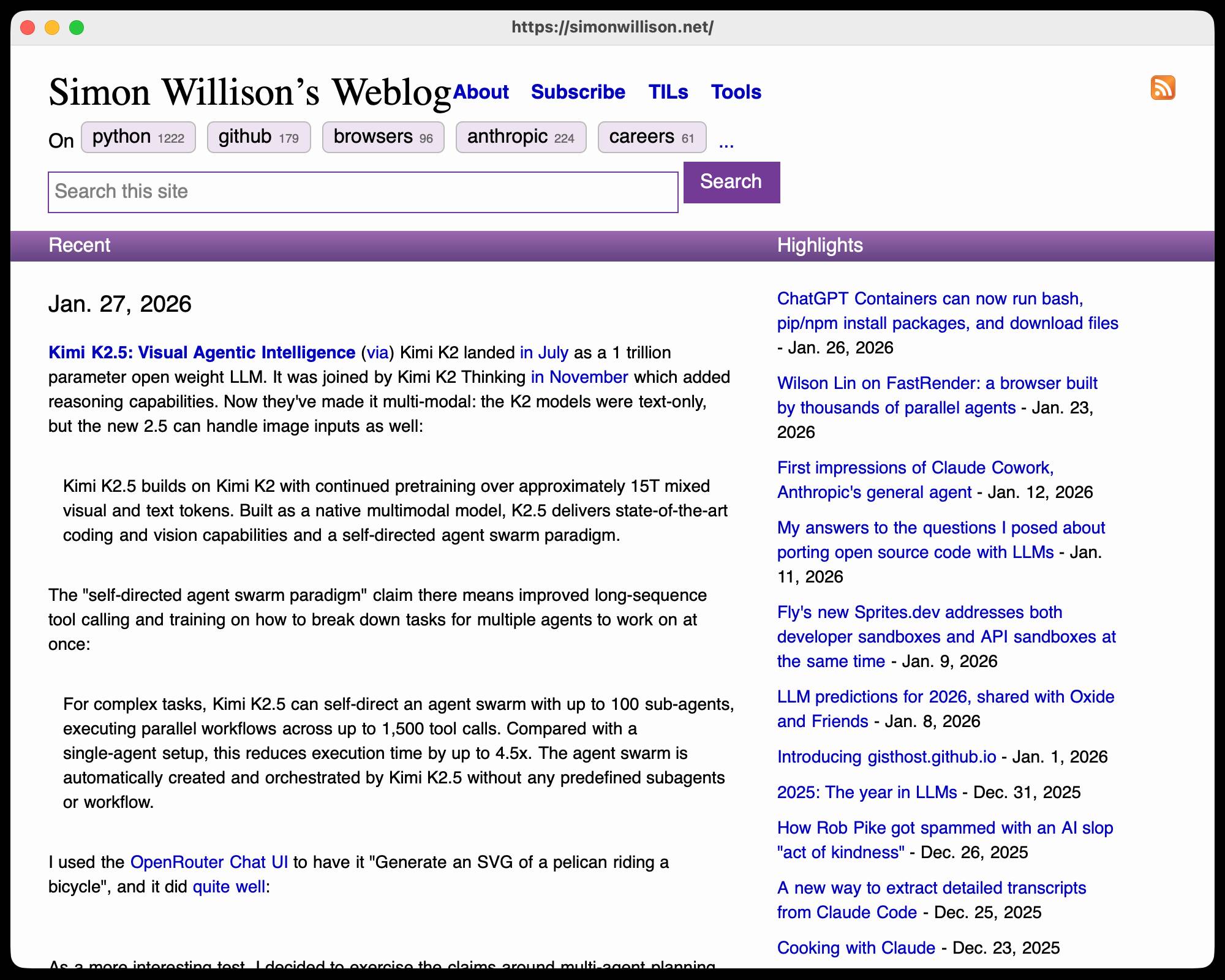
It even rendered my SVG feed subscription icon! A PNG image is missing from the page, which looks like an intermittent bug (there's code to render PNGs).
The code is pretty readable too - here's the flexbox implementation.
I had thought that "build a web browser" was the ideal prompt to really stretch the capabilities of coding agents - and that it would take sophisticated multi-agent harnesses (as seen in the Cursor project) and millions of lines of code to achieve.
Turns out one agent driven by a talented engineer, three days and 20,000 lines of Rust is enough to get a very solid basic renderer working!
I'm going to upgrade my prediction for 2029: I think we're going to get a production-grade web browser built by a small team using AI assistance by then.