7 posts tagged “disclosures”
When I receive value (financial or in-kind) connected to my writing such as travel, accommodation, event access, review units, reimbursements, or honoraria, I disclose it here. See also my disclosures policy.
2026
GitHub Octoverse 2026. I'm at GitHub Universe today (GitHub gave me a free ticket through their "GitHub Stars" program). EVP Jay Parikh just announced this year's Octoverse report, and highlighted these numbers in particular:
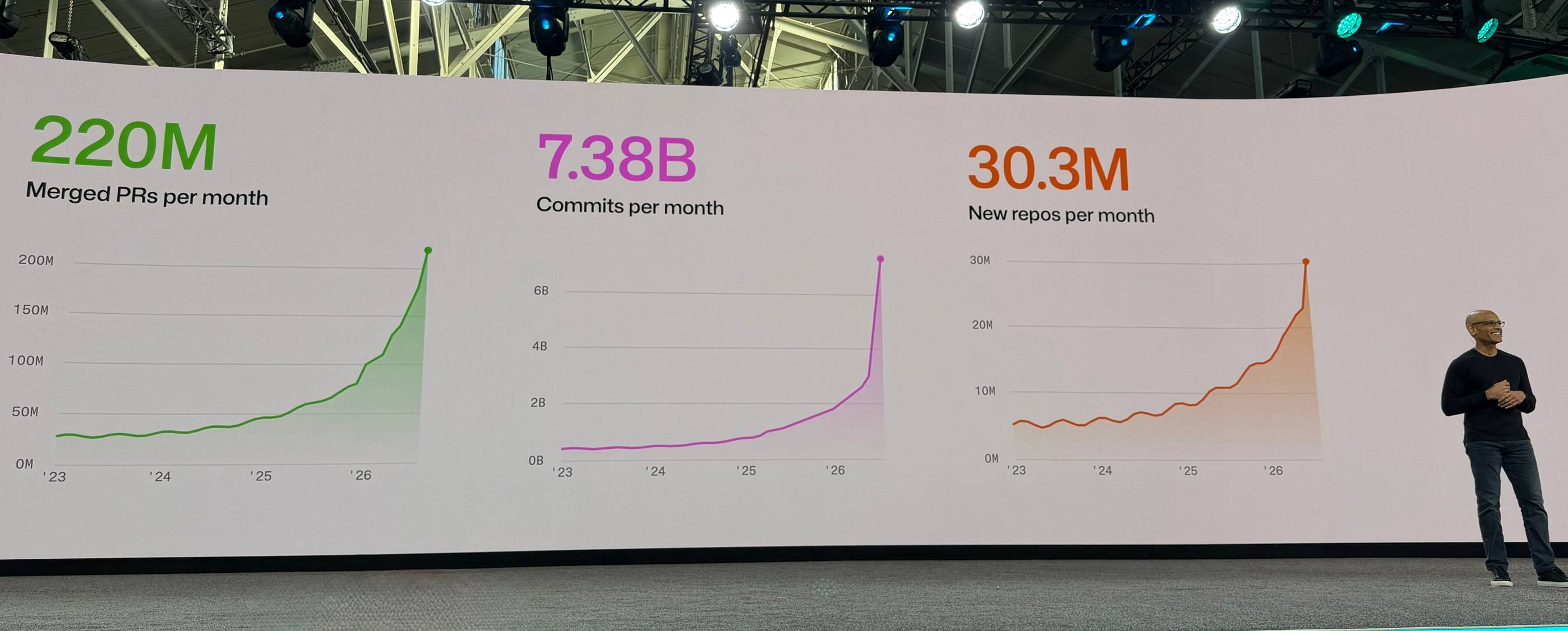
This is a pretty stark representation of the impact of agentic engineering on GitHub. In 2026, merged pull requests tripled in less than a year to 220 million per month. Commits more than tripled to 7.38 billion per month, with most of that increase in the second half of this year. New repository rate doubled this year, to 30.3 million per month.
The report includes new numbers by industry, and breaks out numbers for repositories that involve "interoperability or reverse engineering". The methodology section includes notes about how they did this:
Top countries by pushes to public repositories, adjusted by profile location. Pushes from each country were summed across the Octoverse year. To adjust for biases caused by VPN usage, LLM classification was used to extract the ISO 3166-1 alpha-2 code from the profiles of GitHub users who contributed pushes during this period [...]
Industry. Public repositories created 2022 to 2026 were sorted into NAICS sectors by a fine-tuned multilingual embedding model using name, description, topics, and README, from random samples per year. [...]
Interoperability. Counts public repositories created each year whose name, description, topics, or README mention interoperability or reverse engineering, or related terms, such as clean room implementation, drop-in replacement, or protocol re-implementation.
2025
Hacking the WiFi-enabled color screen GitHub Universe conference badge

I’m at GitHub Universe this week (thanks to a free ticket from Microsoft). Yesterday I picked up my conference badge... which incorporates a full Raspberry Pi Raspberry Pi Pico microcontroller with a battery, color screen, WiFi and bluetooth.
Claude Code for web—a new asynchronous coding agent from Anthropic
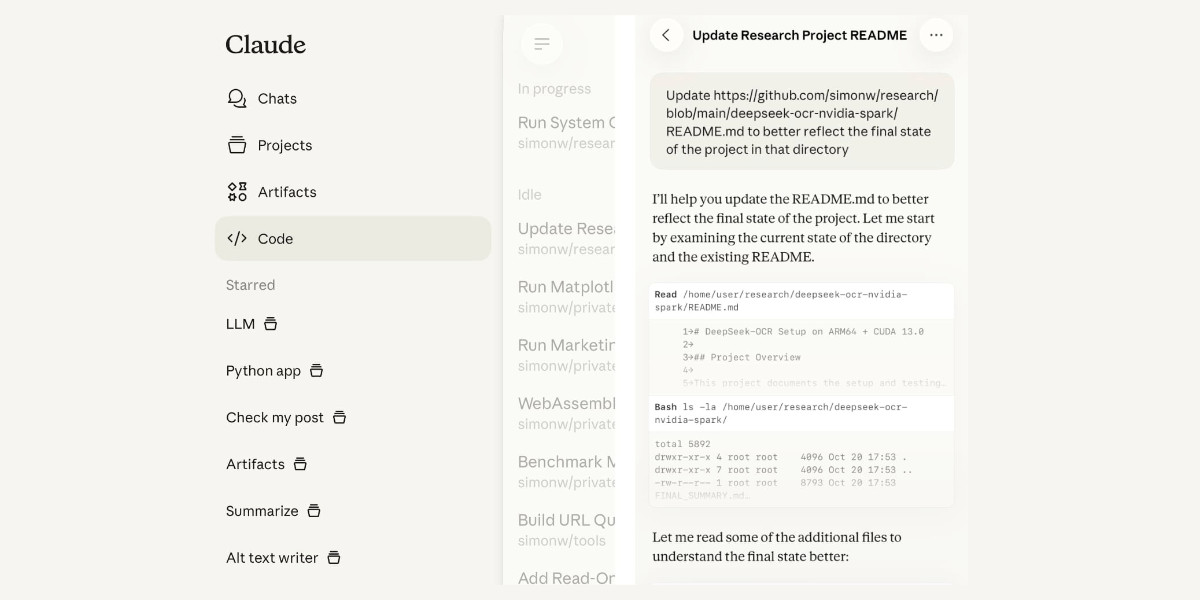
Anthropic launched Claude Code for web this morning. It’s an asynchronous coding agent—their answer to OpenAI’s Codex Cloud and Google’s Jules, and has a very similar shape. I had preview access over the weekend and I’ve already seen some very promising results from it.
[... 1,434 words]NVIDIA DGX Spark: great hardware, early days for the ecosystem
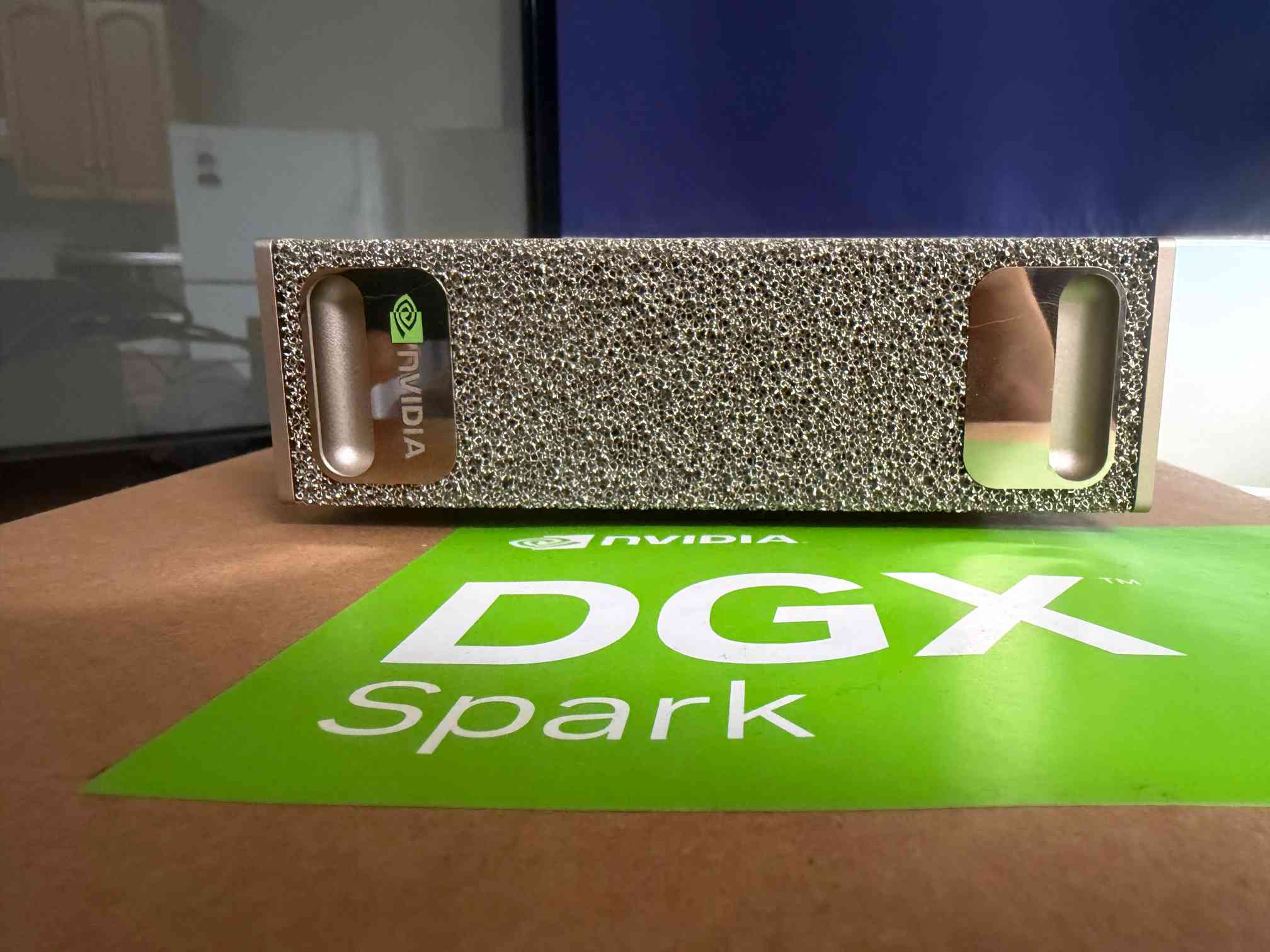
NVIDIA sent me a preview unit of their new DGX Spark desktop “AI supercomputer”. I’ve never had hardware to review before! You can consider this my first ever sponsored post if you like, but they did not pay me any cash and aside from an embargo date they did not request (nor would I grant) any editorial input into what I write about the device.
[... 1,846 words]OpenAI DevDay 2025 live blog
I’m at OpenAI DevDay in Fort Mason, San Francisco today. As I did last year, I’m going to be live blogging the announcements from the kenote. Unlike last year, this year there’s a livestream.
[... 57 words]GitHub Copilot CLI is now in public preview. GitHub now have their own entry in the coding terminal CLI agent space: Copilot CLI.
It's the same basic shape as Claude Code, Codex CLI, Gemini CLI and a growing number of other tools in this space. It's a terminal UI which you accepts instructions and can modify files, run commands and integrate with GitHub's MCP server and other MCP servers that you configure.
Two notable features compared to many of the others:
- It works against the GitHub Models backend. It defaults to Claude Sonnet 4 but you can set
COPILOT_MODEL=gpt-5to switch to GPT-5. Presumably other models will become available soon. - It's billed against your existing GitHub Copilot account. Pricing details are here - they're split into "Agent mode" requests and "Premium" requests. Different plans get different allowances, which are shared with other products in the GitHub Copilot family.
The best available documentation right now is the copilot --help screen - here's a copy of that in a Gist.
It's a competent entry into the market, though it's missing features like the ability to paste in images which have been introduced to Claude Code and Codex CLI over the past few months.
Disclosure: I got a preview of this at an event at Microsoft's offices in Seattle last week. They did not pay me for my time but they did cover my flight, hotel and some dinners.
A couple of weeks ago I was invited to OpenAI's headquarters for a "preview event", for which I had to sign both an NDA and a video release waiver. I suspected it might relate to either GPT-5 or the OpenAI open weight models... and GPT-5 it was!
OpenAI had invited five developers: Claire Vo, Theo Browne, Ben Hylak, Shawn @swyx Wang, and myself. We were all given early access to the new models and asked to spend a couple of hours (of paid time, see my disclosures) experimenting with them, while being filmed by a professional camera crew.
The resulting video is now up on YouTube. Unsurprisingly most of my edits related to SVGs of pelicans.