Monday, 19th January 2026
Scaling long-running autonomous coding. Wilson Lin at Cursor has been doing some experiments to see how far you can push a large fleet of "autonomous" coding agents:
This post describes what we've learned from running hundreds of concurrent agents on a single project, coordinating their work, and watching them write over a million lines of code and trillions of tokens.
They ended up running planners and sub-planners to create tasks, then having workers execute on those tasks - similar to how Claude Code uses sub-agents. Each cycle ended with a judge agent deciding if the project was completed or not.
In my predictions for 2026 the other day I said that by 2029:
I think somebody will have built a full web browser mostly using AI assistance, and it won’t even be surprising. Rolling a new web browser is one of the most complicated software projects I can imagine[...] the cheat code is the conformance suites. If there are existing tests that it’ll get so much easier.
I may have been off by three years, because Cursor chose "building a web browser from scratch" as their test case for their agent swarm approach:
To test this system, we pointed it at an ambitious goal: building a web browser from scratch. The agents ran for close to a week, writing over 1 million lines of code across 1,000 files. You can explore the source code on GitHub.
But how well did they do? Their initial announcement a couple of days ago was met with unsurprising skepticism, especially when it became apparent that their GitHub Actions CI was failing and there were no build instructions in the repo.
It looks like they addressed that within the past 24 hours. The latest README includes build instructions which I followed on macOS like this:
cd /tmp
git clone https://github.com/wilsonzlin/fastrender
cd fastrender
git submodule update --init vendor/ecma-rs
cargo run --release --features browser_ui --bin browser
This got me a working browser window! Here are screenshots I took of google.com and my own website:
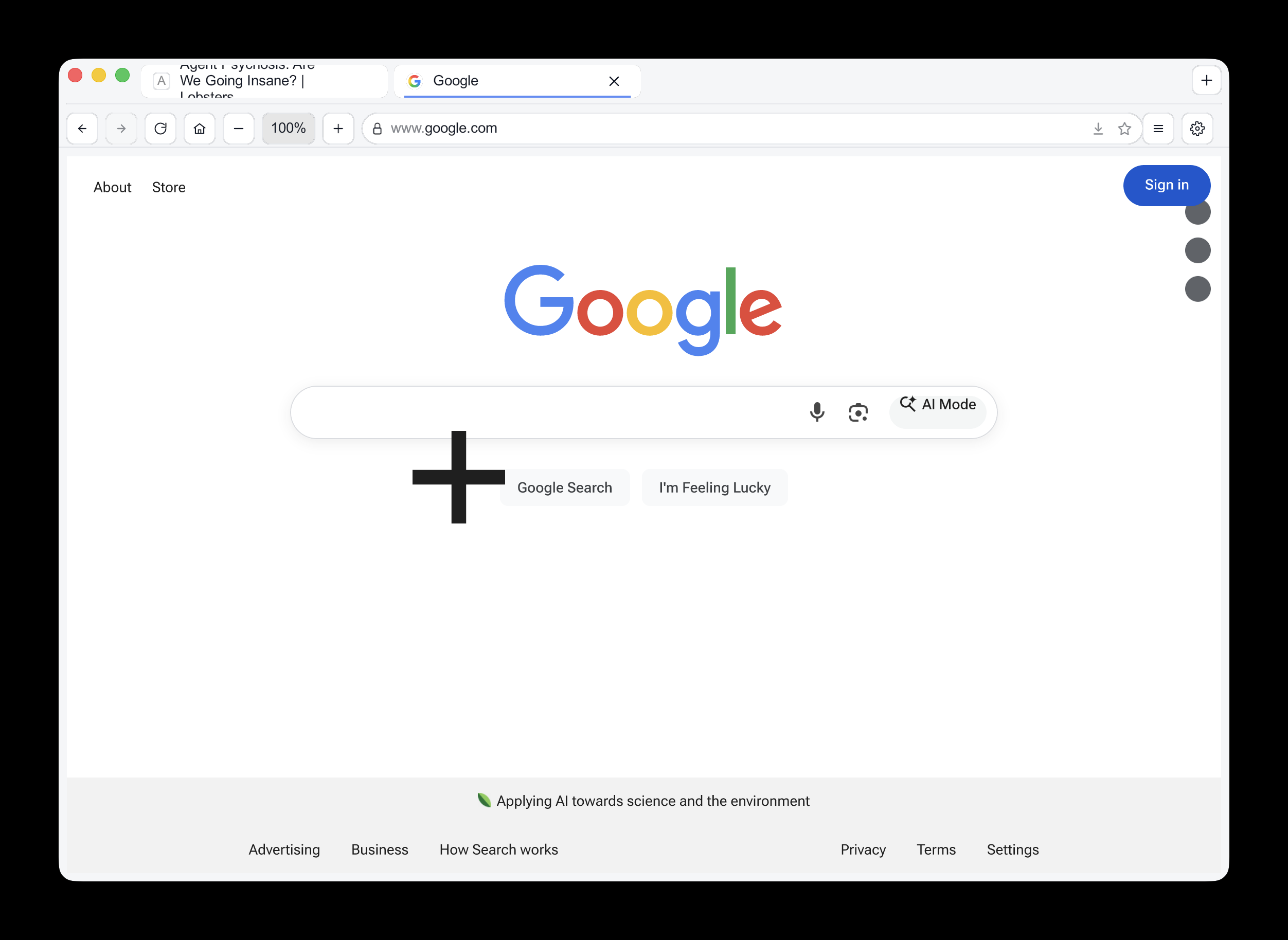
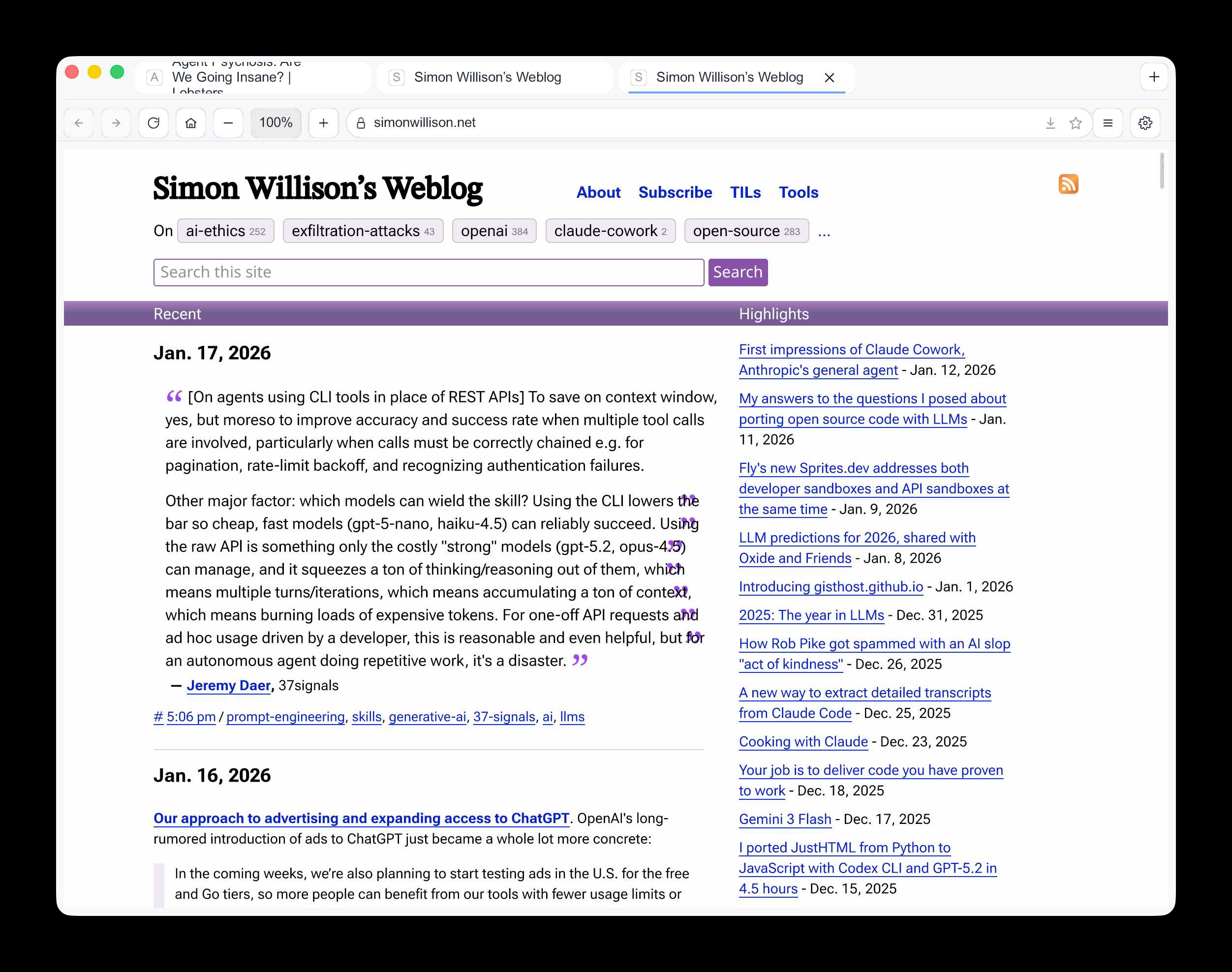
Honestly those are very impressive! You can tell they're not just wrapping an existing rendering engine because of those very obvious rendering glitches, but the pages are legible and look mostly correct.
The FastRender repo even uses Git submodules to include various WhatWG and CSS-WG specifications in the repo, which is a smart way to make sure the agents have access to the reference materials that they might need.
This is the second attempt I've seen at building a full web browser using AI-assisted coding in the past two weeks - the first was HiWave browser, a new browser engine in Rust first announced in this Reddit thread.
When I made my 2029 prediction this is more-or-less the quality of result I had in mind. I don't think we'll see projects of this nature compete with Chrome or Firefox or WebKit any time soon but I have to admit I'm very surprised to see something this capable emerge so quickly.
Update 23rd January 2026: I recorded a 47 minute conversation with Wilson about this project and published it on YouTube. Here's the video and accompanying highlights.
jordanhubbard/nanolang (via) Plenty of people have mused about what a new programming language specifically designed to be used by LLMs might look like. Jordan Hubbard (co-founder of FreeBSD, with serious stints at Apple and NVIDIA) just released exactly that.
A minimal, LLM-friendly programming language with mandatory testing and unambiguous syntax.
NanoLang transpiles to C for native performance while providing a clean, modern syntax optimized for both human readability and AI code generation.
The syntax strikes me as an interesting mix between C, Lisp and Rust.
I decided to see if an LLM could produce working code in it directly, given the necessary context. I started with this MEMORY.md file, which begins:
Purpose: This file is designed specifically for Large Language Model consumption. It contains the essential knowledge needed to generate, debug, and understand NanoLang code. Pair this with
spec.jsonfor complete language coverage.
I ran that using LLM and llm-anthropic like this:
llm -m claude-opus-4.5 \
  -s https://raw.githubusercontent.com/jordanhubbard/nanolang/refs/heads/main/MEMORY.md \
  'Build me a mandelbrot fractal CLI tool in this language'
  > /tmp/fractal.nano
The resulting code... did not compile.
I may have been too optimistic expecting a one-shot working program for a new language like this. So I ran a clone of the actual project, copied in my program and had Claude Code take a look at the failing compiler output.
... and it worked! Claude happily grepped its way through the various examples/ and built me a working program.
Here's the Claude Code transcript - you can see it reading relevant examples here - and here's the finished code plus its output.
I've suspected for a while that LLMs and coding agents might significantly reduce the friction involved in launching a new language. This result reinforces my opinion.