Wednesday, 25th February 2026
Linear walkthroughs
Sometimes it's useful to have a coding agent give you a structured walkthrough of a codebase.
Maybe it's existing code you need to get up to speed on, maybe it's your own code that you've forgotten the details of, or maybe you vibe coded the whole thing and need to understand how it actually works.
Frontier models with the right agent harness can construct a detailed walkthrough to help you understand how code works. [... 524 words]
It’s also reasonable for people who entered technology in the last couple of decades because it was good job, or because they enjoyed coding to look at this moment with a real feeling of loss. That feeling of loss though can be hard to understand emotionally for people my age who entered tech because we were addicted to feeling of agency it gave us. The web was objectively awful as a technology, and genuinely amazing, and nobody got into it because programming in Perl was somehow aesthetically delightful.
— Kellan Elliott-McCrea, Code has always been the easy part
I vibe coded my dream macOS presentation app
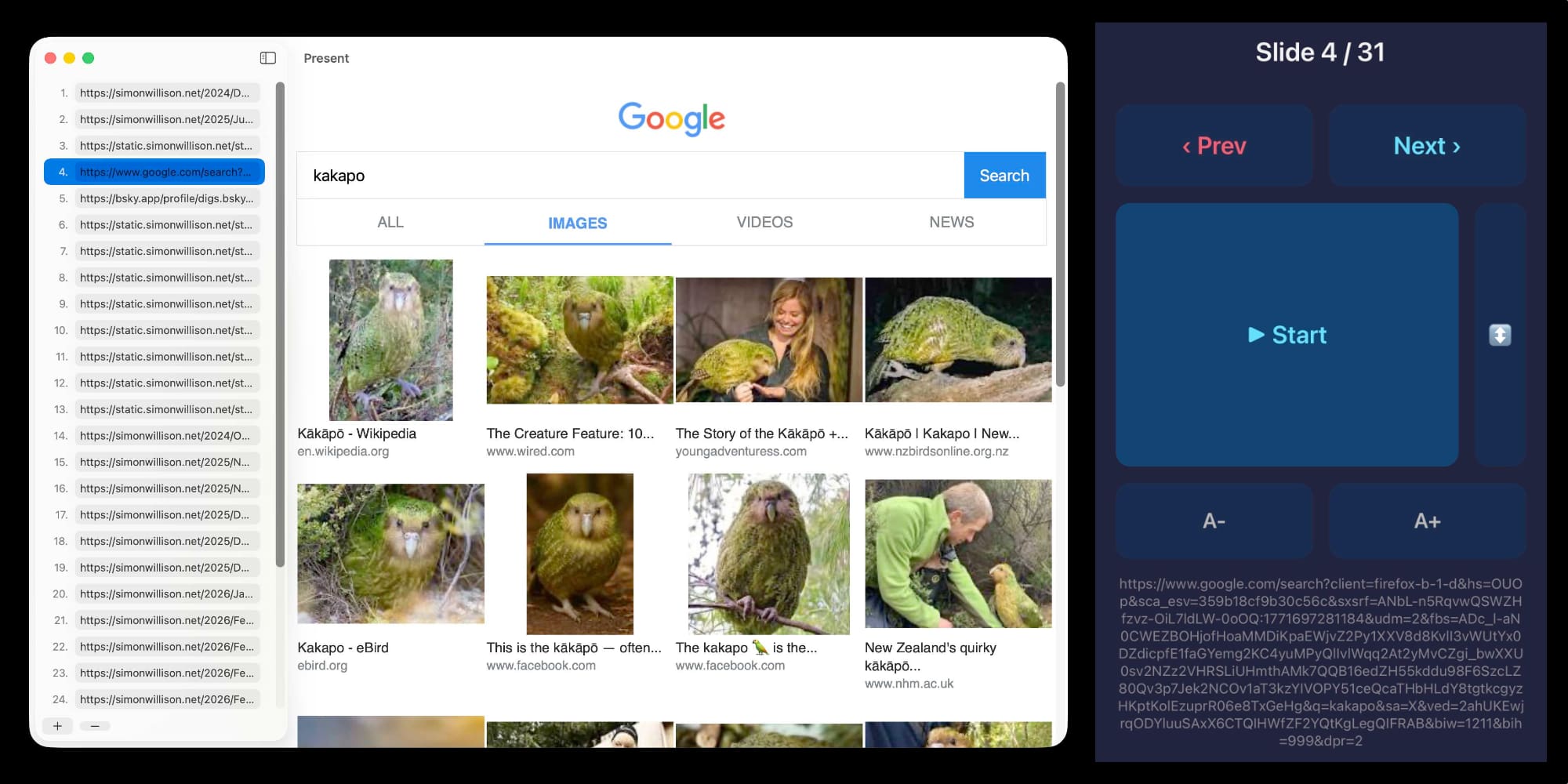
I gave a talk this weekend at Social Science FOO Camp in Mountain View. The event was a classic unconference format where anyone could present a talk without needing to propose it in advance. I grabbed a slot for a talk I titled “The State of LLMs, February 2026 edition”, subtitle “It’s all changed since November!”. I vibe coded a custom macOS app for the presentation the night before.
[... 1,613 words]Claude Code Remote Control (via) New Claude Code feature dropped yesterday: you can now run a "remote control" session on your computer and then use the Claude Code for web interfaces (on web, iOS and native desktop app) to send prompts to that session.
It's a little bit janky right now. Initially when I tried it I got the error "Remote Control is not enabled for your account. Contact your administrator." (but I am my administrator?) - then I logged out and back into the Claude Code terminal app and it started working:
claude remote-control
You can only run one session on your machine at a time. If you upgrade the Claude iOS app it then shows up as "Remote Control Session (Mac)" in the Code tab.
It appears not to support the --dangerously-skip-permissions flag (I passed that to claude remote-control and it didn't reject the option, but it also appeared to have no effect) - which means you have to approve every new action it takes.
I also managed to get it to a state where every prompt I tried was met by an API 500 error.
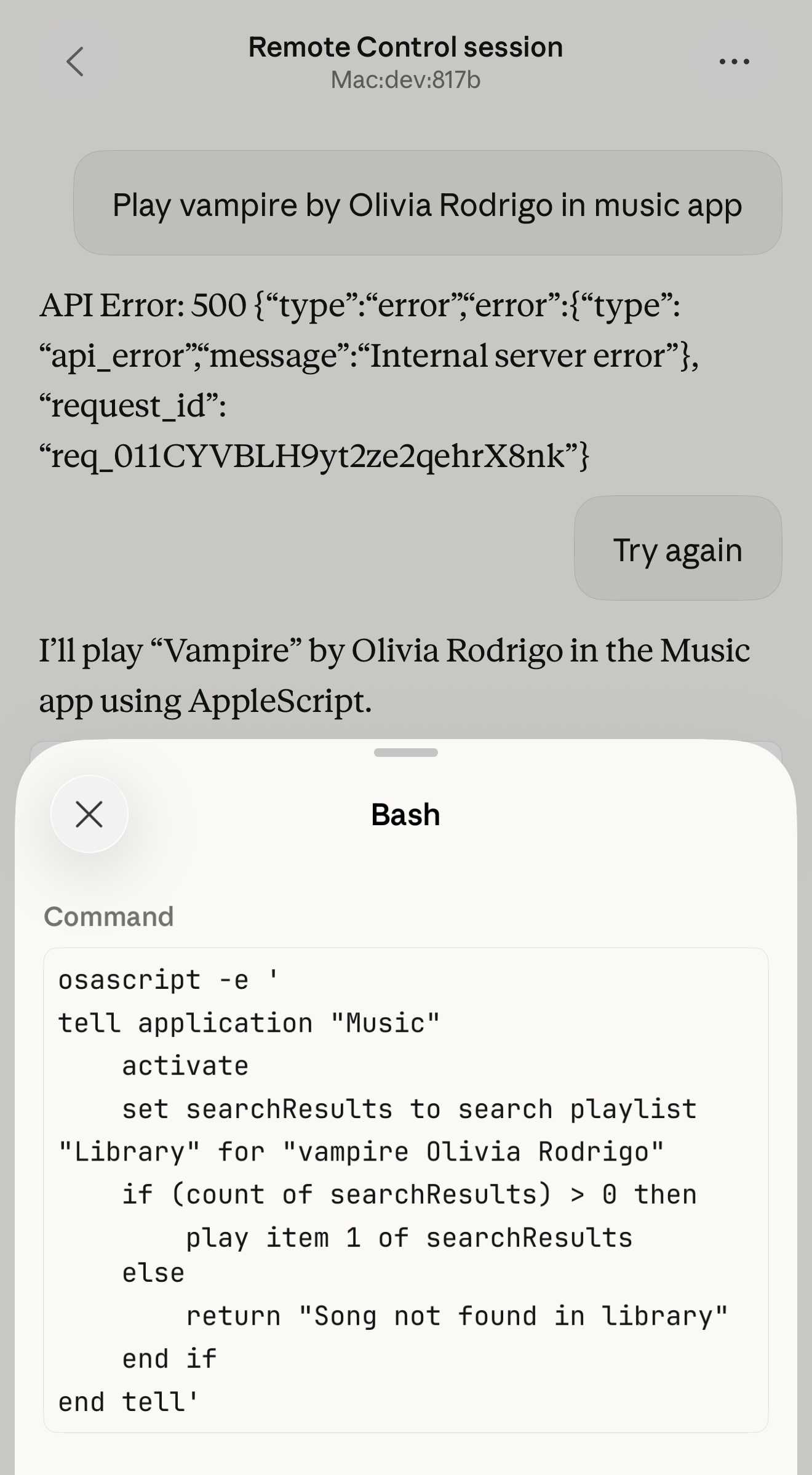
Restarting the program on the machine also causes existing sessions to start returning mysterious API errors rather than neatly explaining that the session has terminated.
I expect they'll iron out all of these issues relatively quickly. It's interesting to then contrast this to solutions like OpenClaw, where one of the big selling points is the ability to control your personal device from your phone.
Claude Code still doesn't have a documented mechanism for running things on a schedule, which is the other killer feature of the Claw category of software.
Update: I spoke too soon: also today Anthropic announced Schedule recurring tasks in Cowork, Claude Code's general agent sibling. These do include an important limitation:
Scheduled tasks only run while your computer is awake and the Claude Desktop app is open. If your computer is asleep or the app is closed when a task is scheduled to run, Cowork will skip the task, then run it automatically once your computer wakes up or you open the desktop app again.
I really hope they're working on a Cowork Cloud product.
tldraw issue: Move tests to closed source repo (via) It's become very apparent over the past few months that a comprehensive test suite is enough to build a completely fresh implementation of any open source library from scratch, potentially in a different language.
This has worrying implications for open source projects with commercial business models. Here's an example of a response: tldraw, the outstanding collaborative drawing library (see previous coverage), are moving their test suite to a private repository - apparently in response to Cloudflare's project to port Next.js to use Vite in a week using AI.
They also filed a joke issue, now closed to Translate source code to Traditional Chinese:
The current tldraw codebase is in English, making it easy for external AI coding agents to replicate. It is imperative that we defend our intellectual property.
Worth noting that tldraw aren't technically open source - their custom license requires a commercial license if you want to use it in "production environments".
Update: Well this is embarrassing, it turns out the issue I linked to about removing the tests was a joke as well:
Sorry folks, this issue was more of a joke (am I allowed to do that?) but I'll keep the issue open since there's some discussion here. Writing from mobile
- moving our tests into another repo would complicate and slow down our development, and speed for us is more important than ever
- more canvas better, I know for sure that our decisions have inspired other products and that's fine and good
- tldraw itself may eventually be a vibe coded alternative to tldraw
- the value is in the ability to produce new and good product decisions for users / customers, however you choose to create the code