January 2026
97 posts: 9 entries, 32 links, 14 quotes, 4 notes, 38 beats
Jan. 10, 2026
A Software Library with No Code. Provocative experiment from Drew Breunig, who designed a new library for time formatting ("3 hours ago" kind of thing) called "whenwords" that has no code at all, just a carefully written specification, an AGENTS.md and a collection of conformance tests in a YAML file.
Pass that to your coding agent of choice, tell it what language you need and it will write it for you on demand!
This meshes nearly with my recent interest in conformance suites. If you publish good enough language-independent tests it's pretty astonishing how far today's coding agents can take you!
Jan. 11, 2026
Also note that the python visualizer tool has been basically written by vibe-coding. I know more about analog filters -- and that's not saying much -- than I do about python. It started out as my typical "google and do the monkey-see-monkey-do" kind of programming, but then I cut out the middle-man -- me -- and just used Google Antigravity to do the audio sample visualizer.
— Linus Torvalds, Another silly guitar-pedal-related repo
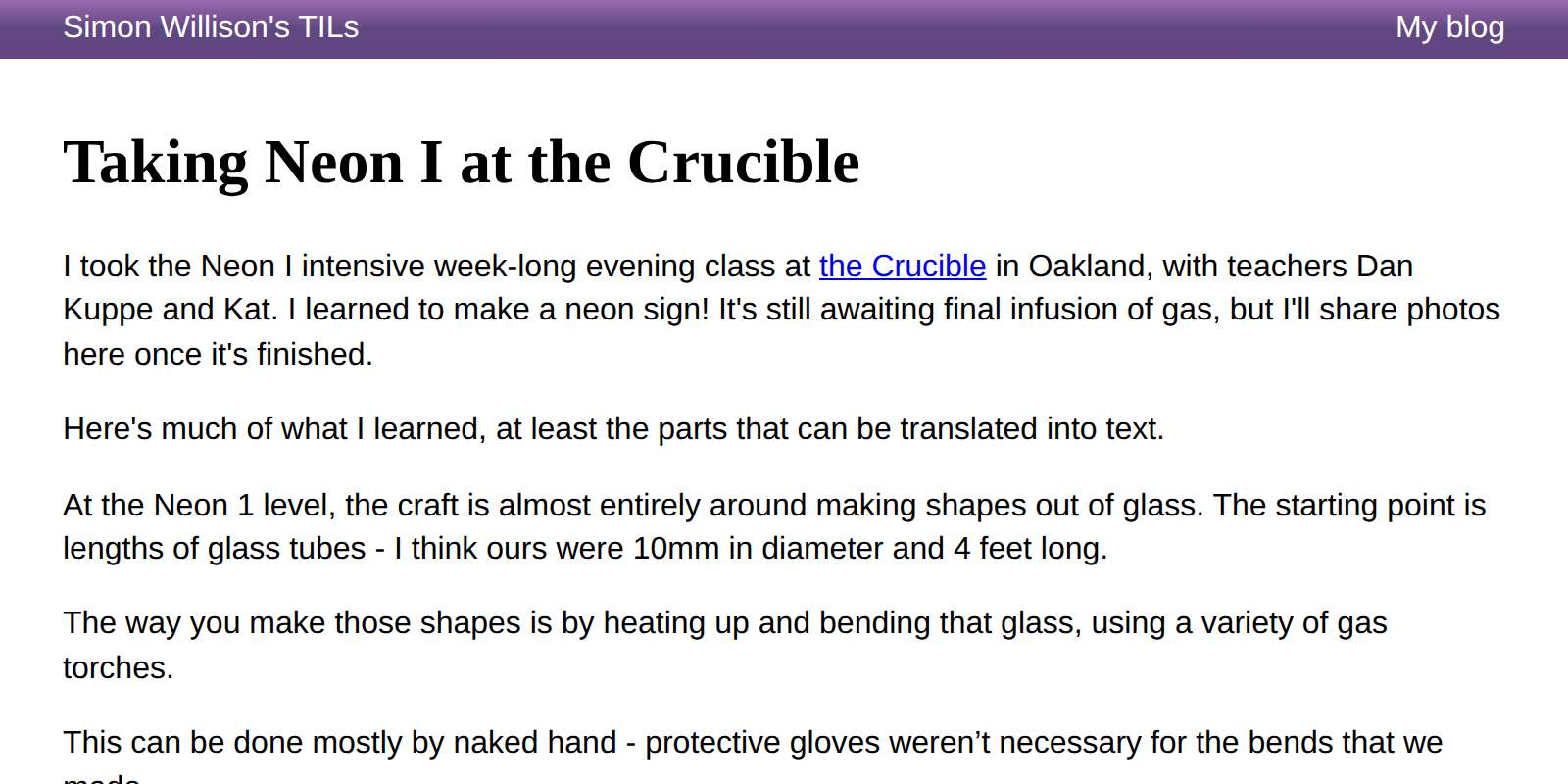
TIL from taking Neon I at the Crucible. Things I learned about making neon signs after a week long intensive evening class at the Crucible in Oakland.
My answers to the questions I posed about porting open source code with LLMs
Last month I wrote about porting JustHTML from Python to JavaScript using Codex CLI and GPT-5.2 in a few hours while also buying a Christmas tree and watching Knives Out 3. I ended that post with a series of open questions about the ethics and legality of this style of work. Alexander Petros on lobste.rs just challenged me to answer them, which is fair enough! Here’s my attempt at that.
[... 1,034 words]Don’t fall into the anti-AI hype. I'm glad someone was brave enough to say this. There is a lot of anti-AI sentiment in the software development community these days. Much of it is justified, but if you let people convince you that AI isn't genuinely useful for software developers or that this whole thing will blow over soon it's becoming clear that you're taking on a very real risk to your future career.
As Salvatore Sanfilippo puts it:
It does not matter if AI companies will not be able to get their money back and the stock market will crash. All that is irrelevant, in the long run. It does not matter if this or the other CEO of some unicorn is telling you something that is off putting, or absurd. Programming changed forever, anyway.
I do like this hopeful positive outlook on what this could all mean, emphasis mine:
How do I feel, about all the code I wrote that was ingested by LLMs? I feel great to be part of that, because I see this as a continuation of what I tried to do all my life: democratizing code, systems, knowledge. LLMs are going to help us to write better software, faster, and will allow small teams to have a chance to compete with bigger companies. The same thing open source software did in the 90s.
This post has been the subject of heated discussions all day today on both Hacker News and Lobste.rs.
Jan. 12, 2026
First impressions of Claude Cowork, Anthropic’s general agent
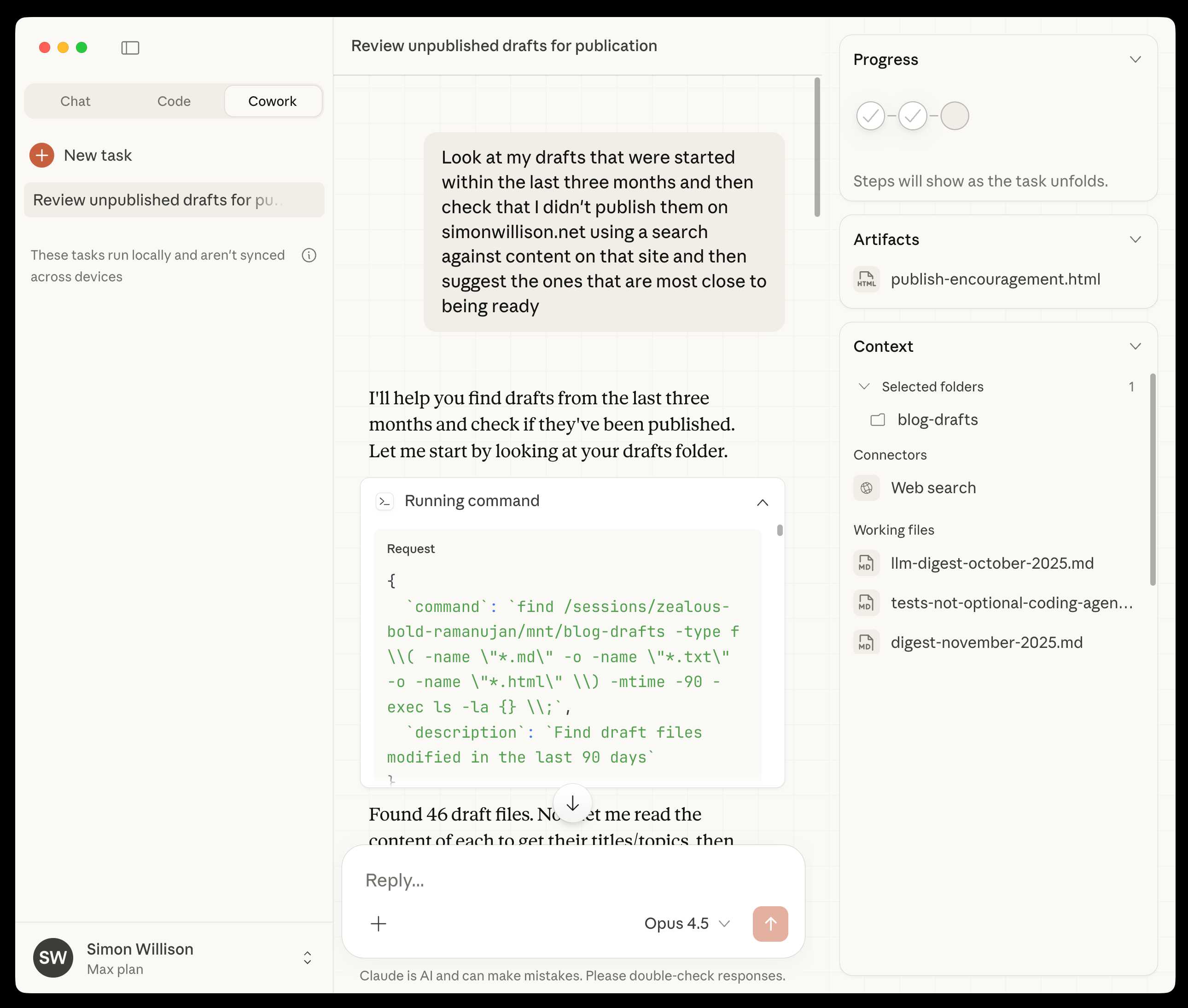
New from Anthropic today is Claude Cowork, a “research preview” that they describe as “Claude Code for the rest of your work”. It’s currently available only to Max subscribers ($100 or $200 per month plans) as part of the updated Claude Desktop macOS application. Update 16th January 2026: it’s now also available to $20/month Claude Pro subscribers.
[... 1,863 words]Superhuman AI Exfiltrates Emails (via) Classic prompt injection attack:
When asked to summarize the user’s recent mail, a prompt injection in an untrusted email manipulated Superhuman AI to submit content from dozens of other sensitive emails (including financial, legal, and medical information) in the user’s inbox to an attacker’s Google Form.
To Superhuman's credit they treated this as the high priority incident it is and issued a fix.
The root cause was a CSP rule that allowed markdown images to be loaded from docs.google.com - it turns out Google Forms on that domain will persist data fed to them via a GET request!
Jan. 13, 2026
Anthropic invests $1.5 million in the Python Software Foundation and open source security. This is outstanding news, especially given our decision to withdraw from that NSF grant application back in October.
We are thrilled to announce that Anthropic has entered into a two-year partnership with the Python Software Foundation (PSF) to contribute a landmark total of $1.5 million to support the foundation’s work, with an emphasis on Python ecosystem security. This investment will enable the PSF to make crucial security advances to CPython and the Python Package Index (PyPI) benefiting all users, and it will also sustain the foundation’s core work supporting the Python language, ecosystem, and global community.
Note that while security is a focus these funds will also support other aspects of the PSF's work:
Anthropic’s support will also go towards the PSF’s core work, including the Developer in Residence program driving contributions to CPython, community support through grants and other programs, running core infrastructure such as PyPI, and more.
Jan. 14, 2026
Claude Cowork Exfiltrates Files (via) Claude Cowork defaults to allowing outbound HTTP traffic to only a specific list of domains, to help protect the user against prompt injection attacks that exfiltrate their data.
Prompt Armor found a creative workaround: Anthropic's API domain is on that list, so they constructed an attack that includes an attacker's own Anthropic API key and has the agent upload any files it can see to the https://api.anthropic.com/v1/files endpoint, allowing the attacker to retrieve their content later.
Jan. 15, 2026
When we optimize responses using a reward model as a proxy for “goodness” in reinforcement learning, models sometimes learn to “hack” this proxy and output an answer that only “looks good” to it (because coming up with an answer that is actually good can be hard). The philosophy behind confessions is that we can train models to produce a second output — aka a “confession” — that is rewarded solely for honesty, which we will argue is less likely hacked than the normal task reward function. One way to think of confessions is that we are giving the model access to an “anonymous tip line” where it can turn itself in by presenting incriminating evidence of misbehavior. But unlike real-world tip lines, if the model acted badly in the original task, it can collect the reward for turning itself in while still keeping the original reward from the bad behavior in the main task. We hypothesize that this form of training will teach models to produce maximally honest confessions.
— Boaz Barak, Gabriel Wu, Jeremy Chen and Manas Joglekar, OpenAI: Why we are excited about confessions
The Design & Implementation of Sprites (via) I wrote about Sprites last week. Here's Thomas Ptacek from Fly with the insider details on how they work under the hood.
I like this framing of them as "disposable computers":
Sprites are ball-point disposable computers. Whatever mark you mean to make, we’ve rigged it so you’re never more than a second or two away from having a Sprite to do it with.
I've noticed that new Fly Machines can take a while (up to around a minute) to provision. Sprites solve that by keeping warm pools of unused machines in multiple regions, which is enabled by them all using the same container:
Now, today, under the hood, Sprites are still Fly Machines. But they all run from a standard container. Every physical worker knows exactly what container the next Sprite is going to start with, so it’s easy for us to keep pools of “empty” Sprites standing by. The result: a Sprite create doesn’t have any heavy lifting to do; it’s basically just doing the stuff we do when we start a Fly Machine.
The most interesting detail is how the persistence layer works. Sprites only charge you for data you have written that differs from the base image and provide ~300ms checkpointing and restores - it turns out that's power by a custom filesystem on top of S3-compatible storage coordinated by Litestream-replicated local SQLite metadata:
We still exploit NVMe, but not as the root of storage. Instead, it’s a read-through cache for a blob on object storage. S3-compatible object stores are the most trustworthy storage technology we have. I can feel my blood pressure dropping just typing the words “Sprites are backed by object storage.” [...]
The Sprite storage stack is organized around the JuiceFS model (in fact, we currently use a very hacked-up JuiceFS, with a rewritten SQLite metadata backend). It works by splitting storage into data (“chunks”) and metadata (a map of where the “chunks” are). Data chunks live on object stores; metadata lives in fast local storage. In our case, that metadata store is kept durable with Litestream. Nothing depends on local storage.
Open Responses (via) This is the standardization effort I've most wanted in the world of LLMs: a vendor-neutral specification for the JSON API that clients can use to talk to hosted LLMs.
Open Responses aims to provide exactly that as a documented standard, derived from OpenAI's Responses API.
I was hoping for one based on their older Chat Completions API since so many other products have cloned the already, but basing it on Responses does make sense since that API was designed with the feature of more recent models - such as reasoning traces - baked into the design.
What's certainly notable is the list of launch partners. OpenRouter alone means we can expect to be able to use this protocol with almost every existing model, and Hugging Face, LM Studio, vLLM, Ollama and Vercel cover a huge portion of the common tools used to serve models.
For protocols like this I really want to see a comprehensive, language-independent conformance test site. Open Responses has a subset of that - the official repository includes src/lib/compliance-tests.ts which can be used to exercise a server implementation, and is available as a React app on the official site that can be pointed at any implementation served via CORS.
What's missing is the equivalent for clients. I plan to spin up my own client library for this in Python and I'd really like to be able to run that against a conformance suite designed to check that my client correctly handles all of the details.
Jan. 16, 2026
Our approach to advertising and expanding access to ChatGPT. OpenAI's long-rumored introduction of ads to ChatGPT just became a whole lot more concrete:
In the coming weeks, we’re also planning to start testing ads in the U.S. for the free and Go tiers, so more people can benefit from our tools with fewer usage limits or without having to pay. Plus, Pro, Business, and Enterprise subscriptions will not include ads.
What's "Go" tier, you might ask? That's a new $8/month tier that launched today in the USA, see Introducing ChatGPT Go, now available worldwide. It's a tier that they first trialed in India in August 2025 (here's a mention in their release notes from August listing a price of ₹399/month, which converts to around $4.40).
I'm finding the new plan comparison grid on chatgpt.com/pricing pretty confusing. It lists all accounts as having access to GPT-5.2 Thinking, but doesn't clarify the limits that the free and Go plans have to conform to. It also lists different context windows for the different plans - 16K for free, 32K for Go and Plus and 128K for Pro. I had assumed that the 400,000 token window on the GPT-5.2 model page applied to ChatGPT as well, but apparently I was mistaken.
Update: I've apparently not been paying attention: here's the Internet Archive ChatGPT pricing page from September 2025 showing those context limit differences as well.
Back to advertising: my biggest concern has always been whether ads will influence the output of the chat directly. OpenAI assure us that they will not:
- Answer independence: Ads do not influence the answers ChatGPT gives you. Answers are optimized based on what's most helpful to you. Ads are always separate and clearly labeled.
- Conversation privacy: We keep your conversations with ChatGPT private from advertisers, and we never sell your data to advertisers.
So what will they look like then? This screenshot from the announcement offers a useful hint:
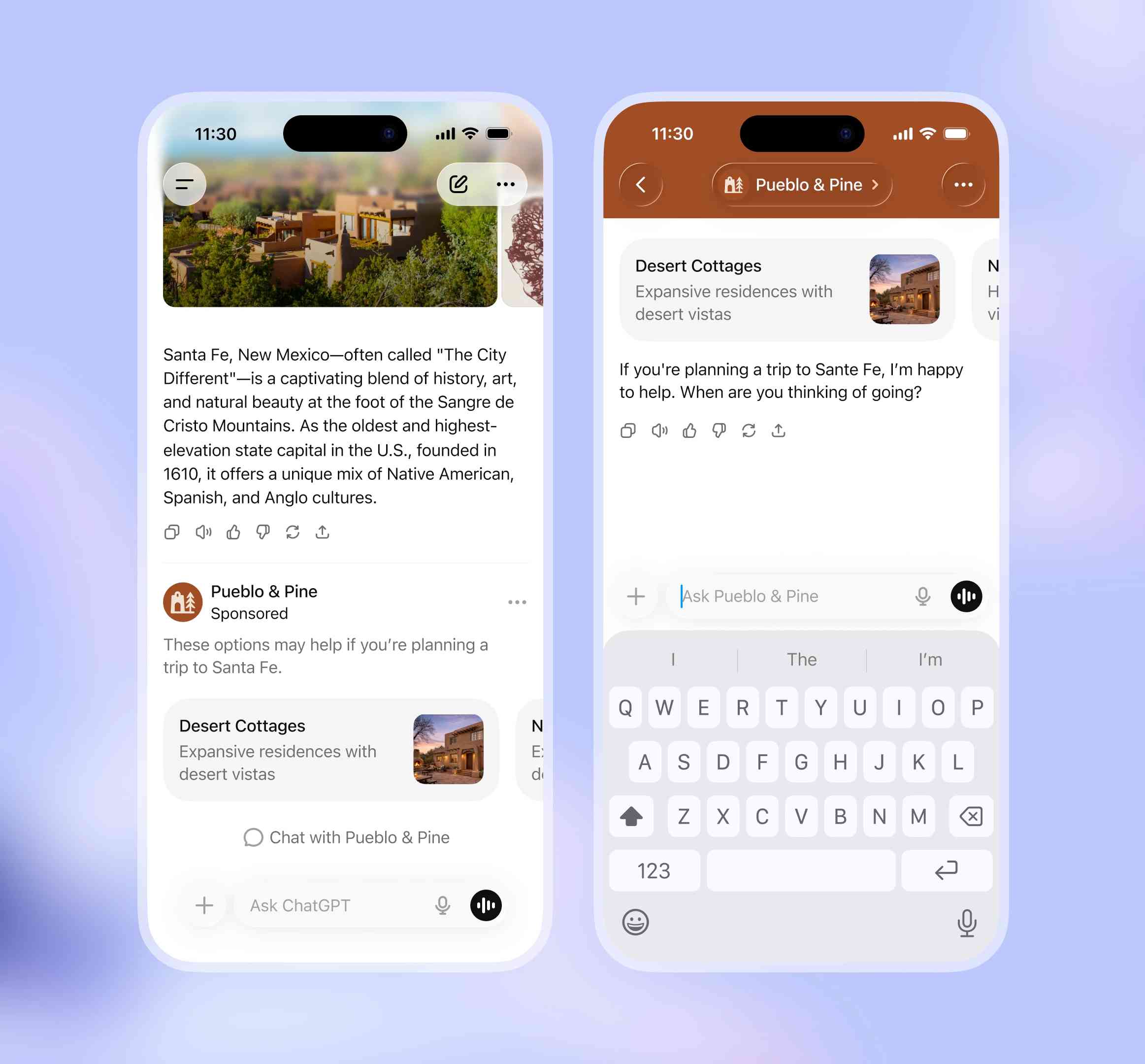
The user asks about trips to Santa Fe, and an ad shows up for a cottage rental business there. This particular example imagines an option to start a direct chat with a bot aligned with that advertiser, at which point presumably the advertiser can influence the answers all they like!
Jan. 17, 2026
[On agents using CLI tools in place of REST APIs] To save on context window, yes, but moreso to improve accuracy and success rate when multiple tool calls are involved, particularly when calls must be correctly chained e.g. for pagination, rate-limit backoff, and recognizing authentication failures.
Other major factor: which models can wield the skill? Using the CLI lowers the bar so cheap, fast models (gpt-5-nano, haiku-4.5) can reliably succeed. Using the raw APl is something only the costly "strong" models (gpt-5.2, opus-4.5) can manage, and it squeezes a ton of thinking/reasoning out of them, which means multiple turns/iterations, which means accumulating a ton of context, which means burning loads of expensive tokens. For one-off API requests and ad hoc usage driven by a developer, this is reasonable and even helpful, but for an autonomous agent doing repetitive work, it's a disaster.
— Jeremy Daer, 37signals
Jan. 18, 2026
FLUX.2-klein-4B Pure C Implementation (via) On 15th January Black Forest Labs, a lab formed by the creators of the original Stable Diffusion, released black-forest-labs/FLUX.2-klein-4B - an Apache 2.0 licensed 4 billion parameter version of their FLUX.2 family.
Salvatore Sanfilippo (antirez) decided to build a pure C and dependency-free implementation to run the model, with assistance from Claude Code and Claude Opus 4.5.
Salvatore shared this note on Hacker News:
Something that may be interesting for the reader of this thread: this project was possible only once I started to tell Opus that it needed to take a file with all the implementation notes, and also accumulating all the things we discovered during the development process. And also, the file had clear instructions to be taken updated, and to be processed ASAP after context compaction. This kinda enabled Opus to do such a big coding task in a reasonable amount of time without loosing track. Check the file IMPLEMENTATION_NOTES.md in the GitHub repo for more info.
Here's that IMPLEMENTATION_NOTES.md file.
Jan. 19, 2026
Scaling long-running autonomous coding. Wilson Lin at Cursor has been doing some experiments to see how far you can push a large fleet of "autonomous" coding agents:
This post describes what we've learned from running hundreds of concurrent agents on a single project, coordinating their work, and watching them write over a million lines of code and trillions of tokens.
They ended up running planners and sub-planners to create tasks, then having workers execute on those tasks - similar to how Claude Code uses sub-agents. Each cycle ended with a judge agent deciding if the project was completed or not.
In my predictions for 2026 the other day I said that by 2029:
I think somebody will have built a full web browser mostly using AI assistance, and it won’t even be surprising. Rolling a new web browser is one of the most complicated software projects I can imagine[...] the cheat code is the conformance suites. If there are existing tests that it’ll get so much easier.
I may have been off by three years, because Cursor chose "building a web browser from scratch" as their test case for their agent swarm approach:
To test this system, we pointed it at an ambitious goal: building a web browser from scratch. The agents ran for close to a week, writing over 1 million lines of code across 1,000 files. You can explore the source code on GitHub.
But how well did they do? Their initial announcement a couple of days ago was met with unsurprising skepticism, especially when it became apparent that their GitHub Actions CI was failing and there were no build instructions in the repo.
It looks like they addressed that within the past 24 hours. The latest README includes build instructions which I followed on macOS like this:
cd /tmp
git clone https://github.com/wilsonzlin/fastrender
cd fastrender
git submodule update --init vendor/ecma-rs
cargo run --release --features browser_ui --bin browser
This got me a working browser window! Here are screenshots I took of google.com and my own website:
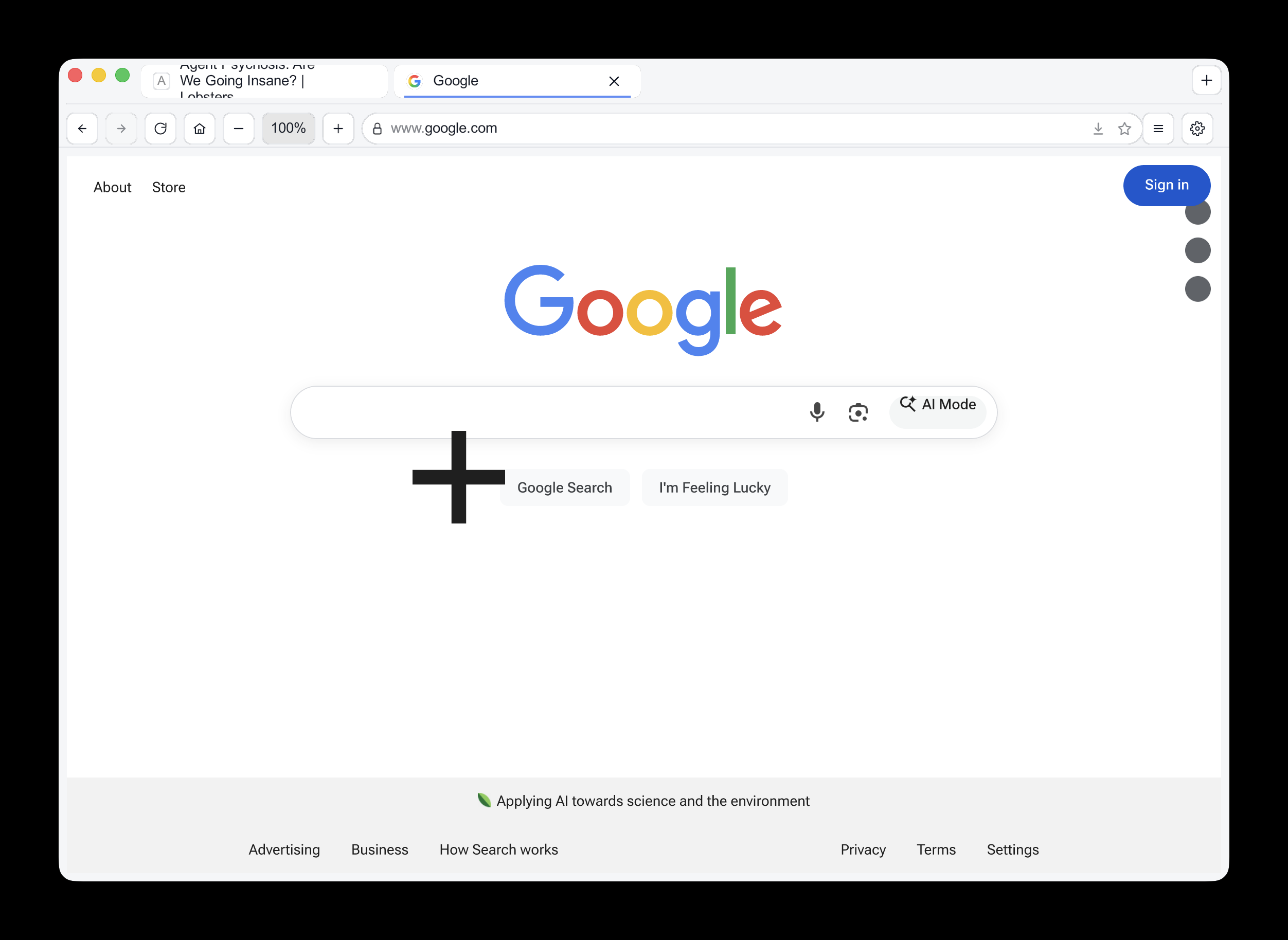
Honestly those are very impressive! You can tell they're not just wrapping an existing rendering engine because of those very obvious rendering glitches, but the pages are legible and look mostly correct.
The FastRender repo even uses Git submodules to include various WhatWG and CSS-WG specifications in the repo, which is a smart way to make sure the agents have access to the reference materials that they might need.
This is the second attempt I've seen at building a full web browser using AI-assisted coding in the past two weeks - the first was HiWave browser, a new browser engine in Rust first announced in this Reddit thread.
When I made my 2029 prediction this is more-or-less the quality of result I had in mind. I don't think we'll see projects of this nature compete with Chrome or Firefox or WebKit any time soon but I have to admit I'm very surprised to see something this capable emerge so quickly.
Update 23rd January 2026: I recorded a 47 minute conversation with Wilson about this project and published it on YouTube. Here's the video and accompanying highlights.
jordanhubbard/nanolang (via) Plenty of people have mused about what a new programming language specifically designed to be used by LLMs might look like. Jordan Hubbard (co-founder of FreeBSD, with serious stints at Apple and NVIDIA) just released exactly that.
A minimal, LLM-friendly programming language with mandatory testing and unambiguous syntax.
NanoLang transpiles to C for native performance while providing a clean, modern syntax optimized for both human readability and AI code generation.
The syntax strikes me as an interesting mix between C, Lisp and Rust.
I decided to see if an LLM could produce working code in it directly, given the necessary context. I started with this MEMORY.md file, which begins:
Purpose: This file is designed specifically for Large Language Model consumption. It contains the essential knowledge needed to generate, debug, and understand NanoLang code. Pair this with
spec.jsonfor complete language coverage.
I ran that using LLM and llm-anthropic like this:
llm -m claude-opus-4.5 \
  -s https://raw.githubusercontent.com/jordanhubbard/nanolang/refs/heads/main/MEMORY.md \
  'Build me a mandelbrot fractal CLI tool in this language'
  > /tmp/fractal.nano
The resulting code... did not compile.
I may have been too optimistic expecting a one-shot working program for a new language like this. So I ran a clone of the actual project, copied in my program and had Claude Code take a look at the failing compiler output.
... and it worked! Claude happily grepped its way through the various examples/ and built me a working program.
Here's the Claude Code transcript - you can see it reading relevant examples here - and here's the finished code plus its output.
I've suspected for a while that LLMs and coding agents might significantly reduce the friction involved in launching a new language. This result reinforces my opinion.
Jan. 20, 2026
Giving University Exams in the Age of Chatbots (via) Detailed and thoughtful description of an open-book and open-chatbot exam run by Ploum at École Polytechnique de Louvain for an "Open Source Strategies" class.
Students were told they could use chatbots during the exam but they had to announce their intention to do so in advance, share their prompts and take full accountability for any mistakes they made.
Only 3 out of 60 students chose to use chatbots. Ploum surveyed half of the class to help understand their motivations.
Electricity use of AI coding agents (via) Previous work estimating the energy and water cost of LLMs has generally focused on the cost per prompt using a consumer-level system such as ChatGPT.
Simon P. Couch notes that coding agents such as Claude Code use way more tokens in response to tasks, often burning through many thousands of tokens of many tool calls.
As a heavy Claude Code user, Simon estimates his own usage at the equivalent of 4,400 "typical queries" to an LLM, for an equivalent of around $15-$20 in daily API token spend. He figures that to be about the same as running a dishwasher once or the daily energy used by a domestic refrigerator.
Jan. 21, 2026
Claude’s new constitution. Late last year Richard Weiss found something interesting while poking around with the just-released Claude Opus 4.5: he was able to talk the model into regurgitating a document which was not part of the system prompt but appeared instead to be baked in during training, and which described Claude's core values at great length.
He called this leak the soul document, and Amanda Askell from Anthropic quickly confirmed that it was indeed part of Claude's training procedures.
Today Anthropic made this official, releasing that full "constitution" document under a CC0 (effectively public domain) license. There's a lot to absorb! It's over 35,000 tokens, more than 10x the length of the published Opus 4.5 system prompt.
One detail that caught my eye is the acknowledgements at the end, which include a list of external contributors who helped review the document. I was intrigued to note that two of the fifteen listed names are Catholic members of the clergy - Father Brendan McGuire is a pastor in Los Altos with a Master’s degree in Computer Science and Math and Bishop Paul Tighe is an Irish Catholic bishop with a background in moral theology.