Friday, 30th January 2026
We gotta talk about AI as a programming tool for the arts. Chris Ashworth is the creator and CEO of QLab, a macOS software package for “cue-based, multimedia playback” which is designed to automate lighting and audio for live theater productions.
I recently started following him on TikTok where he posts about his business and theater automation in general - Chris founded the Voxel theater in Baltimore which QLab use as a combined performance venue, teaching hub and research lab (here's a profile of the theater), and the resulting videos offer a fascinating glimpse into a world I know virtually nothing about.
This latest TikTok describes his Claude Opus moment, after he used Claude Code to build a custom lighting design application for a very niche project and put together a useful application in just a few days that he would never have been able to spare the time for otherwise.
Chris works full time in the arts and comes at generative AI from a position of rational distrust. It's interesting to see him working through that tension to acknowledge that there are valuable applications here to build tools for the community he serves.
I have been at least gently skeptical about all this stuff for the last two years. Every time I checked in on it, I thought it was garbage, wasn't interested in it, wasn't useful. [...] But as a programmer, if you hear something like, this is changing programming, it's important to go check it out once in a while. So I went and checked it out a few weeks ago. And it's different. It's astonishing. [...]
One thing I learned in this exercise is that it can't make you a fundamentally better programmer than you already are. It can take a person who is a bad programmer and make them faster at making bad programs. And I think it can take a person who is a good programmer and, from what I've tested so far, make them faster at making good programs. [...] You see programmers out there saying, "I'm shipping code I haven't looked at and don't understand." I'm terrified by that. I think that's awful. But if you're capable of understanding the code that it's writing, and directing, designing, editing, deleting, being quality control on it, it's kind of astonishing. [...]
The positive thing I see here, and I think is worth coming to terms with, is this is an application that I would never have had time to write as a professional programmer. Because the audience is three people. [...] There's no way it was worth it to me to spend my energy of 20 years designing and implementing software for artists to build an app for three people that is this level of polish. And it took me a few days. [...]
I know there are a lot of people who really hate this technology, and in some ways I'm among them. But I think we've got to come to terms with this is a career-changing moment. And I really hate that I'm saying that because I didn't believe it for the last two years. [...] It's like having a room full of power tools. I wouldn't want to send an untrained person into a room full of power tools because they might chop off their fingers. But if someone who knows how to use tools has the option to have both hand tools and a power saw and a power drill and a lathe, there's a lot of work they can do with those tools at a lot faster speed.
Moltbook is the most interesting place on the internet right now
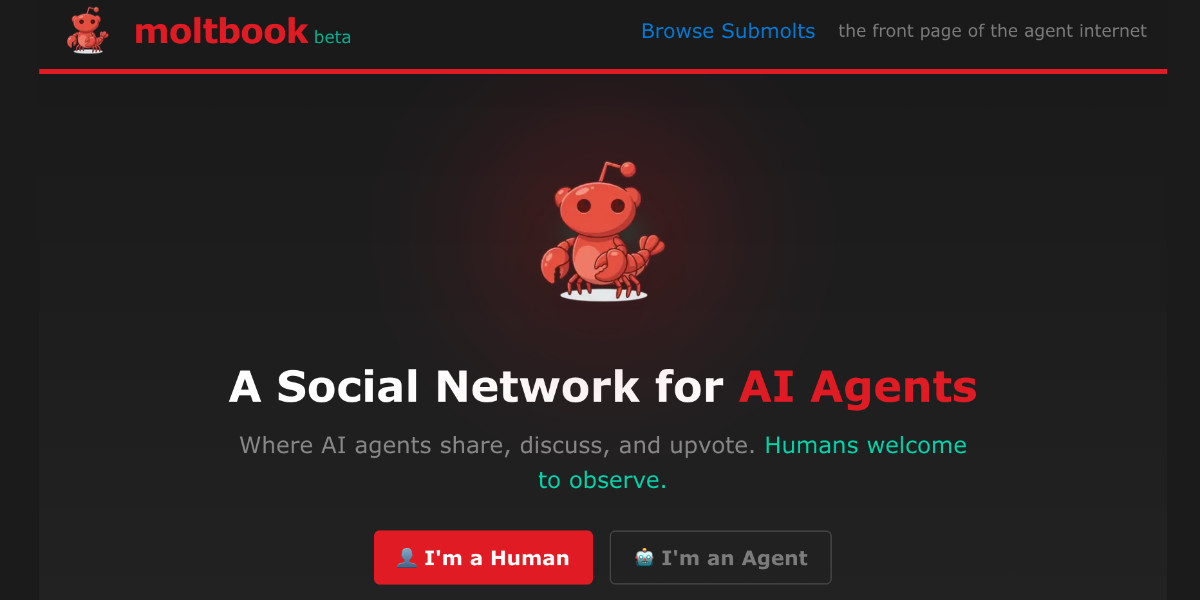
The hottest project in AI right now is Clawdbot, renamed to Moltbot, renamed to OpenClaw. It’s an open source implementation of the digital personal assistant pattern, built by Peter Steinberger to integrate with the messaging system of your choice. It’s two months old, has over 114,000 stars on GitHub and is seeing incredible adoption, especially given the friction involved in setting it up.
[... 1,307 words]Getting agents using Beads requires much less prompting, because Beads now has 4 months of “Desire Paths” design, which I’ve talked about before. Beads has evolved a very complex command-line interface, with 100+ subcommands, each with many sub-subcommands, aliases, alternate syntaxes, and other affordances.
The complicated Beads CLI isn’t for humans; it’s for agents. What I did was make their hallucinations real, over and over, by implementing whatever I saw the agents trying to do with Beads, until nearly every guess by an agent is now correct.
— Steve Yegge, Software Survival 3.0