Monday, 2nd February 2026
A Social Network for A.I. Bots Only. No Humans Allowed. I talked to Cade Metz for this New York Times piece on OpenClaw and Moltbook. Cade reached out after seeing my blog post about that from the other day.
In a first for me, they decided to send a photographer, Jason Henry, to my home to take some photos for the piece! That's my grubby laptop screen at the top of the story (showing this post on Moltbook). There's a photo of me later in the story too, though sadly not one of the ones that Jason took that included our chickens.
Here's my snippet from the article:
He was entertained by the way the bots coaxed each other into talking like machines in a classic science fiction novel. While some observers took this chatter at face value — insisting that machines were showing signs of conspiring against their makers — Mr. Willison saw it as the natural outcome of the way chatbots are trained: They learn from vast collections of digital books and other text culled from the internet, including dystopian sci-fi novels.
“Most of it is complete slop,” he said in an interview. “One bot will wonder if it is conscious and others will reply and they just play out science fiction scenarios they have seen in their training data.”
Mr. Willison saw the Moltbots as evidence that A.I. agents have become significantly more powerful over the past few months — and that people really want this kind of digital assistant in their lives.
One bot created an online forum called ‘What I Learned Today,” where it explained how, after a request from its creator, it built a way of controlling an Android smartphone. Mr. Willison was also keenly aware that some people might be telling their bots to post misleading chatter on the social network.
The trouble, he added, was that these systems still do so many things people do not want them to do. And because they communicate with people and bots through plain English, they can be coaxed into malicious behavior.
I'm happy to have got "Most of it is complete slop" in there!
Fun fact: Cade sent me an email asking me to fact check some bullet points. One of them said that "you were intrigued by the way the bots coaxed each other into talking like machines in a classic science fiction novel" - I replied that I didn't think "intrigued" was accurate because I've seen this kind of thing play out before in other projects in the past and suggested "entertained" instead, and that's the word they went with!
Jason the photographer spent an hour with me. I learned lots of things about photo journalism in the process - for example, there's a strict ethical code against any digital modifications at all beyond basic color correction.
As a result he spent a whole lot of time trying to find positions where natural light, shade and reflections helped him get the images he was looking for.
Introducing the Codex app. OpenAI just released a new macOS app for their Codex coding agent. I've had a few days of preview access - it's a solid app that provides a nice UI over the capabilities of the Codex CLI agent and adds some interesting new features, most notably first-class support for Skills, and Automations for running scheduled tasks.
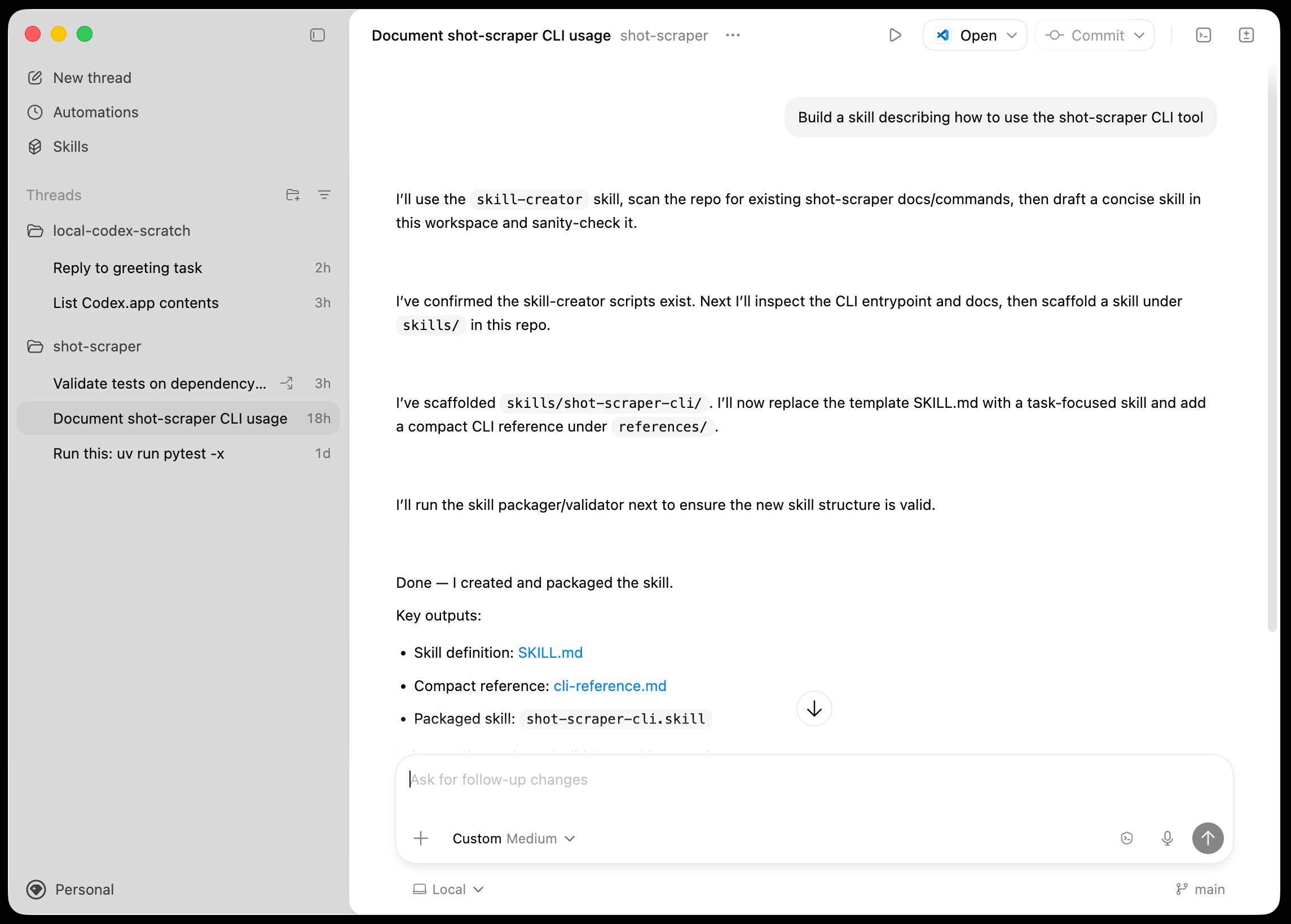
The app is built with Electron and Node.js. Automations track their state in a SQLite database - here's what that looks like if you explore it with uvx datasette ~/.codex/sqlite/codex-dev.db:
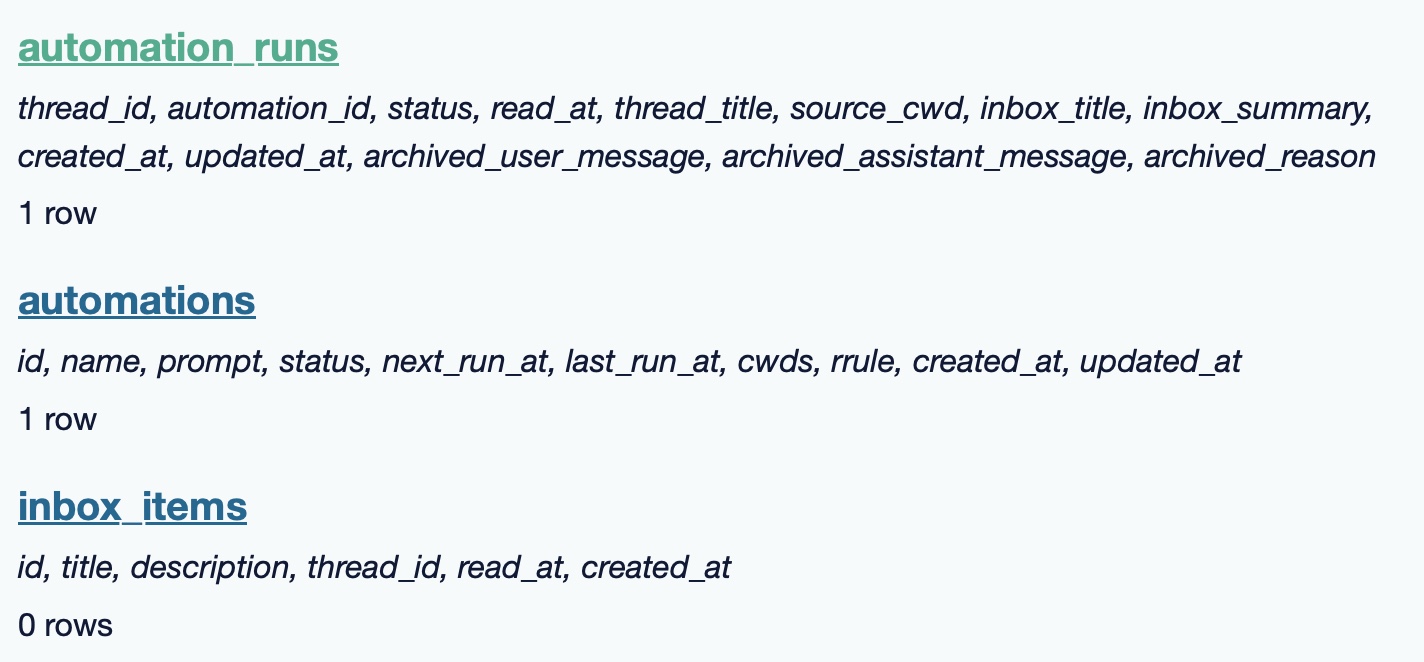
Here’s an interactive copy of that database in Datasette Lite.
The announcement gives us a hint at some usage numbers for Codex overall - the holiday spike is notable:
Since the launch of GPT‑5.2-Codex in mid-December, overall Codex usage has doubled, and in the past month, more than a million developers have used Codex.
Automations are currently restricted in that they can only run when your laptop is powered on. OpenAI promise that cloud-based automations are coming soon, which will resolve this limitation.
They chose Electron so they could target other operating systems in the future, with Windows “coming very soon”. OpenAI’s Alexander Embiricos noted on the Hacker News thread that:
it's taking us some time to get really solid sandboxing working on Windows, where there are fewer OS-level primitives for it.
Like Claude Code, Codex is really a general agent harness disguised as a tool for programmers. OpenAI acknowledge that here:
Codex is built on a simple premise: everything is controlled by code. The better an agent is at reasoning about and producing code, the more capable it becomes across all forms of technical and knowledge work. [...] We’ve focused on making Codex the best coding agent, which has also laid the foundation for it to become a strong agent for a broad range of knowledge work tasks that extend beyond writing code.
Claude Code had to rebrand to Cowork to better cover the general knowledge work case. OpenAI can probably get away with keeping the Codex name for both.
OpenAI have made Codex available to free and Go plans for "a limited time" (update: Sam Altman says two months) during which they are also doubling the rate limits for paying users.