Tuesday, 30th December 2025
In essence a language model changes you from a programmer who writes lines of code, to a programmer that manages the context the model has access to, prunes irrelevant things, adds useful material to context, and writes detailed specifications. If that doesn't sound fun to you, you won't enjoy it.
Think about it as if it is a junior developer that has read every textbook in the world but has 0 practical experience with your specific codebase, and is prone to forgetting anything but the most recent hour of things you've told it. What do you want to tell that intern to help them progress?
Eg you might put sticky notes on their desk to remind them of where your style guide lives, what the API documentation is for the APIs you use, some checklists of what is done and what is left to do, etc.
But the intern gets confused easily if it keeps accumulating sticky notes and there are now 100 sticky notes, so you have to periodically clear out irrelevant stickies and replace them with new stickies.
— Liz Fong-Jones, thread on Bluesky
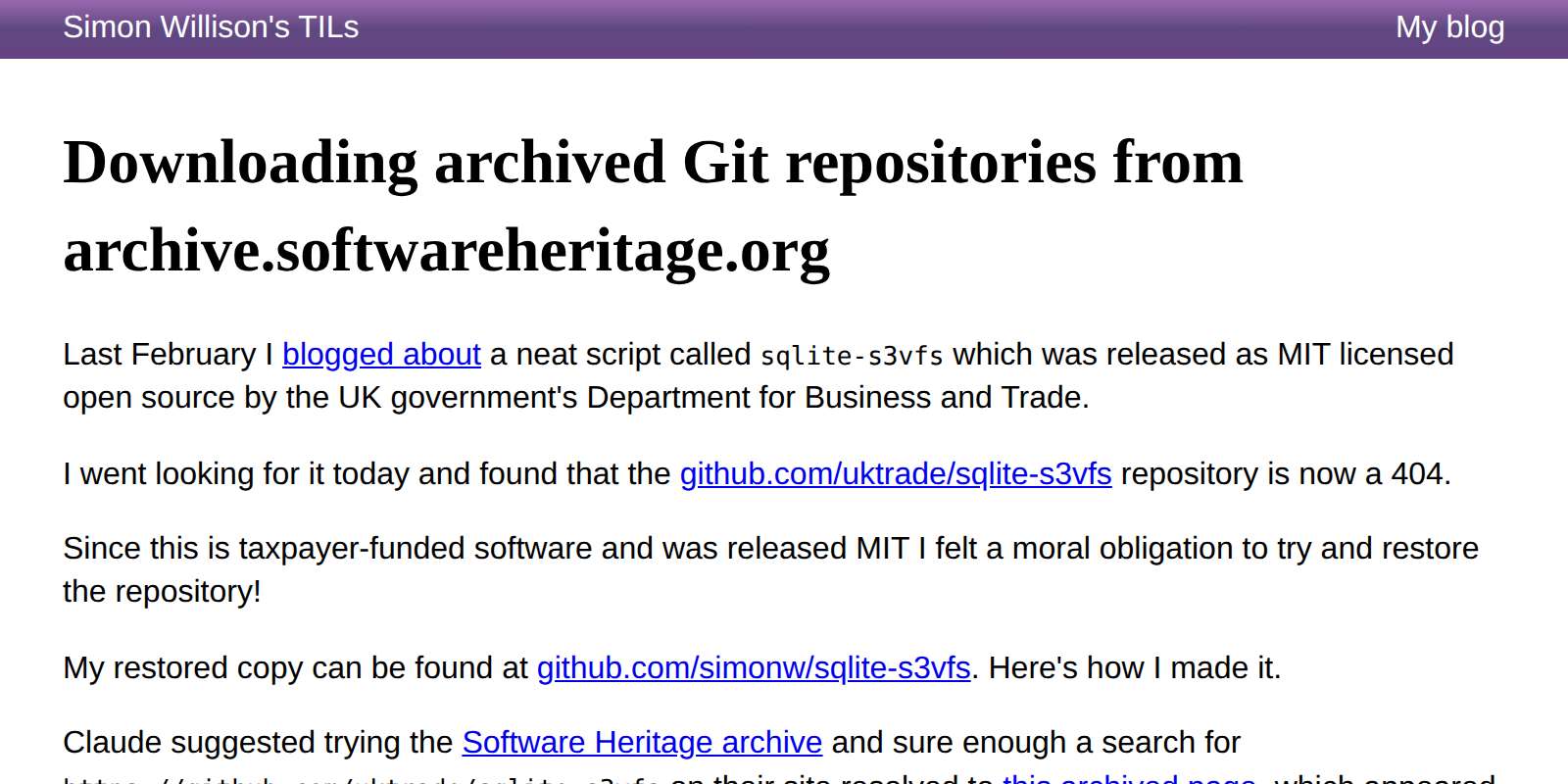
TIL: Downloading archived Git repositories from archive.softwareheritage.org
(via)
Back in February I blogged about a neat Python library called sqlite-s3vfs for accessing SQLite databases hosted in an S3 bucket, released as MIT licensed open source by the UK government's Department for Business and Trade.
I went looking for it today and found that the github.com/uktrade/sqlite-s3vfs repository is now a 404.
Since this is taxpayer-funded open source software I saw it as my moral duty to try and restore access! It turns out a full copy had been captured by the Software Heritage archive, so I was able to restore the repository from there. My copy is now archived at simonw/sqlite-s3vfs.
The process for retrieving an archive was non-obvious, so I've written up a TIL and also published a new Software Heritage Repository Retriever tool which takes advantage of the CORS-enabled APIs provided by Software Heritage. Here's the Claude Code transcript from building that.
[...] The puzzle is still there. What’s gone is the labor. I never enjoyed hitting keys, writing minimal repro cases with little insight, digging through debug logs, or trying to decipher some obscure AWS IAM permission error. That work wasn’t the puzzle for me. It was just friction, laborious and frustrating. The thinking remains; the hitting of the keys and the frustrating is what’s been removed.