Friday, 5th December 2025
The Resonant Computing Manifesto. Launched today at WIRED’s The Big Interview event, this manifesto (of which I'm a founding signatory) encourages a positive framework for thinking about building hyper-personalized AI-powered software - while avoiding the attention hijacking anti-patterns that defined so much of the last decade of software design.
This part in particular resonates with me:
For decades, technology has required standardized solutions to complex human problems. In order to scale software, you had to build for the average user, sanding away the edge cases. In many ways, this is why our digital world has come to resemble the sterile, deadening architecture that Alexander spent his career pushing back against.
This is where AI provides a missing puzzle piece. Software can now respond fluidly to the context and particularity of each human—at scale. One-size-fits-all is no longer a technological or economic necessity. Where once our digital environments inevitably shaped us against our will, we can now build technology that adaptively shapes itself in service of our individual and collective aspirations.
There are echos here of the Malleable software concept from Ink & Switch.
The manifesto proposes five principles for building resonant software: Keeping data private and under personal stewardship, building software that's dedicated to the user's interests, ensuring plural and distributed control rather than platform monopolies, making tools adaptable to individual context, and designing for prosocial membership of shared spaces.
Steven Levy talked to the manifesto's lead instigator Alex Komoroske and provides some extra flavor in It's Time to Save Silicon Valley From Itself:
By 2025, it was clear to Komoroske and his cohort that Big Tech had strayed far from its early idealistic principles. As Silicon Valley began to align itself more strongly with political interests, the idea emerged within the group to lay out a different course, and a casual suggestion led to a process where some in the group began drafting what became today’s manifesto. They chose the word “resonant” to describe their vision mainly because of its positive connotations. As the document explains, “It’s the experience of encountering something that speaks to our deeper values.”
Thoughts on Go vs. Rust vs. Zig (via) Thoughtful commentary on Go, Rust, and Zig by Sinclair Target. I haven't seen a single comparison that covers all three before and I learned a lot from reading this.
One thing that I hadn't noticed before is that none of these three languages implement class-based OOP.
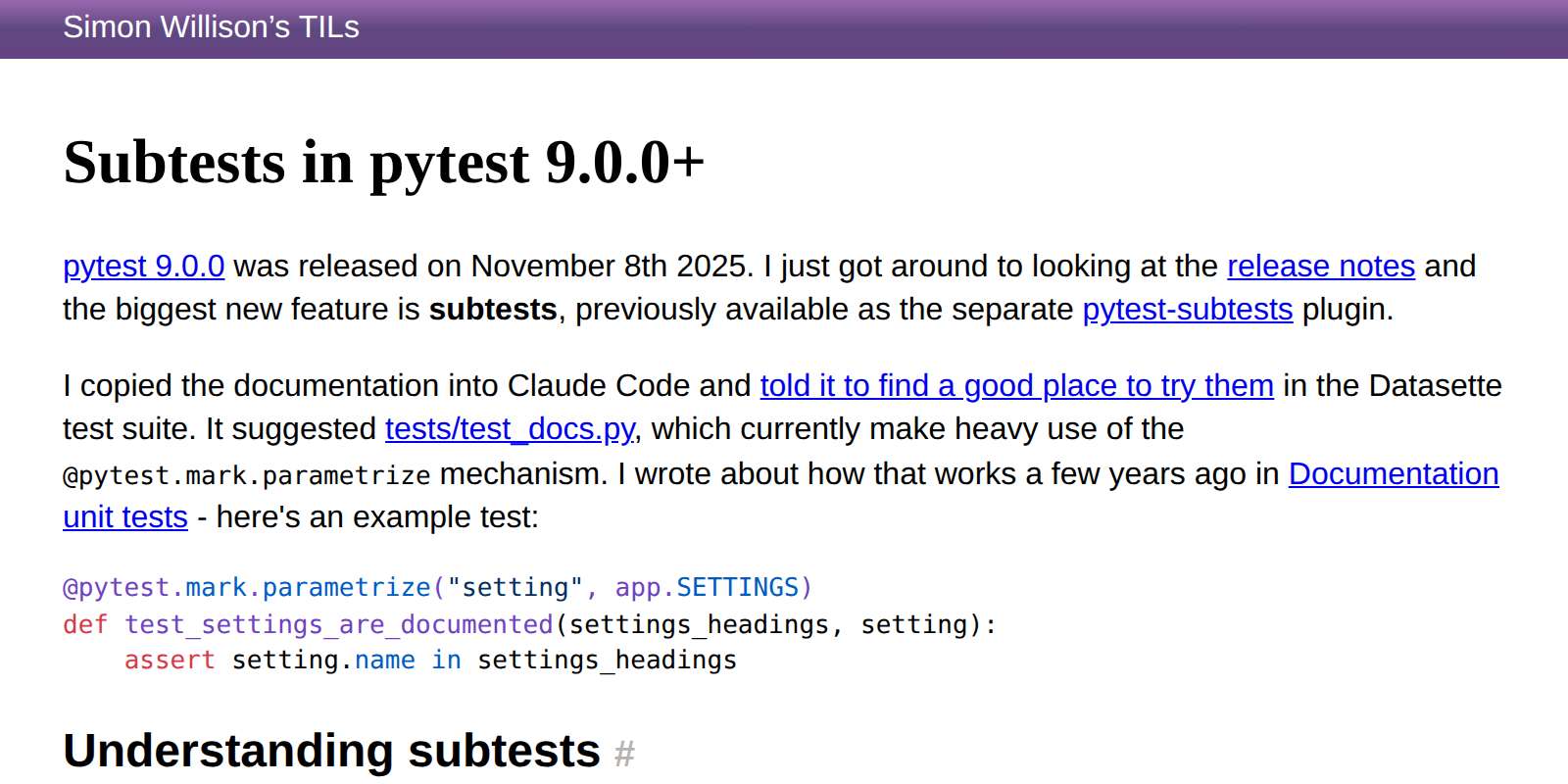
TIL: Subtests in pytest 9.0.0+. I spotted an interesting new feature in the release notes for pytest 9.0.0: subtests.
I'm a big user of the pytest.mark.parametrize decorator - see Documentation unit tests from 2018 - so I thought it would be interesting to try out subtests and see if they're a useful alternative.
Short version: this parameterized test:
@pytest.mark.parametrize("setting", app.SETTINGS)
def test_settings_are_documented(settings_headings, setting):
    assert setting.name in settings_headings
Becomes this using subtests instead:
def test_settings_are_documented(settings_headings, subtests):
    for setting in app.SETTINGS:
        with subtests.test(setting=setting.name):
            assert setting.name in settings_headings
Why is this better? Two reasons:
- It appears to run a bit faster
- Subtests can be created programatically after running some setup code first
I had Claude Code port several tests to the new pattern. I like it.