Tuesday, 4th August 2026
Gas Town was intended to be reusable, but I only ever wound up using it to build itself. Gas Town fell apart at the seams with Opus 4.7. Up through 4.6 it was working brilliantly. With 4.7 we saw the introduction of the "just two more things" tic, which prevented Opus from ever converging on being ready to do real work—it always wanted to fiddle with Gas Town itself. The Opus tic never went away, so Gas Town effectively burned down. It had other problems, too, but 4.7 was the final straw.
— Steve Yegge, The Shape of Things to Come
PipeNetwork/minimax-h3-mlx. MiniMax released MiniMax-H3 two days ago - they describe it as a "a general-purpose, omni-modal generative system", which in practice means it accepts text, images, audio and video and can use them to generate up to 15 second video clips with audio included.
This Python package ports it to MLX for running on Apple Silicon.
I got it running on my M5 Max MacBook Pro. I cloned the repo and ran the model like this:
# First download the models
uvx --from huggingface_hub hf download MiniMaxAI/MiniMax-H3 \
  --include 'FL2VA/*' --exclude 'FL2VA/transformer/*'
uvx --from huggingface_hub hf download pipenetwork/MiniMax-H3-MLX-8bit

# Now run the prompt
uv run --with mlx-vlm \
  --with-requirements requirements.txt python scripts/generate.py \
  "a rainbow colored skunk leaps over a mossy log in a supermarket" \
  -o skunk.mp4 \
  -c ~/.cache/huggingface/hub/models--MiniMaxAI--MiniMax-H3/snapshots/fa9c8ab1eaa21c8ae25e7e40b83b2e6002f340af/FL2VA \
  -t ~/.cache/huggingface/hub/models--pipenetwork--MiniMax-H3-MLX-8bit/snapshots/3ac52081470b0488921c3ec3ba84a39097bf2361
Here's the video I got for the prompt:
a rainbow colored skunk leaps over a mossy log in a supermarket
It downloaded ~115 GB of model files, and the video generation took just under 45 minutes.
The video is impressive, but the audio is weird speech-like garbage, because I didn't provide any prompt guidance as to what the audio should be. The prompting guide (which I didn't read prior to this experiment) has a whole bunch of information on how to get this to work.
Includes new features enabled by LLM 0.32:
- New models:
claude-fable-5,claude-sonnet-5, andclaude-opus-5. #75, #76- Added server-side tools for
WebSearch,WebFetch,CodeExecution, andAnthropicMCP, available through LLM's-Tinterface or Pythontools=. The previous-o web_search*options have been removed in favor of-T WebSearch. #79- Upgraded to llm>=0.32. Reasoning, tool calls, tool results, and server-side tool results now stream as typed events. Reasoning for
llmCLI prompts now displays to standard error unless you pass--hide-reasoning/-R.- Simplified extended thinking to
thinkingandthinking_effort(low,medium,high,xhigh, ormax). Claude 5 models think by default;-o thinking 0disables thinking for Sonnet 5 and Opus 5, while Fable 5 always thinks.-R/--hide-reasoningnow omits reasoning from responses and logs. Thethinking_budget,thinking_display, andthinking_adaptiveoptions have been removed. #80
New release of LLM adds support for reasoning traces, OpenAI Responses, server-side tools, and smarter logging
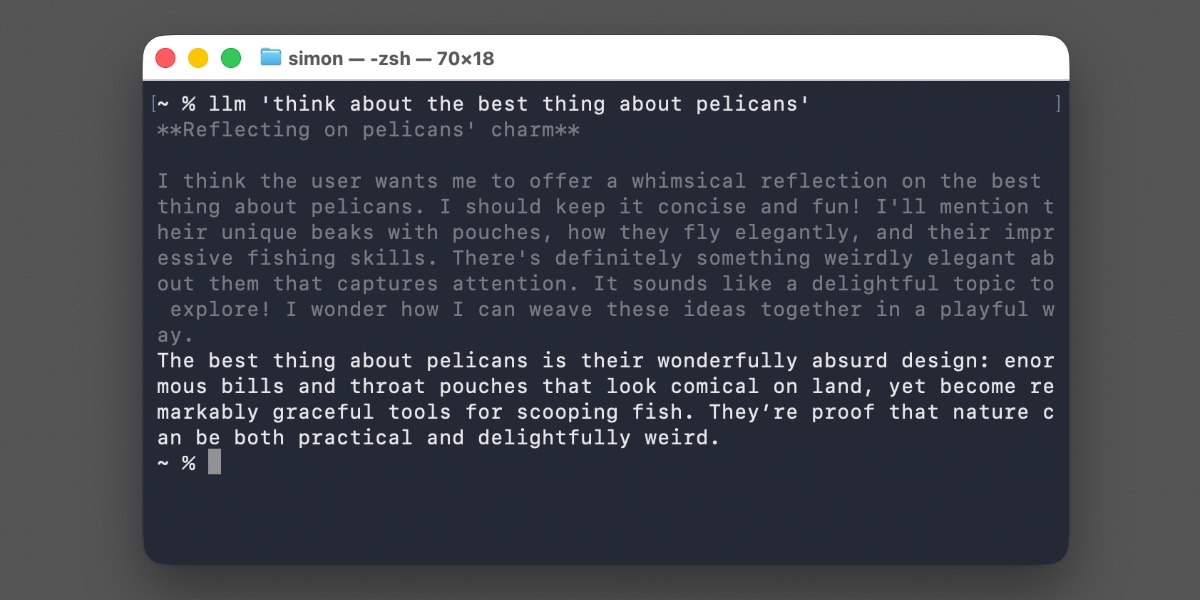
I released LLM 0.32 this morning, the most significant new version of LLM since the initial launch of the project. The new version includes support for visible reasoning traces, server-side provider tools, redesigned content-addressable SQLite logs, new models, and new features enabled by the OpenAI Responses API. I also released a new version of the llm-anthropic plugin with substantial updates of its own.
[... 1,230 words]