4 posts tagged “browser-challenge”
Attempts to create a web browser - or at the very least an HTML+CSS renderer - using assistance from coding agents.
2026
One Human + One Agent = One Browser From Scratch (via) embedding-shapes was so infuriated by the hype around Cursor's FastRender browser project - thousands of parallel agents producing ~1.6 million lines of Rust - that they were inspired to take a go at building a web browser using coding agents themselves.
The result is one-agent-one-browser and it's really impressive. Over three days they drove a single Codex CLI agent to build 20,000 lines of Rust that successfully renders HTML+CSS with no Rust crate dependencies at all - though it does (reasonably) use Windows, macOS and Linux system frameworks for image and text rendering.
I installed the 1MB macOS binary release and ran it against my blog:
chmod 755 ~/Downloads/one-agent-one-browser-macOS-ARM64
~/Downloads/one-agent-one-browser-macOS-ARM64 https://simonwillison.net/
Here's the result:
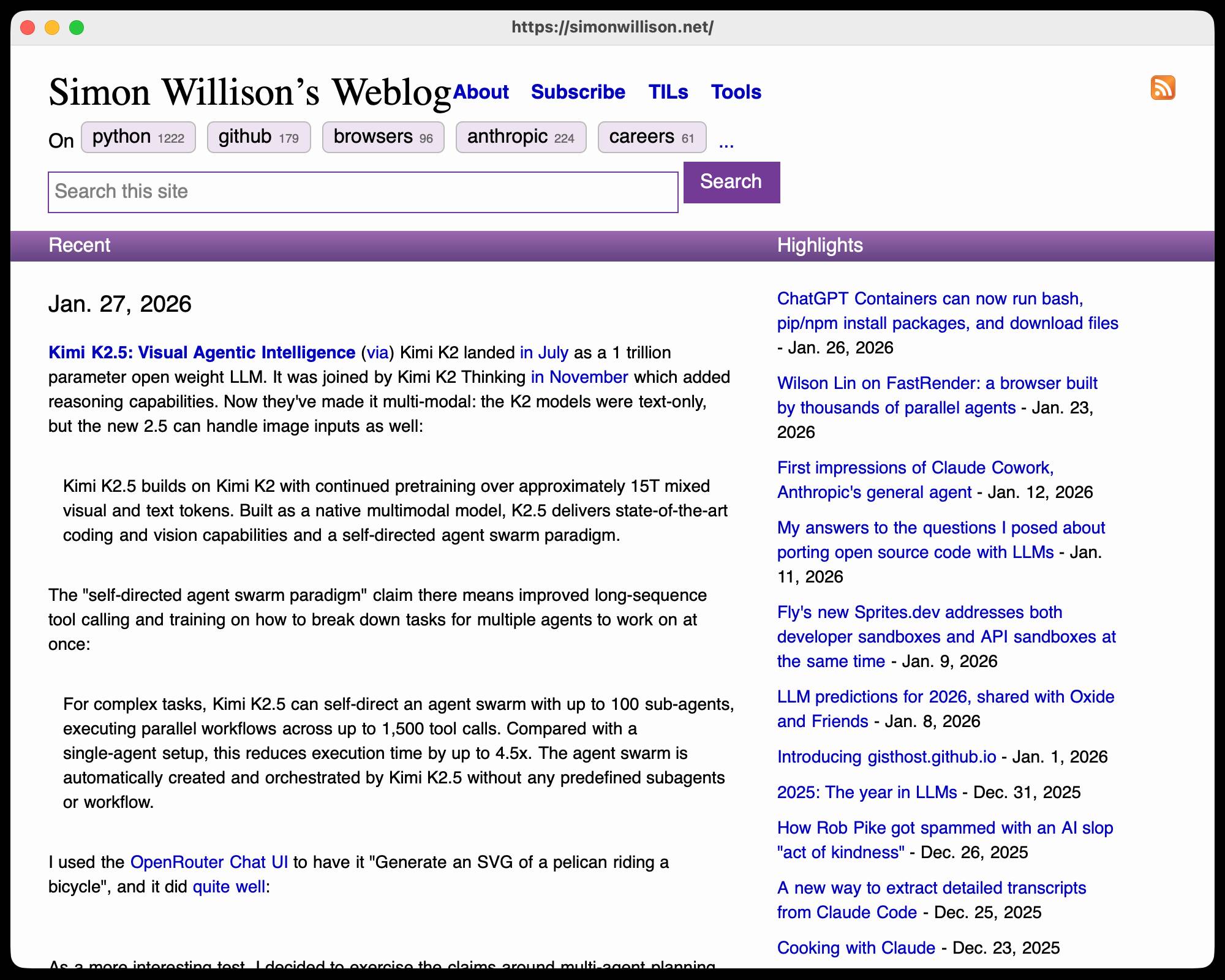
It even rendered my SVG feed subscription icon! A PNG image is missing from the page, which looks like an intermittent bug (there's code to render PNGs).
The code is pretty readable too - here's the flexbox implementation.
I had thought that "build a web browser" was the ideal prompt to really stretch the capabilities of coding agents - and that it would take sophisticated multi-agent harnesses (as seen in the Cursor project) and millions of lines of code to achieve.
Turns out one agent driven by a talented engineer, three days and 20,000 lines of Rust is enough to get a very solid basic renderer working!
I'm going to upgrade my prediction for 2029: I think we're going to get a production-grade web browser built by a small team using AI assistance by then.
Wilson Lin on FastRender: a browser built by thousands of parallel agents
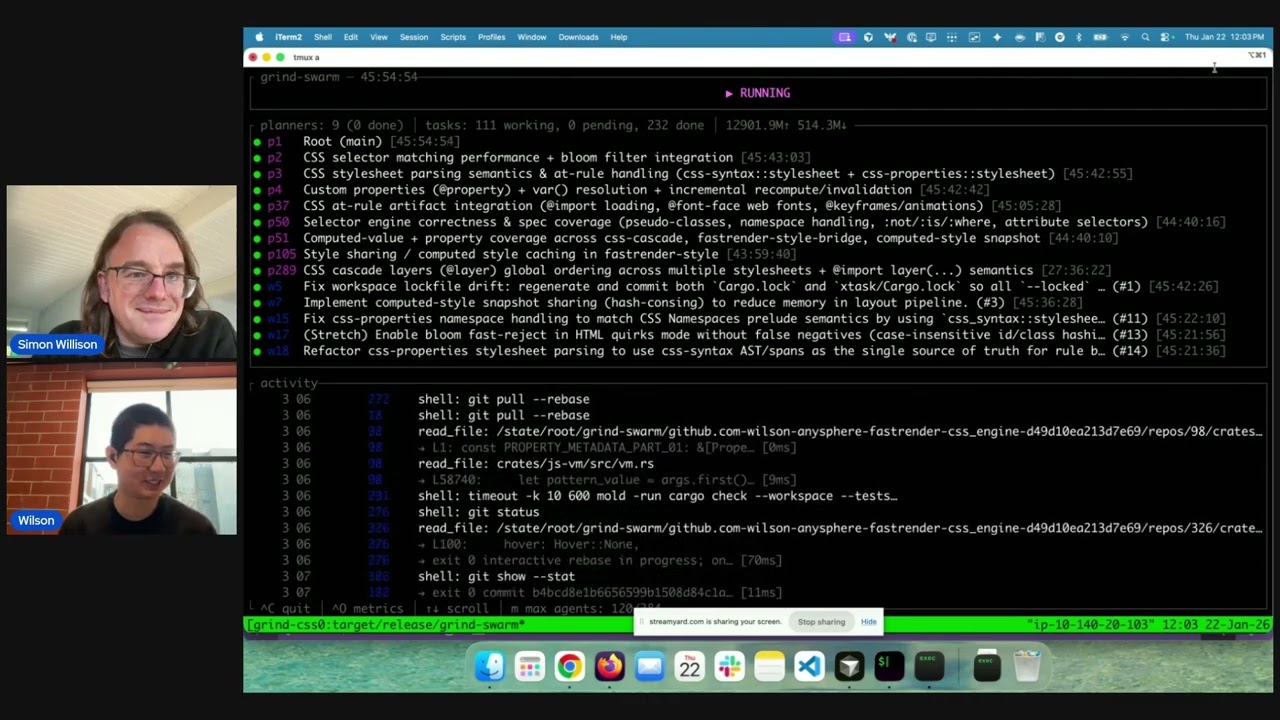
Last week Cursor published Scaling long-running autonomous coding, an article describing their research efforts into coordinating large numbers of autonomous coding agents. One of the projects mentioned in the article was FastRender, a web browser they built from scratch using their agent swarms. I wanted to learn more so I asked Wilson Lin, the engineer behind FastRender, if we could record a conversation about the project. That 47 minute video is now available on YouTube. I’ve included some of the highlights below.
[... 2,243 words]Scaling long-running autonomous coding. Wilson Lin at Cursor has been doing some experiments to see how far you can push a large fleet of "autonomous" coding agents:
This post describes what we've learned from running hundreds of concurrent agents on a single project, coordinating their work, and watching them write over a million lines of code and trillions of tokens.
They ended up running planners and sub-planners to create tasks, then having workers execute on those tasks - similar to how Claude Code uses sub-agents. Each cycle ended with a judge agent deciding if the project was completed or not.
In my predictions for 2026 the other day I said that by 2029:
I think somebody will have built a full web browser mostly using AI assistance, and it won’t even be surprising. Rolling a new web browser is one of the most complicated software projects I can imagine[...] the cheat code is the conformance suites. If there are existing tests that it’ll get so much easier.
I may have been off by three years, because Cursor chose "building a web browser from scratch" as their test case for their agent swarm approach:
To test this system, we pointed it at an ambitious goal: building a web browser from scratch. The agents ran for close to a week, writing over 1 million lines of code across 1,000 files. You can explore the source code on GitHub.
But how well did they do? Their initial announcement a couple of days ago was met with unsurprising skepticism, especially when it became apparent that their GitHub Actions CI was failing and there were no build instructions in the repo.
It looks like they addressed that within the past 24 hours. The latest README includes build instructions which I followed on macOS like this:
cd /tmp
git clone https://github.com/wilsonzlin/fastrender
cd fastrender
git submodule update --init vendor/ecma-rs
cargo run --release --features browser_ui --bin browser
This got me a working browser window! Here are screenshots I took of google.com and my own website:
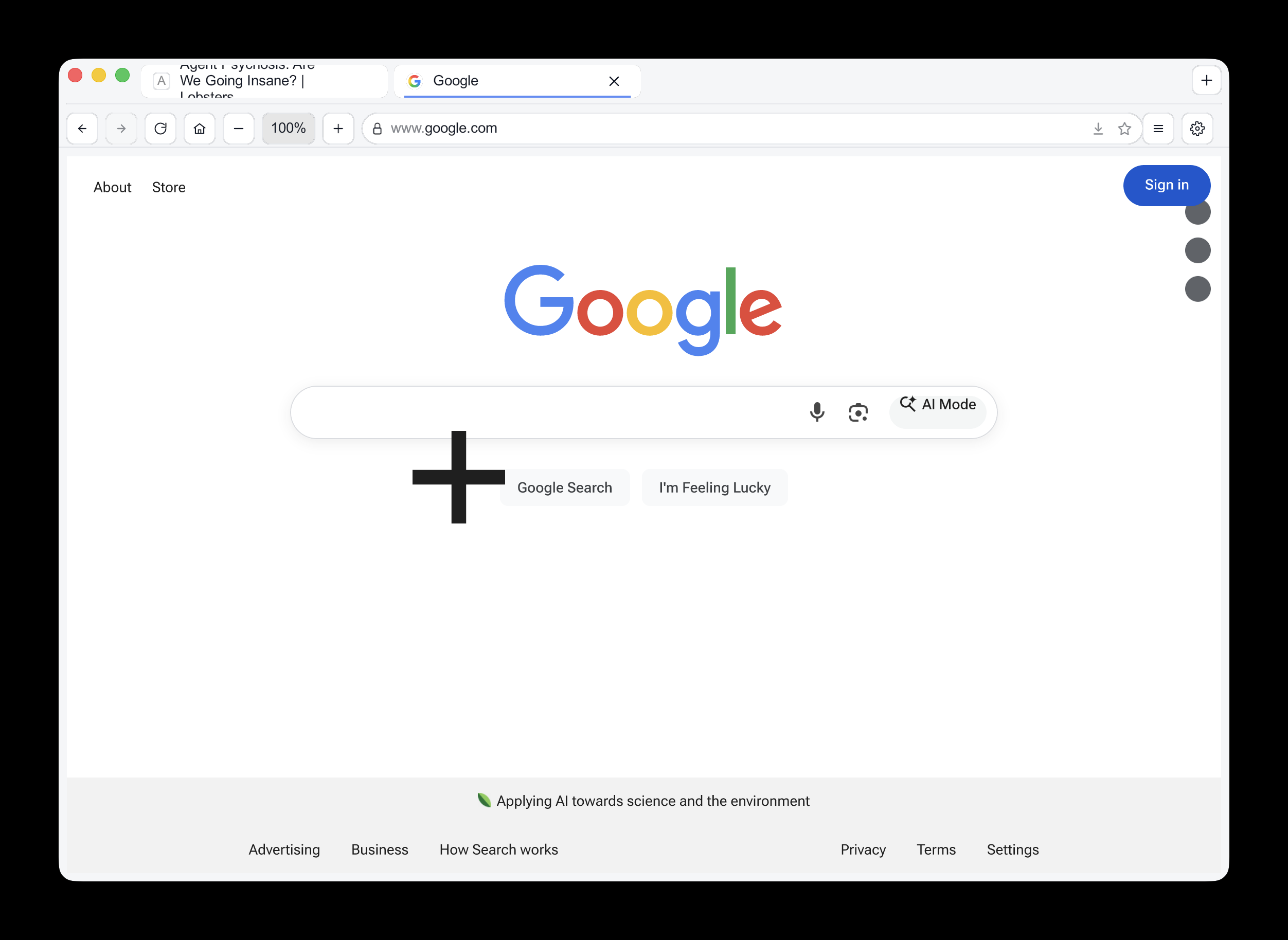
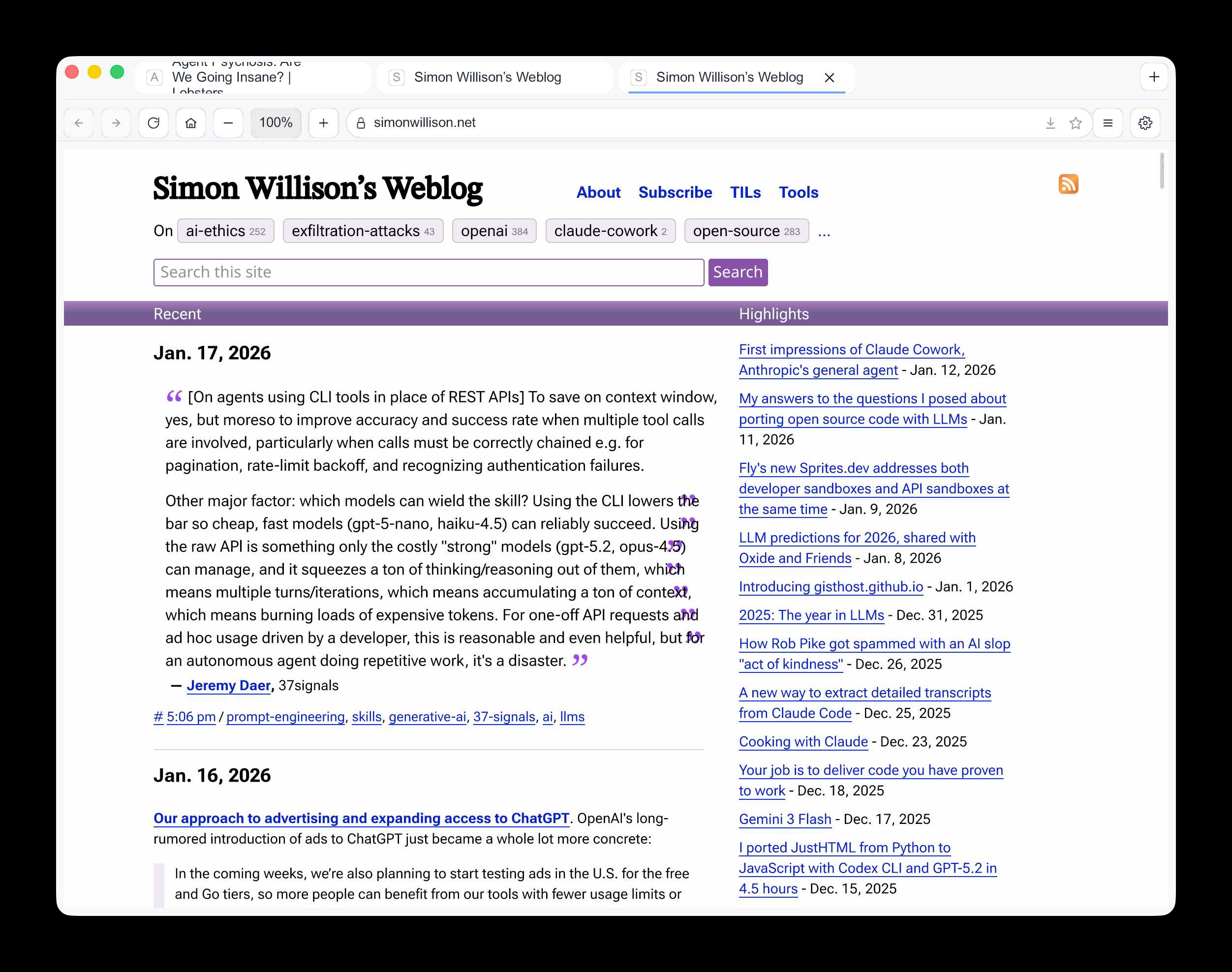
Honestly those are very impressive! You can tell they're not just wrapping an existing rendering engine because of those very obvious rendering glitches, but the pages are legible and look mostly correct.
The FastRender repo even uses Git submodules to include various WhatWG and CSS-WG specifications in the repo, which is a smart way to make sure the agents have access to the reference materials that they might need.
This is the second attempt I've seen at building a full web browser using AI-assisted coding in the past two weeks - the first was HiWave browser, a new browser engine in Rust first announced in this Reddit thread.
When I made my 2029 prediction this is more-or-less the quality of result I had in mind. I don't think we'll see projects of this nature compete with Chrome or Firefox or WebKit any time soon but I have to admit I'm very surprised to see something this capable emerge so quickly.
Update 23rd January 2026: I recorded a 47 minute conversation with Wilson about this project and published it on YouTube. Here's the video and accompanying highlights.
LLM predictions for 2026, shared with Oxide and Friends

I joined a recording of the Oxide and Friends podcast on Tuesday to talk about 1, 3 and 6 year predictions for the tech industry. This is my second appearance on their annual predictions episode, you can see my predictions from January 2025 here. Here’s the page for this year’s episode, with options to listen in all of your favorite podcast apps or directly on YouTube.
[... 1,773 words]