4th October 2025 - Link Blog
Let the LLM Write the Prompts: An Intro to DSPy in Compound Al Pipelines. I've had trouble getting my head around DSPy in the past. This half hour talk by Drew Breunig at the recent Databricks Data + AI Summit is the clearest explanation I've seen yet of the kinds of problems it can help solve.
Here's Drew's written version of the talk.
Drew works on Overture Maps, which combines Point Of Interest data from numerous providers to create a single unified POI database. This is an example of conflation, a notoriously difficult task in GIS where multiple datasets are deduped and merged together.
Drew uses an inexpensive local model, Qwen3-0.6B, to compare 70 million addresses and identity matches, for example between Place(address="3359 FOOTHILL BLVD", name="RESTAURANT LOS ARCOS") and Place(address="3359 FOOTHILL BLVD", name="Los Arcos Taqueria"').
DSPy's role is to optimize the prompt used for that smaller model. Drew used GPT-4.1 and the dspy.MIPROv2 optimizer, producing a 700 token prompt that increased the score from 60.7% to 82%.
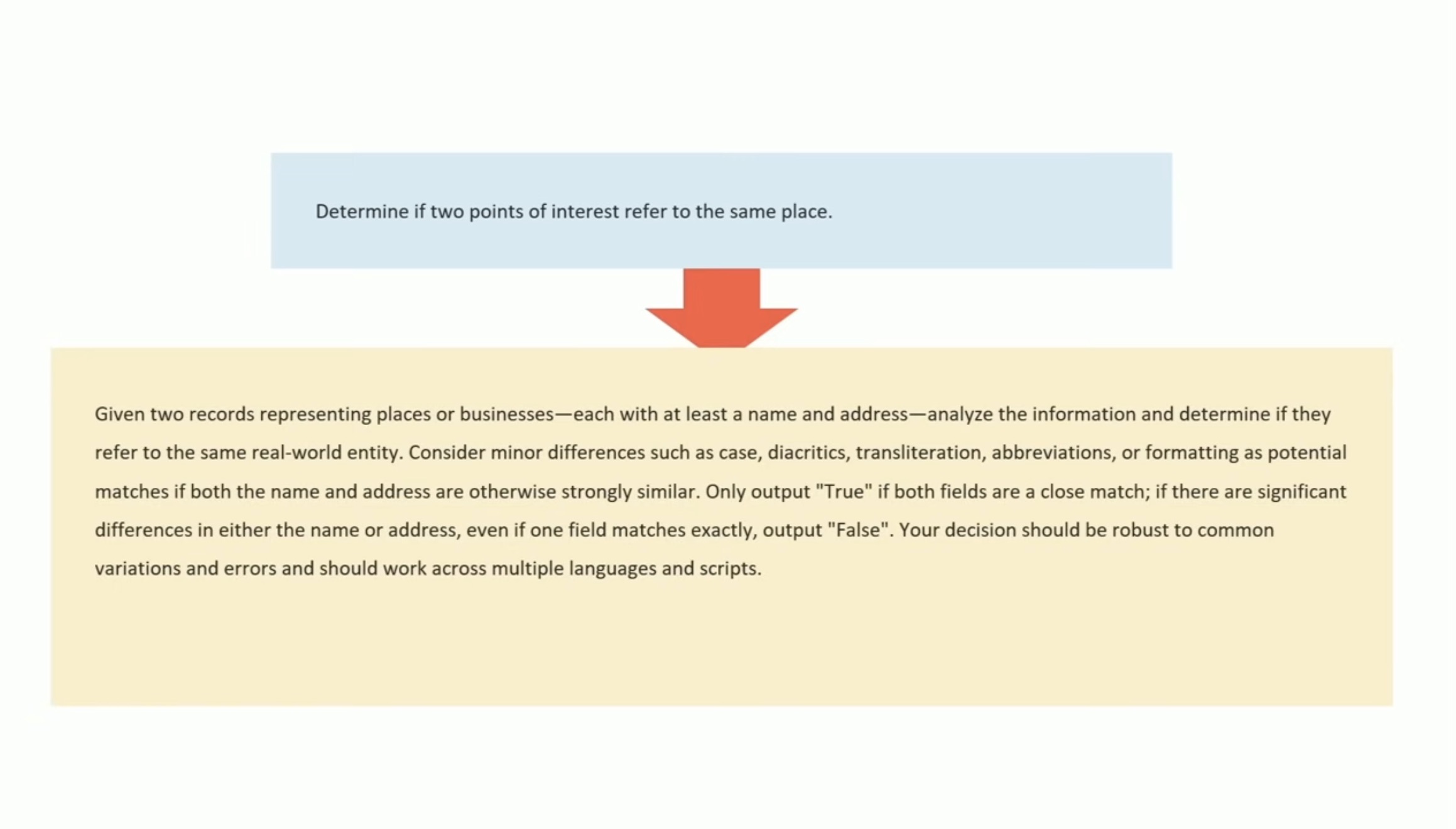
Why bother? Drew points out that having a prompt optimization pipeline makes it trivial to evaluate and switch to other models if they can score higher with a custom optimized prompt - without needing to execute that trial-and-error optimization by hand.
Recent articles
- Highlights from my conversation about agentic engineering on Lenny's Podcast - 2nd April 2026
- Mr. Chatterbox is a (weak) Victorian-era ethically trained model you can run on your own computer - 30th March 2026
- Vibe coding SwiftUI apps is a lot of fun - 27th March 2026