Simon Willison’s Weblog

Newsletter

18th November 2026

Release llm-gemini 0.38 — LLM plugin to access Google's Gemini family of models

Today Google introduced Gemini 4 Neon. I wrote recently about how confusing the pricing for the Gemini 4 series was - Neon has somehow made this even worse.

Previously the Gemini 4 lineup was Hydrogen, Argon, and Carbon - where Argon and Carbon were the same price, and Hydrogen was 3/4 of that price now but will be 1/4 of that price when the other two double an 1st December once their initial discount pricing expires.

The Neon announcement pretends that Argon doesn't exist. Here's their new image explaining the model line-up:
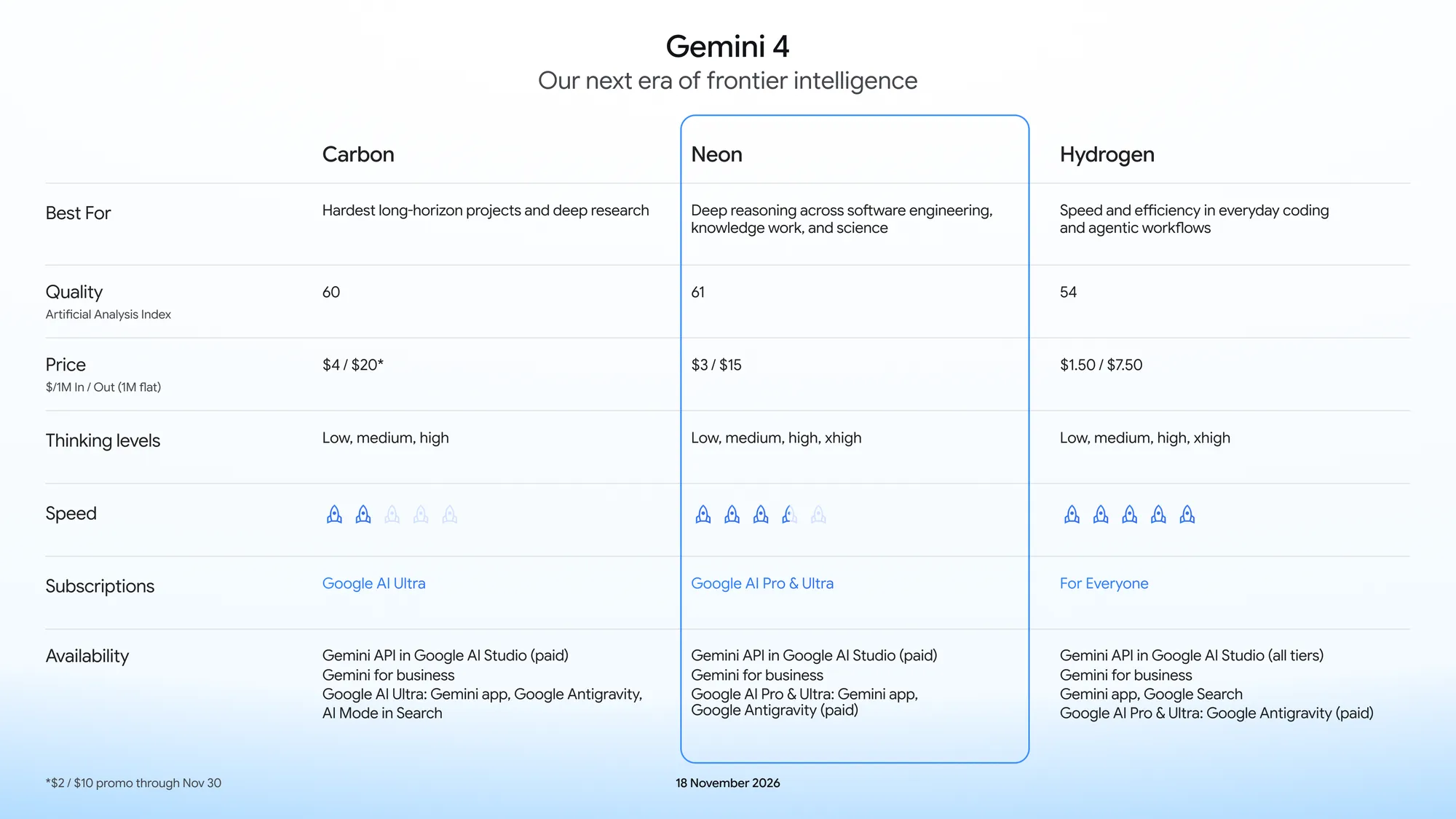
Comparison table slide titled "Gemini 4 - Our next era of frontier intelligence" with three model columns, Carbon, Neon and Hydrogen, where the Neon column is highlighted with a blue outline. Best For: Carbon - Hardest long-horizon projects and deep research; Neon - Deep reasoning across software engineering, knowledge work, and science; Hydrogen - Speed and efficiency in everyday coding and agentic workflows. Quality (Artificial Analysis Index): Carbon 60, Neon 61, Hydrogen 54. Price ($/1M In / Out (1M flat)): Carbon $4 / $20*, Neon $3 / $15, Hydrogen $1.50 / $7.50. Thinking levels: Carbon - Low, medium, high; Neon - Low, medium, high, xhigh; Hydrogen - Low, medium, high, xhigh. Speed (shown as rocket icons out of five): Carbon 2, Neon 3.5, Hydrogen 5. Subscriptions: Carbon - Google AI Ultra; Neon - Google AI Pro & Ultra; Hydrogen - For Everyone. Availability: Carbon - Gemini API in Google AI Studio (paid), Gemini for business, Google AI Ultra: Gemini app, Google Antigravity, AI Mode in Search; Neon - Gemini API in Google AI Studio (paid), Gemini for business, Google AI Pro & Ultra: Gemini app, Google Antigravity (paid); Hydrogen - Gemini API in Google AI Studio (all tiers), Gemini for business, Gemini app, Google Search, Google AI Pro & Ultra: Google Antigravity (paid). Footnote: *$2 / $10 promo through Nov 30. Dated 18 November 2026.

So the lineup now, from most to least expensive, is Carbon, Neon, Hydrogen.

Except Carbon is currently half price, so right now Neon ($3/million input, $15/million output) is the most expensive of the three - then Carbon ($2/$10), then Hydrogen ($1.50/$7.50). I guess this will make more sense when Carbon doubles to $4/$20 on December 1st.

I ran some pelicans through the three reasoning levels for Neon - low, medium, high.

I dropped Argon from my Gemini 4 comparison grid - here's the new Gemini 4 lineup, where the Neon pelicans do look better than Hydrogen and worse than Carbon:
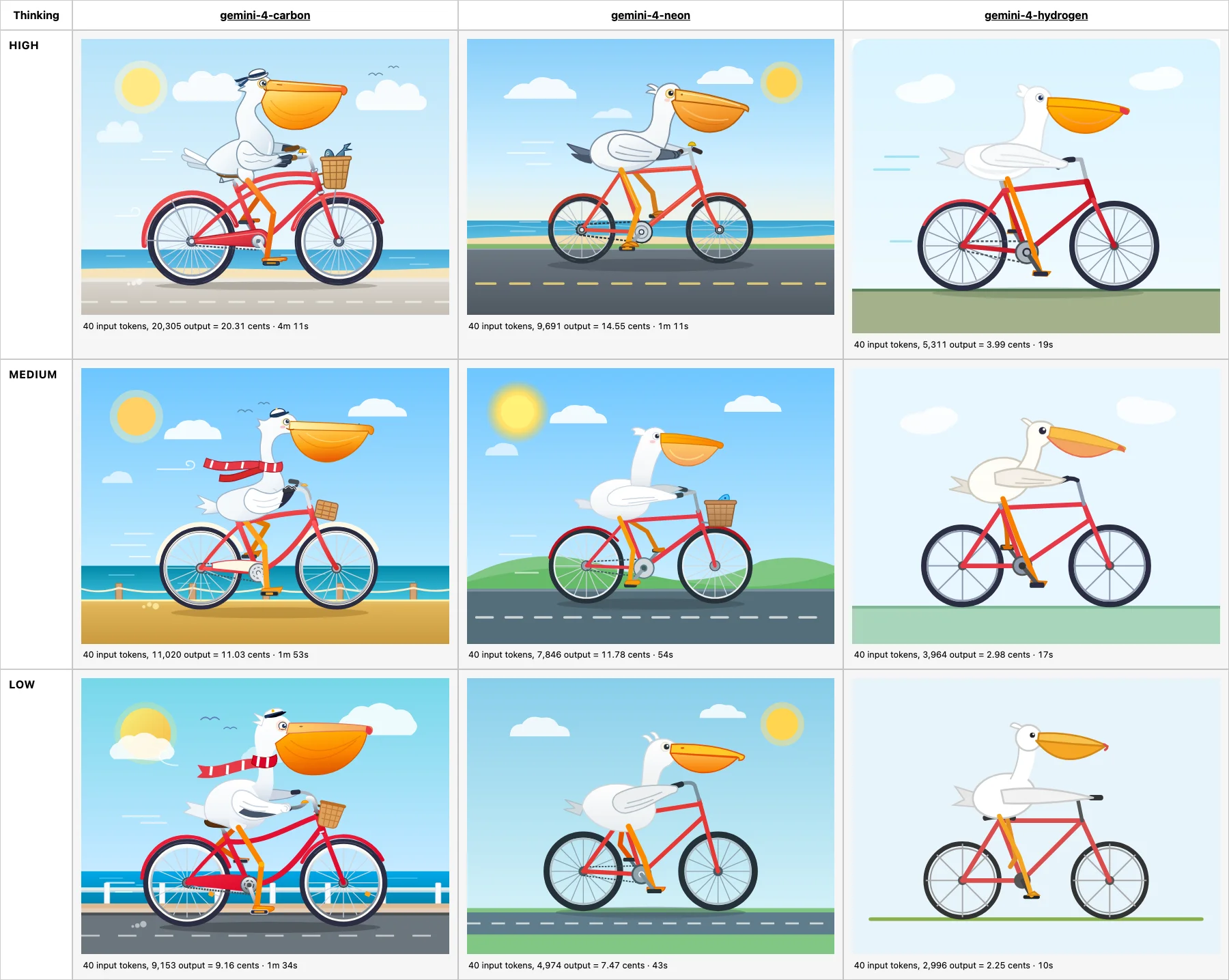
Comparison grid of nine flat vector-style illustrations of a pelican riding a red bicycle, arranged as a table with three model columns and three thinking-level rows. Column headers: Thinking, gemini-4-carbon, gemini-4-neon, gemini-4-hydrogen. Row HIGH: gemini-4-carbon is the most detailed of all, a pelican in a sailor cap on a red cruiser bike with fenders, chain guard and a wicker basket holding a fish, on a beach promenade with ocean, sun, clouds and distant birds, captioned "40 input tokens, 20,305 output = 20.31 cents · 4m 11s"; gemini-4-neon is a clean, well-proportioned pelican on a simpler red bike on a road with a yellow dashed line and the sea behind, captioned "40 input tokens, 9,691 output = 14.55 cents · 1m 11s"; gemini-4-hydrogen is a plainer pelican on a basic red bike with speed lines, flat green ground and a pale sky, captioned "40 input tokens, 5,311 output = 3.99 cents · 19s". Row MEDIUM: gemini-4-carbon adds a red striped scarf blowing in the wind plus the sailor cap, cream fenders, a basket and a beach with a rope fence, captioned "40 input tokens, 11,020 output = 11.03 cents · 1m 53s"; gemini-4-neon has a basket with a fish, green hills and a grey road, captioned "40 input tokens, 7,846 output = 11.78 cents · 54s"; gemini-4-hydrogen is a simple pelican and bike on a flat green strip with faint clouds, captioned "40 input tokens, 3,964 output = 2.98 cents · 17s". Row LOW: gemini-4-carbon is still richly detailed with cap, scarf, basket, a seaside railing and a road, captioned "40 input tokens, 9,153 output = 9.16 cents · 1m 34s"; gemini-4-neon is a simpler pelican on a bike with no basket, on a road edged with grass, captioned "40 input tokens, 4,974 output = 7.47 cents · 43s"; gemini-4-hydrogen is the most minimal, a basic pelican and thin-framed bike over a single green line on a plain pale background, captioned "40 input tokens, 2,996 output = 2.25 cents · 10s". Overall, detail and polish drop from carbon to neon to hydrogen and, less sharply, from high to low thinking, while every image remains a recognisable pelican on a bicycle.

As I've done with several recent models, I also fired the following prompt against Gemini 4 Neon on "extra" effort level in Google Antigravity:

Make a three js animation where yonkers stands up as a big mech (cool stand up motion) and stomps around manhattan and queens and Brooklyn, use openstreetmap mapping data

Here's the result.

This is a beat by Simon Willison, posted on 18th November 2026.

Monthly briefing

Sponsor me for $10/month and get a curated email digest of the month's most important LLM developments.

Pay me to send you less!

Sponsor & subscribe