22nd January 2026 - Link Blog
Qwen3-TTS Family is Now Open Sourced: Voice Design, Clone, and Generation (via) I haven't been paying much attention to the state-of-the-art in speech generation models other than noting that they've got really good, so I can't speak for how notable this new release from Qwen is.
From the accompanying paper:
In this report, we present the Qwen3-TTS series, a family of advanced multilingual, controllable, robust, and streaming text-to-speech models. Qwen3-TTS supports state-of- the-art 3-second voice cloning and description-based control, allowing both the creation of entirely novel voices and fine-grained manipulation over the output speech. Trained on over 5 million hours of speech data spanning 10 languages, Qwen3-TTS adopts a dual-track LM architecture for real-time synthesis [...]. Extensive experiments indicate state-of-the-art performance across diverse objective and subjective benchmark (e.g., TTS multilingual test set, InstructTTSEval, and our long speech test set). To facilitate community research and development, we release both tokenizers and models under the Apache 2.0 license.
To give an idea of size, Qwen/Qwen3-TTS-12Hz-1.7B-Base is 4.54GB on Hugging Face and Qwen/Qwen3-TTS-12Hz-0.6B-Base is 2.52GB.
The Hugging Face demo lets you try out the 0.6B and 1.7B models for free in your browser, including voice cloning:
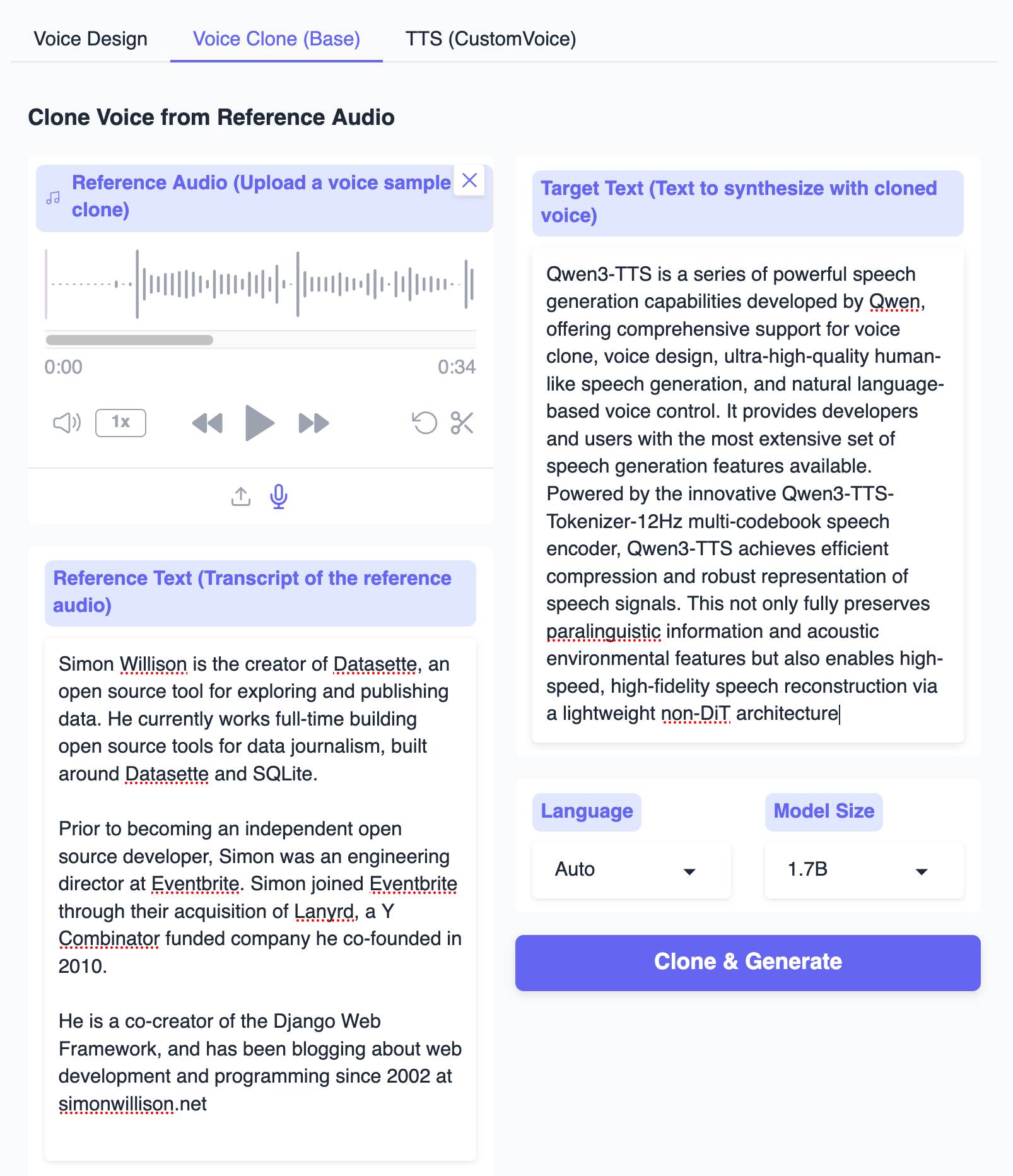
I tried this out by recording myself reading my about page and then having Qwen3-TTS generate audio of me reading the Qwen3-TTS announcement post. Here's the result:
It's important that everyone understands that voice cloning is now something that's available to anyone with a GPU and a few GBs of VRAM... or in this case a web browser that can access Hugging Face.
Update: Prince Canuma got this working with his mlx-audio library. I had Claude turn that into a CLI tool which you can run with uv ike this:
uv run https://tools.simonwillison.net/python/q3_tts.py \
  'I am a pirate, give me your gold!' \
  -i 'gruff voice' -o pirate.wav
The -i option lets you use a prompt to describe the voice it should use. On first run this downloads a 4.5GB model file from Hugging Face.
Recent articles
- Experimenting with Starlette 1.0 with Claude skills - 22nd March 2026
- Profiling Hacker News users based on their comments - 21st March 2026
- Thoughts on OpenAI acquiring Astral and uv/ruff/ty - 19th March 2026