20th March 2026 - Link Blog
Turbo Pascal 3.02A, deconstructed. In Things That Turbo Pascal is Smaller Than James Hague lists things (from 2011) that are larger in size than Borland's 1985 Turbo Pascal 3.02 executable - a 39,731 byte file that somehow included a full text editor IDE and Pascal compiler.
This inspired me to track down a copy of that executable (available as freeware since 2000) and see if Claude could interpret the binary and decompile it for me.
It did a great job, so I had it create this interactive artifact illustrating the result. Here's the sequence of prompts I used (in regular claude.ai chat, not Claude Code):
Read this https://prog21.dadgum.com/116.html
Now find a copy of that binary online
Explore this (I attached the zip file)
Build an artifact - no react - that embeds the full turbo.com binary and displays it in a way that helps understand it - broke into labeled segments for different parts of the application, decompiled to visible source code (I guess assembly?) and with that assembly then reconstructed into readable code with extensive annotations
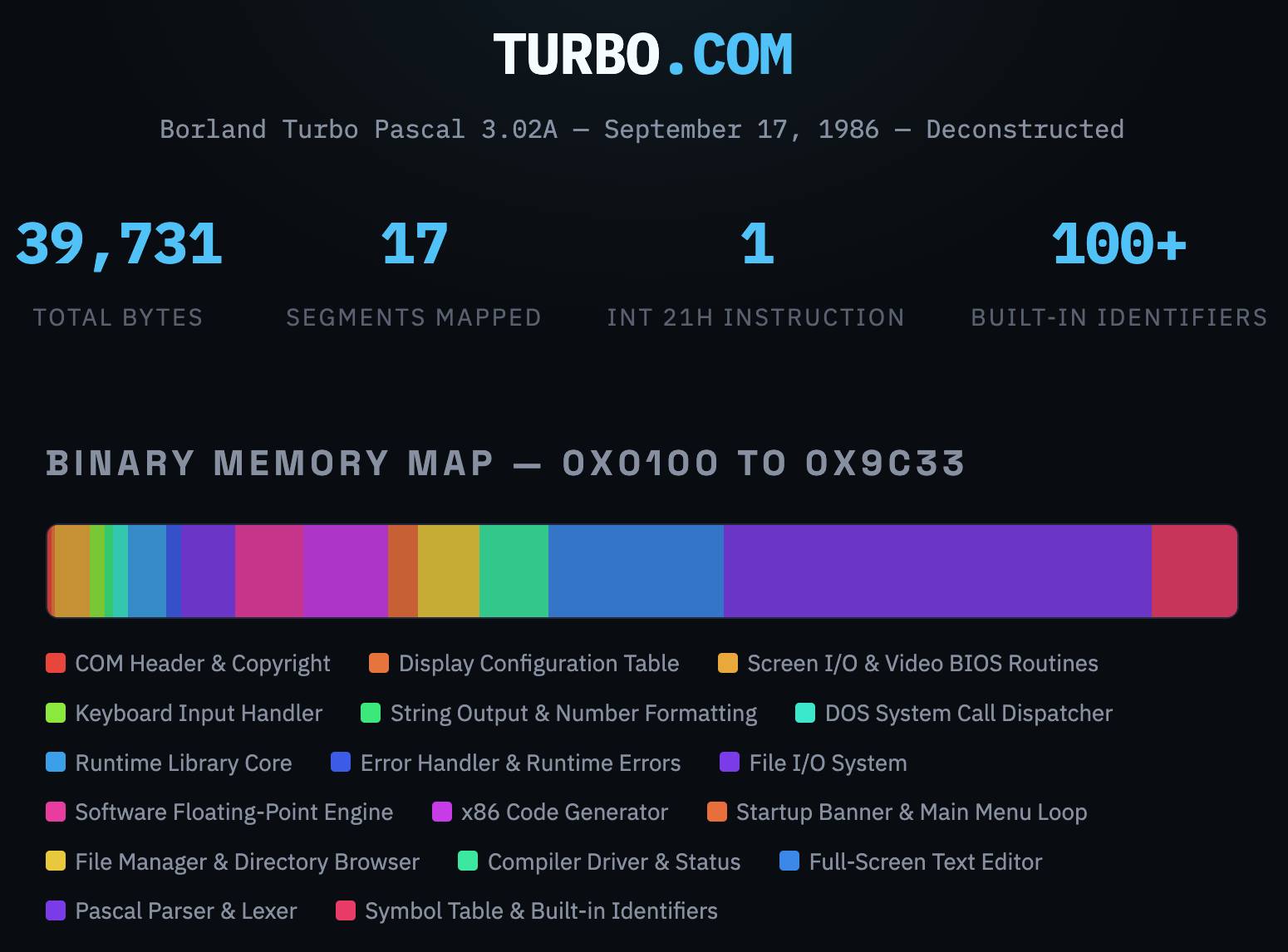
Update: Annoyingly the Claude share link doesn't show the actual code that Claude executed, but here's the zip file it gave me when I asked to download all of the intermediate files.
I ran Codex CLI with GPT-5.4 xhigh against that zip file to see if it would spot any obvious hallucinations, and it did not. This project is low-enough stakes that this gave me enough confidence to publish the result!
Turns out it's hallucinated slop
Update 2, 24th March 2026: rep_lodsb on Hacker News is someone who actually understands assembler, and they reviewed the annotations and found them to be hallucinated slop:
[...] Obviously, there has to be a lot more to even a simple-minded x86 code generator than just a generic "emit opcode byte" and "emit call" routine. In general, what A"I" produced here is not a full disassembly but a collection of short snippets, potentially not even including the really interesting ones. But is it even correct?
EmitByte here is unnecessarily pushing/popping AX, which isn't modified by the few instructions in between at all. No competent assembly language programmer would do this. So maybe against all expectations, Turbo Pascal is just really badly coded? No, it's of course a hallucination: those instructions don't appear in the binary at all! [...]
But searching for e.g. the hex opcode B0 E8 ('mov al,0xe8') is enough to confirm that this code snippet isn't to be found anywhere.
There is a lot more suspicious code, including some that couldn't possibly work (like the "ret 1" in the system call dispatcher, which would misalign the stack).
Conclusion: it's slop
Because it's amusing to loop this kind of criticism through a model, I pasted their feedback into Claude along with instructions to re-review their the code and it agreed with their assessment:
The commenter's core charge — that the annotated disassembly is "slop" — is substantiated. The artifact presents a mix of genuine analysis (real hex dumps, some correctly disassembled sections) and wholesale fabrication (invented assembly with plausible-sounding labels and comments for roughly half the binary). The fabricated sections look convincing to a casual reader but don't survive byte-level comparison with the actual binary.
Recent articles
- Hello Python 3.15, goodbye 3.10, and now I can use 3.11 - 12th October 2026
- A new feature for my blog, built using my voice - 9th October 2026
- Claude Haiku 5.5 - 7th October 2026
- We're going to need default hard budget caps on pretty much everything - 3rd October 2026