Guides > Agentic Engineering Patterns > Interactive explanations
Changes to Interactive explanations
Feb. 28, 2026, 11:09 p.m. #
---
+++
@@ -10,7 +10,7 @@
## Understanding word clouds
-In [An AI agent coding skeptic tries AI agent coding, in excessive detail](https://minimaxir.com/2026/02/ai-agent-coding/) Max Woolf mentioned testing LLM's Rust abilities with the prompt `Create a Rust app that can create "word cloud" data visualizations given a long input text`.
+In [An AI agent coding skeptic tries AI agent coding, in excessive detail](https://minimaxir.com/2026/02/ai-agent-coding/) Max Woolf mentioned testing LLMs' Rust abilities with the prompt `Create a Rust app that can create "word cloud" data visualizations given a long input text`.
This captured my imagination: I've always wanted to know how word clouds work, so I fired off an [asynchronous research project](https://simonwillison.net/2025/Nov/6/async-code-research/) - [initial prompt here](https://github.com/simonw/research/pull/91#issue-4002426963), [code and report here](https://github.com/simonw/research/tree/main/rust-wordcloud) - to explore the idea.
@@ -38,8 +38,8 @@
This was using Claude Opus 4.6, which turns out to have quite good taste when it comes to building explanatory animations.
-If you watch the animation closely you can see that for each word it attempts to place it somewhere on the page by showing a box, run checks if that box intersects and existing word. If so it continues to try to find a good spot, moving outward in a spiral from the center.
+If you watch the animation closely you can see that for each word it attempts to place it somewhere on the page by showing a box, run checks if that box intersects an existing word. If so it continues to try to find a good spot, moving outward in a spiral from the center.
-I found that this animation really helped the way the algorithm worked click for me.
+I found that this animation really helped make the way the algorithm worked click for me.
I have long been a fan of animations and interactive interfaces to help explain different concepts. A good coding agent can produce these on demand to help explain code - its own code or code written by others.
Draft status changed from draft to published.
Feb. 28, 2026, 11:08 p.m. #
---
+++
@@ -34,4 +34,12 @@
````
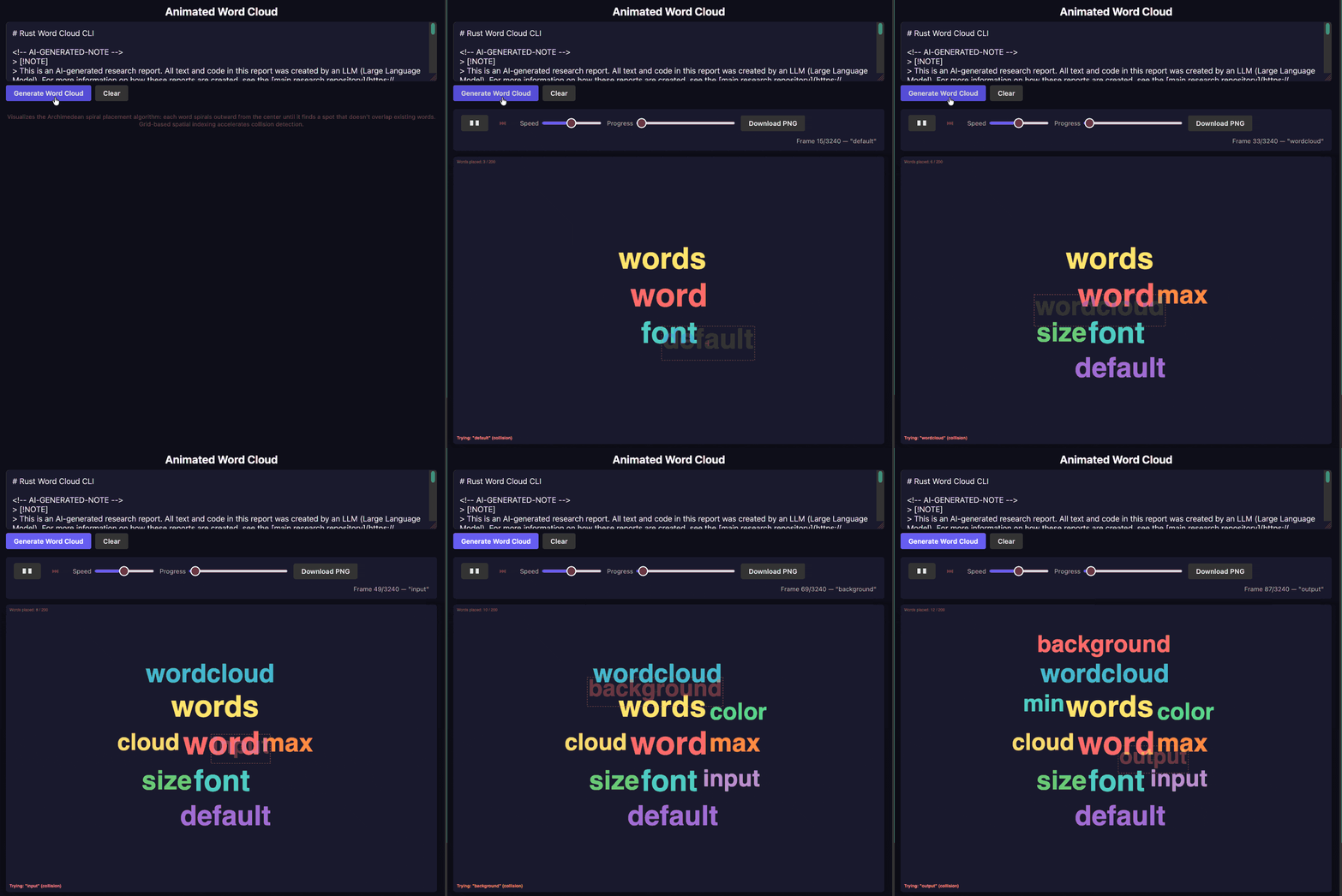
You can [play with the result here](https://tools.simonwillison.net/animated-word-cloud). Here's an animated GIF demo:
-
+
+
+This was using Claude Opus 4.6, which turns out to have quite good taste when it comes to building explanatory animations.
+
+If you watch the animation closely you can see that for each word it attempts to place it somewhere on the page by showing a box, run checks if that box intersects and existing word. If so it continues to try to find a good spot, moving outward in a spiral from the center.
+
+I found that this animation really helped the way the algorithm worked click for me.
+
+I have long been a fan of animations and interactive interfaces to help explain different concepts. A good coding agent can produce these on demand to help explain code - its own code or code written by others.
Feb. 28, 2026, 10:52 p.m. #
---
+++
@@ -1,6 +1,6 @@
When we lose track of how code written by our agents works we take on **cognitive debt**.
-For a lot of things this doesn't matter: if the code fetches some data from a database and outputs it as JSON the implementation details are likely simple enough that we don't need to care. We can try out the new feature and make a very solid guess at how it works, the glance over the code to be sure.
+For a lot of things this doesn't matter: if the code fetches some data from a database and outputs it as JSON the implementation details are likely simple enough that we don't need to care. We can try out the new feature and make a very solid guess at how it works, then glance over the code to be sure.
Often though the details really do matter. If the core of our application becomes a black box that we don't fully understand we can no longer confidently reason about it, which makes planning new features harder and eventually slows our progress in the same way that accumulated technical debt does.
Feb. 28, 2026, 10:48 p.m. #
---
+++
@@ -31,4 +31,7 @@
Fetch https://raw.githubusercontent.com/simonw/research/refs/heads/main/rust-wordcloud/walkthrough.md to /tmp using curl so you can read the whole thing
Inspired by that, build animated-word-cloud.html - a page that accepts pasted text (which it persists in the `#fragment` of the URL such that a page loaded with that `#` populated will use that text as input and auto-submit it) such that when you submit the text it builds a word cloud using the algorithm described in that document but does it animated, to make the algorithm as clear to understand. Include a slider for the animation which can be paused and the speed adjusted or even stepped through frame by frame while paused. At any stage the visible in-progress word cloud can be downloaded as a PNG.
-````
+````
+You can [play with the result here](https://tools.simonwillison.net/animated-word-cloud). Here's an animated GIF demo:
+
+
Feb. 28, 2026, 10:44 p.m. #
---
+++
@@ -1,5 +1,3 @@
-Interactive explanations
-
When we lose track of how code written by our agents works we take on **cognitive debt**.
For a lot of things this doesn't matter: if the code fetches some data from a database and outputs it as JSON the implementation details are likely simple enough that we don't need to care. We can try out the new feature and make a very solid guess at how it works, the glance over the code to be sure.
Feb. 28, 2026, 10:43 p.m. #
Initial version.