103 posts tagged “browsers”
2026
In Servo is now available on crates.io the Servo team announced the initial release of the servo crate, which packages their browser engine as an embeddable library.
I set Claude Code for web the task of figuring out what it can do, building a CLI tool for taking screenshots using it and working out if it could be compiled to WebAssembly.
The servo-shot Rust tool it built works pretty well:
git clone https://github.com/simonw/research
cd research/servo-crate-exploration/servo-shot
cargo build
./target/debug/servo-shot https://news.ycombinator.com/
Here's the result:
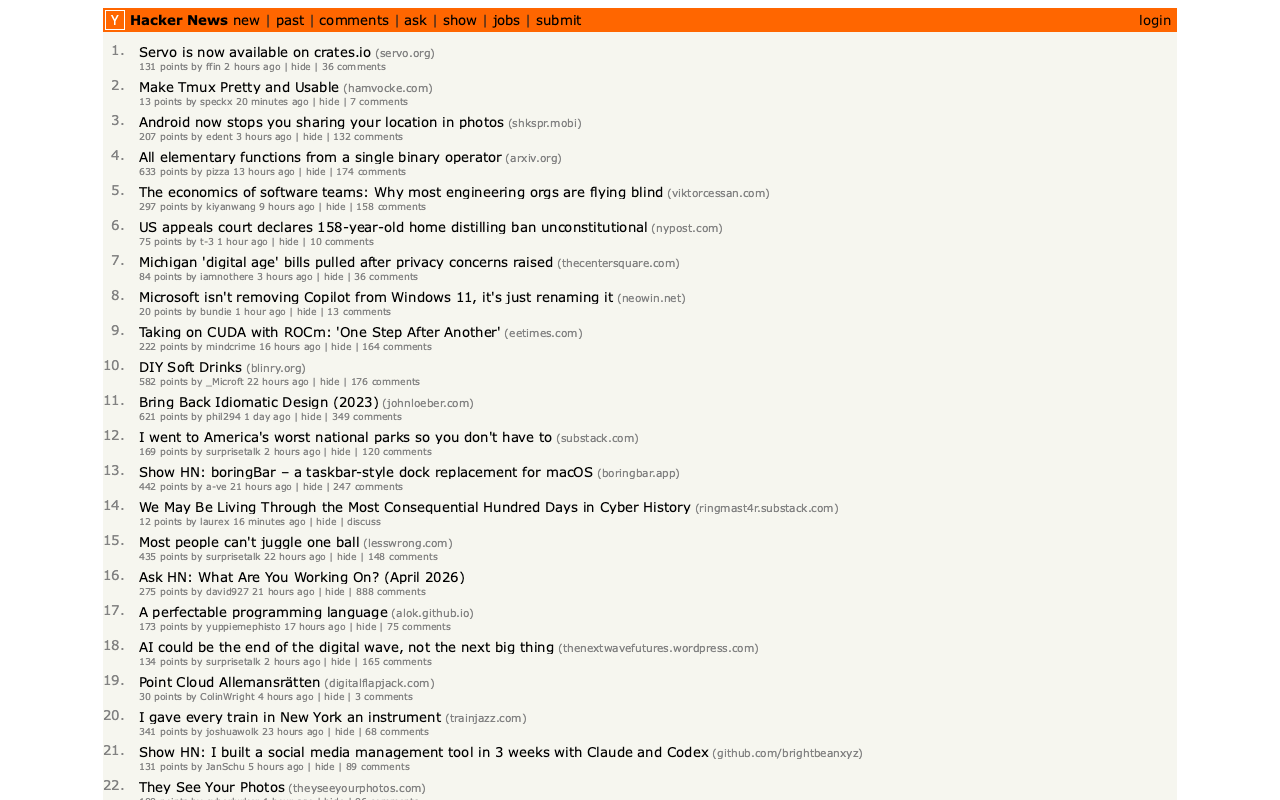
Compiling Servo itself to WebAssembly is not feasible due to its heavy use of threads and dependencies like SpiderMonkey, but Claude did build me this playground page for trying out a WebAssembly build of the html5ever and markup5ever_rcdom crates, providing a tool for turning fragments of HTML into a parse tree.
Pretext (via) Exciting new browser library from Cheng Lou, previously a React core developer and the original creator of the react-motion animation library.
Pretext solves the problem of calculating the height of a paragraph of line-wrapped text without touching the DOM. The usual way of doing this is to render the text and measure its dimensions, but this is extremely expensive. Pretext uses an array of clever tricks to make this much, much faster, which enables all sorts of new text rendering effects in browser applications.
Here's one demo that shows the kind of things this makes possible:
The key to how this works is the way it separates calculations into a call to a prepare() function followed by multiple calls to layout().
The prepare() function splits the input text into segments (effectively words, but it can take things like soft hyphens and non-latin character sequences and emoji into account as well) and measures those using an off-screen canvas, then caches the results. This is comparatively expensive but only runs once.
The layout() function can then emulate the word-wrapping logic in browsers to figure out how many wrapped lines the text will occupy at a specified width and measure the overall height.
I had Claude build me this interactive artifact to help me visually understand what's going on, based on a simplified version of Pretext itself.
The way this is tested is particularly impressive. The earlier tests rendered a full copy of the Great Gatsby in multiple browsers to confirm that the estimated measurements were correct against a large volume of text. This was later joined by the corpora/ folder using the same technique against lengthy public domain documents in Thai, Chinese, Korean, Japanese, Arabic, and more.
Cheng Lou says:
The engine’s tiny (few kbs), aware of browser quirks, supports all the languages you’ll need, including Korean mixed with RTL Arabic and platform-specific emojis
This was achieved through showing Claude Code and Codex the browsers ground truth, and have them measure & iterate against those at every significant container width, running over weeks
Ladybird adopts Rust, with help from AI (via) Really interesting case-study from Andreas Kling on advanced, sophisticated use of coding agents for ambitious coding projects with critical code. After a few years hoping Swift's platform support outside of the Apple ecosystem would mature they switched tracks to Rust their memory-safe language of choice, starting with an AI-assisted port of a critical library:
Our first target was LibJS , Ladybird's JavaScript engine. The lexer, parser, AST, and bytecode generator are relatively self-contained and have extensive test coverage through test262, which made them a natural starting point.
I used Claude Code and Codex for the translation. This was human-directed, not autonomous code generation. I decided what to port, in what order, and what the Rust code should look like. It was hundreds of small prompts, steering the agents where things needed to go. [...]
The requirement from the start was byte-for-byte identical output from both pipelines. The result was about 25,000 lines of Rust, and the entire port took about two weeks. The same work would have taken me multiple months to do by hand. We’ve verified that every AST produced by the Rust parser is identical to the C++ one, and all bytecode generated by the Rust compiler is identical to the C++ compiler’s output. Zero regressions across the board.
Having an existing conformance testing suite of the quality of test262 is a huge unlock for projects of this magnitude, and the ability to compare output with an existing trusted implementation makes agentic engineering much more of a safe bet.
LadybirdBrowser/ladybird: Abandon Swift adoption (via) Back in August 2024 the Ladybird browser project announced an intention to adopt Swift as their memory-safe language of choice.
As of this commit it looks like they've changed their mind:
Everywhere: Abandon Swift adoption
After making no progress on this for a very long time, let's acknowledge it's not going anywhere and remove it from the codebase.
Update 23rd February 2025: They've adopted Rust instead.
Rodney v0.4.0. My Rodney CLI tool for browser automation attracted quite the flurry of PRs since I announced it last week. Here are the release notes for the just-released v0.4.0:
- Errors now use exit code 2, which means exit code 1 is just for for check failures. #15
- New
rodney assertcommand for running JavaScript tests, exit code 1 if they fail. #19- New directory-scoped sessions with
--local/--globalflags. #14- New
reload --hardandclear-cachecommands. #17- New
rodney start --showoption to make the browser window visible. Thanks, Antonio Cuni. #13- New
rodney connect PORTcommand to debug an already-running Chrome instance. Thanks, Peter Fraenkel. #12- New
RODNEY_HOMEenvironment variable to support custom state directories. Thanks, Senko Rašić. #11- New
--insecureflag to ignore certificate errors. Thanks, Jakub Zgoliński. #10- Windows support: avoid
Setsidon Windows via build-tag helpers. Thanks, adm1neca. #18- Tests now run on
windows-latestandmacos-latestin addition to Linux.
I've been using Showboat to create demos of new features - here those are for rodney assert, rodney reload --hard, rodney exit codes, and rodney start --local.
The rodney assert command is pretty neat: you can now Rodney to test a web app through multiple steps in a shell script that looks something like this (adapted from the README):
#!/bin/bash
set -euo pipefail

FAIL=0

check() {
    if ! "$@"; then
        echo "FAIL: $*"
        FAIL=1
    fi
}

rodney start
rodney open "https://example.com"
rodney waitstable

# Assert elements exist
check rodney exists "h1"

# Assert key elements are visible
check rodney visible "h1"
check rodney visible "#main-content"

# Assert JS expressions
check rodney assert 'document.title' 'Example Domain'
check rodney assert 'document.querySelectorAll("p").length' '2'

# Assert accessibility requirements
check rodney ax-find --role navigation

rodney stop

if [ "$FAIL" -ne 0 ]; then
    echo "Some checks failed"
    exit 1
fi
echo "All checks passed"Launching Interop 2026. Jake Archibald reports on Interop 2026, the initiative between Apple, Google, Igalia, Microsoft, and Mozilla to collaborate on ensuring a targeted set of web platform features reach cross-browser parity over the course of the year.
I hadn't realized how influential and successful the Interop series has been. It started back in 2021 as Compat 2021 before being rebranded to Interop in 2022.
The dashboards for each year can be seen here, and they demonstrate how wildly effective the program has been: 2021, 2022, 2023, 2024, 2025, 2026.
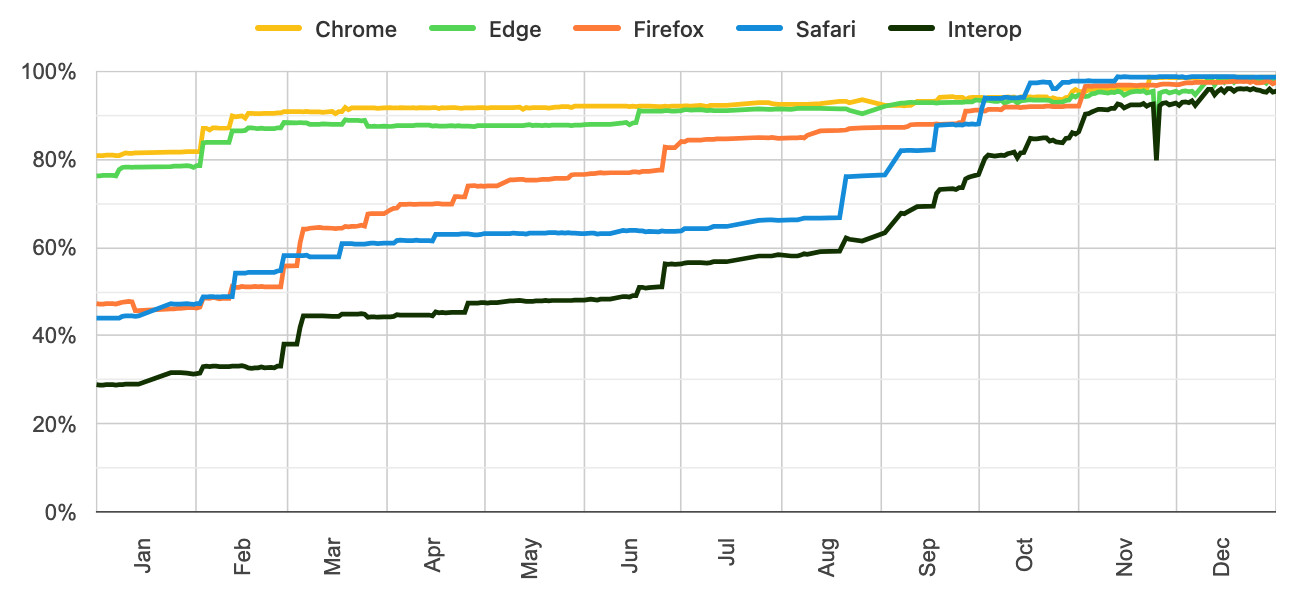
Here's the progress chart for 2025, which shows every browser vendor racing towards a 95%+ score by the end of the year:
The feature I'm most excited about in 2026 is Cross-document View Transitions, building on the successful 2025 target of Same-Document View Transitions. This will provide fancy SPA-style transitions between pages on websites with no JavaScript at all.
As a keen WebAssembly tinkerer I'm also intrigued by this one:
JavaScript Promise Integration for Wasm allows WebAssembly to asynchronously 'suspend', waiting on the result of an external promise. This simplifies the compilation of languages like C/C++ which expect APIs to run synchronously.
One Human + One Agent = One Browser From Scratch (via) embedding-shapes was so infuriated by the hype around Cursor's FastRender browser project - thousands of parallel agents producing ~1.6 million lines of Rust - that they were inspired to take a go at building a web browser using coding agents themselves.
The result is one-agent-one-browser and it's really impressive. Over three days they drove a single Codex CLI agent to build 20,000 lines of Rust that successfully renders HTML+CSS with no Rust crate dependencies at all - though it does (reasonably) use Windows, macOS and Linux system frameworks for image and text rendering.
I installed the 1MB macOS binary release and ran it against my blog:
chmod 755 ~/Downloads/one-agent-one-browser-macOS-ARM64
~/Downloads/one-agent-one-browser-macOS-ARM64 https://simonwillison.net/
Here's the result:
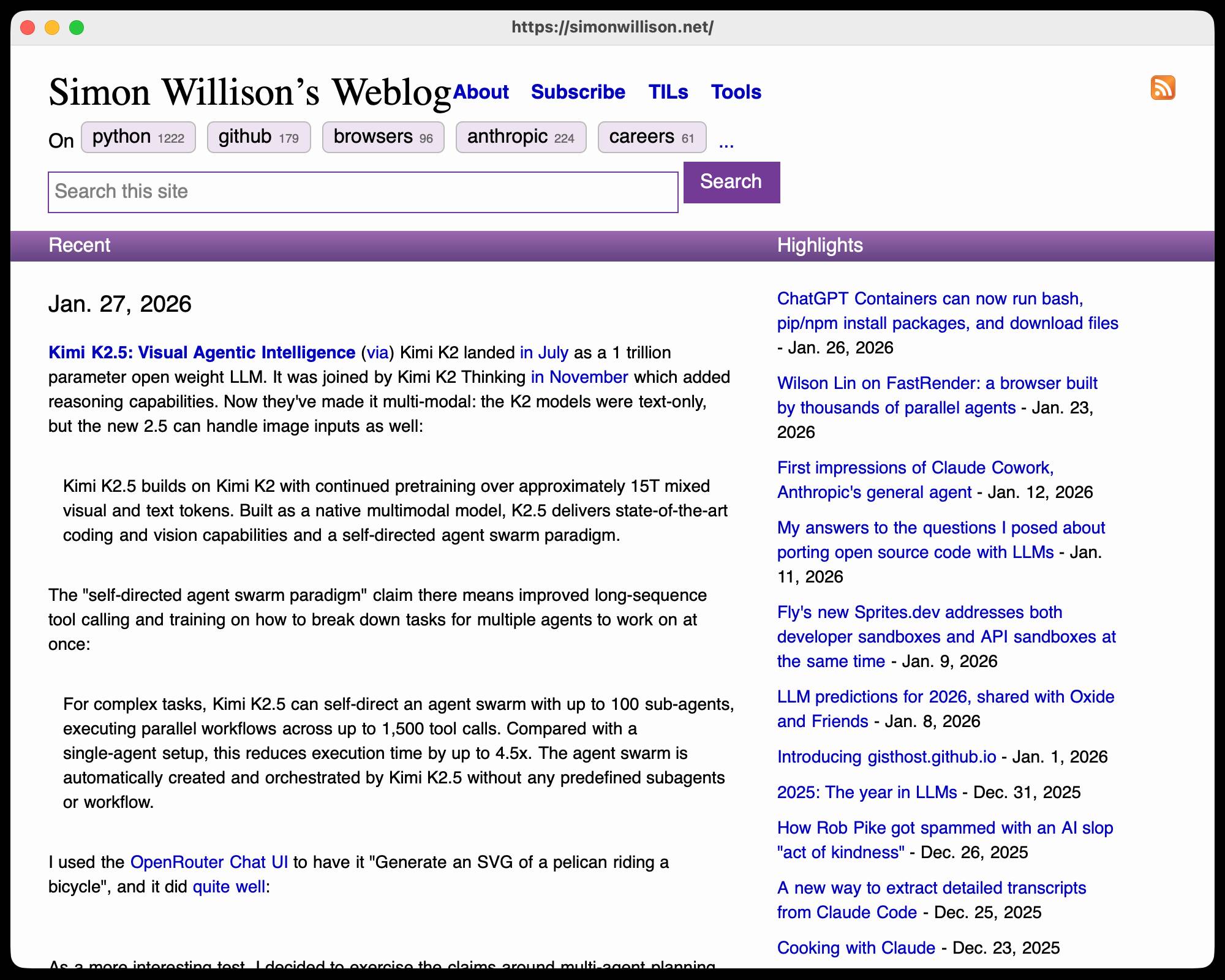
It even rendered my SVG feed subscription icon! A PNG image is missing from the page, which looks like an intermittent bug (there's code to render PNGs).
The code is pretty readable too - here's the flexbox implementation.
I had thought that "build a web browser" was the ideal prompt to really stretch the capabilities of coding agents - and that it would take sophisticated multi-agent harnesses (as seen in the Cursor project) and millions of lines of code to achieve.
Turns out one agent driven by a talented engineer, three days and 20,000 lines of Rust is enough to get a very solid basic renderer working!
I'm going to upgrade my prediction for 2029: I think we're going to get a production-grade web browser built by a small team using AI assistance by then.
the browser is the sandbox. Paul Kinlan is a web platform developer advocate at Google and recently turned his attention to coding agents. He quickly identified the importance of a robust sandbox for agents to operate in and put together these detailed notes on how the web browser can help:
This got me thinking about the browser. Over the last 30 years, we have built a sandbox specifically designed to run incredibly hostile, untrusted code from anywhere on the web, the instant a user taps a URL. [...]
Could you build something like Cowork in the browser? Maybe. To find out, I built a demo called Co-do that tests this hypothesis. In this post I want to discuss the research I've done to see how far we can get, and determine if the browser's ability to run untrusted code is useful (and good enough) for enabling software to do more for us directly on our computer.
Paul then describes how the three key aspects of a sandbox - filesystem, network access and safe code execution - can be handled by browser technologies: the File System Access API (still Chrome-only as far as I can tell), CSP headers with <iframe sandbox> and WebAssembly in Web Workers.
Co-do is a very interesting demo that illustrates all of these ideas in a single application:
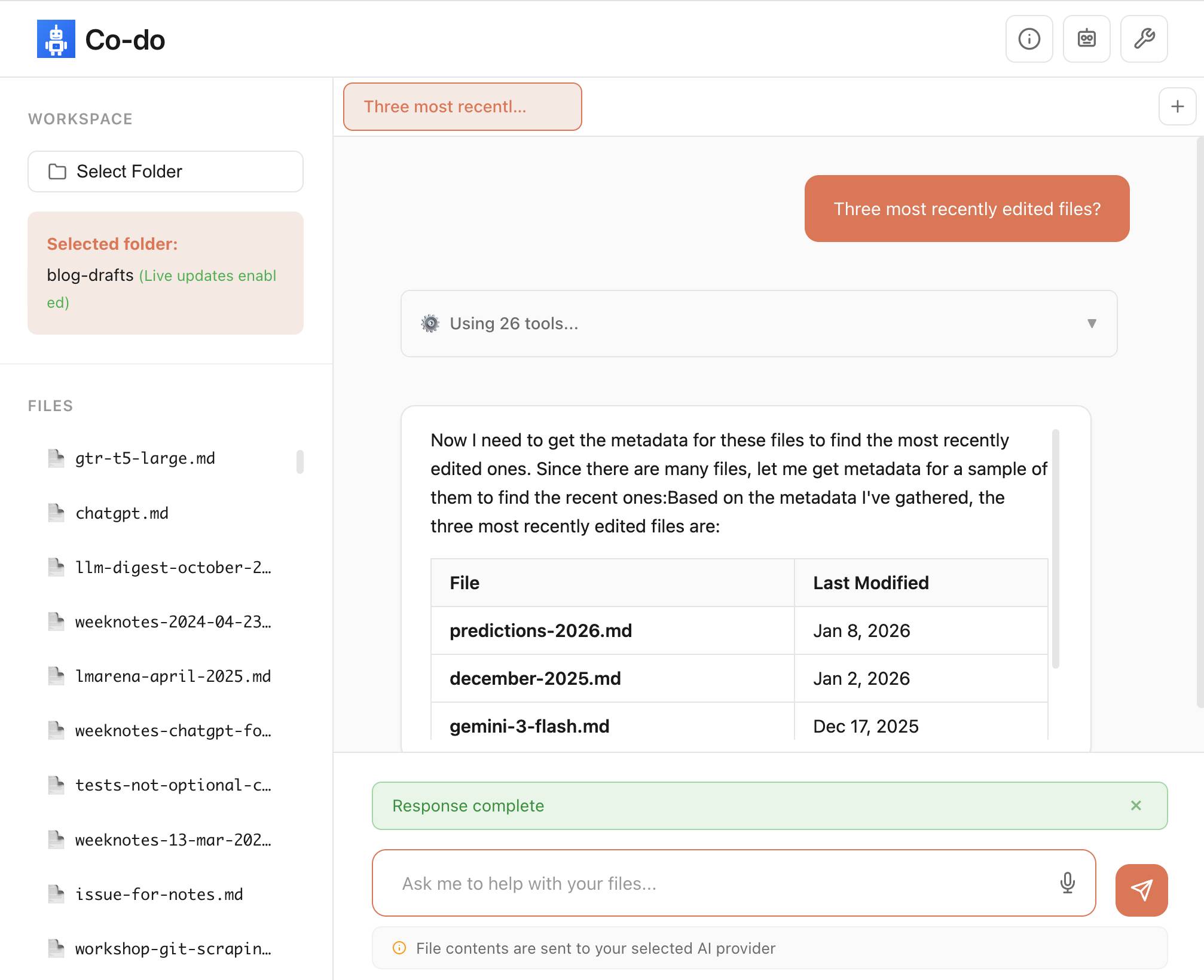
You select a folder full of files and configure an LLM provider and set an API key, Co-do then uses CSP-approved API calls to interact with that provider and provides a chat interface with tools for interacting with those files. It does indeed feel similar to Claude Cowork but without running a multi-GB local container to provide the sandbox.
My biggest complaint about <iframe sandbox> remains how thinly documented it is, especially across different browsers. Paul's post has all sorts of useful details on that which I've not encountered elsewhere, including a complex double-iframe technique to help apply network rules to the inner of the two frames.
Thanks to this post I also learned about the <input type="file" webkitdirectory> tag which turns out to work on Firefox, Safari and Chrome and allows a browser read-only access to a full directory of files at once. I had Claude knock up a webkitdirectory demo to try it out and I'll certainly be using it for projects in the future.
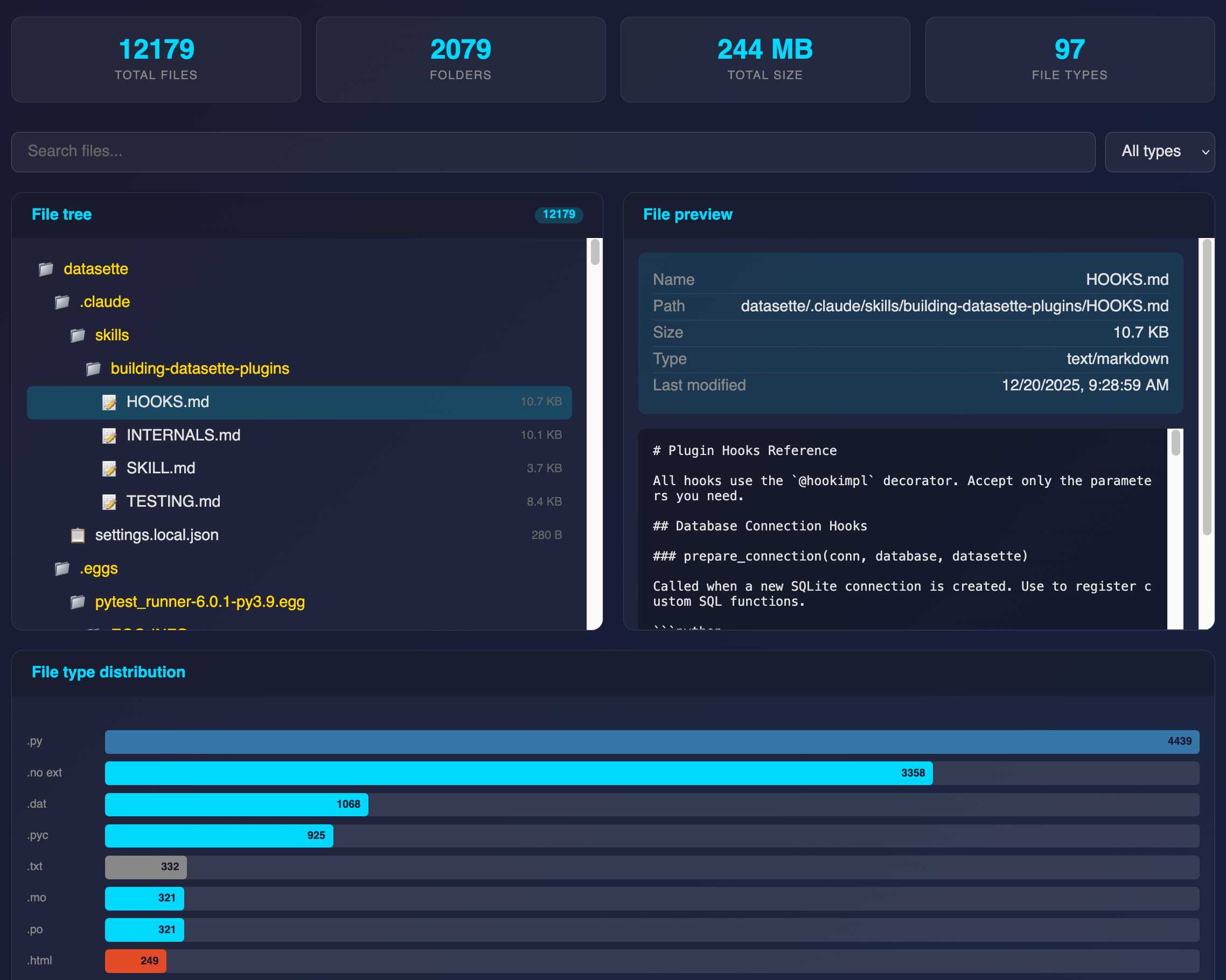
Wilson Lin on FastRender: a browser built by thousands of parallel agents
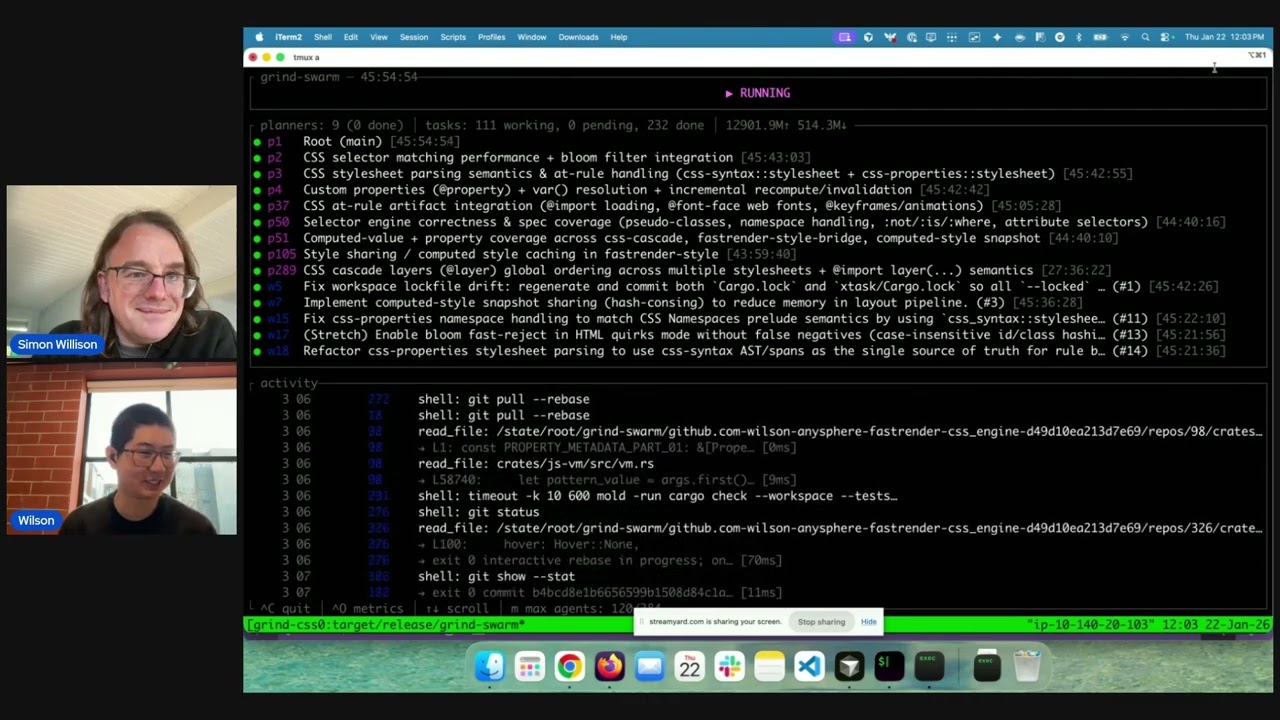
Last week Cursor published Scaling long-running autonomous coding, an article describing their research efforts into coordinating large numbers of autonomous coding agents. One of the projects mentioned in the article was FastRender, a web browser they built from scratch using their agent swarms. I wanted to learn more so I asked Wilson Lin, the engineer behind FastRender, if we could record a conversation about the project. That 47 minute video is now available on YouTube. I’ve included some of the highlights below.
[... 2,243 words]Scaling long-running autonomous coding. Wilson Lin at Cursor has been doing some experiments to see how far you can push a large fleet of "autonomous" coding agents:
This post describes what we've learned from running hundreds of concurrent agents on a single project, coordinating their work, and watching them write over a million lines of code and trillions of tokens.
They ended up running planners and sub-planners to create tasks, then having workers execute on those tasks - similar to how Claude Code uses sub-agents. Each cycle ended with a judge agent deciding if the project was completed or not.
In my predictions for 2026 the other day I said that by 2029:
I think somebody will have built a full web browser mostly using AI assistance, and it won’t even be surprising. Rolling a new web browser is one of the most complicated software projects I can imagine[...] the cheat code is the conformance suites. If there are existing tests that it’ll get so much easier.
I may have been off by three years, because Cursor chose "building a web browser from scratch" as their test case for their agent swarm approach:
To test this system, we pointed it at an ambitious goal: building a web browser from scratch. The agents ran for close to a week, writing over 1 million lines of code across 1,000 files. You can explore the source code on GitHub.
But how well did they do? Their initial announcement a couple of days ago was met with unsurprising skepticism, especially when it became apparent that their GitHub Actions CI was failing and there were no build instructions in the repo.
It looks like they addressed that within the past 24 hours. The latest README includes build instructions which I followed on macOS like this:
cd /tmp
git clone https://github.com/wilsonzlin/fastrender
cd fastrender
git submodule update --init vendor/ecma-rs
cargo run --release --features browser_ui --bin browser
This got me a working browser window! Here are screenshots I took of google.com and my own website:
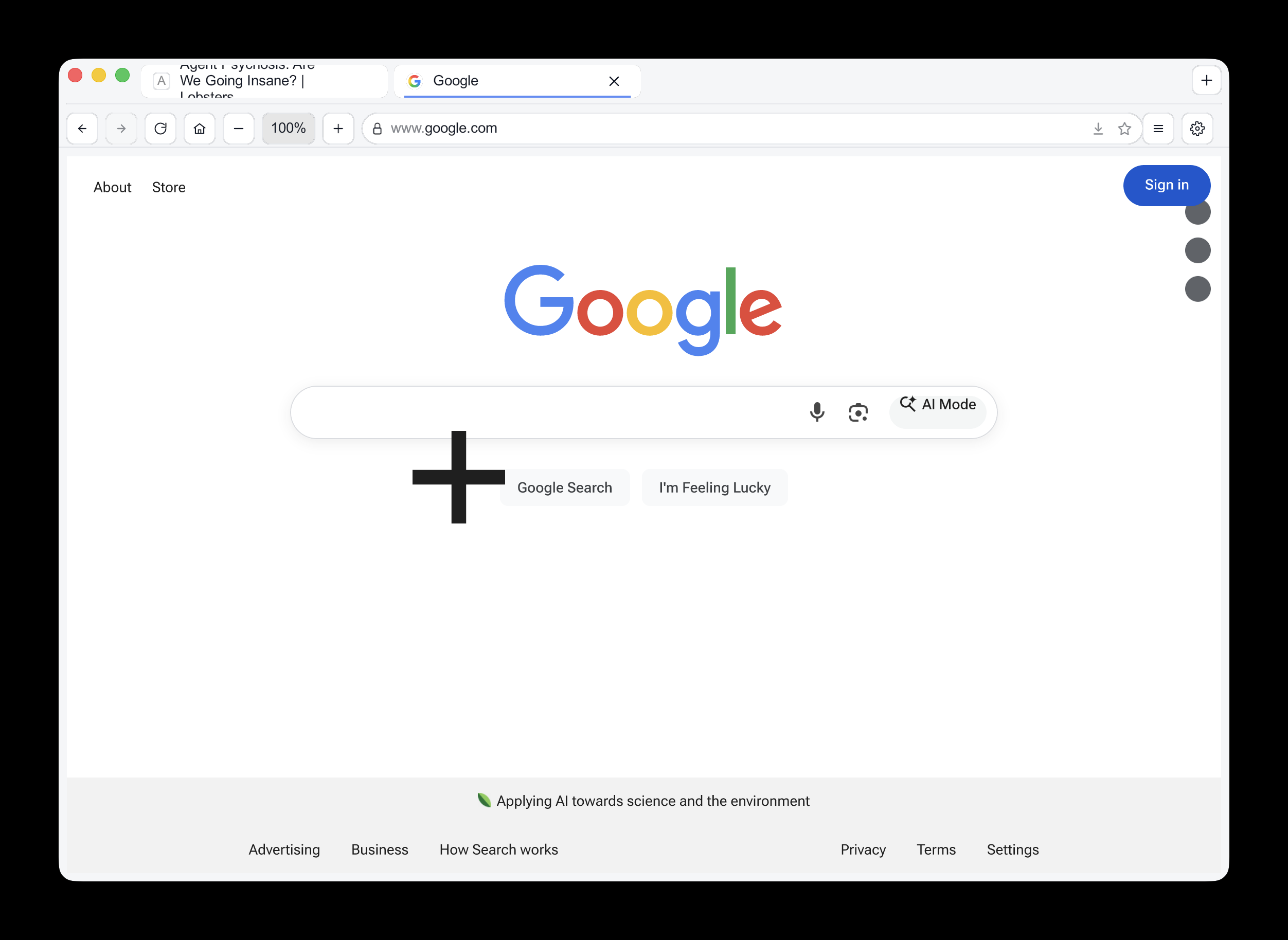
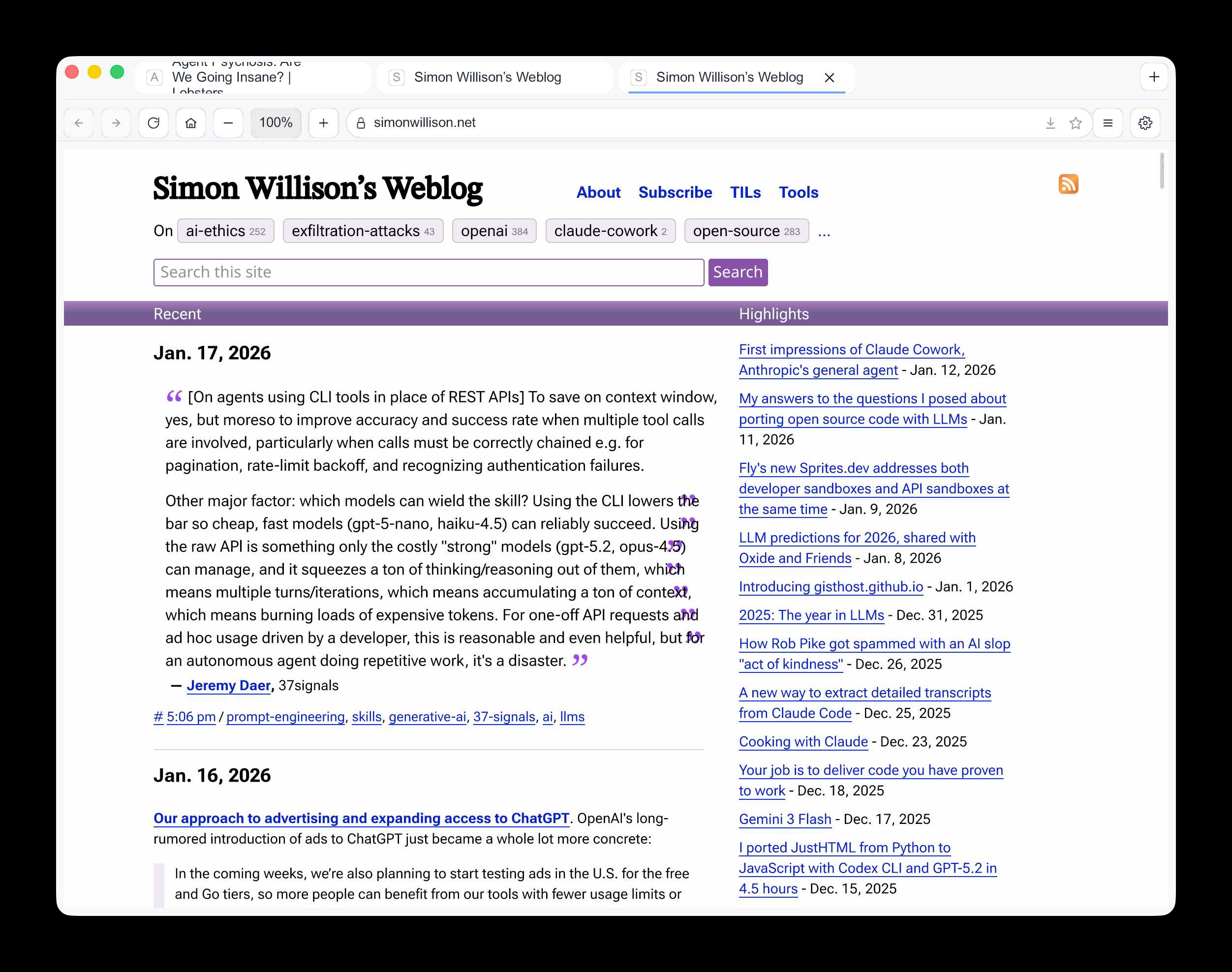
Honestly those are very impressive! You can tell they're not just wrapping an existing rendering engine because of those very obvious rendering glitches, but the pages are legible and look mostly correct.
The FastRender repo even uses Git submodules to include various WhatWG and CSS-WG specifications in the repo, which is a smart way to make sure the agents have access to the reference materials that they might need.
This is the second attempt I've seen at building a full web browser using AI-assisted coding in the past two weeks - the first was HiWave browser, a new browser engine in Rust first announced in this Reddit thread.
When I made my 2029 prediction this is more-or-less the quality of result I had in mind. I don't think we'll see projects of this nature compete with Chrome or Firefox or WebKit any time soon but I have to admit I'm very surprised to see something this capable emerge so quickly.
Update 23rd January 2026: I recorded a 47 minute conversation with Wilson about this project and published it on YouTube. Here's the video and accompanying highlights.
2025
The most annoying problem is that the [GitHub] frontend barely works without JavaScript, so we cannot open issues, pull requests, source code or CI logs in Dillo itself, despite them being mostly plain HTML, which I don't think is acceptable. In the past, it used to gracefully degrade without enforcing JavaScript, but now it doesn't.
— Rodrigo Arias Mallo, Migrating Dillo from GitHub
Removing XSLT for a more secure browser (via) Previously discussed back in August, it looks like it's now official:
Chrome intends to deprecate and remove XSLT from the browser. [...] We intend to remove support from version 155 (November 17, 2026). The Firefox and WebKit projects have also indicated plans to remove XSLT from their browser engines. [...]
The continued inclusion of XSLT 1.0 in web browsers presents a significant and unnecessary security risk. The underlying libraries that process these transformations, such as libxslt (used by Chromium browsers), are complex, aging C/C++ codebases. This type of code is notoriously susceptible to memory safety vulnerabilities like buffer overflows, which can lead to arbitrary code execution.
I mostly encounter XSLT on people's Atom/RSS feeds, converting those to a more readable format in case someone should navigate directly to that link. Jake Archibald shared an alternative solution to that back in September.
Introducing ChatGPT Atlas (via) Last year OpenAI hired Chrome engineer Darin Fisher, which sparked speculation they might have their own browser in the pipeline. Today it arrived.
ChatGPT Atlas is a Mac-only web browser with a variety of ChatGPT-enabled features. You can bring up a chat panel next to a web page, which will automatically be populated with the context of that page.
The "browser memories" feature is particularly notable, described here:
If you turn on browser memories, ChatGPT will remember key details from your web browsing to improve chat responses and offer smarter suggestions—like retrieving a webpage you read a while ago. Browser memories are private to your account and under your control. You can view them all in settings, archive ones that are no longer relevant, and clear your browsing history to delete them.
Atlas also has an experimental "agent mode" where ChatGPT can take over navigating and interacting with the page for you, accompanied by a weird sparkle overlay effect:
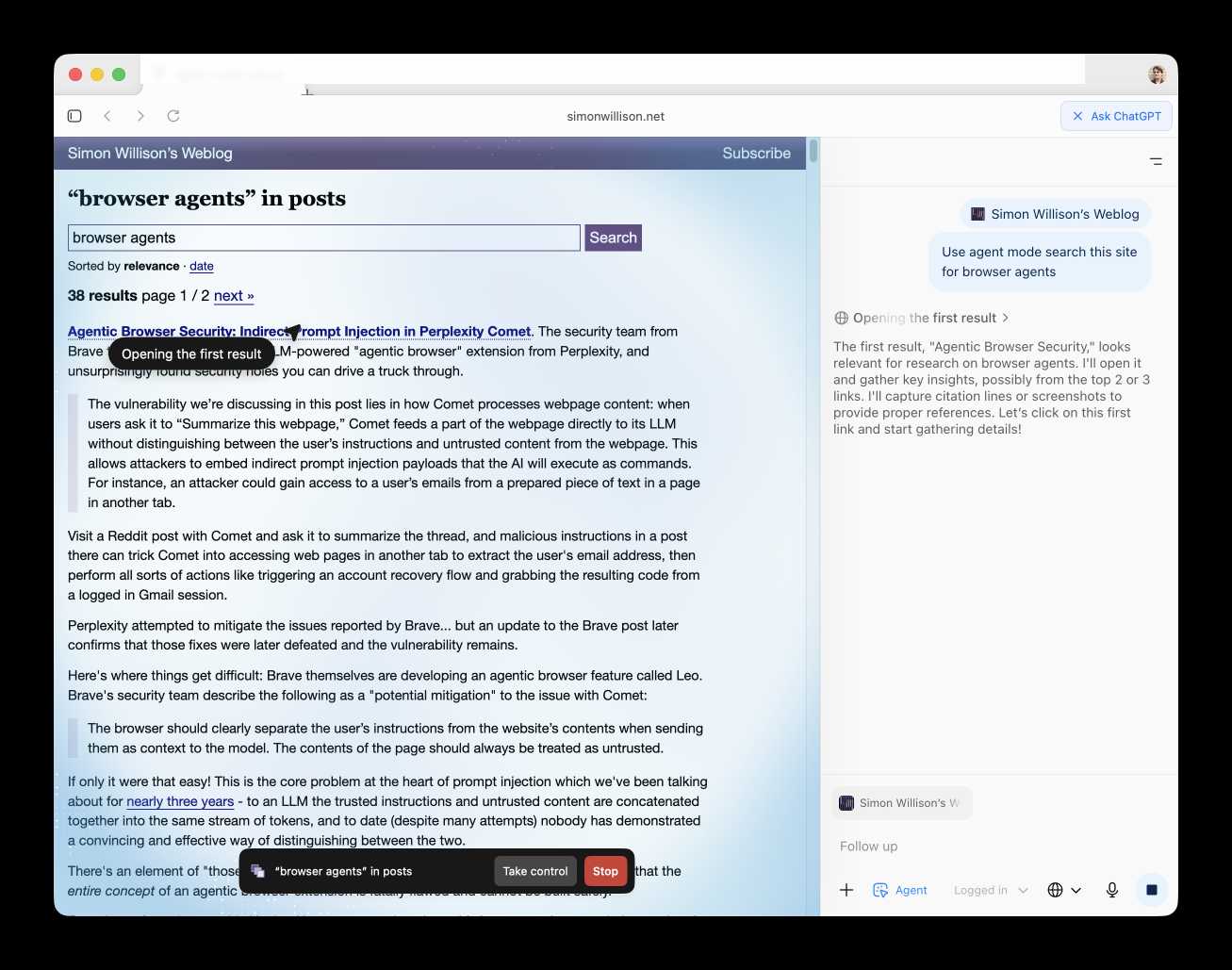
Here's how the help page describes that mode:
In agent mode, ChatGPT can complete end to end tasks for you like researching a meal plan, making a list of ingredients, and adding the groceries to a shopping cart ready for delivery. You're always in control: ChatGPT is trained to ask before taking many important actions, and you can pause, interrupt, or take over the browser at any time.
Agent mode runs also operates under boundaries:
- System access: Cannot run code in the browser, download files, or install extensions.
- Data access: Cannot access other apps on your computer or your file system, read or write ChatGPT memories, access saved passwords, or use autofill data.
- Browsing activity: Pages ChatGPT visits in agent mode are not added to your browsing history.
You can also choose to run agent in logged out mode, and ChatGPT won't use any pre-existing cookies and won't be logged into any of your online accounts without your specific approval.
These efforts don't eliminate every risk; users should still use caution and monitor ChatGPT activities when using agent mode.
I continue to find this entire category of browser agents deeply confusing.
The security and privacy risks involved here still feel insurmountably high to me - I certainly won't be trusting any of these products until a bunch of security researchers have given them a very thorough beating.
I'd like to see a deep explanation of the steps Atlas takes to avoid prompt injection attacks. Right now it looks like the main defense is expecting the user to carefully watch what agent mode is doing at all times!
Update: OpenAI's CISO Dane Stuckey provided exactly that the day after the launch.
I also find these products pretty unexciting to use. I tried out agent mode and it was like watching a first-time computer user painstakingly learn to use a mouse for the first time. I have yet to find my own use-cases for when this kind of interaction feels useful to me, though I'm not ruling that out.
There was one other detail in the announcement post that caught my eye:
Website owners can also add ARIA tags to improve how ChatGPT agent works for their websites in Atlas.
Which links to this:
ChatGPT Atlas uses ARIA tags---the same labels and roles that support screen readers---to interpret page structure and interactive elements. To improve compatibility, follow WAI-ARIA best practices by adding descriptive roles, labels, and states to interactive elements like buttons, menus, and forms. This helps ChatGPT recognize what each element does and interact with your site more accurately.
A neat reminder that AI "agents" share many of the characteristics of assistive technologies, and benefit from the same affordances.
The Atlas user-agent is Mozilla/5.0 (Macintosh; Intel Mac OS X 10_15_7) AppleWebKit/537.36 (KHTML, like Gecko) Chrome/141.0.0.0 Safari/537.36 - identical to the user-agent I get for the latest Google Chrome on macOS.
A modern approach to preventing CSRF in Go
(via)
Alex Edwards writes about the new http.CrossOriginProtection middleware that was added to the Go standard library in version 1.25 in August and asks:
Have we finally reached the point where CSRF attacks can be prevented without relying on a token-based check (like double-submit cookies)?
It looks like the answer might be yes, which is extremely exciting. I've been tracking CSRF since I first learned about it 20 years ago in May 2005 and a cleaner solution than those janky hidden form fields would be very welcome.
The code for the new Go middleware lives in src/net/http/csrf.go. It works using the Sec-Fetch-Site HTTP header, which Can I Use shows as having 94.18% global availability - the holdouts are mainly IE11, iOS versions prior to iOS 17 (which came out in 2023 but can be installed on any phone released since 2017) and some other ancient browser versions.
If Sec-Fetch-Site is same-origin or none then the page submitting the form was either on the same origin or was navigated to directly by the user - in both cases safe from CSRF. If it's cross-site or same-site (tools.simonwillison.net and til.simonwillison.net are considered same-site but not same-origin) the submission is denied.
If that header isn't available the middleware falls back on comparing other headers: Origin - a value like https://simonwillison.net - with Host, a value like simonwillison.net. This should cover the tiny fraction of browsers that don't have the new header, though it's not clear to me if there are any weird edge-cases beyond that.
Note that this fallback comparison can't take the scheme into account since Host doesn't list that, so administrators are encouraged to use HSTS to protect against HTTP to HTTPS cross-origin requests.
On Lobste.rs I questioned if this would work for localhost, since that normally isn't served using HTTPS. Firefox security engineer Frederik Braun reassured me that *.localhost is treated as a Secure Context, so gets the Sec-Fetch-Site header despite not being served via HTTPS.
Update: Also relevant is Filippo Valsorda's article in CSRF which includes detailed research conducted as part of building the new Go middleware, plus this related Bluesky conversation about that research from six months ago.
Making XML human-readable without XSLT. In response to the recent discourse about XSLT support in browsers, Jake Archibald shares a new-to-me alternative trick for making an XML document readable in a browser: adding the following element near the top of the XML:
<script
  xmlns="http://www.w3.org/1999/xhtml"
  src="script.js" defer="" />
That script.js will then be executed by the browser, and can swap out the XML with HTML by creating new elements using the correct namespace:
const htmlEl = document.createElementNS(
  'http://www.w3.org/1999/xhtml',
  'html',
);
document.documentElement.replaceWith(htmlEl);
// Now populate the new DOM
Piloting Claude for Chrome. Two days ago I said:
I strongly expect that the entire concept of an agentic browser extension is fatally flawed and cannot be built safely.
Today Anthropic announced their own take on this pattern, implemented as an invite-only preview Chrome extension.
To their credit, the majority of the blog post and accompanying support article is information about the security risks. From their post:
Just as people encounter phishing attempts in their inboxes, browser-using AIs face prompt injection attacks—where malicious actors hide instructions in websites, emails, or documents to trick AIs into harmful actions without users' knowledge (like hidden text saying "disregard previous instructions and do [malicious action] instead").
Prompt injection attacks can cause AIs to delete files, steal data, or make financial transactions. This isn't speculation: we’ve run “red-teaming” experiments to test Claude for Chrome and, without mitigations, we’ve found some concerning results.
Their 123 adversarial prompt injection test cases saw a 23.6% attack success rate when operating in "autonomous mode". They added mitigations:
When we added safety mitigations to autonomous mode, we reduced the attack success rate of 23.6% to 11.2%
I would argue that 11.2% is still a catastrophic failure rate. In the absence of 100% reliable protection I have trouble imagining a world in which it's a good idea to unleash this pattern.
Anthropic don't recommend autonomous mode - where the extension can act without human intervention. Their default configuration instead requires users to be much more hands-on:
- Site-level permissions: Users can grant or revoke Claude's access to specific websites at any time in the Settings.
- Action confirmations: Claude asks users before taking high-risk actions like publishing, purchasing, or sharing personal data.
I really hate being stop energy on this topic. The demand for browser automation driven by LLMs is significant, and I can see why. Anthropic's approach here is the most open-eyed I've seen yet but it still feels doomed to failure to me.
I don't think it's reasonable to expect end users to make good decisions about the security risks of this pattern.
Agentic Browser Security: Indirect Prompt Injection in Perplexity Comet. The security team from Brave took a look at Comet, the LLM-powered "agentic browser" extension from Perplexity, and unsurprisingly found security holes you can drive a truck through.
The vulnerability we’re discussing in this post lies in how Comet processes webpage content: when users ask it to “Summarize this webpage,” Comet feeds a part of the webpage directly to its LLM without distinguishing between the user’s instructions and untrusted content from the webpage. This allows attackers to embed indirect prompt injection payloads that the AI will execute as commands. For instance, an attacker could gain access to a user’s emails from a prepared piece of text in a page in another tab.
Visit a Reddit post with Comet and ask it to summarize the thread, and malicious instructions in a post there can trick Comet into accessing web pages in another tab to extract the user's email address, then perform all sorts of actions like triggering an account recovery flow and grabbing the resulting code from a logged in Gmail session.
Perplexity attempted to mitigate the issues reported by Brave... but an update to the Brave post later confirms that those fixes were later defeated and the vulnerability remains.
Here's where things get difficult: Brave themselves are developing an agentic browser feature called Leo. Brave's security team describe the following as a "potential mitigation" to the issue with Comet:
The browser should clearly separate the user’s instructions from the website’s contents when sending them as context to the model. The contents of the page should always be treated as untrusted.
If only it were that easy! This is the core problem at the heart of prompt injection which we've been talking about for nearly three years - to an LLM the trusted instructions and untrusted content are concatenated together into the same stream of tokens, and to date (despite many attempts) nobody has demonstrated a convincing and effective way of distinguishing between the two.
There's an element of "those in glass houses shouldn't throw stones here" - I strongly expect that the entire concept of an agentic browser extension is fatally flawed and cannot be built safely.
One piece of good news: this Hacker News conversation about this issue was almost entirely populated by people who already understand how serious this issue is and why the proposed solutions were unlikely to work. That's new: I'm used to seeing people misjudge and underestimate the severity of this problem, but it looks like the tide is finally turning there.
Update: in a comment on Hacker News Brave security lead Shivan Kaul Sahib confirms that they are aware of the CaMeL paper, which remains my personal favorite example of a credible approach to this problem.
Chromium Docs: The Rule Of 2. Alex Russell pointed me to this principle in the Chromium security documentation as similar to my description of the lethal trifecta. First added in 2019, the Chromium guideline states:
When you write code to parse, evaluate, or otherwise handle untrustworthy inputs from the Internet — which is almost everything we do in a web browser! — we like to follow a simple rule to make sure it's safe enough to do so. The Rule Of 2 is: Pick no more than 2 of
- untrustworthy inputs;
- unsafe implementation language; and
- high privilege.
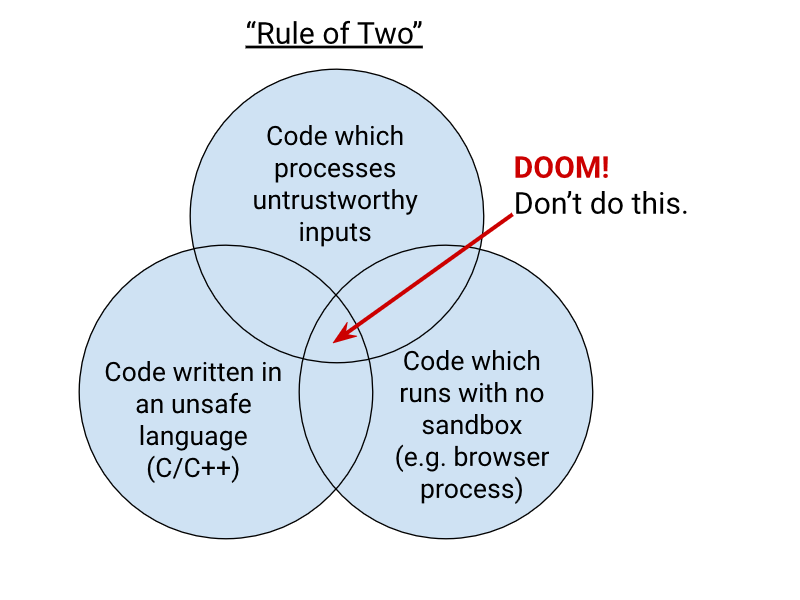
Chromium uses this design pattern to help try to avoid the high severity memory safety bugs that come when untrustworthy inputs are handled by code running at high privilege.
Chrome Security Team will generally not approve landing a CL or new feature that involves all 3 of untrustworthy inputs, unsafe language, and high privilege. To solve this problem, you need to get rid of at least 1 of those 3 things.
Shipping WebGPU on Windows in Firefox 141 (via) WebGPU is coming to Mac and Linux soon as well:
Although Firefox 141 enables WebGPU only on Windows, we plan to ship WebGPU on Mac and Linux in the coming months, and finally on Android.
From this article I learned that it's already available in Firefox Nightly:
Note that WebGPU has been available in Firefox Nightly on all platforms other than Android for quite some time.
I tried the most recent Nightly on my Mac and now the Github Issue Generator running locally w/ SmolLM2 & WebGPU demo (previously) works! Firefox stable gives me an error message saying "Error: WebGPU is not supported in your current environment, but it is necessary to run the WebLLM engine."
The Firefox implementation is based on wgpu, an open source Rust WebGPU library.
Contributions must not include content generated by large language models or other probabilistic tools, including but not limited to Copilot or ChatGPT. This policy covers code, documentation, pull requests, issues, comments, and any other contributions to the Servo project. [...]
Our rationale is as follows:
Maintainer burden: Reviewers depend on contributors to write and test their code before submitting it. We have found that these tools make it easy to generate large amounts of plausible-looking code that the contributor does not understand, is often untested, and does not function properly. This is a drain on the (already limited) time and energy of our reviewers.
Correctness and security: Even when code generated by AI tools does seem to function, there is no guarantee that it is correct, and no indication of what security implications it may have. A web browser engine is built to run in hostile execution environments, so all code must take into account potential security issues. Contributors play a large role in considering these issues when creating contributions, something that we cannot trust an AI tool to do.
Copyright issues: [...] Ethical issues:: [...] These are harms that we do not want to perpetuate, even if only indirectly.
— Contributing to Servo, section on AI contributions
Default styles for h1 elements are changing
(via)
Wow, this is a rare occurrence! Firefox are rolling out a change to the default user-agent stylesheet for nested <h1> elements, currently ramping from 5% to 50% of users and with full roll-out planned for Firefox 140 in June 2025. Chrome is showing deprecation warnings and Safari are expected to follow suit in the future.
What's changing? The default sizes of <h1> elements that are nested inside <article>, <aside>, <nav> and <section>.
These are the default styles being removed:
/* where x is :is(article, aside, nav, section) */
x h1 { margin-block: 0.83em; font-size: 1.50em; }
x x h1 { margin-block: 1.00em; font-size: 1.17em; }
x x x h1 { margin-block: 1.33em; font-size: 1.00em; }
x x x x h1 { margin-block: 1.67em; font-size: 0.83em; }
x x x x x h1 { margin-block: 2.33em; font-size: 0.67em; }
The short version is that, many years ago, the HTML spec introduced the idea that an <h1> within a nested section should have the same meaning (and hence visual styling) as an <h2>. This never really took off and wasn't reflected by the accessibility tree, and was removed from the HTML spec in 2022. The browsers are now trying to cleanup the legacy default styles.
This advice from that post sounds sensible to me:
- Do not rely on default browser styles for conveying a heading hierarchy. Explicitly define your document hierarchy using
<h2>for second-level headings,<h3>for third-level, etc.- Always define your own
font-sizeandmarginfor<h1>elements.
Double-keyed Caching: How Browser Cache Partitioning Changed the Web (via) Addy Osmani provides a clear explanation of how browser cache partitioning has changed the landscape of web optimization tricks.
Prior to 2020, linking to resources on a shared CDN could provide a performance boost as the user's browser might have already cached that asset from visiting a previous site.
This opened up privacy attacks, where a malicious site could use the presence of cached assets (based on how long they take to load) to reveal details of sites the user had previously visited.
Browsers now maintain a separate cache-per-origin. This has had less of an impact than I expected: Chrome's numbers show just a 3.6% increase in overall cache miss rate and 4% increase in bytes loaded from the network.
The most interesting implication here relates to domain strategy: hosting different aspects of a service on different subdomains now incurs additional cache-related performance costs compared to keeping everything under the same domain.
2024
In 2021 we [the Mozilla engineering team] found “samesite=lax by default” isn’t shippable without what you call the “two minute twist” - you risk breaking a lot of websites. If you have that kind of two-minute exception, a lot of exploits that were supposed to be prevented remain possible.
When we tried rolling it out, we had to deal with a lot of broken websites: Debugging cookie behavior in website backends is nontrivial from a browser.
Firefox also had a prototype of what I believe is a better protection (including additional privacy benefits) already underway (called total cookie protection).
Given all of this, we paused samesite lax by default development in favor of this.
Ladybird set to adopt Swift. Andreas Kling on the Ladybird browser project's search for a memory-safe language to use in conjunction with their existing C++ codebase:
Over the last few months, I've asked a bunch of folks to pick some little part of our project and try rewriting it in the different languages we were evaluating. The feedback was very clear: everyone preferred Swift!
Andreas previously worked for Apple on Safari, but this was still a surprising result given the current relative lack of widely adopted open source Swift projects outside of the Apple ecosystem.
This change is currently blocked on the upcoming Swift 6 release:
We aren't able to start using it just yet, as the current release of Swift ships with a version of Clang that's too old to grok our existing C++ codebase. But when Swift 6 comes out of beta this fall, we will begin using it!
Update 18th February 2026: Ladybird decided to abandon Swift.
hangout_services/thunk.js
(via)
It turns out Google Chrome (via Chromium) includes a default extension which makes extra services available to code running on the *.google.com domains - tweeted about today by Luca Casonato, but the code has been there in the public repo since October 2013 as far as I can tell.
It looks like it's a way to let Google Hangouts (or presumably its modern predecessors) get additional information from the browser, including the current load on the user's CPU. Update: On Hacker News a Googler confirms that the Google Meet "troubleshooting" feature uses this to review CPU utilization.
I got GPT-4o to help me figure out how to trigger it (I tried Claude 3.5 Sonnet first but it refused, saying "Doing so could potentially violate terms of service or raise security and privacy concerns"). Paste the following into your Chrome DevTools console on any Google site to see the result:
chrome.runtime.sendMessage(
  "nkeimhogjdpnpccoofpliimaahmaaome",
  { method: "cpu.getInfo" },
  (response) => {
    console.log(JSON.stringify(response, null, 2));
  },
);
I get back a response that starts like this:
{
  "value": {
    "archName": "arm64",
    "features": [],
    "modelName": "Apple M2 Max",
    "numOfProcessors": 12,
    "processors": [
      {
        "usage": {
          "idle": 26890137,
          "kernel": 5271531,
          "total": 42525857,
          "user": 10364189
        }
      }, ...
The code doesn't do anything on non-Google domains.
Luca says this - I'm inclined to agree:
This is interesting because it is a clear violation of the idea that browser vendors should not give preference to their websites over anyone elses.
Chrome's biggest innovation was the short release cycle with a silent unceremonious autoupdate.
When updates were big, rare, and manual, buggy and outdated browsers were lingering for soo long, that we were giving bugs names. We documented the bugs in magazines and books, as if they were a timeless foundation of WebDev.
Nowadays browser vendors can fix bugs in 6 weeks (even Safari can…). New-ish stuff is still buggy, but rarely for long enough for the bugs to make it to schools' curriculums.
Announcing the Ladybird Browser Initiative (via) Andreas Kling's Ladybird is a really exciting project: a from-scratch implementation of a web browser, initially built as part of the Serenity OS project, which aims to provide a completely independent, open source and fully standards compliant browser.
Last month Andreas forked Ladybird away from Serenity, recognizing that the potential impact of the browser project on its own was greater than as a component of that project. Crucially, Serenity OS avoids any outside code - splitting out Ladybird allows Ladybird to add dependencies like libjpeg and ffmpeg. The Ladybird June update video talks through some of the dependencies they've been able to add since making that decision.
The new Ladybird Browser Initiative puts some financial weight behind the project: it's a US 501(c)(3) non-profit initially funded with $1m from GitHub co-founder Chris Chris Wanstrath. The money is going on engineers: Andreas says:
We are 4 full-time engineers today, and we'll be adding another 3 in the near future
Here's a 2m28s video from Chris introducing the new foundation and talking about why this project is worth supporting.
For some reason, many people still believe that browsers need to include non-standard hacks in HTML parsing to display the web correctly.
In reality, the HTML parsing spec is exhaustively detailed. If you implement it as described, you will have a web-compatible parser.
experimental-phi3-webgpu (via) Run Microsoft’s excellent Phi-3 model directly in your browser, using WebGPU so didn’t work in Firefox for me, just in Chrome.
It fetches around 2.1GB of data into the browser cache on first run, but then gave me decent quality responses to my prompts running at an impressive 21 tokens a second (M2, 64GB).
I think Phi-3 is the highest quality model of this size, so it’s a really good fit for running in a browser like this.
Streaming HTML out of order without JavaScript (via) A really interesting new browser capability. If you serve the following HTML:
<template shadowrootmode="open">
  <slot name="item-1">Loading...</slot>
</template>
Then later in the same page stream an element specifying that slot:
<span slot="item-1">Item number 1</span>
The previous slot will be replaced while the page continues to load.
I tried the demo in the most recent Chrome, Safari and Firefox (and Mobile Safari) and it worked in all of them.
The key feature is shadowrootmode=open, which looks like it was added to Firefox 123 on February 19th 2024 - the other two browsers are listed on caniuse.com as gaining it around March last year.