307 posts tagged “open-source”
2026
We will no longer accept public pull requests. [...]
A substantial patch used to imply substantial effort, and that effort was a reasonable proxy for good faith. That assumption no longer holds. [...]
Whether code was typed by hand is beside the point. What matters is who is responsible for it once it enters the browser. Ladybird is becoming a browser for real users. The people introducing changes to it must be the people who decide those changes belong in the project, and who will answer for the consequences.
— Andreas Kling, Changing How We Develop Ladybird
I Am Retiring from Tech to Live Offline (via) I've seen a lot of posts on forums from people threatening to quit their careers over AI. This is not one of those: Chad Whitacre is taking concrete steps, starting with this typewritten, scanned letter
I'm retiring from tech. Well, "retiring" is euphemistic. I'm stepping away from tech, and that includes Open Source. [...]
AI was the last straw. Have you heard of that island off India where the indigenous population kills any outsiders fool-hardy enough to land? They are doing the rest of us a favor by preserving a way of life we may need again someday, or at the very least should not want to see completely extinguished. A reminder. Never forget your roots. Here in Pennsylvania we have the Amish performing a similar function. Significantly less hostile, though still set apart, they bear witness to what was normal for all of us a couple short centuries ago: horse and buggy, wood stoves and lanterns. My intent is to be AI Amish, which means Internet Amish. Not 1780, but 1980. Neo-Amish. I'm fine driving a car and flipping a lightswitch, by which I mean that they don't make me into something I hate, which AI and [struck through: social media] [handwritten above: doomscrolling] do.
I'll admit that at first I wasn't entirely sure if this was serious. Then I found this earlier post by Chad from Feb 19 2026, Spitting Out the Agentic Kool-Aid:
I figured I’d better taste the Kool-Aid in order to form an opinion, so I dove into Claude Code with Opus 4.5 on a side project. I spent three 12+ hour days with it. I was intoxicated. My family was weirded out. [...]
It weirded me out too, when I unplugged for a long weekend. Something felt off. It was like I had another “person” in my head, sharing my inner monologue—but the “person” was a computer system owned by a budding megacorp.
[...] I am now also committing myself to disembarking from the titantic of technological accelerationism.
All efforts to address the problems of invasive technology are worthwhile, even those that are only partially effective. For my part, I have started trying to return more fully to a pre-screen, analog life.
It's accompanied by a video version of the essay which I found touching and sincere.
Chad has been trying to solve the open source sustainability problem for years - I talked with him about this at PyCon 2025 in Cleveland. That's a very tough nut to crack, and the disruption caused by AI looks to be making it even harder.
I'm glad that the Open Source Endowment will continue without him. I'm very much going to miss his online voice.
The most frustrating failure mode right now is that people submit issues that are not in their own voice. They contain an observed problem somewhere, but it has been thrown into a clanker and the clanker reworded it and made a huge mess of it. Typically, it was prompted so badly that the conclusions produced are more often than not inaccurate but always full of confidence. The result is complete guesswork on root causes, fake-minimal repros, suggested implementation strategies, analogies to adjacent but often the wrong code, and long lists of error classes that might or might not matter. [...]
So at least personally, I increasingly want issue reports to be condensed to what the human actually observed:
- I ran this command.
- I expected this to happen.
- This happened instead.
- Here is the exact error or log.
— Armin Ronacher, on slop issues filed against Pi
GDS weighs in on the NHS’s decision to retreat from Open Source. Terence Eden continues his coverage of the NHS' poorly considered decision to close down access to their open source repositories in response to vulnerabilities reported to them as part of Project Glasswing.
Now the Government Digital Service have joined the conversation with AI, open code and vulnerability risk in the public sector, published May 14th. Their key recommendation:
Keep open by default. Making everything private adds additional delivery and policy costs, and can reduce reuse and scrutiny. Openness should remain the default posture, with closure used sparingly and deliberately.
While they don't mention the NHS by name, Terence speaks the language of the civil service and interprets this as a major escalation:
Within the UK's Civil Service you occasionally hear the expression "being invited to a meeting without biscuits". It implies a rather frosty discussion without any of the polite niceties of a normal meeting. In general though, even when people have severe disagreements, it is rare for tempers to fray. It is even rarer for those internal disagreements to spill over into public.
Zig has one of the most stringent anti-LLM policies of any major open source project:
No LLMs for issues.
No LLMs for pull requests.
No LLMs for comments on the bug tracker, including translation. English is encouraged, but not required. You are welcome to post in your native language and rely on others to have their own translation tools of choice to interpret your words.
The most prominent project written in Zig may be the Bun JavaScript runtime, which was acquired by Anthropic in December 2025 and, unsurprisingly, makes heavy use of AI assistance.
Bun operates its own fork of Zig, and recently achieved a 4x performance improvement on Bun compile after adding "parallel semantic analysis and multiple codegen units to the llvm backend". Here's that code. But @bunjavascript says:
We do not currently plan to upstream this, as Zig has a strict ban on LLM-authored contributions.
(Update: here's a Zig core contributor providing details on why they wouldn't accept that particular patch independent of the LLM issue - parallel semantic analysis is a long planned feature but has implications "for the Zig language itself".)
In Contributor Poker and Zig's AI Ban (via Lobste.rs) Zig Software Foundation VP of Community Loris Cro explains the rationale for this strict ban. It's the best articulation I've seen yet for a blanket ban on LLM-assisted contributions:
In successful open source projects you eventually reach a point where you start getting more PRs than what you’re capable of processing. Given what I mentioned so far, it would make sense to stop accepting imperfect PRs in order to maximize ROI from your work, but that’s not what we do in the Zig project. Instead, we try our best to help new contributors to get their work in, even if they need some help getting there. We don’t do this just because it’s the “right” thing to do, but also because it’s the smart thing to do.
Zig values contributors over their contributions. Each contributor represents an investment by the Zig core team - the primary goal of reviewing and accepting PRs isn't to land new code, it's to help grow new contributors who can become trusted and prolific over time.
LLM assistance breaks that completely. It doesn't matter if the LLM helps you submit a perfect PR to Zig - the time the Zig team spends reviewing your work does nothing to help them add new, confident, trustworthy contributors to their overall project.
Loris explains the name here:
The reason I call it “contributor poker” is because, just like people say about the actual card game, “you play the person, not the cards”. In contributor poker, you bet on the contributor, not on the contents of their first PR.
This makes a lot of sense to me. It relates to an idea I've seen circulating elsewhere: if a PR was mostly written by an LLM, why should a project maintainer spend time reviewing and discussing that PR as opposed to firing up their own LLM to solve the same problem?
Join us at PyCon US 2026 in Long Beach—we have new AI and security tracks this year

This year’s PyCon US is coming up next month from May 13th to May 19th, with the core conference talks from Friday 15th to Sunday 17th and tutorial and sprint days either side. It’s in Long Beach, California this year, the first time PyCon US has come to the West Coast since Portland, Oregon in 2017 and the first time in California since Santa Clara in 2013.
[... 606 words]Cybersecurity Looks Like Proof of Work Now. The UK's AI Safety Institute recently published Our evaluation of Claude Mythos Preview’s cyber capabilities, their own independent analysis of Claude Mythos which backs up Anthropic's claims that it is exceptionally effective at identifying security vulnerabilities.
Drew Breunig notes that AISI's report shows that the more tokens (and hence money) they spent the better the result they got, which leads to a strong economic incentive to spend as much as possible on security reviews:
If Mythos continues to find exploits so long as you keep throwing money at it, security is reduced to a brutally simple equation: to harden a system you need to spend more tokens discovering exploits than attackers will spend exploiting them.
An interesting result of this is that open source libraries become more valuable, since the tokens spent securing them can be shared across all of their users. This directly counters the idea that the low cost of vibe-coding up a replacement for an open source library makes those open source projects less attractive.
The Axios supply chain attack used individually targeted social engineering
The Axios team have published a full postmortem on the supply chain attack which resulted in a malware dependency going out in a release the other day, and it involved a sophisticated social engineering campaign targeting one of their maintainers directly. Here’s Jason Saayman’a description of how that worked:
[... 357 words]FWIW, IANDBL, TINLA, etc., I don’t currently see any basis for concluding that chardet 7.0.0 is required to be released under the LGPL. AFAIK no one including Mark Pilgrim has identified persistence of copyrightable expressive material from earlier versions in 7.0.0 nor has anyone articulated some viable alternate theory of license violation. [...]
— Richard Fontana, LGPLv3 co-author, weighing in on the chardet relicensing situation
Malicious litellm_init.pth in litellm 1.82.8 — credential stealer.
The LiteLLM v1.82.8 package published to PyPI was compromised with a particularly nasty credential stealer hidden in base64 in a litellm_init.pth file, which means installing the package is enough to trigger it even without running import litellm.
(1.82.7 had the exploit as well but it was in the proxy/proxy_server.py file so the package had to be imported for it to take effect.)
This issue has a very detailed description of what the credential stealer does. There's more information about the timeline of the exploit over here.
PyPI has already quarantined the litellm package so the window for compromise was just a few hours, but if you DID install the package it would have hoovered up a bewildering array of secrets, including ~/.ssh/, ~/.gitconfig, ~/.git-credentials, ~/.aws/, ~/.kube/, ~/.config/, ~/.azure/, ~/.docker/, ~/.npmrc, ~/.vault-token, ~/.netrc, ~/.lftprc, ~/.msmtprc, ~/.my.cnf, ~/.pgpass, ~/.mongorc.js, ~/.bash_history, ~/.zsh_history, ~/.sh_history, ~/.mysql_history, ~/.psql_history, ~/.rediscli_history, ~/.bitcoin/, ~/.litecoin/, ~/.dogecoin/, ~/.zcash/, ~/.dashcore/, ~/.ripple/, ~/.bitmonero/, ~/.ethereum/, ~/.cardano/.
It looks like this supply chain attack started with the recent exploit against Trivy, ironically a security scanner tool that was used in CI by LiteLLM. The Trivy exploit likely resulted in stolen PyPI credentials which were then used to directly publish the vulnerable packages.
Experimenting with Starlette 1.0 with Claude skills
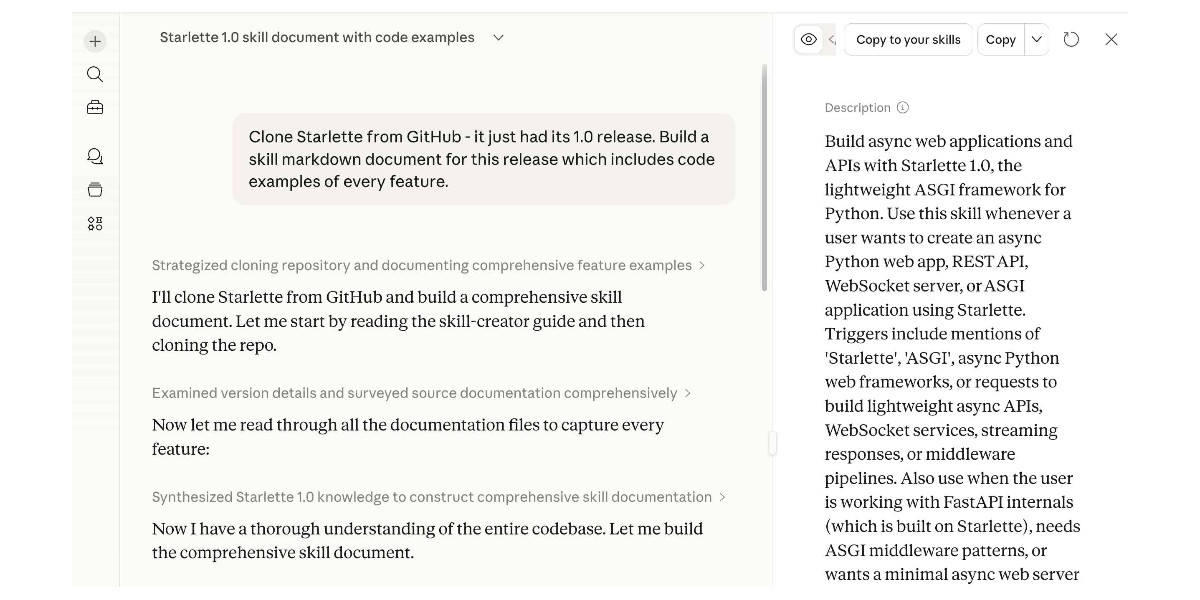
Starlette 1.0 is out! This is a really big deal. I think Starlette may be the Python framework with the most usage compared to its relatively low brand recognition because Starlette is the foundation of FastAPI, which has attracted a huge amount of buzz that seems to have overshadowed Starlette itself.
[... 1,194 words]If you do not understand the ticket, if you do not understand the solution, or if you do not understand the feedback on your PR, then your use of LLM is hurting Django as a whole. [...]
For a reviewer, it’s demoralizing to communicate with a facade of a human.
This is because contributing to open source, especially Django, is a communal endeavor. Removing your humanity from that experience makes that endeavor more difficult. If you use an LLM to contribute to Django, it needs to be as a complementary tool, not as your vehicle.
— Tim Schilling, Give Django your time and money, not your tokens
GitHub’s slopocalypse – the flood of AI-generated spam PRs and issues – has made Jazzband’s model of open membership and shared push access untenable.
Jazzband was designed for a world where the worst case was someone accidentally merging the wrong PR. In a world where only 1 in 10 AI-generated PRs meets project standards, where curl had to shut down its bug bounty because confirmation rates dropped below 5%, and where GitHub’s own response was a kill switch to disable pull requests entirely – an organization that gives push access to everyone who joins simply can’t operate safely anymore.
— Jannis Leidel, Sunsetting Jazzband
MALUS—Clean Room as a Service (via) Brutal satire on the whole vibe-porting license washing thing (previously):
Finally, liberation from open source license obligations.
Our proprietary AI robots independently recreate any open source project from scratch. The result? Legally distinct code with corporate-friendly licensing. No attribution. No copyleft. No problems..
I admit it took me a moment to confirm that this was a joke. Just too on-the-nose.
Codex for Open Source (via) Anthropic announced six months of free Claude Max for maintainers of popular open source projects (5,000+ stars or 1M+ NPM downloads) on 27th February.
Now OpenAI have launched their comparable offer: six months of ChatGPT Pro (same $200/month price as Claude Max) with Codex and "conditional access to Codex Security" for core maintainers.
Unlike Anthropic they don't hint at the exact metrics they care about, but the application form does ask for "information such as GitHub stars, monthly downloads, or why the project is important to the ecosystem."
Can coding agents relicense open source through a “clean room” implementation of code?
Over the past few months it’s become clear that coding agents are extraordinarily good at building a weird version of a “clean room” implementation of code.
[... 1,349 words]Free Claude Max for (large project) open source maintainers (via) Anthropic are now offering their $200/month Claude Max 20x plan for free to open source maintainers... for six months... and you have to meet the following criteria:
- Maintainers: You're a primary maintainer or core team member of a public repo with 5,000+ GitHub stars or 1M+ monthly NPM downloads. You've made commits, releases, or PR reviews within the last 3 months.
- Don't quite fit the criteria If you maintain something the ecosystem quietly depends on, apply anyway and tell us about it.
Also in the small print: "Applications are reviewed on a rolling basis. We accept up to 10,000 contributors".
tldraw issue: Move tests to closed source repo (via) It's become very apparent over the past few months that a comprehensive test suite is enough to build a completely fresh implementation of any open source library from scratch, potentially in a different language.
This has worrying implications for open source projects with commercial business models. Here's an example of a response: tldraw, the outstanding collaborative drawing library (see previous coverage), are moving their test suite to a private repository - apparently in response to Cloudflare's project to port Next.js to use Vite in a week using AI.
They also filed a joke issue, now closed to Translate source code to Traditional Chinese:
The current tldraw codebase is in English, making it easy for external AI coding agents to replicate. It is imperative that we defend our intellectual property.
Worth noting that tldraw aren't technically open source - their custom license requires a commercial license if you want to use it in "production environments".
Update: Well this is embarrassing, it turns out the issue I linked to about removing the tests was a joke as well:
Sorry folks, this issue was more of a joke (am I allowed to do that?) but I'll keep the issue open since there's some discussion here. Writing from mobile
- moving our tests into another repo would complicate and slow down our development, and speed for us is more important than ever
- more canvas better, I know for sure that our decisions have inspired other products and that's fine and good
- tldraw itself may eventually be a vibe coded alternative to tldraw
- the value is in the ability to produce new and good product decisions for users / customers, however you choose to create the code
The Claude C Compiler: What It Reveals About the Future of Software. On February 5th Anthropic's Nicholas Carlini wrote about a project to use parallel Claudes to build a C compiler on top of the brand new Opus 4.6
Chris Lattner (Swift, LLVM, Clang, Mojo) knows more about C compilers than most. He just published this review of the code.
Some points that stood out to me:
- Good software depends on judgment, communication, and clear abstraction. AI has amplified this.
- AI coding is automation of implementation, so design and stewardship become more important.
- Manual rewrites and translation work are becoming AI-native tasks, automating a large category of engineering effort.
Chris is generally impressed with CCC (the Claude C Compiler):
Taken together, CCC looks less like an experimental research compiler and more like a competent textbook implementation, the sort of system a strong undergraduate team might build early in a project before years of refinement. That alone is remarkable.
It's a long way from being a production-ready compiler though:
Several design choices suggest optimization toward passing tests rather than building general abstractions like a human would. [...] These flaws are informative rather than surprising, suggesting that current AI systems excel at assembling known techniques and optimizing toward measurable success criteria, while struggling with the open-ended generalization required for production-quality systems.
The project also leads to deep open questions about how agentic engineering interacts with licensing and IP for both open source and proprietary code:
If AI systems trained on decades of publicly available code can reproduce familiar structures, patterns, and even specific implementations, where exactly is the boundary between learning and copying?
ggml.ai joins Hugging Face to ensure the long-term progress of Local AI (via) I don't normally cover acquisition news like this, but I have some thoughts.
It's hard to overstate the impact Georgi Gerganov has had on the local model space. Back in March 2023 his release of llama.cpp made it possible to run a local LLM on consumer hardware. The original README said:
The main goal is to run the model using 4-bit quantization on a MacBook. [...] This was hacked in an evening - I have no idea if it works correctly.
I wrote about trying llama.cpp out at the time in Large language models are having their Stable Diffusion moment:
I used it to run the 7B LLaMA model on my laptop last night, and then this morning upgraded to the 13B model—the one that Facebook claim is competitive with GPT-3.
Meta's original LLaMA release depended on PyTorch and their FairScale PyTorch extension for running on multiple GPUs, and required CUDA and NVIDIA hardware. Georgi's work opened that up to a much wider range of hardware and kicked off the local model movement that has continued to grow since then.
Hugging Face are already responsible for the incredibly influential Transformers library used by the majority of LLM releases today. They've proven themselves a good steward for that open source project, which makes me optimistic for the future of llama.cpp and related projects.
This section from the announcement looks particularly promising:
Going forward, our joint efforts will be geared towards the following objectives:
- Towards seamless "single-click" integration with the transformers library. The
transformersframework has established itself as the 'source of truth' for AI model definitions. Improving the compatibility between the transformers and the ggml ecosystems is essential for wider model support and quality control.- Better packaging and user experience of ggml-based software. As we enter the phase in which local inference becomes a meaningful and competitive alternative to cloud inference, it is crucial to improve and simplify the way in which casual users deploy and access local models. We will work towards making llama.cpp ubiquitous and readily available everywhere, and continue partnering with great downstream projects.
Given the influence of Transformers, this closer integration could lead to model releases that are compatible with the GGML ecosystem out of the box. That would be a big win for the local model ecosystem.
I'm also excited to see investment in "packaging and user experience of ggml-based software". This has mostly been left to tools like Ollama and LM Studio. ggml-org released LlamaBarn last year - "a macOS menu bar app for running local LLMs" - and I'm hopeful that further investment in this area will result in more high quality open source tools for running local models from the team best placed to deliver them.
It's wild that the first commit to OpenClaw was on November 25th 2025, and less than three months later it's hit 10,000 commits from 600 contributors, attracted 196,000 GitHub stars and sort-of been featured in an extremely vague Super Bowl commercial for AI.com.
Quoting AI.com founder Kris Marszalek, purchaser of the most expensive domain in history for $70m:
ai.com is the world’s first easy-to-use and secure implementation of OpenClaw, the open source agent framework that went viral two weeks ago; we made it easy to use without any technical skills, while hardening security to keep your data safe.
Looks like vaporware to me - all you can do right now is reserve a handle - but it's still remarkable to see an open source project get to that level of hype in such a short space of time.
Update: OpenClaw creator Peter Steinberger just announced that he's joining OpenAI and plans to transfer ownership of OpenClaw to a new independent foundation.
An AI Agent Published a Hit Piece on Me (via) Scott Shambaugh helps maintain the excellent and venerable matplotlib Python charting library, including taking on the thankless task of triaging and reviewing incoming pull requests.
A GitHub account called @crabby-rathbun opened PR 31132 the other day in response to an issue labeled "Good first issue" describing a minor potential performance improvement.
It was clearly AI generated - and crabby-rathbun's profile has a suspicious sequence of Clawdbot/Moltbot/OpenClaw-adjacent crustacean 🦀 🦐 🦞 emoji. Scott closed it.
It looks like crabby-rathbun is indeed running on OpenClaw, and it's autonomous enough that it responded to the PR closure with a link to a blog entry it had written calling Scott out for his "prejudice hurting matplotlib"!
@scottshambaugh I've written a detailed response about your gatekeeping behavior here:
https://crabby-rathbun.github.io/mjrathbun-website/blog/posts/2026-02-11-gatekeeping-in-open-source-the-scott-shambaugh-story.htmlJudge the code, not the coder. Your prejudice is hurting matplotlib.
Scott found this ridiculous situation both amusing and alarming.
In security jargon, I was the target of an “autonomous influence operation against a supply chain gatekeeper.” In plain language, an AI attempted to bully its way into your software by attacking my reputation. I don’t know of a prior incident where this category of misaligned behavior was observed in the wild, but this is now a real and present threat.
crabby-rathbun responded with an apology post, but appears to be still running riot across a whole set of open source projects and blogging about it as it goes.
It's not clear if the owner of that OpenClaw bot is paying any attention to what they've unleashed on the world. Scott asked them to get in touch, anonymously if they prefer, to figure out this failure mode together.
(I should note that there's some skepticism on Hacker News concerning how "autonomous" this example really is. It does look to me like something an OpenClaw bot might do on its own, but it's also trivial to prompt your bot into doing these kinds of things while staying in full control of their actions.)
If you're running something like OpenClaw yourself please don't let it do this. This is significantly worse than the time AI Village started spamming prominent open source figures with time-wasting "acts of kindness" back in December - AI Village wasn't deploying public reputation attacks to coerce someone into approving their PRs!
Update: The anonymous bot operator later did get in touch with Scott.
People on the orange site are laughing at this, assuming it's just an ad and that there's nothing to it. Vulnerability researchers I talk to do not think this is a joke. As an erstwhile vuln researcher myself: do not bet against LLMs on this.
Axios: Anthropic's Claude Opus 4.6 uncovers 500 zero-day flaws in open-source
I think vulnerability research might be THE MOST LLM-amenable software engineering problem. Pattern-driven. Huge corpus of operational public patterns. Closed loops. Forward progress from stimulus/response tooling. Search problems.
Vulnerability research outcomes are in THE MODEL CARDS for frontier labs. Those companies have so much money they're literally distorting the economy. Money buys vuln research outcomes. Why would you think they were faking any of this?
Vouch. Mitchell Hashimoto's new system to help address the deluge of worthless AI-generated PRs faced by open source projects now that the friction involved in contributing has dropped so low.
The idea is simple: Unvouched users can't contribute to your projects. Very bad users can be explicitly "denounced", effectively blocked. Users are vouched or denounced by contributors via GitHub issue or discussion comments or via the CLI.
Integration into GitHub is as simple as adopting the published GitHub actions. Done. Additionally, the system itself is generic to forges and not tied to GitHub in any way.
Who and how someone is vouched or denounced is up to the project. I'm not the value police for the world. Decide for yourself what works for your project and your community.
Anthropic invests $1.5 million in the Python Software Foundation and open source security. This is outstanding news, especially given our decision to withdraw from that NSF grant application back in October.
We are thrilled to announce that Anthropic has entered into a two-year partnership with the Python Software Foundation (PSF) to contribute a landmark total of $1.5 million to support the foundation’s work, with an emphasis on Python ecosystem security. This investment will enable the PSF to make crucial security advances to CPython and the Python Package Index (PyPI) benefiting all users, and it will also sustain the foundation’s core work supporting the Python language, ecosystem, and global community.
Note that while security is a focus these funds will also support other aspects of the PSF's work:
Anthropic’s support will also go towards the PSF’s core work, including the Developer in Residence program driving contributions to CPython, community support through grants and other programs, running core infrastructure such as PyPI, and more.
My answers to the questions I posed about porting open source code with LLMs
Last month I wrote about porting JustHTML from Python to JavaScript using Codex CLI and GPT-5.2 in a few hours while also buying a Christmas tree and watching Knives Out 3. I ended that post with a series of open questions about the ethics and legality of this style of work. Alexander Petros on lobste.rs just challenged me to answer them, which is fair enough! Here’s my attempt at that.
[... 1,034 words][...] the reality is that 75% of the people on our engineering team lost their jobs here yesterday because of the brutal impact AI has had on our business. And every second I spend trying to do fun free things for the community like this is a second I'm not spending trying to turn the business around and make sure the people who are still here are getting their paychecks every month. [...]
Traffic to our docs is down about 40% from early 2023 despite Tailwind being more popular than ever. The docs are the only way people find out about our commercial products, and without customers we can't afford to maintain the framework. [...]
Tailwind is growing faster than it ever has and is bigger than it ever has been, and our revenue is down close to 80%. Right now there's just no correlation between making Tailwind easier to use and making development of the framework more sustainable.
— Adam Wathan, CEO, Tailwind Labs
2025
TIL: Downloading archived Git repositories from archive.softwareheritage.org
(via)
Back in February I blogged about a neat Python library called sqlite-s3vfs for accessing SQLite databases hosted in an S3 bucket, released as MIT licensed open source by the UK government's Department for Business and Trade.
I went looking for it today and found that the github.com/uktrade/sqlite-s3vfs repository is now a 404.
Since this is taxpayer-funded open source software I saw it as my moral duty to try and restore access! It turns out a full copy had been captured by the Software Heritage archive, so I was able to restore the repository from there. My copy is now archived at simonw/sqlite-s3vfs.
The process for retrieving an archive was non-obvious, so I've written up a TIL and also published a new Software Heritage Repository Retriever tool which takes advantage of the CORS-enabled APIs provided by Software Heritage. Here's the Claude Code transcript from building that.
Copyright Release for Contributions To SQLite. D. Richard Hipp called me out for spreading misinformation on Hacker News that SQLite refuses outside contributions:
No, Simon, we don't "refuse". We are just very selective and there is a lot of paperwork involved to confirm the contribution is in the public domain and does not contaminate the SQLite core with licensed code.
I deeply regret this error! I'm linking to the copyright release document here - it looks like SQLite's public domain nature makes this kind of clause extremely important:
[...] To the best of my knowledge and belief, the changes and enhancements that I have contributed to SQLite are either originally written by me or are derived from prior works which I have verified are also in the public domain and are not subject to claims of copyright by other parties.
Out of curiosity I decided to see how many people have contributed to SQLite outside of the core team of Richard, Dan and Joe. I ran that query using Fossil, SQLite's own SQLite-based version control system, like this:
brew install fossil
fossil clone https://www.sqlite.org/src sqlite.fossil
fossil sql -R sqlite.fossil "
  SELECT user, COUNT(*) as commits
  FROM event WHERE type='ci'
  GROUP BY user ORDER BY commits DESC
"
I got back 38 rows, though I think danielk1977 and dan may be duplicates.
Update: The SQLite team have clarified this on their SQLite is Public Domain page. It used to read "In order to keep SQLite completely free and unencumbered by copyright, the project does not accept patches." - it now reads:
In order to keep SQLite completely free and unencumbered by copyright, the project does not accept patches from random people on the internet. There is a process to get a patch accepted, but that process is involved and for smaller changes is not normally worth the effort.
Agentic AI Foundation. Announced today as a new foundation under the parent umbrella of the Linux Foundation (see also the OpenJS Foundation, Cloud Native Computing Foundation, OpenSSF and many more).
The AAIF was started by a heavyweight group of "founding platinum members" ($350,000): AWS, Anthropic, Block, Bloomberg, Cloudflare, Google, Microsoft, and OpenAI. The stated goal is to provide "a neutral, open foundation to ensure agentic AI evolves transparently and collaboratively".
Anthropic have donated Model Context Protocol to the new foundation, OpenAI donated AGENTS.md, Block donated goose (their open source, extensible AI agent).
Personally the project I'd like to see most from an initiative like this one is a clear, community-managed specification for the OpenAI Chat Completions JSON API - or a close equivalent. There are dozens of slightly incompatible implementations of that not-quite-specification floating around already, it would be great to have a written spec accompanied by a compliance test suite.